
French abstract painter Bernard Frize creates artworks full of paradoxes
The Berlin-based artist's paintings may seem random, the striking pieces are created with imposed constraints in the form of protocols and systems.
By Y-Jean Mun-Delsalle -
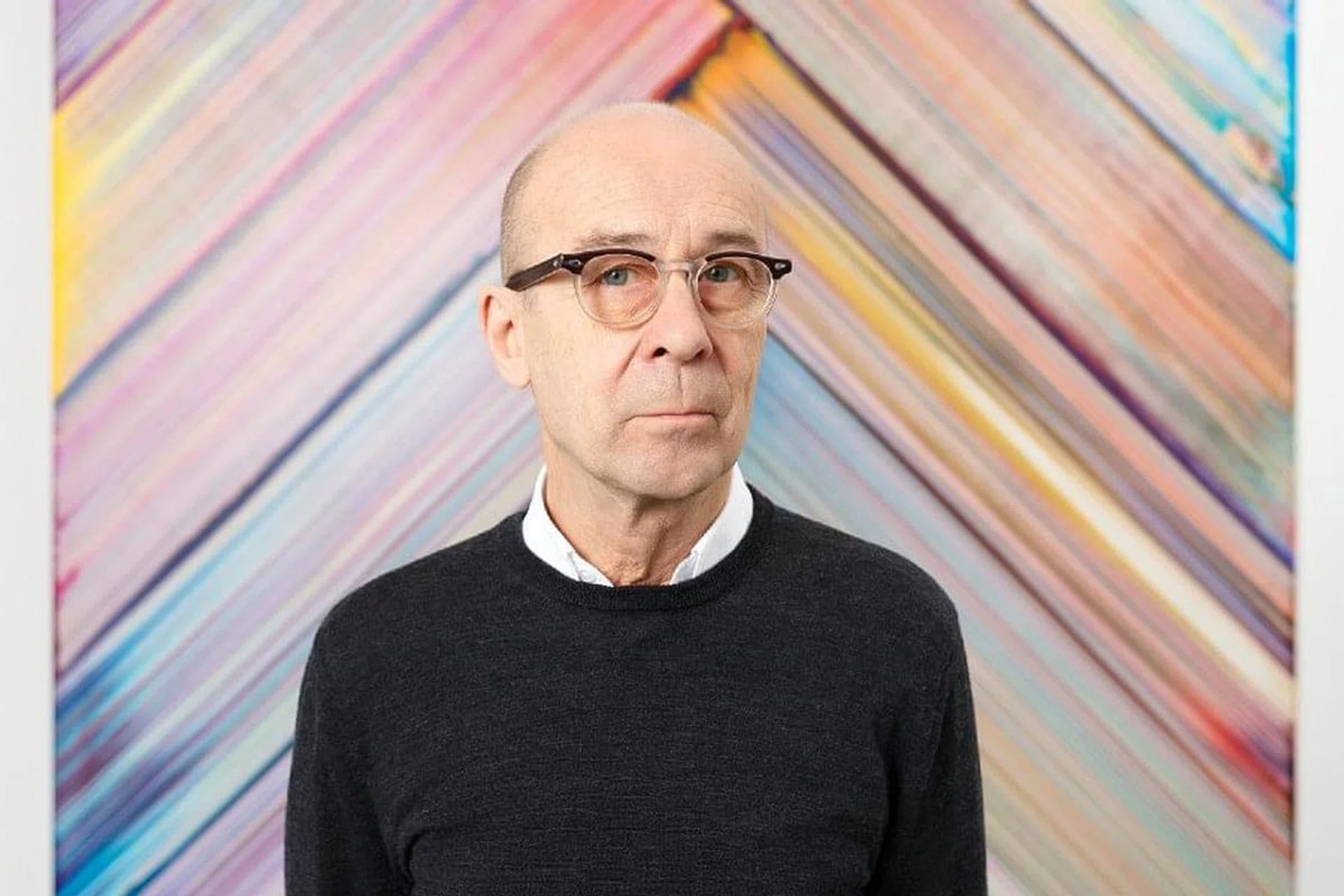
One of the greatest living french painters, Bernard Frize believes in a kind of autonomous artwork in which the brush almost paints by itself and his hand is practically absent, as he has invented a new language for painting that’s all about non-choice and nonexpression.
Although Bernard Frize has been painting for over four decades, the Berlin-based artist feels that he keeps repeating the same motions and producing the same canvases day after day, trapped in an endless cycle, as if his oeuvre hasn’t evolved since his first exhibition in 1977.
“Sometimes I look at my work and I think I’m always doing the same thing and it doesn’t make me happy,” he says, “I’ve the feeling it’s always the same preoccupation even if the images are very different.” However, it’s precisely this feeling of failure, that he hasn’t accomplished what he had set out to achieve, which keeps him going. “Most of the time I’m failing,” he admits. “This is why it’s so interesting and why I’m interested.” Bernard assures that as long as he finds pleasure in painting, he’ll continue to do what he has been doing.
Pictured: Bernard's works on show at the Perrotin gallery in 2019.
Puzzle of a man
Bernard’s works are riddled with paradoxes. They are saturated with innumerable colours yet he says that he is not interested in colour. He just uses as many as he can to avoid having to make a choice. In fact, the colours he uses are arbitrary, as he never composes the colour.
“I don’t think painting is a matter of taste,” he discloses, “Taste itself is subjective, it is based on personal preferences, which shouldn’t matter to an artist when he creates his work. Once while at one of my shows, I noticed that a collector was just buying pieces of my works that match the colour of his curtains.
It disturbed me because I wasn’t interested in having my artworks become a form of decoration. However, the fact is people buy blue if they like blue or red if they like red, but I’m not interested in that. It’s not what I think painting is about.”
From the ground up
Random as his paintings may seen, they are nonetheless strikingly beautiful and far from ordinary, thanks to his immense technical virtuosity.
Imposing constraints on his art in the form of protocols and systems – whether it’s filling the surface of a canvas in one stroke using a bouquet of paintbrushes or several people painting simultaneously and passing brushes between them without breaking contact with the canvas – he points out, “I’m trying to make a painting with the least decisions possible or to find a good reason to make a painting, or just the desire to have this line here and this line here – just simple things. In general, my paintings are very simple and everyone could do them. There’s nothing special about them.”
Pictured: Gliale, by Bernard Frize in 2013
Hoping to efface himself from his artworks in order to depict the creative act as nonpersonal, non-subjective and non-expressionist since “it’s not my personal life that I’m exposing in the painting; nobody is or should be interested in my ego”, Bernard nonetheless drops clues as to how they were made, purposely leaving lines visible.
“For someone looking at the painting, it’s interesting to be able to look at what was happening during its production, and not only theresulting work because I think a painting is addressed to the intellect as much as the feelings or sensibilities of people,” he notes.
“We have as much to occupy our mind from it as there is pleasure in looking at it. The spectator must adopt a heuristic approach in order to assemble everything that has gone into the work: the ideas, the materiality and the desire to exist. I always think to leave traces of what I’ve done behind so that people can retrace my footsteps. It could lead to another type of explanation of why I did that. I think that to be able to ask why, you have to ask how first.”
"I don't like immersive paintings; I don't like this idea of manipulating the viewer. I like that the viewer can stand in front of the painting and make his own judgement."
Puzzle of a boy
Born in 1949 in Saint-Mande, France, Bernard’s father was a serviceman who fought in WWII and all the French colonial wars and his mother a housewife. Failing to reconcile his political engagement with his artistic approach, he dropped out of arts school in Aix-en- Provence and Montpellier and took a break from painting.
Arriving in Paris in the early ’70s, he established his own silkscreen printing business, where he printed for other artists like Pierre Soulages, and was a ski instructor in the wintertime to supplement his income. He started to paint again in 1976 before his first exhibition the following year, at a time when the medium of painting had fallen from grace, especially in France, and post-modern art and photography were gaining in popularity.
Bernard describes how he eventually was able to express himself, “First of all, by being less ambitious, not thinking that I would change the world, which I did not understand, and that my action would be more limited. Before being political, a work of art has to be a work of art. It’s more that this piece of art has to be in conformity with your thoughts, so I found a way that was much humbler and that I could be satisfied with.”
France to Germany
Bernard explains why he chooses to create in Berlin, having set up his studio there in 2003, “I like Berlin. When I went there, there was a lot more freedom for me compared to Paris. There were many more painters in Berlin than in Paris, so I had friends I could exchange with about painting. But it has changed very much; now it’s becoming very expensive, as all cities in the world, and there is nothing special anymore. The German artists I know are having careers and have no time anymore to discuss, and they have tonnes of assistants, so they are in another world. But for me it’s nice because I always consider Berlin to be a capital in the countryside, especially in the summer."
"There is a lot of green in the city. Also I’m a foreigner. I like to be a foreigner so I don’t have to know anything and I don’t need to speak German or French; I can speak broken English. So on one hand, it’s very comfortable. On the other hand, it’s absolutely uncomfortable. The uncomfortable part makes me curious and think about everything again, so I don’t develop habits. This is what I like in Berlin: I’m forced to experiment much more because everything is difficult.”
Insane Beauty
Like a child at play, Bernard devises rules for the simultaneous creation of two artworks (Margarita and Continent) using the drips of one canvas placed horizontally to form the basis of another placed beneath. Wig is the result of leaving imprints made with a large round brush whose end is flat rather than pointy, while he calls Teeny a “painting of lies” as it’s impossible to paint a grid by passing over and under like a weave.
In his airbrushed Oma, he offers us the paradox of an invisible painting that is painful to look at due to its blinding, blurred effects, thereby seducing and repulsing us at the same time. He’s fond of the idea of “generation and corruption” when something occurs above a system that ruins it. Take for instance, Oude, where the movement from stains of liquid paint on a polychrome background creates and destroys simultaneously.
Working alone using brushes loaded with paint able to form very long lines, Bernard employs fine, transparent and liquid acrylic resin that leads to a cold, flat, smooth and waxed surface devoid of the painter’s gesture to keep the viewer at a certain distance from his painting.
Pictured: Bernard's Oma painting