
Share this article
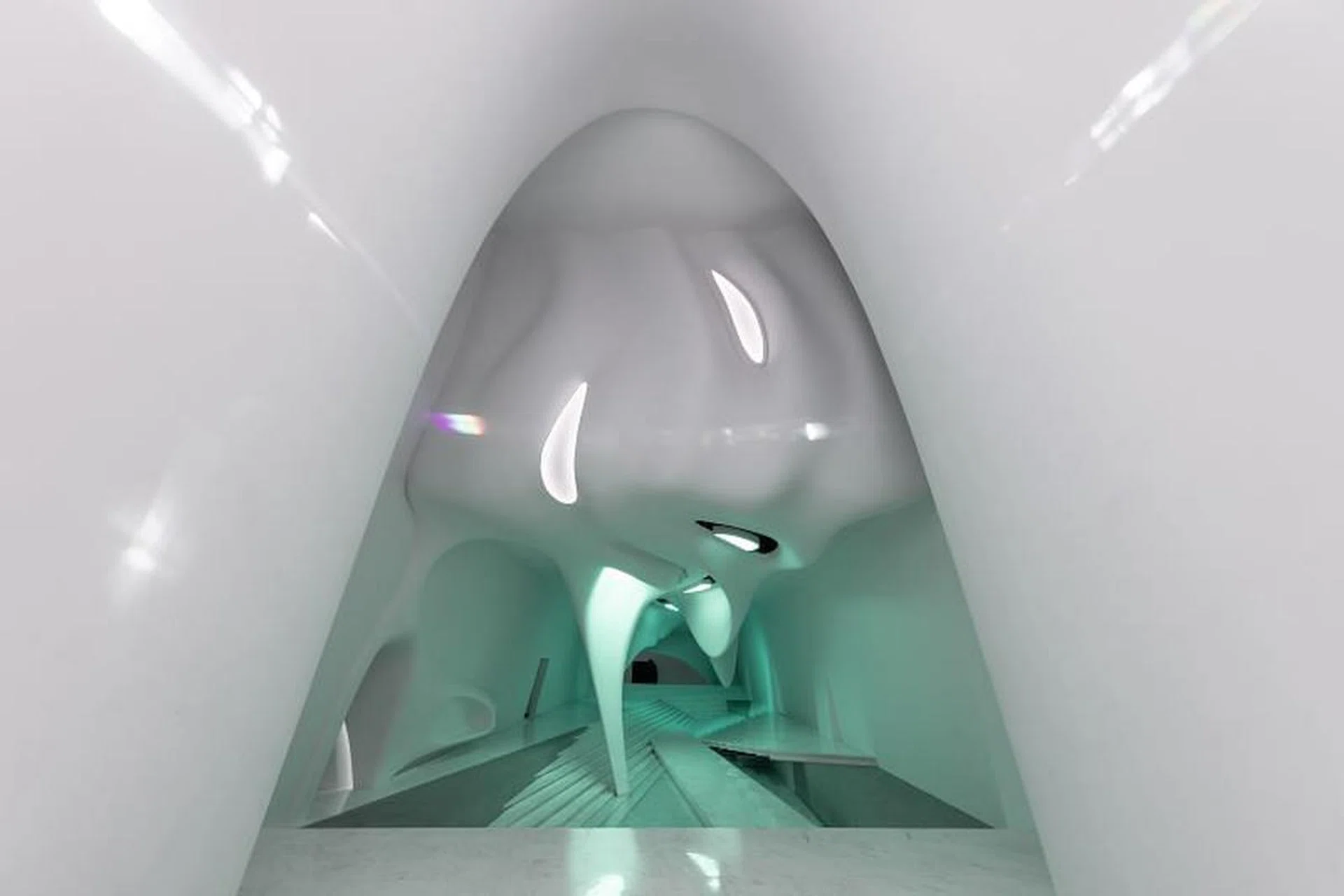
At first glance, you might be forgiven for thinking the image above is an AI-generated picture. But no, it's not by MidJourney, RoomGPT or Interior AI. This is a photograph of an actual space designed by interior studio SpActrum for MREGINA - a wedding gown specialist. By focusing on organic curves and artistic lighting, the design team (headed by director Yan Pan and lighting designer Guan XiaoHao) created a super-sensual and almost alien-like terrain across the 712 sqm space now known as M2 Art Centre.
Scroll down to swoon over the spaces that seemingly defy gravity and make you feel like you're stepping into the midst of a lava lamp!
M2 Art Centre is a multifunctional art space located in Hangzhou (Xingyao Centre, Binjiang District), which originated from a wedding dress showroom.
The initial purpose of the space as a wedding gown studio triggered the team to reflect on women and their choices in marriage and relationships: Marriage is no longer a default option for everyone in contemporary society but rather a rational choice for individuals to grasp their own lives.
With this in mind, SpActrum proposed a bold and radical concept to transform the space into a versatile space that could also serve as an event venue for shows and performances.
Two questions led the dramatic design of the interior-scape.
Can a contemporary commercial exhibition space be expanded into a mind-body journey with some psychic touch, providing an opportunity for introspection and contemplation of life before the wedding moment?
Can a space imbued with profound meaning serve as a versatile venue in the city, hosting various artistic and design activities?
The site of M2 is located in the plinth of a high-rise office building, and the original space was a gym space with a swimming pool.
The spatial sequence of the site begins at the square elevator hall on one side of the main space, followed by the more than 40-meter-long strip-shaped main space, with the floor partially sinking about 1.5 meters and the end being a 10-meter-high space.
When Yan Pan, the chief designer of SpActrum, initially explored the site, the basic storyline of M2 Art centre had already been outlined based on the preliminary on-site conditions: stepping into the sunken swimming pool, the sense of height in the main space was further stretched, and standing at the end of the pool, looking up at the 10-meter-high end space, Yan Pan instantly felt a strong sense of sacred calling.
The strong connection between the designer and the site made it clear that the design of M2 should be based on respect for the power of the place, seeking to express their spatial potentials.
Departing from the elevator hall, the pathway leads into a dark, enigmatic space where black stones float, smoothly but sharply descending from the faint light of the sky. They are mysterious, like the Ten Commandments descending upon Mount Sinai.
One of the black stones partially covers a bright white opening, leading into a domed space where the ground slopes gently upward. The highest point of the space is an arched opening that rises from both sides.
Looking back from the main space towards this location, the complete form of the space appears like a cocoon that contains the seeds of human beings, with the arched opening resembling an eyelid that visitors stand inside. This is the first place visitors land when arriving on this alien planet, and where they take their first glimpse at the new world.
By leveraging high space, the concept of an inverted valley is established, which makes the space ground clean and inclusive and suspends the themed objects in the air.
The mirror-inverted reflection of conventional landscape objects creates aesthetic tension. At the same time, these hillsides are geometricized, more slender, ethereal, round and sharp than natural hills, because they are separated from the gravitational constraints of natural hills.
In this world, there is a unique experience of anti-gravity. The valley itself is a winding path, so when it is inverted, the peaks become hanging screens, and the path is dimly visible in the separated areas.
As the viewer passes through the highest point of the cocoon chamber's opening, the ground path continues to descend, and the steepness of the valley is magnified. The peaks hang, curl, concave, elongate, and coexist. In many angles, they look like some physical representation of human senses such as ears, eyes, and mouths.
The spatial circulation deviates towards the diagonal direction of the oblique space, which extends the walking experience. The short steps in the space are vertical, while the long steps are mirror-like diagonals, complementing the original concrete structure of the pool and exposing some of its edges.
The steps extend downwards until they intersect on both sides, forming a pool. At the end of the pool, the steps continue to extend upwards, forming an aerial altar, attempting to approach the infinite nature with rationality.
The altar is located under the dome, and its massive volume resembles an oracle, an eternal object from beyond the sky. Then, the holy light descends and flickers at the highest point of the entire space. Looking back, it presents the most magnificent and extraordinary scenery in the space.
Leaving the hat-shaped space from the highest point of the stairs, one enters the fantastic main space, as if entering a movie space that reviews one's life. The ignorant and bewildered youth arrive in this world, and the hanging peaks resemble lips and earlobes, as if they are calling out, whispering, inspiring, tempting, desiring, and making noise, trying to influence the innocent new life everywhere. They may be lost or moved, but ultimately, when facing the holy light that connects heaven and earth, they look back and understand themselves. This is the main storyline of the space.
SpActrum explores the potentials of space and establishes four different geometric languages: flat geometry, regular surfaces, free-form surfaces, and symmetrical free-form surfaces. These correspond to the cocoon (the cradle when people leave their homes), classical temples (human wisdom and rationality), nature (essentially the humanization of nature, including an understanding of chaos), and divinity (absolute grandeur), respectively.
M2 Art centre is a place with unique spiritual characteristics and rich symbolic meanings.
Through metaphorical spatial narrative and the use of different categories of geometric forms under the control of superb geometric mastery, the space is endowed with ambiguous and multiple meanings, with many metaphors and references hidden in the pure geometric forms.
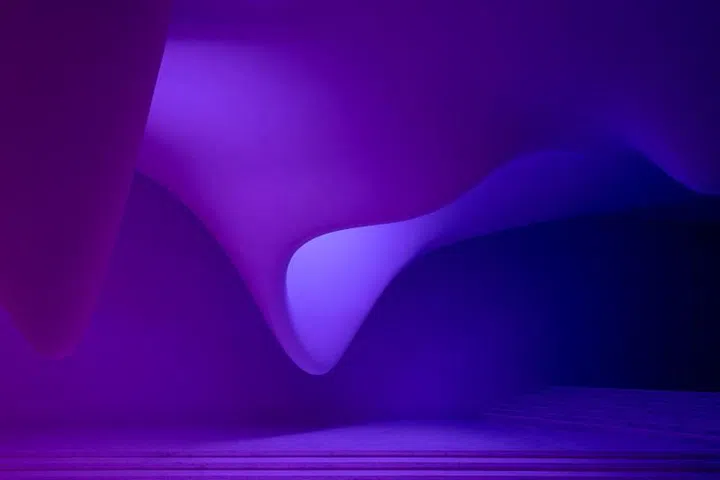
The lighting can also be designed to create different atmospheres, from a cold-white glacial effect to a deeply soothing purple-hued space.
The awe-inspiring spatial design becomes the perfect venue not only for wedding photogrpahy, but shows and performances as well.
Soft lines help to draw the viwer into the billowy depths of the interiors.
The use of white marble echoes classical architecture, while the extensive use of light films brings an endless sense of space.
SpActrum establishes a connection between geometry and emotion through geometric manipulation, which originates from our deep collective memory as humans and goes beyond the original narrative, becoming our intuitive response to the space.