
In the past decade, Russia’s street-art movement has emerged from the shadows. So much so that the Russian port city of St Petersburg now has a dedicated Street Art Museum. Moscow, in particular, has launched its own street-art initiatives. To enliven the capital city’s drab neighbourhoods and old buildings, the government has invited local artists to paint murals.
The story of Moscow’s street art begins with a single building, painted white, blue and red – the colours of the national flag. The Mosselprom (above) rises 10 storeys over the main pedestrian street, Arbat. When the building was erected almost 100 years ago, it was among the tallest in Moscow.
The avant-garde art community still influences the landscape of modern Moscow. For a time, portraits of artist Alexander Rodchenko, architect Vladimir Tatlin and painter Wassily Kandinsky (above) all appeared on fireproof walls in the city – put there by the pioneers of modern street art, a group called Zuk Club. Today, only Kandinsky’s image remains on Fonvizina Street.
But there are other murals by Zuk Club that can still be found around Moscow. Two are dedicated to composers Igor Stravinsky (above; 34/41 Bolshaya Polyanka Street) and Alexander Scriabin (19 Gilyarovskogo Street).
During the past 10 years, another street artist Petro is said to have painted more than 100 works in the capital – two of which can be found on Bolshoy Sukharevsky Lane. He covered one of two arched passageways with bright swirls of colour, and the other (above) with geometric shapes that look like falling diamonds. “In my works, one can find traces of Russian art,” says Petro. “I redefined Soviet avant-garde and Suprematism, which can be seen in my geometrical works.”
Over on Rozhdestvenskaya Street, Australian artist Fintan Magee has also left his message, in the form of a girl (above) dropping a corked bottle containing a note into the sea.
More murals were featured at the second Artmossphere Street Art Biennale. One of its curators, Dmitri Aske, is another big name in the local scene. His artwork (above), titled The Key, enlivens Orlikov Lane. “The artist is responsible for his message, I wanted my work to be understandable for locals,” he says. “The girl in the water symbolises daily routine. She holds the key, which represents the way to solve any problem.”
At Ciderella, Zoom’s work (above) features Soviet actress Nonna Mordyukova, accompanied by two stormtroopers. The Star Wars characters are perhaps intended to symbolise Russia’s controversial Voluntary People’s Guard, which ceased to operate in the early 1990s. “Street art, for me, is an opportunity to make a statement,” says the artist. “I am inspired by cinema and like to mix cinematic images in my work.”
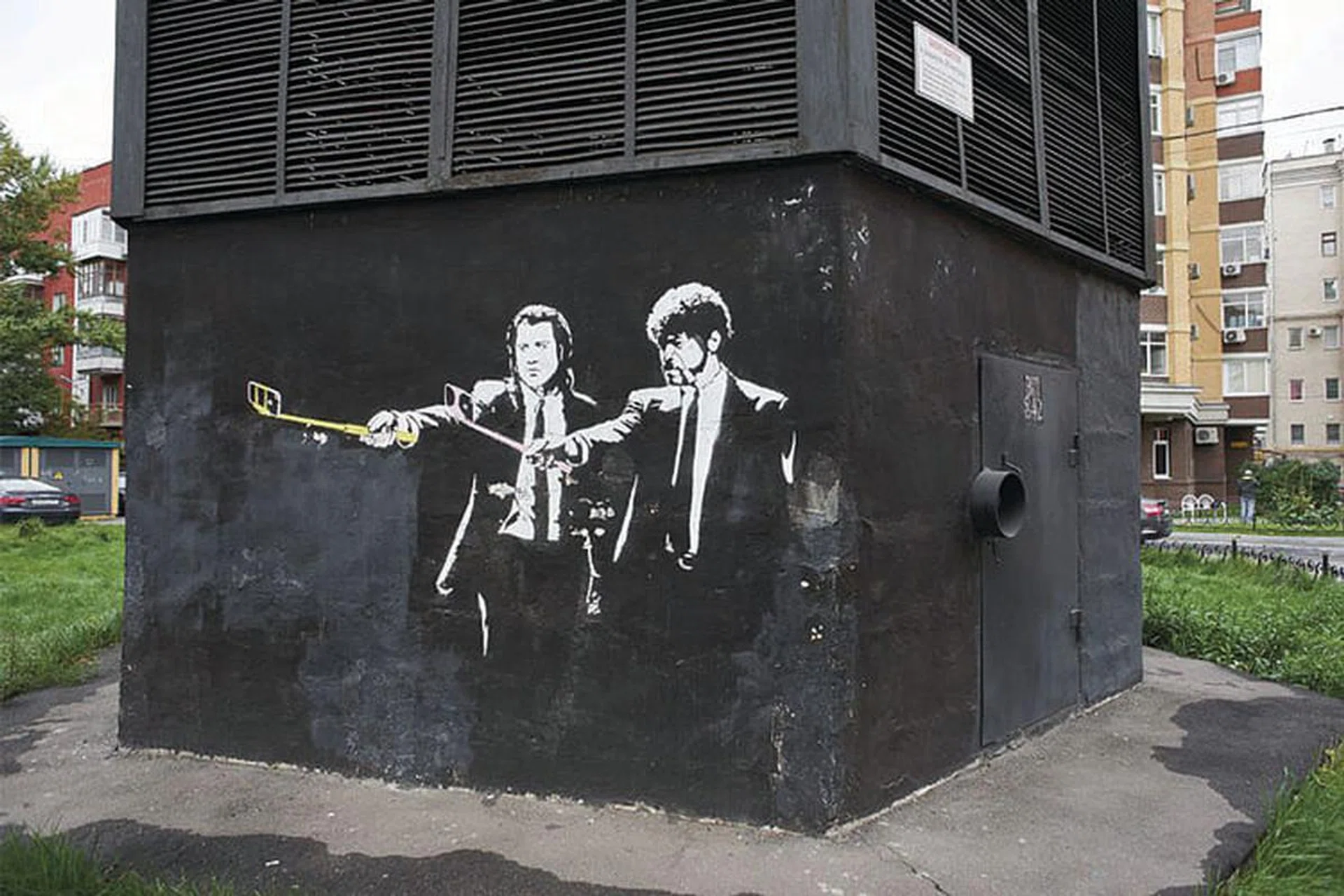
Today, around 10 of the roughly 70 original murals he has created can be found in Moscow. One of them, Ippolit: Dedicated to CCTV (3 Pavlovsky Lane), captures a scene from the Soviet film, The Irony of Fate – a comedy often watched by Russians to celebrate the New Year. Other movie figures can be found on Lyusinovskaya Street, where a mural (above) depicts the characters from Pulp Fiction taking a selfie.
But Zoom’s favourite work is dedicated to the city he adores. I Love You, Moscow (above; 7-9 Khokhlovsky Lane) captures a Russian border guard with his dog. The famous bronze monument sits at Revolution Square metro station and has become a popular attraction. Students scratch the canine’s nose to pass exams, while others do the same for luck. No matter what time it is, there always seems to be someone polishing the shiny dog – a symbol, perhaps, of the city’s new artistic transformation.
This story first appeared on silverkris.com