
These projects are competing for the World Building of the Year award which will be announced at the World Architectural Festival from Nov 15 to 17 in Berlin.
Assisi Hospice, Singapore
by New Space Architects
Hospices don't have to be depressing places, going by the brief given by the new Assisi Hospice to make the space "less hospital-like".
It now looks like a pared-down resort. The bright and airy wards have balconies, so patients get a view of the outdoors even from their beds. Patients are encouraged to personalise their rooms, to give it a more homey feel.
Assisi Hospice is also the first in Singapore to have a paediatric ward, which opens out to a kids' playground that children can escape to.
The hospice prides itself on having lots of greenery on site, from the sensory garden on the rooftop, to the courtyard on the ground floor. The various green spaces are seen as a form of therapy for patients.
This article was first published on The Business Times.
The Smile, London
by Alison Brooks Architects
Created for the 2016 London Design Festival, The Smile, located in Chelsea College of Art's Rootstein Hopkins Parade Ground, offers an immersive sensory environment, integrating structure, space and light to form a public gathering place.
Conceived as a habitable arc poised on the horizon, the pavilion takes the form of a four-sided curved timber tube that cantilevers 12 metres in two directions from its centre point.
Visitors enter the pavilion through an opening where the arc touches the ground, then move to the other end of the 34m long curved space, gradually moving towards light.
Each open end of the pavilion offers a viewing platform to enjoy framed views of London.
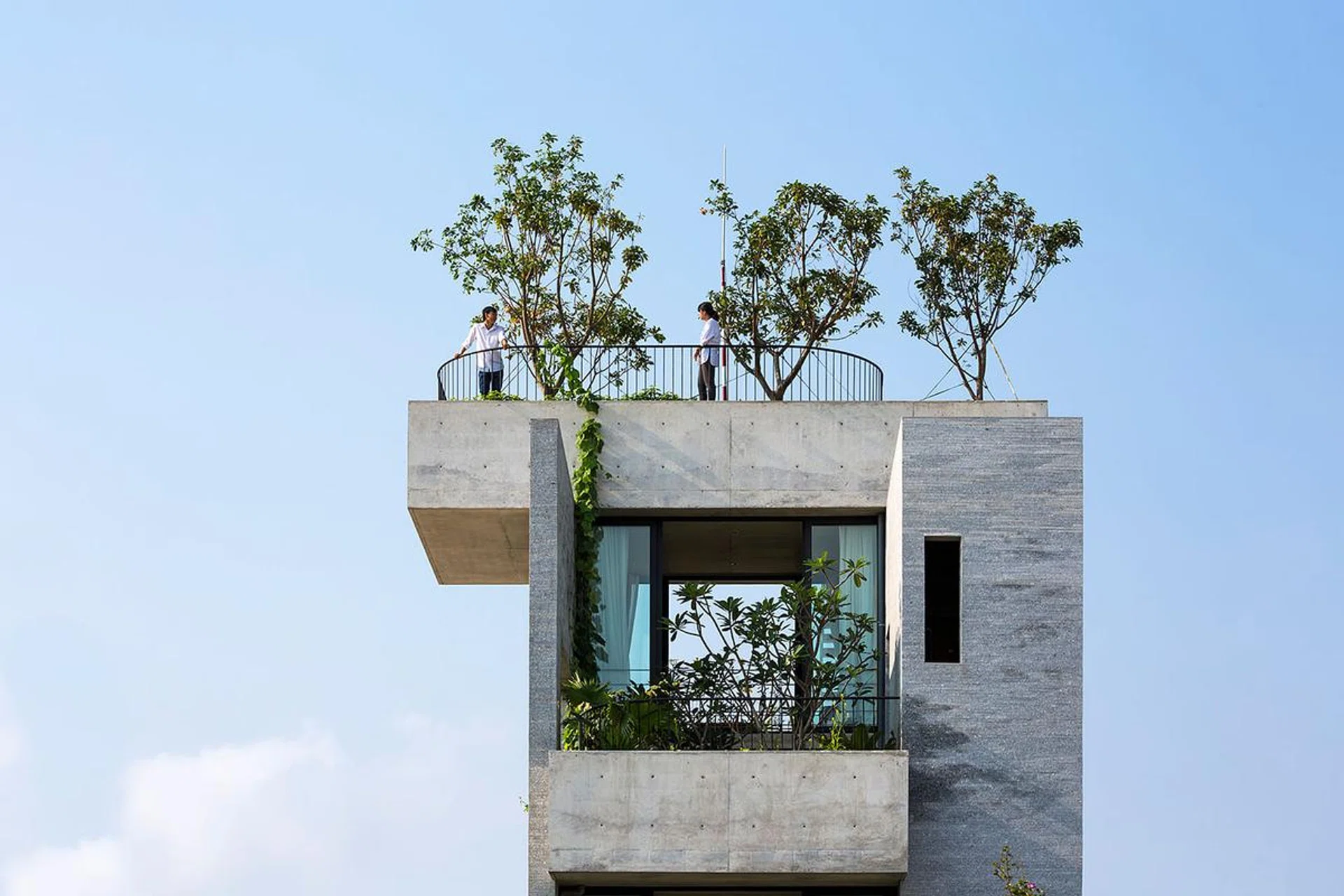
Binh House, Ho Chi Minh City
by VTN Architects
As cities develop, urban areas lose their connection with nature. VTN Architects wants to change that.
Binh House, a home for a family of three generations, brings greenery into the home, while its interiors provide each family with privacy and yet still providing space for interaction.
Gardens are located on top of the vertical stacking spaces. This improves the microclimate by using natural ventilation and daylight in every room.
Binh House is part of VTN's 'House for Trees' development, which provides a solution for sustainable development in tropical countries.
Port House, Antwerp
Zaha Hadid Architects
The new Port House repurposes a derelict fire station into a new headquarters for the port - bringing together its 500 staff who previously worked in different buildings around the city.
The design brief required the fire station to be preserved. Other than that, Zaha Hadid Architects - which won the design competition - had carte blanche to do as they wished.
The team created a new building that appears to float over the old. Surrounded by water, the new extension's facade is a glazed surface that ripples like waves and reflects the changing tones and colours of the skyline.
Triangular facets, some transparent and others opaque, ensure sufficient sunlight within the building, while also controlling the glare of the sun. At the same time, alternating transparent and opaque facade panels breaks down the volume of the new extension, giving panoramic views of the Scheldt, the city and the port.
Suzhou Chapel, Suzhou
by Neri&Hu Design and Research Office
Located within the Sangha resort in Suzhou, Suzhou Chapel disrupts any preconceived ideas of how a chapel should look.
Its combination of brick walls and a floating white volume references other buildings found on the site, as well as the local vernacular of white rendered walls and black roofs.
The different heights of the brick walls interweave with each other to create a choreographed landscaped journey leading into the building itself.
In the day, the white box, which is a layer of perforated metal skin, shimmers gently in the sunlight, subtly exposing its content. In the night, the white box becomes a jewel-like beacon, its various windows emitting a soft glow in all directions.
Zhuhai Opera House, Zhuhai
by CR Institute of Architectural & Urban Design
The designers of the Zhuhai Opera House were inspired by the humble mollusc, Asia Moon Scallop, when they were designing the building.
Built on a plot of reclaimed land, opposite the city's main seafront, the Zhuhai Opera House boasts two structures resembling shells.
The larger of the two shells houses a concert hall, a lobby, an auditorium and a stage, to host symphonies, chamber music, operas and ballets. The smaller shell contains a theatre suitable for fashion shows and art events.
The shells are designed to take into account the local typhoon and heavy rain, and built to last for at least a century
Petersen Automotive Museum
by Los Angeles, by Kohn Pedersen Fox Associates
With its red and silver facade, the museum, which showcases the art, experience, culture and heritage of the automobile, is not easy to miss.
While a new building would have been expensive, a new facade and interior renovation provided a sustainable and affordable solution.
The architecture firm's design coalesced around the metaphor of a car: if the existing building was the chassis, then the design was the body.
The building was given a new exterior wrap which was composed of steel ribbons, red rainscreen, outrigger and structural trees. The steel ribbons evoke a sense of speed and movement.
Urban Rigger, Copenhagen
by Bjarke Ingels Group
Talk about waterfront living. Urban Rigger is the first floating, carbon neutral housing constructed from shipping containers and designed to be mass-produced as an affordable and sustainable alternative to rising housing prices.
The hexagonal configuration of nine upcycled containers offer 12 residences, a courtyard and roof terrace, encouraging a sense of community and social interaction. The containers are modified and fitted with insulation, heating systems, windows, doors, bedroom, kitchen and living room.
During a period in which climate change and rising sea levels are a concern, this is one of the most resilient forms of housing because it moves with the water.