
Home Tour: $85,000 Art-filled renovation for a new 3-bedroom condo at Penrose
In this new Penrose apartment, Metre Architects turn a winding entryway into an art-led spatial experience.
By Gwyneth Goh -
Share this article
Most homeowners might see a long, winding corridor as wasted space. For Walter and Melody, the unusual entry of their new apartment at Penrose condominiun was precisely what drew them to the unit.
“Usually when you come into a house, you enter straight into the living space,” Walter shares, “But we bought this place because of the L-shaped corridor. It gives privacy—and we turned it into a mini gallery.”
Rather than seeing it as wasted space, these homeowners recognised its potential to become a threshold: a place where the outside world could be shed, and the home’s identity introduced.
Working with Metre Architects, the couple leaned into this idea from the outset, allowing the corridor to shape the tone of the entire apartment. A dark timber-lined ceiling lowers over the passage, guiding movement forward before the space opens into the living and dining area beyond—an intentional pause that reframes arrival as experience rather than transition.
Who Lives Here: Walter, 43, in the corporate insurance industry, his wife Melody, their two children and a helper
Home: A new 3-bedroom condominium at Penrose
Size: 102 sqm (approximately 1,098 sq ft)
Interior Designer: Woon Chung Yen, Metre Architects
Where art sets the tone
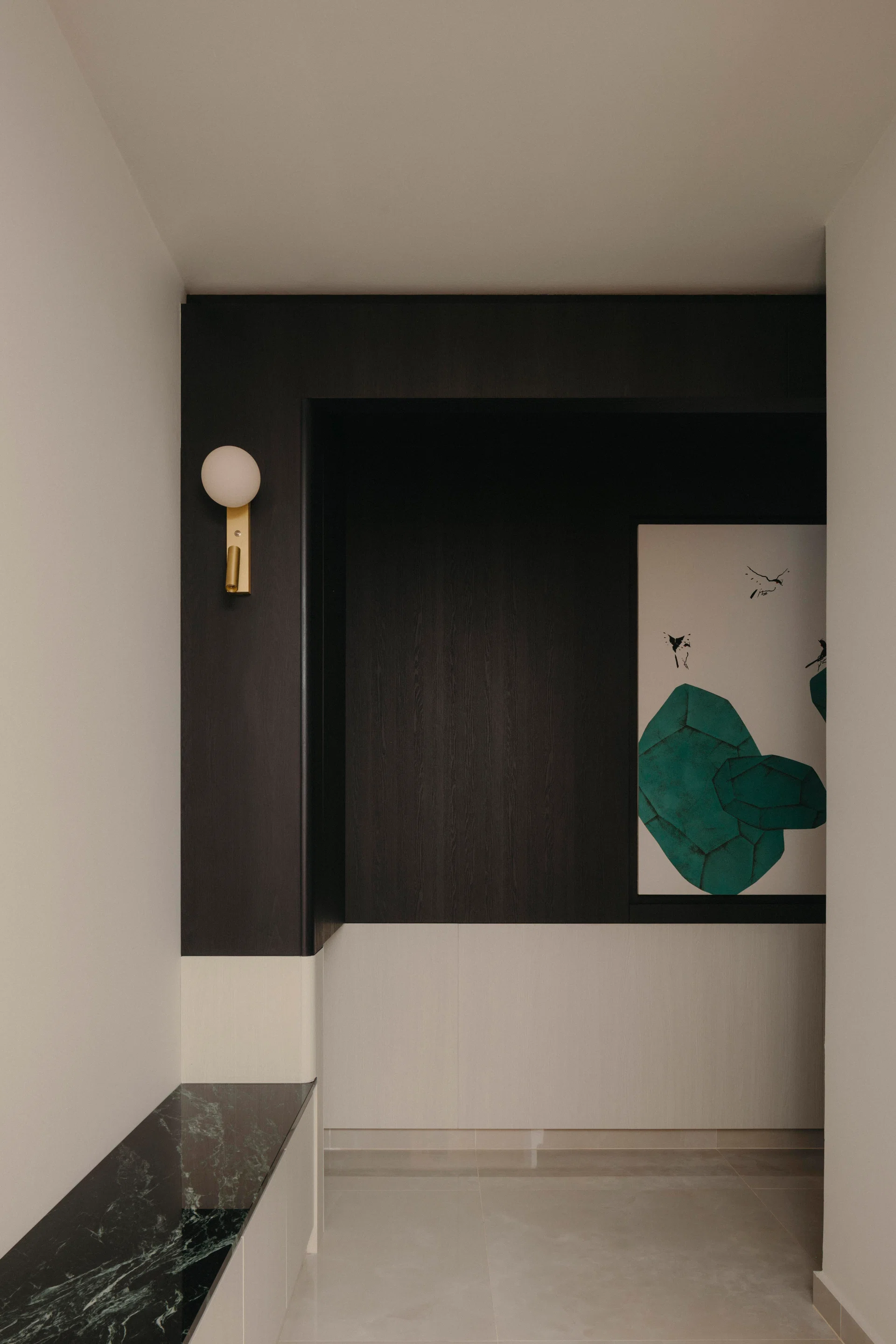
The entry corridor sets the emotional register for the home. Instead of leading straight into the living area, it slows the pace, narrowing slightly as a dark timber-lined ceiling lowers overhead. The effect is deliberate: a gentle compression that draws attention forward and invites a moment of pause.
On the left, the first artwork comes into view. Commissioned from Singaporean artist Tay Bak Chiang, Tian Lun Zhi Le (family bliss) anchors the corridor with calm authority.
Rendered in layered green stone forms inspired by Bukit Timah Nature Reserve’s natural terrain, the piece depicts four birds—one for each family member—quietly establishing themes of togetherness and grounding. Set against dark timber, the artwork reads almost like a window rather than a wall piece, easing the transition from outside to in.
Further along, the palette shifts. The second artwork, Wu Wei Qian Xing (to boldly go), introduces a striking red composition fractured with gold undertones. Where the first piece soothes, this one energises, signalling movement, ambition, and continuity. Its placement is intentional: encountered only after one has moved deeper into the home, it marks progression rather than arrival.
By the time the corridor opens out, the artworks have already done their work. They frame the experience of entering the home not as a passageway to be rushed through, but as a threshold—one that clears the mind, slows the body, and prepares the occupant for the calm beyond.
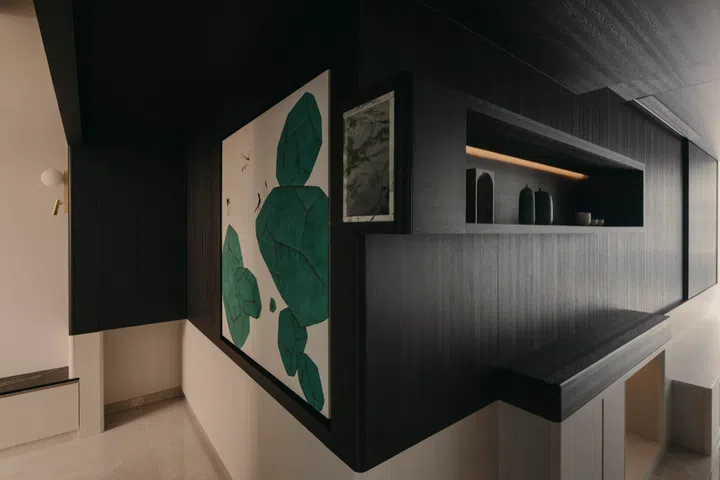
The artworks frame the corridor as a threshold rather than a passageway, setting the emotional tone before the space opens into the living and dining area of a 3-bedroom (1,098 sq ft) condo in Penrose.
Artistic interior design
“The whole house, when I come back, has to be completely relaxing,” says Walter. “It has to give off that artistic feel, that’s different from other houses.”
With busy professional schedules, the family wanted a home that felt like retreat rather than extension of work life, one that could offer rest, clarity, and a sense of originality. “One of our requirements was: you have to make this a unique space.”
That desire for originality shaped both the brief and the process. Walter, an aspiring art collector, entrusted the design almost entirely to Woon Chung Yen, founding partner of Metre Architects, giving the studio latitude to push ideas beyond convention.
“We are very conventional,” Walter admits. “But since I like art, we just went for it.”
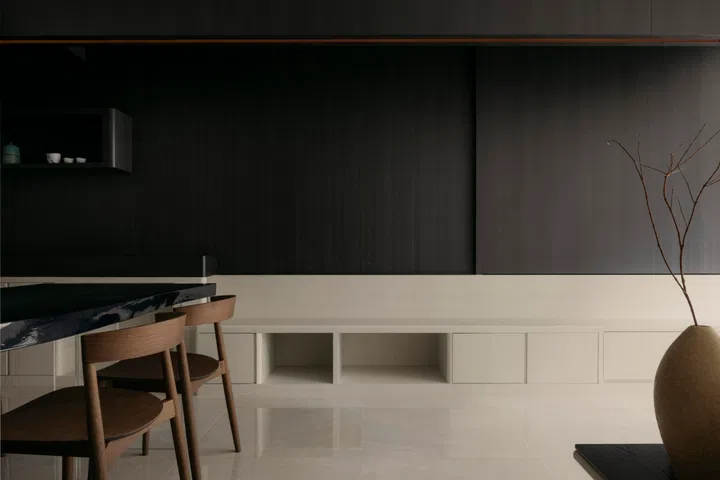
Dark timber frames the open living and dining area, lending a quiet sense of calm and ease to this 3-bedroom (1,098 sq ft) condo in Penrose.
Open living and dining
As the corridor opens out, the home unfolds as a single, continuous living and dining space.
The dark timber ceiling lifts, light spreads across the room, and the earlier sense of compression gives way to openness and ease. It is a subtle release—one that reinforces the idea of the home as a place to slow down rather than impress.
Here, black and white form the architectural base, allowing material contrast to do its quiet work. Dark timber surfaces are balanced by pale flooring and soft daylight, while art and objects introduce depth without visual noise.
The space is deliberately uncluttered, designed to feel calm and grounded even when the family is gathered.
Running along one side of the living area is a long built-in bench—an unassuming element that quietly supports how the family uses the space.
For Walter, it has become a favourite spot to read, offering a comfortable perch that feels both grounded and slightly set apart from the main seating. When guests come over, the bench easily shifts roles, doubling as additional seating without disrupting the openness of the room.
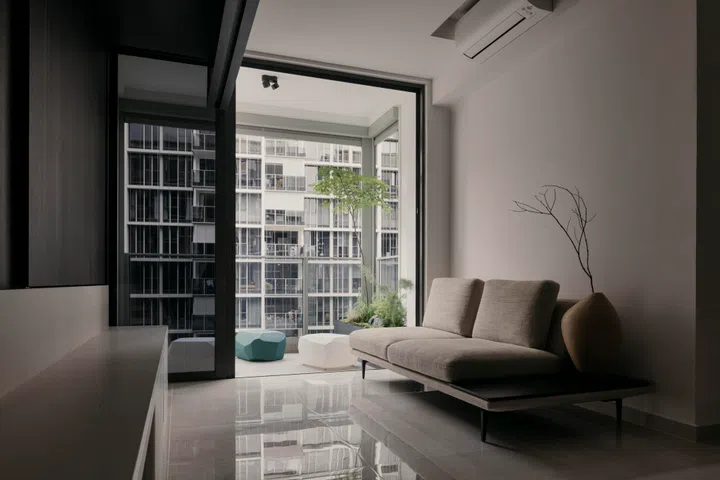
Rock-like Serralunga Meteor stools in the living area mirror the green stone forms seen in Tian Lun Zhi Le at the entry, extending the artwork’s language into the living space of a 3-bedroom (1,098 sq ft) condo in Penrose.
Recurring rock motif
Out on the balcony, three small rock-like Serralunga Meteor benches introduce a softer, more playful counterpoint. Sculptural yet unobtrusive, they echo the organic forms seen earlier in the entry corridor—an association that was intentional.
As expected, one of these small seats appears in green, subtly referencing Tay Bak Chiang’s artwork.
“I guess it would be the uncanny resemblance of Serralunga’s Meteor green stool to the green rock by Tay Bak Chiang,” says Woon, reflecting on his proudest design moment in the home.
“Perhaps the rock form is more fundamental to all cultures than we are aware of.”
Placed loosely within the living space, the stools function as casual seating or side tables, but more importantly, they reinforce a quiet continuity between art, object and architecture—where forms recur, resonate, and settle naturally into daily life.
“As an architect, I strongly believe that good spaces need to be moulded,” Woon says. From the tunnelling of the entry corridor to the peripheral bench that hugs the living and dining area, sculptural elements are used to delineate and layer the home.
“In architecture, we term this as ‘form-making’,” he explains. “Since space is shaped by form, interiors may also be sculpted in the same way.”
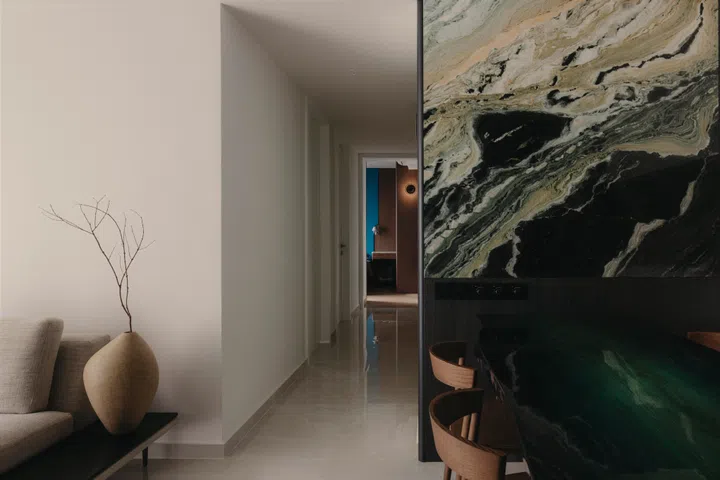
The dining area sits between the living space and kitchen, conceived as a calm, open, shared zone for everyday meals.
Rare zelkova dining table
The dining area is anchored by two statement pieces that work in quiet tandem: a green zelkova dining table and the Shangri-La Green marble feature above it.
Explaining how the widened dining space is visually grounded by the feature, Woon likens the Shangri-La Green marble to a “natural painting”—its expressive veining introducing depth and movement, holding the space without the need for additional ornament.
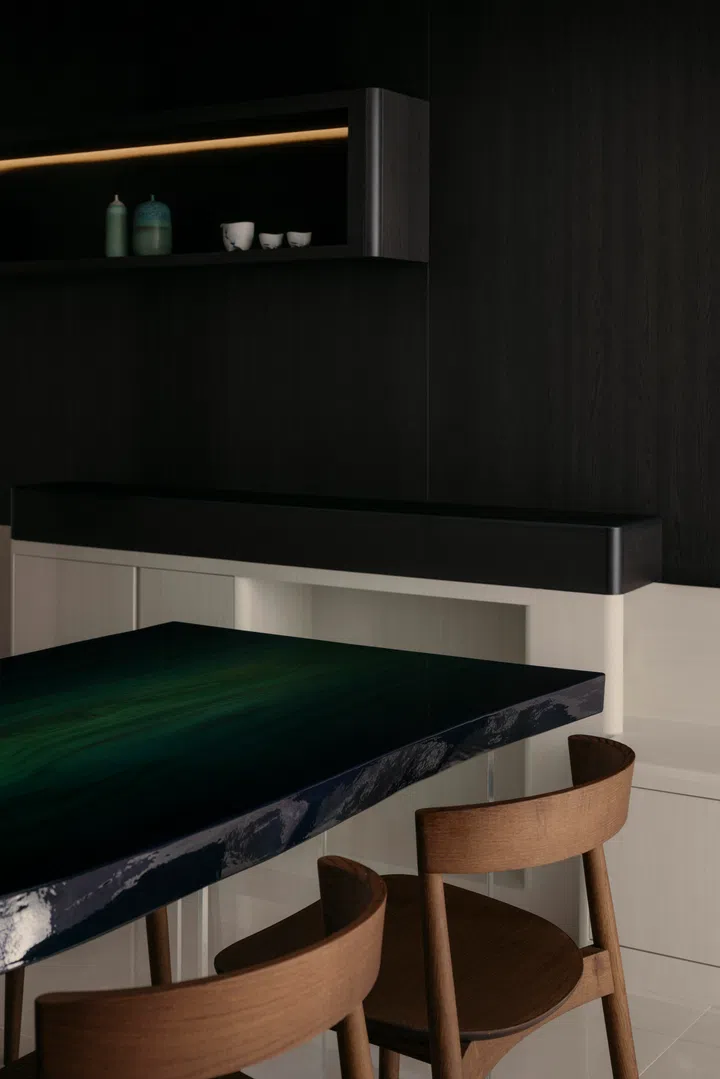
A custom dining table made from Japanese zelkova and dyed with natural indigo grounds the dining area against dark timber joinery.
Beneath it sits a slab of Japanese zelkova, dyed in a green gradation that Woon sees as an extension of the marble’s tones.
Raised on transparent acrylic legs, the table appears to float lightly within the space. Its glossy, piano-like finish reflects the marble’s green veins above, setting up a subtle contrast between stone and timber surfaces.

In close-up, the table’s blue-green grain recalls natural stone and landscape formations, echoing the art-led language of the entryway.
For Walter, the table was an instinctive choice. “This table is unique because there’s no other piece in Singapore,” he says. “If you look closely at it, it looks like a long island with waves crashing on the beach. Only zelkova wood is able to create this effect.”
Set against the marble backdrop, it anchors the dining area both visually and emotionally, serving as the everyday centre of family life within the open-plan home.
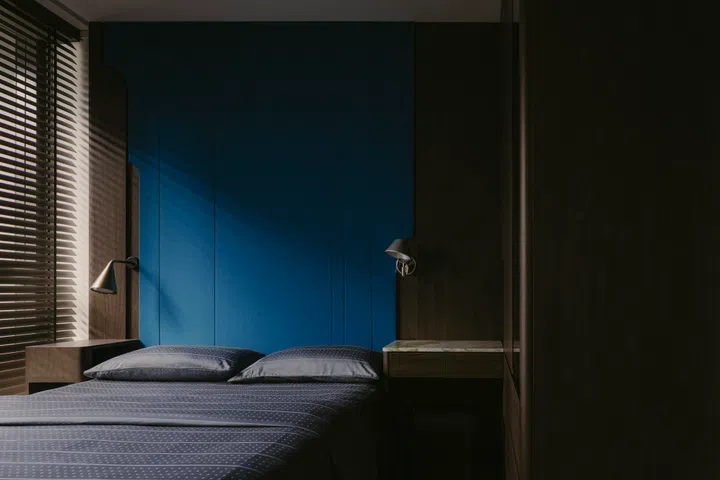
Dark timber joinery and a blue upholstered headboard set a calm, restrained tone in the master bedroom.
Master bedroom
If the entry sequence is about transition and the living spaces about gathering, the master bedroom is where the home settles into rest.
Here, the palette shifts decisively towards restraint, with dark timber, muted textiles and a rich blue upholstered headboard setting a quieter tone.
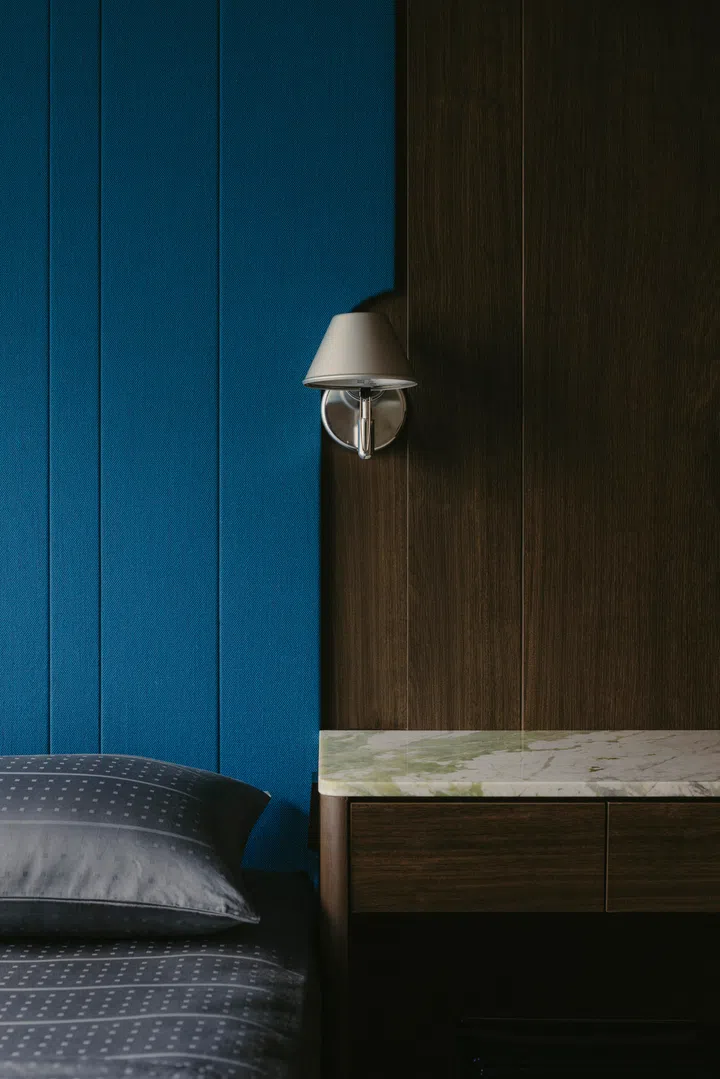
Melody’s favourite marble surface brings quiet contrast to the master bedroom’s restrained palette.
Dressing Table
One personal detail finds its way into the room through material choice. “My wife’s favourite marble is actually on the dressing table,” Walter notes, “The splash of green on white is like a graffiti painting so it is quite special.”
Used sparingly, it introduces a gentle contrast against the darker timber, adding a touch of brightness without breaking the room’s overall restraint.
According to Woon, the intention was to keep the room composed and grounded, allowing colour and texture to work subtly rather than decoratively. The blue Kvadrat headboard introduces depth without overpowering the space, while the surrounding timber surfaces provide warmth and continuity with the rest of the home.
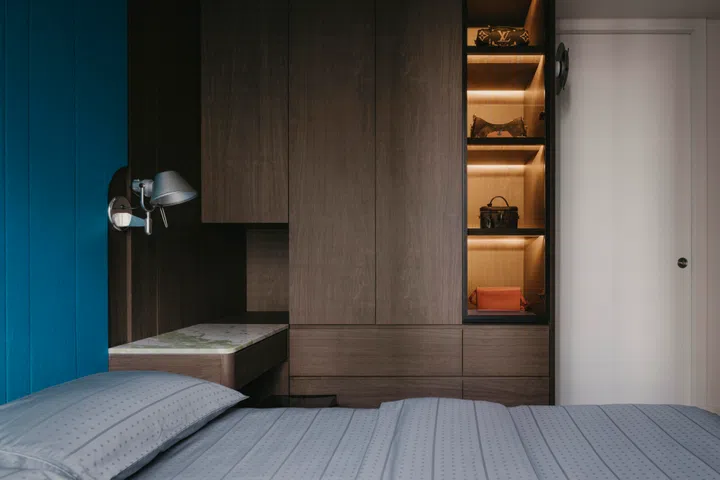
A softly lit display niche breaks up the wardrobe wall, adding warmth without disrupting the room’s quiet palette.
Storage is handled discreetly. A full-height wardrobe wall is punctuated by a softly lit display niche, offering a moment of visual interest without disrupting the room’s overall restraint.
Task lighting is pared back to essentials, reinforcing the idea of the bedroom as a place for winding down rather than stimulation.
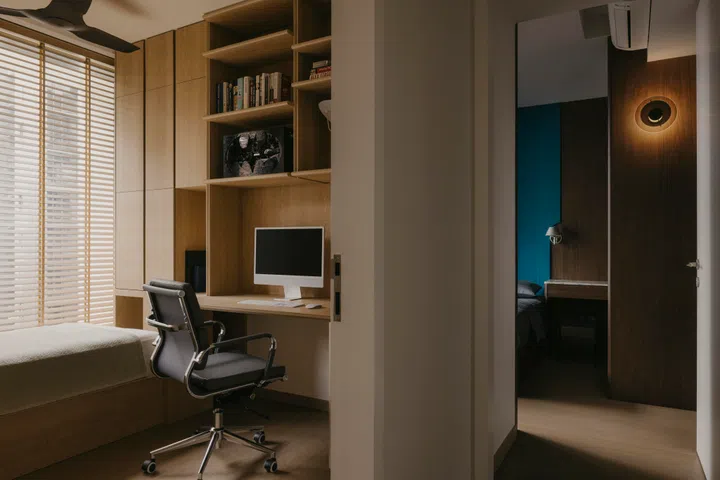
The guest room doubles as Walter’s workspace, with built-in timber shelving framing a compact desk and display ledges.
Guest room
The guest room is where Walter allows himself a bit of indulgence. Conceived as a flexible space that doubles as a work zone, it reflects a different, more personal side of how he inhabits the home. This is his private corner designed for reading, working, and retreating.
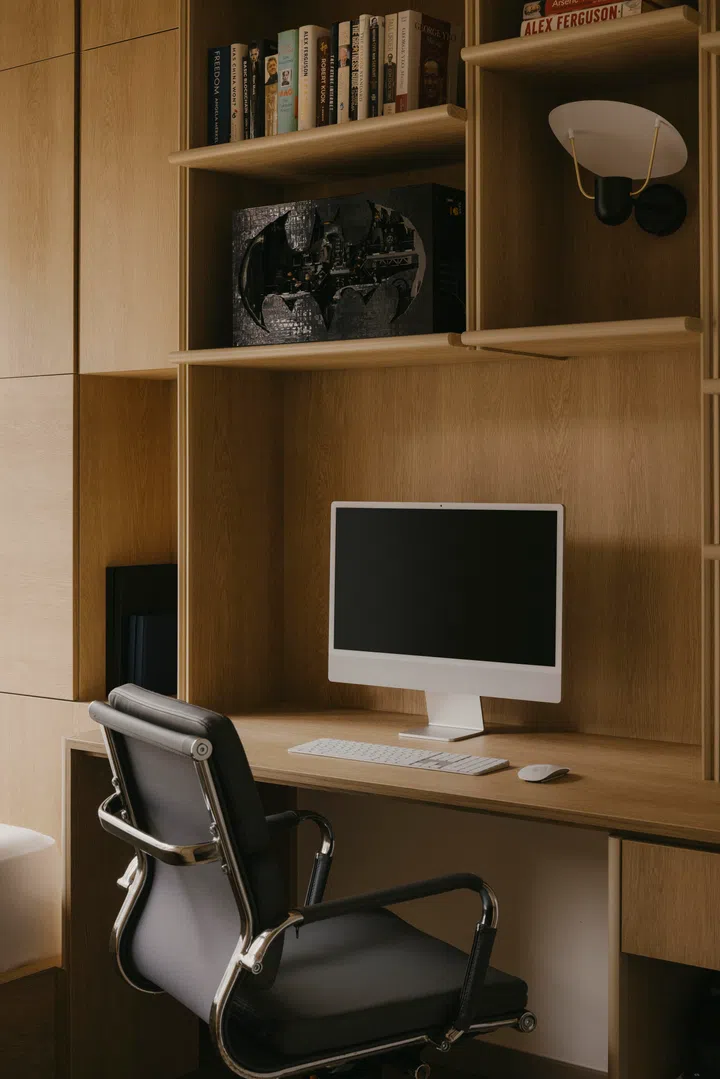
A Lego Batcave model tucked among books and personal objects supports the room’s nickname: Walter’s “Batcave”.
“This is my Batcave,” Walter says with a laugh. Lined in warm timber and tucked away from the main living areas, the room feels intentionally enclosed—quiet, focused, and slightly inward-looking. Built-in shelving frames the desk, holding books, objects, and a small Lego Batcave piece that gives the space its name.
Rather than treating the guest room as an afterthought, the same attention to proportion and integration carries through. The desk, shelving, and bed are all shaped as part of a continuous architectural system, allowing the room to shift easily between functions.
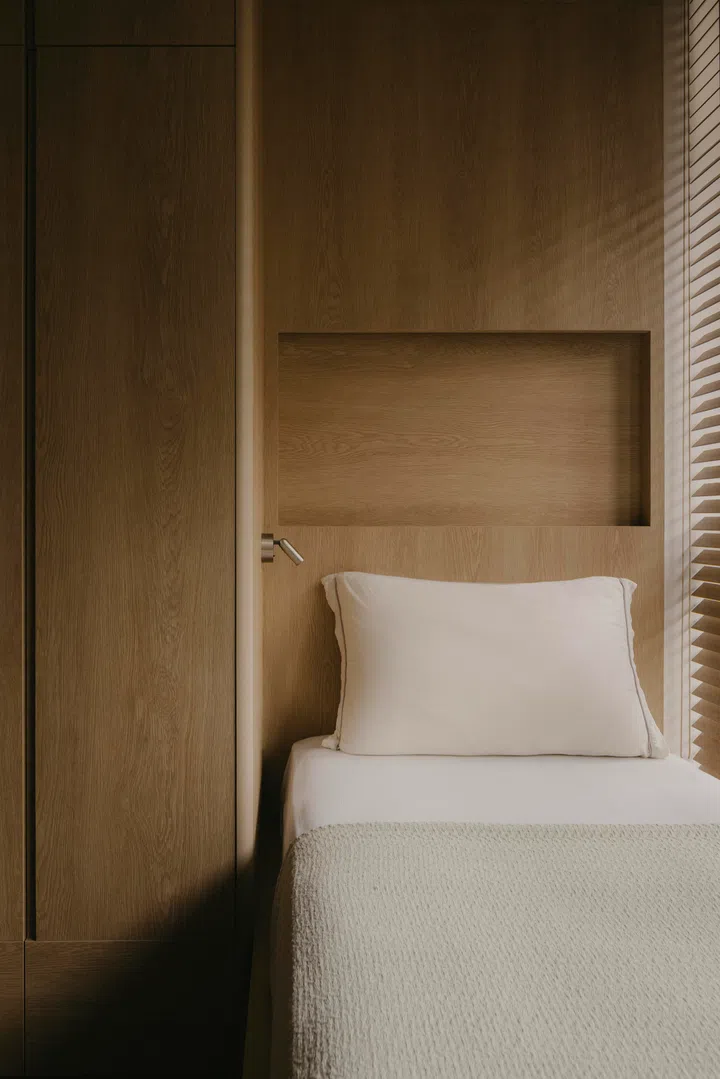
A built-in bed and concealed storage keep the guest room calm and functional, allowing it to shift easily between work and rest.
$85,000 Renovation cost
The renovation took approximately nine months from the start of design to completion. While the $85,000 budget covered core renovation works—including carpentry, marble finishes, bedrooms, electrical works, and a layered lighting scheme—the overall investment increased significantly once art and furniture were factored in.
Walter shares that the total spend comes closer to $150,000, reflecting the value placed on commissioned artworks and statement pieces collected for the home.
The two artworks at the entry alone cost around $15,000, while the custom Itakura tabletop was approximately $11,000. Furniture and objects also contributed to the final figure, with the imported European sculptural stone stools costing close to $1,000 each.
Taken together, the completed home reflects a deliberate allocation of resources—where a restrained architectural foundation is complemented by art, furniture and carefully chosen objects for depth, character and long-term value.
Can’t get enough of this home? We spoke with the homeowner to understand more about their design thinking and favourite home pieces here: