
Home Tour: $230,000 Monochrome Makeover of a Dual-Key 3-Bedroom Condo in Rajah Tower
Space Sense Studio transforms a spacious 1980s apartment into a dual-key home, defined by streamlined monochrome finishes, a striking kitchen island, and bold graphic lighting.
By Gwyneth Goh -
Share this article
Apartments from the 1980s often come with quirks that newer developments cannot replicate—generous floor areas, stepped levels, and layouts that carry a sense of character. For Kelvin Teo of Space Sense Studio, stepping into this Rajah Tower unit was unforgettable.
“I was mesmerised by the unique layout despite the old original condition,” he recalls. At over 2,100 square feet, the three-bedroom apartment offered the scope to be reconfigured, and with a $230,000 budget, the brief was to transform it into a dual-key home with income potential.
Beyond surface upgrades, Kelvin had to rethink the apartment from the ground up. The reconfiguration created space for a self-sufficient studio as well as a reorganised main unit, with new zones for cooking, working, and entertaining. Along the way, design flourishes such as bold lighting features and a streamlined monochrome palette turned functional changes into defining statements, setting the tone for the rest of the home.
Who Lived Here: A former client of Space Sense Studio who has since sold the home
Home: A dual-key 3-bedroom condo unit at Rajah Tower
Size: 2,100 sq ft
Renovation Cost: $230,000
Interior Designer: Kelvin Teo, Space Sense Studio
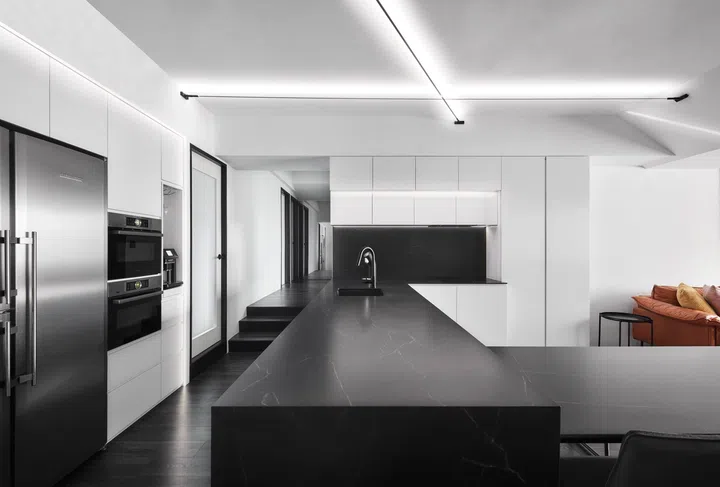
Sleek white cabinetry and dark counters streamline the reconfigured kitchen, while integrated appliances keep the design clean and functional.
The Kitchen Island
At the heart of the reconfigured layout is the dry kitchen. Kelvin instinctively centred it around an island—a feature he considers essential in his work. “The dry kitchen island is one feature that I hope to do in every house if possible. If you look at many of my designs, most come with a kitchen island,” he says.
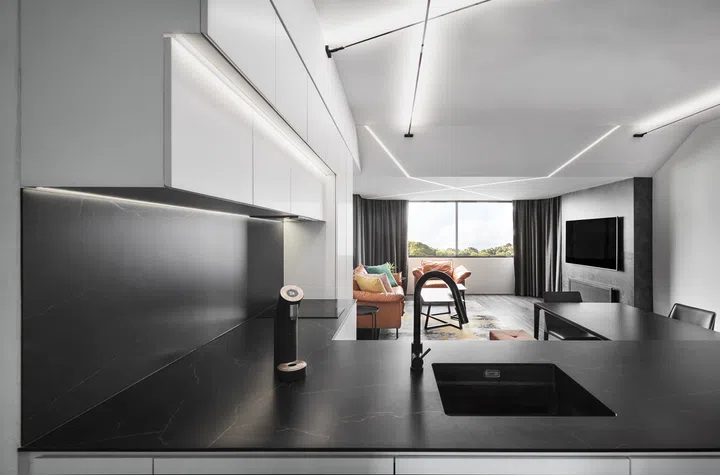
For Kelvin, the island is a design signature. “Most of my projects come with a kitchen island,” he notes—a detail that creates both a practical surface and a natural gathering spot.
Here, the island does more than provide extra counter space. Positioned to face the living and dining areas, it allows the cook to remain part of the action.
“The idea is to be able to overlook the entire space—dining and living—and communicate or host while preparing food for guests,” Kelvin explains. In this way, the kitchen becomes not only functional but also social, reinforcing its role as the home’s hub.
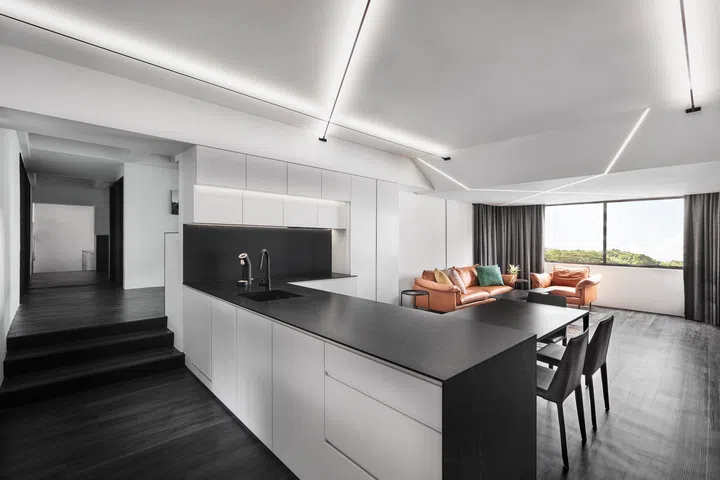
The dry kitchen island anchors the open-plan layout, linking cooking and dining with the adjoining living area.
Sleek cabinetry and dark counters frame the island, maintaining the monochrome palette while concealing practical details. Paired with a built-in bench and dining table, the composition creates a seamless flow between cooking, eating, and gathering, embodying Kelvin’s belief that the kitchen should be as much about connection as utility.
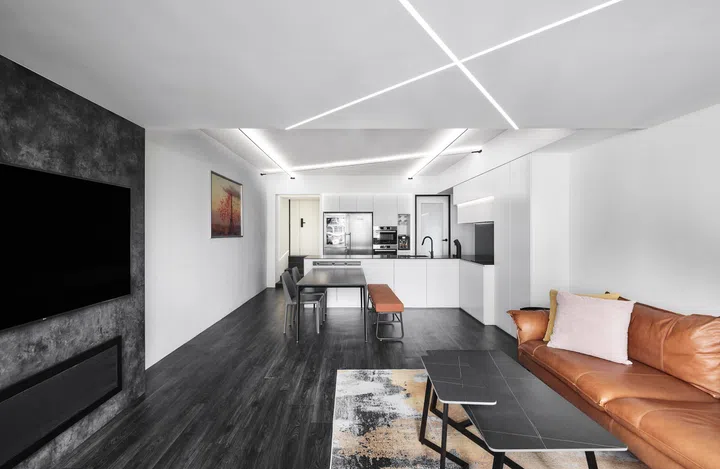
Graphic LED strips run across the ceiling, turning a practical lighting solution into a bold design statement.
Open-plan living and dining
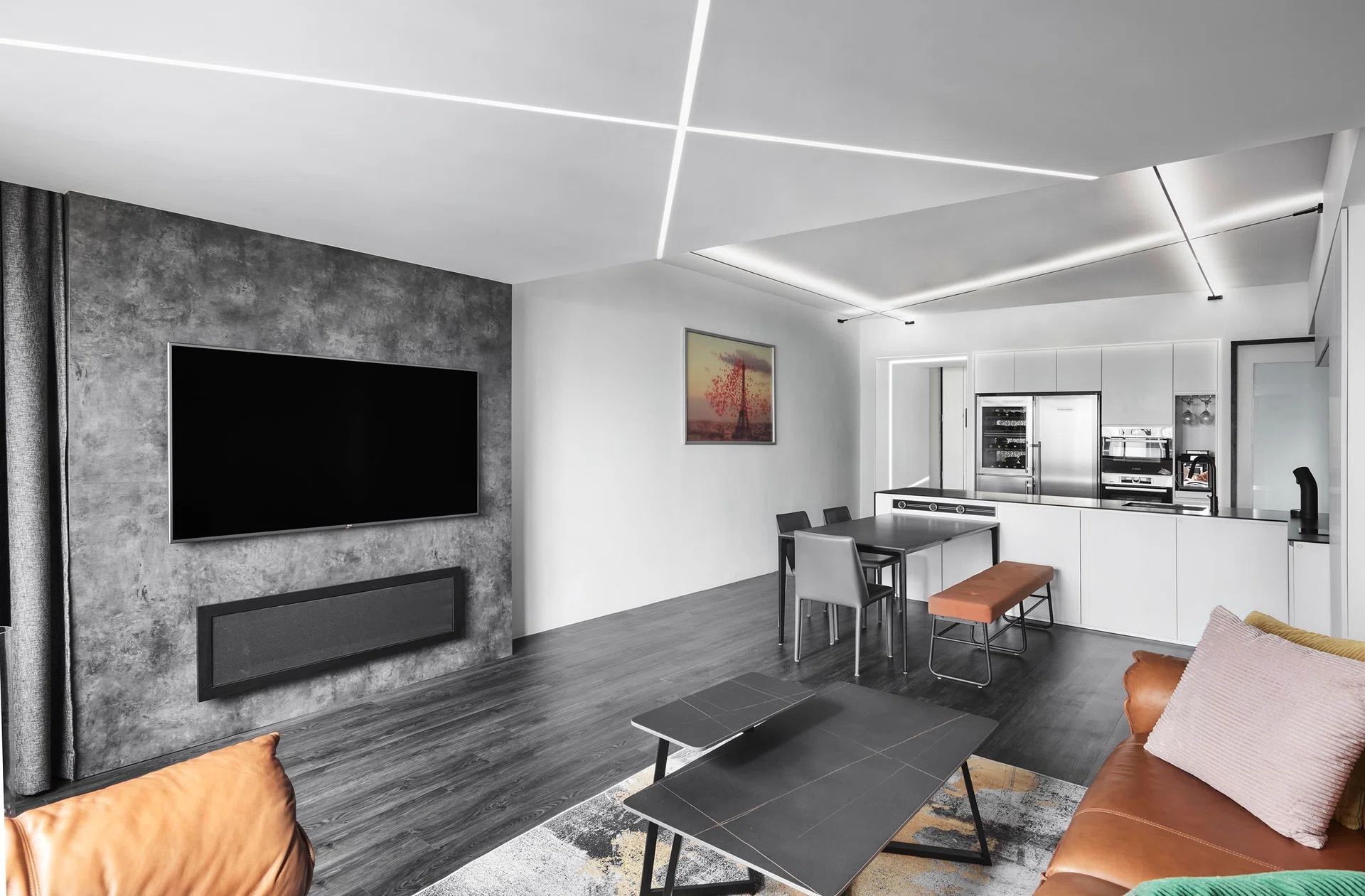
If the kitchen is the hub of the apartment, the ceiling above the open-plan living and dining space is where Kelvin allowed himself to experiment with light as an art form. “I really love how I designed the lights, especially in the living, dining and dry kitchen area,” he says.
With uneven ceiling heights to contend with, he treated the ceiling as a canvas, running LED strips in unconventional lines. “The cross LED light that you see from the lower ceiling was actually straight lines marked by a laser, but because of the slanted ceiling, the line kind of distorted,” he explains.
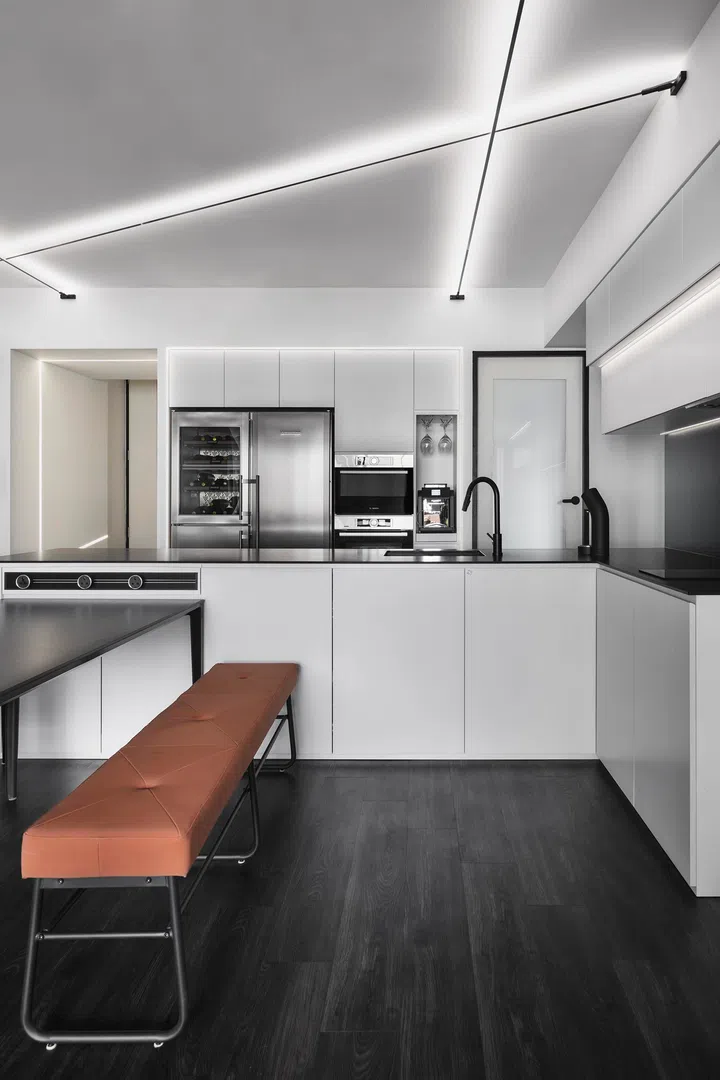
The monochrome palette is softened with tan leathers, balancing warmth against the graphic geometry overhead.
The result is a striking graphic element that unifies the open-plan space. The linear beams create a sense of movement across the ceiling, while balancing the monochrome scheme with a touch of drama.
“I feel lighting is an important feature in a space, and always like to explore new ways to enhance it visually, making them into an art form if possible, not compromising on the illumination,” says Kelvin. More than simply offering illumination, the lighting here becomes a talking point—proof that functional details can also carry an artistic weight.
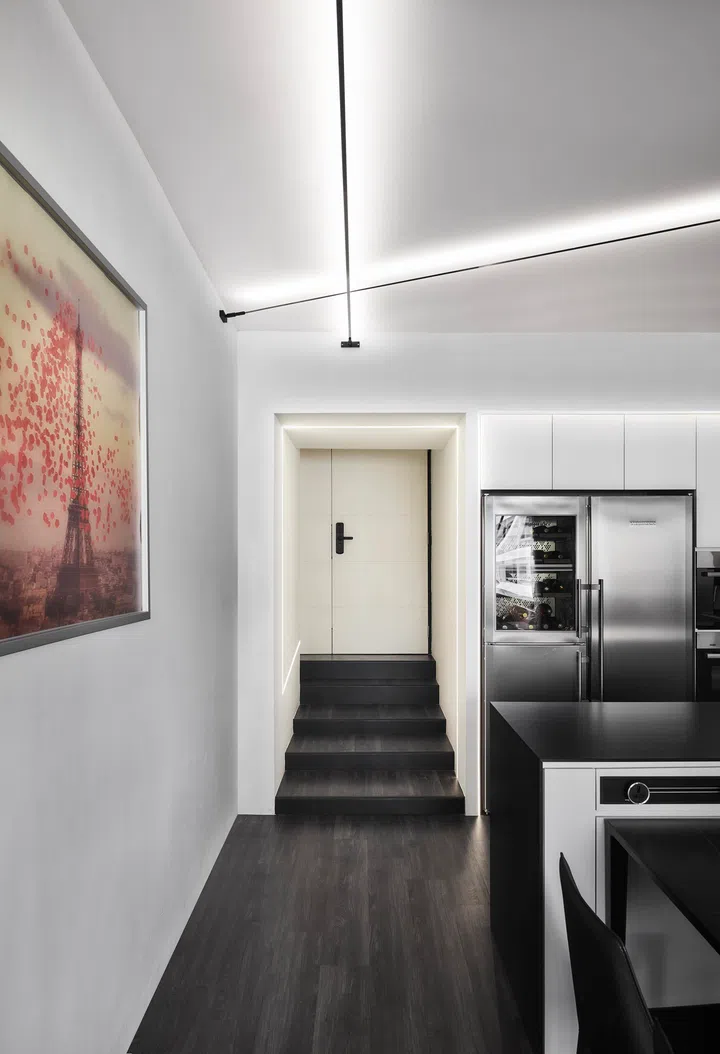
Split levels, a hallmark of 1980s apartments, are retained and refined with lighting to highlight their sculptural quality.
Stepped levels and extended corridor
One of the apartment’s quirks is the split-level flooring—a hallmark of older developments. Instead of erasing these differences, Kelvin embraced them as part of the home’s character. “I actually love the different level of the spaces; this reflects the uniqueness of old units,” he says.
By refining the stair proportions and framing them with light, he turned what might once have been an obstacle into a feature. The elongated corridor that follows acts as a visual spine, subtly separating communal areas from the private rooms beyond.
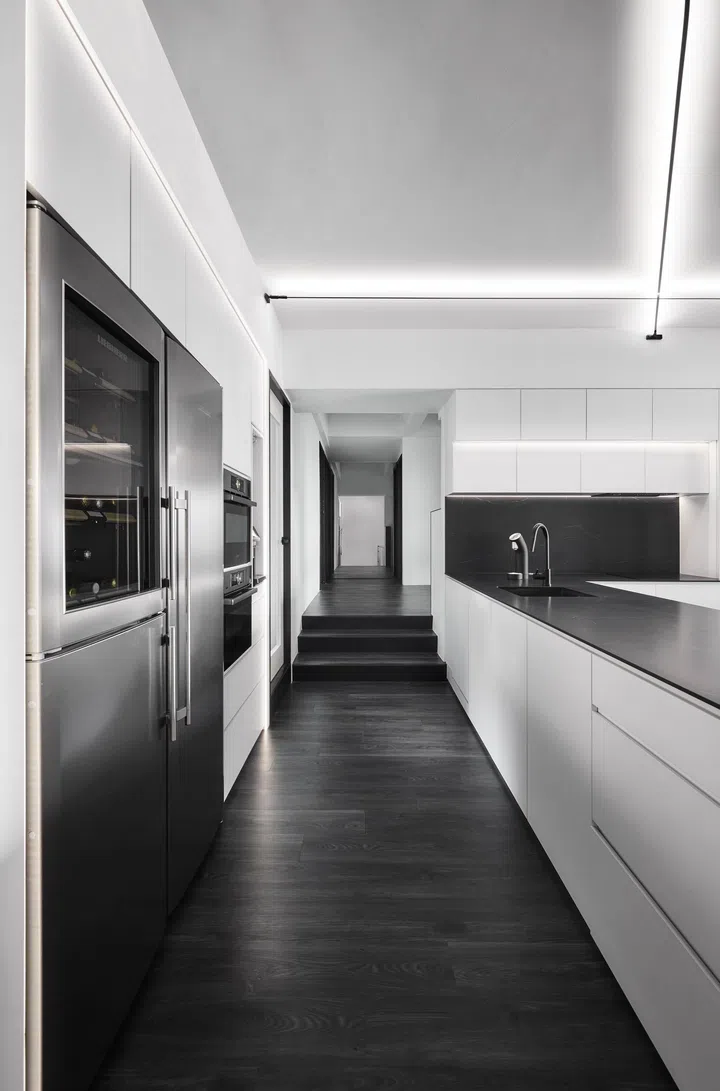
The extended corridor, lined with clean cabinetry and graphic lines, separates communal and private zones while reinforcing the home’s monochrome geometry.
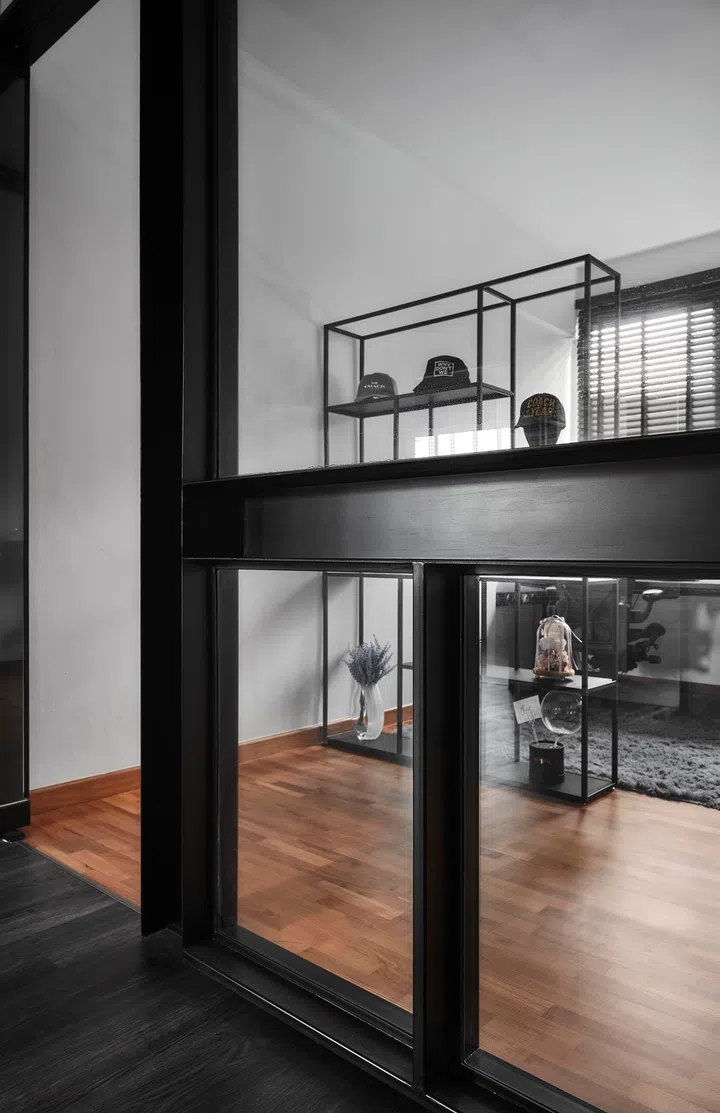
Glass walls define the study while allowing light to filter into the adjoining corridor.
Study Room
The study was carved out of one of the original bedrooms, with glass panels allowing natural light to filter into the adjacent passageway. This gesture not only brightens a transitional zone but also maintains a sense of openness while keeping the workspace defined. “The glass at the study room is to provide natural light to the passageway leading to the bedrooms,” explains Kelvin.
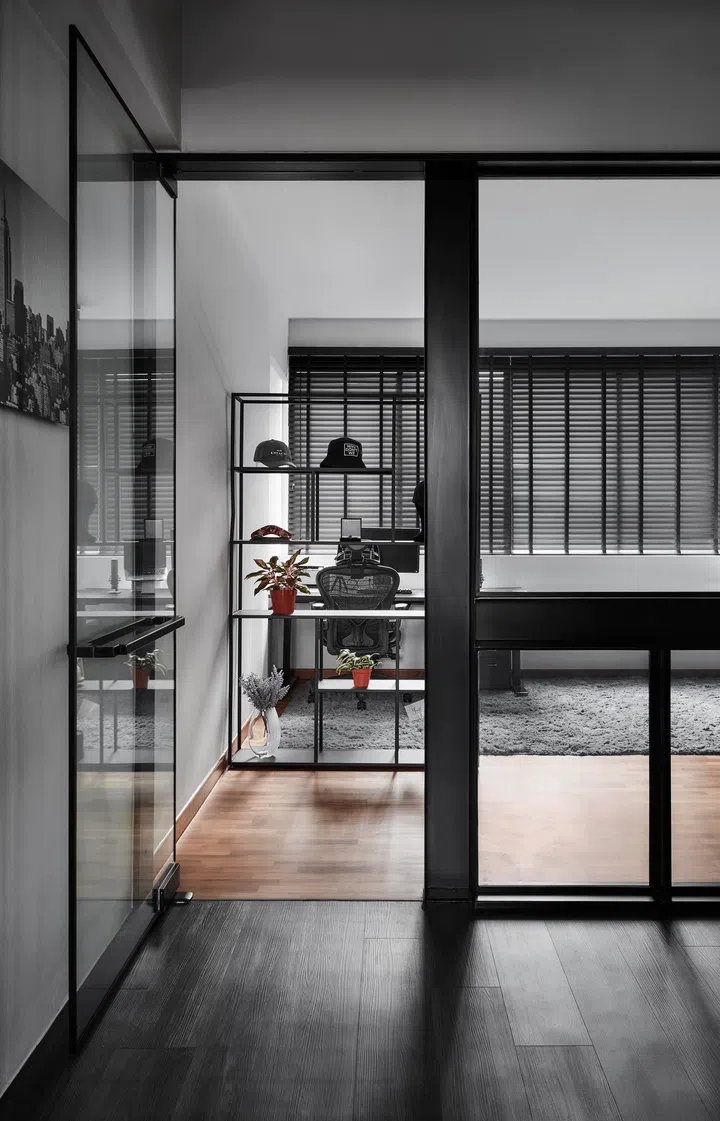
A steel-framed shelving unit creates a functional backdrop for video calls while lending the space visual depth.
Inside, the layout is pared back to essentials: a desk for work and a shelving divider that doubles as a backdrop. “What the owner needed was a desk and a nice background when conducting Zoom calls,” says Kelvin. The steel-framed shelves allow personal touches to be displayed without overwhelming the room, while the monochrome palette continues the apartment’s visual consistency.
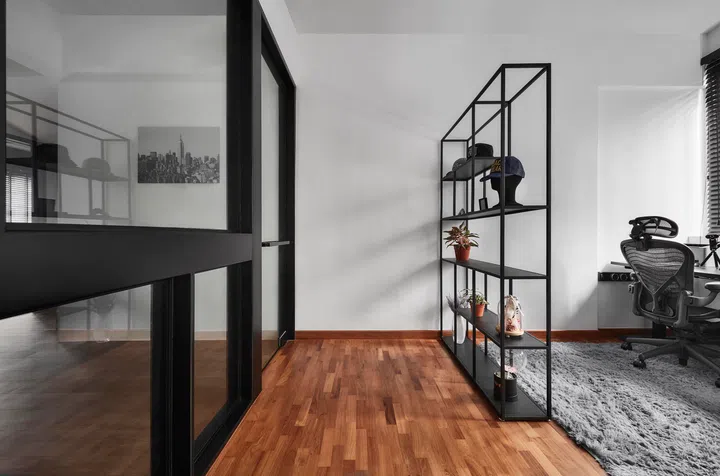
The study is pared down to essentials: a desk for work and a clean, structured background.
$230,000 Renovation Cost
The $230,000 renovation and was completed in three months. For Kelvin, Rajah Tower was as much about reorganisation as it was about expression. From transforming an outdated 1980s layout into a dual-key configuration, to experimenting with lighting as art, the project carries his hallmarks of monochrome clarity and creative detailing.
When asked about his biggest takeaway from this project, he reflects on “being consistent in my design work and building good relationships with my current and future clients,” adding that this ethos has sustained him for more than 20 years. Completing the home on time, without compromise, remains one of his proudest achievements.