
Home Tour: A contractor’s own $110,000 renovation for his 4-room HDB in Northshore Crescent
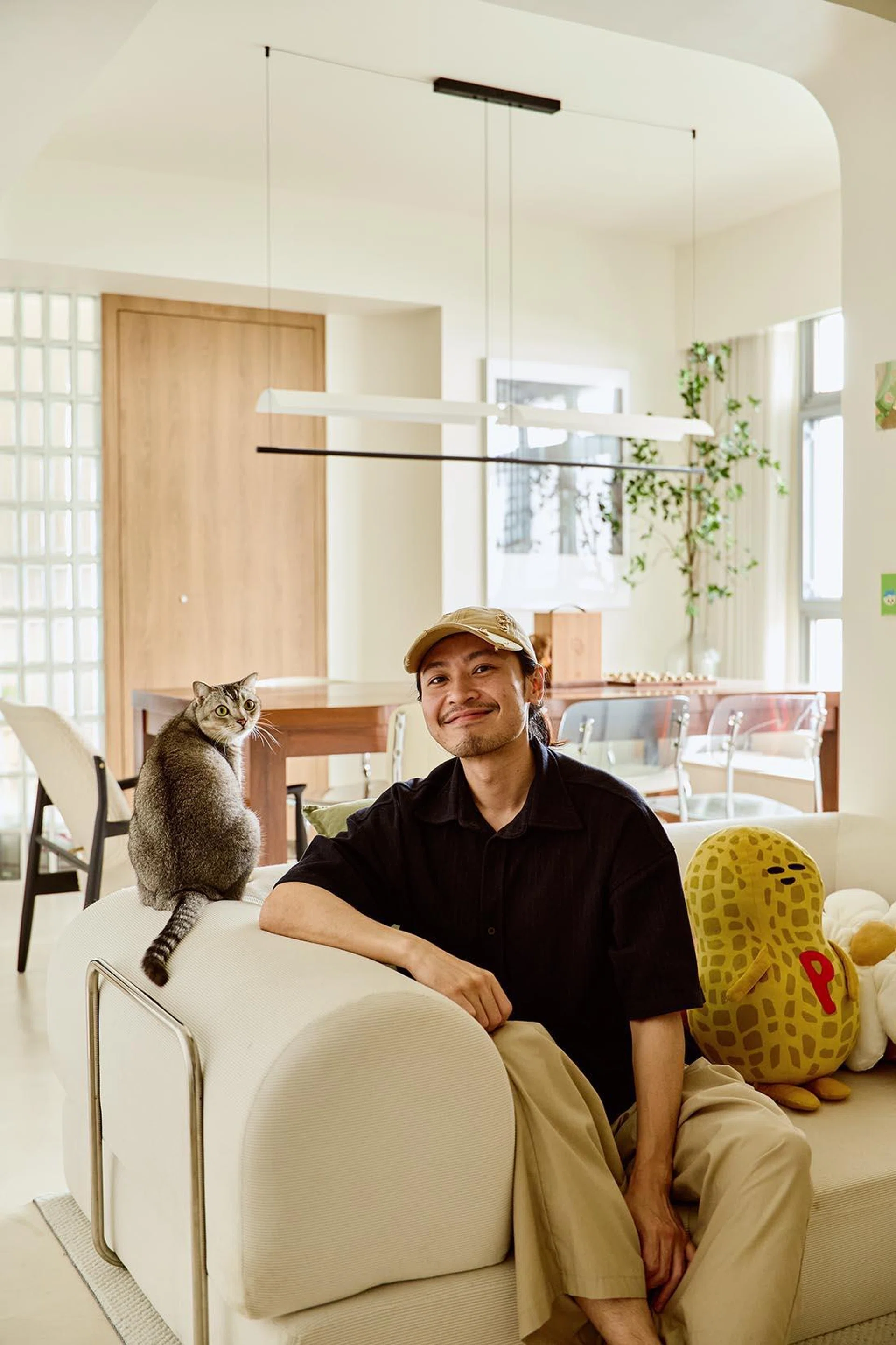
In this 1,000 sq ft sea-facing flat, 32-year-old contractor Kai Li redesigns his own home from scratch, reconfiguring the layout to prioritise airflow, function and materials that “resonate”.
By Gwyneth Goh -
Share this article
The front door opens directly into the kitchen, but the space does not reveal itself all at once. A band of warm wood frames the entry, creating what Kai, 32, a contractor and owner of Persqft, describes as “an intermediary space” for decompressing. Beyond it, sightlines begin to shift—a curved glass brick wall draws the eye toward the living area, while daylight filters in from the sea-facing end of the flat.
The transition from straight lines to softened edges is intentional, guiding movement before the full width of the space is felt. “From the main door toward the living room, a door creates cross ventilation,” Kai explains. “When designing for a space, you want to know what the natural advantages are to work with. It’s always using the site conditions to help us with our decisions.”
Those natural advantages were what convinced him to choose the unit in the first place. “We always wanted a sea view, have the nice breeze,” he says. “Singapore doesn’t really have a lot of these kinds of spaces and they’re so overpriced. We’re just lucky. It’s really the luck of the draw sometimes.”
When the shades are up, the living area enjoys what he calls a “full view of the sea… we look directly towards Malaysia.”
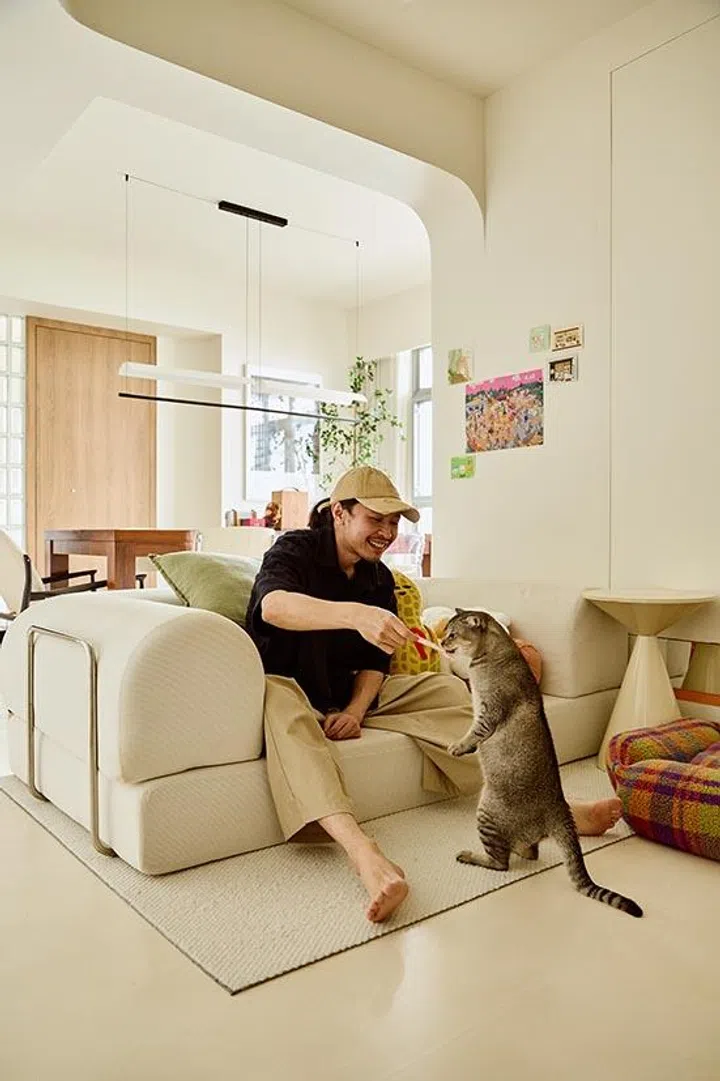
Kai relaxes in the open-plan living area with his cat Monmon.
Who Lives Here: Kai, 32, contractor and owner of Persqft, and his cat Monmon
Home: A 4-room HDB flat in Northshore Crescent
Size: Approximately 1,000 sq ft
Interior Designer: Homeowner (also known professionally as Jake Lee), Persqft
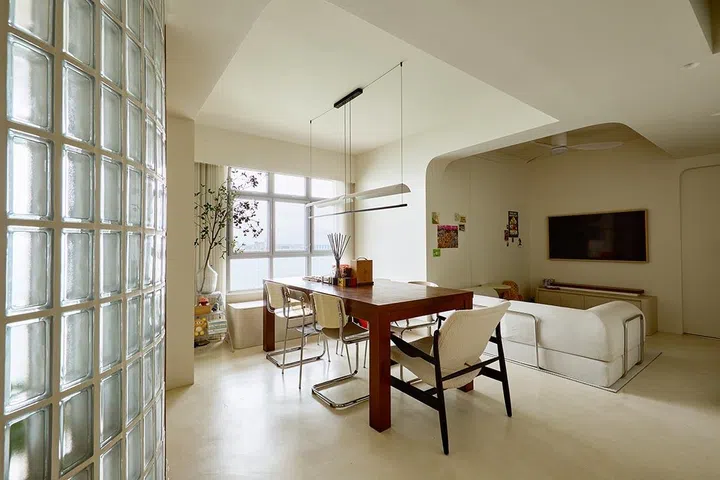
With all non-structural walls removed, the dining and living areas now read as one continuous space, opening up sightlines and letting daylight travel deeper into the home.
Resetting the layout: putting function before aesthetics
The sea view and cross-ventilation were immediate draws, but the original layout required significant reworking. “One of the most annoying things was the bomb shelter being in the middle of the house,” Kai recalls. “It created a lot of problems when trying to play with layout.”
Instead of sitting discreetly at a corner, the shelter interrupted the centre of the plan, limiting how rooms could connect. For someone approaching the renovation spatially rather than cosmetically, that constraint dictated everything. “We hacked out every available structural wall there is and reconfigured the layout from that point. There’s no original wall left except for the structural ones, of course.”
The three-month renovation became less about finishes and more about clearing the plan so the flat could breathe. “The $110k really went into that portion.” Function anchored every decision that followed. “I started with function first. When function is the lynch pin, that’s a non-negotiable already.”
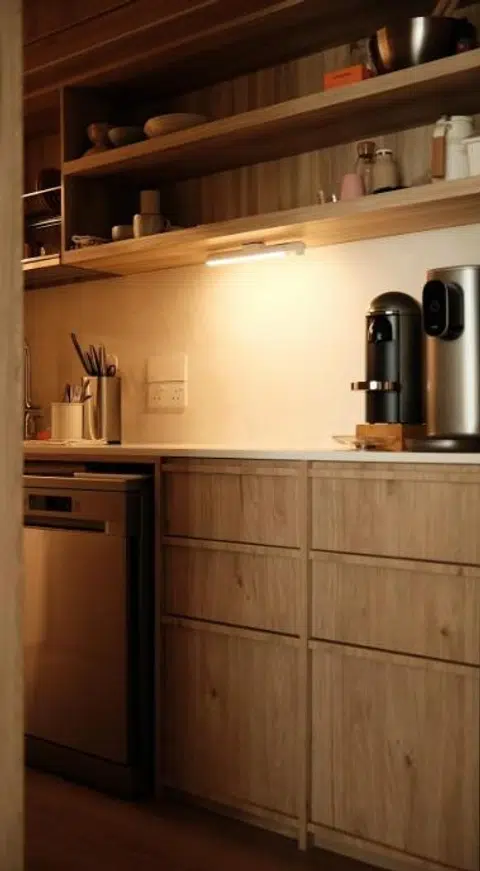
Compact and pared back, the kitchen was intentionally kept small and efficient, conceding floor area and daylight to circulation and the main living spaces.
Compressing the Kitchen, Expanding the Home
That clarity begins at the kitchen. “I only cook steak or pasta, so I decided to have a really small kitchen—a functional one, but really small. I want the house to be more about the other living spaces, not just the kitchen.” Instead of defaulting to the typical open-concept show kitchen, Kai deliberately reduced it to let circulation, light and the living area take priority.
The front door opens into a compact foyer, but if the sliding panel to the living area is shut, all you’d see straight ahead is a narrow galley kitchen, with timber cabinetry lining both sides and just enough clearance to move comfortably through. It is compact by design, with open shelving and under-cabinet lighting keeping it practical without drawing attention. The footprint is tight but considered—just enough for daily use—allowing the rest of the flat to feel more open and generous.
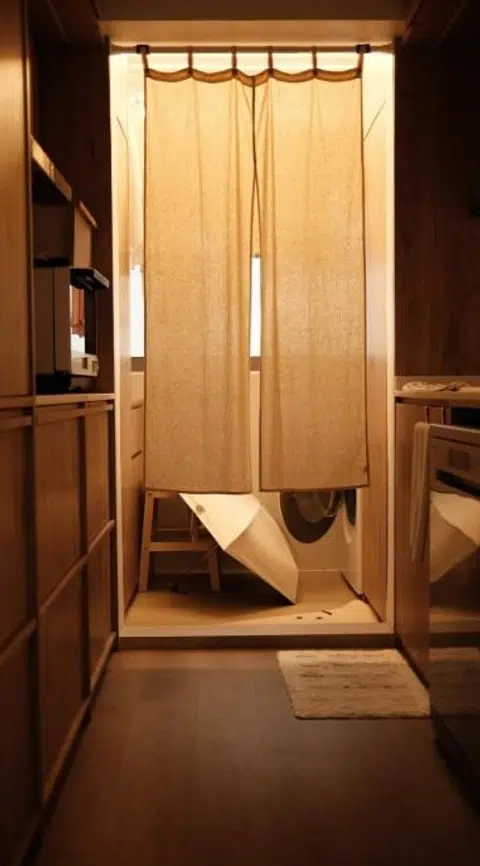
The yard sits at the far end of the kitchen corridor, separated by soft curtains and kept on the “outside of the house” to contain service functions.
The Yard
At the far end of this corridor sits the yard, slightly recessed and separated by soft entry curtains instead of a solid door. The fabric filters light while maintaining airflow, visually softening what is essentially the most utilitarian zone of the home.
Kai intentionally positioned the laundry area on the “outside of the house,” keeping service functions tucked away at the least prominent end of the flat.
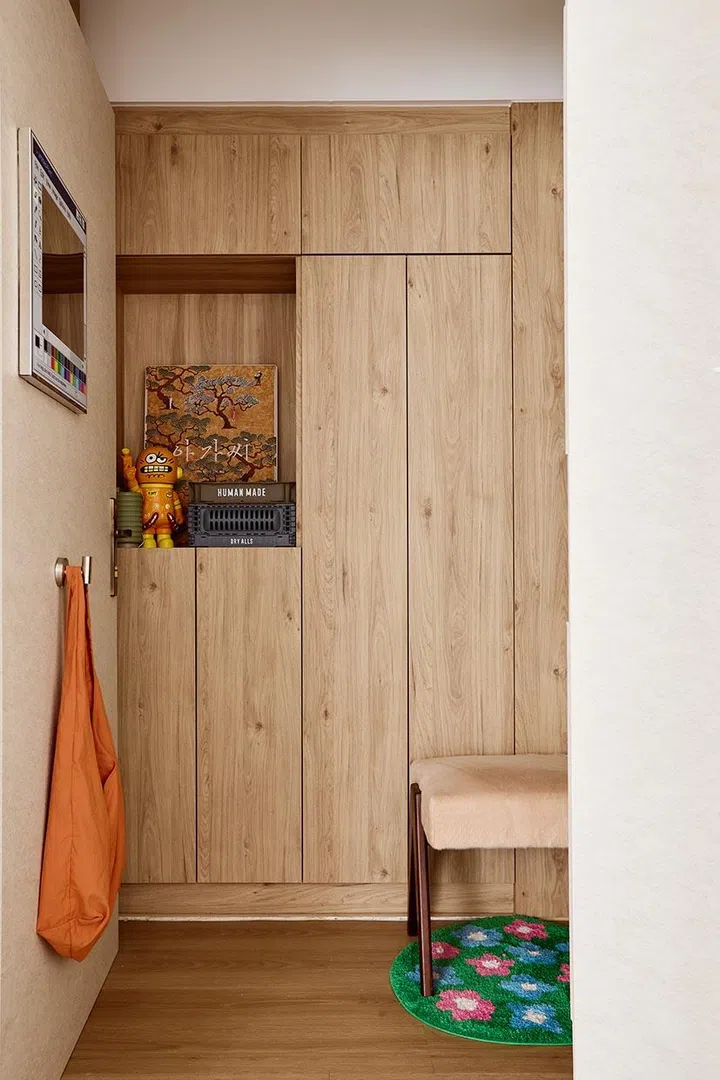
Full-height storage lines the foyer, keeping shoes and bags tucked away while maintaining the warm wood tone that defines this decompression space at the entrance.
The decompression chamber
At the front door, what greets you upon arrival is the compact foyer wrapped in wood tones—a deliberate buffer. Here, full-height cabinetry absorbs everyday clutter, a shallow ledge showcases quirky pieces, and a bench invites you to comfortably remove your shoes. “When you enter the home, there’s an intermediary space for you to decompress first,” says Kai. “I chose wood tone.”
The effect is deliberate: warmer, slightly enclosed, and visually distinct from the rest of the home. A fluted glass sliding panel keeps the main space concealed, so all you see is this quiet entry zone. If the laundry sits on the “outside of the house”, as Kai describes, then this foyer reinforces the idea of transition: from public corridor to private interior, from outside to in.
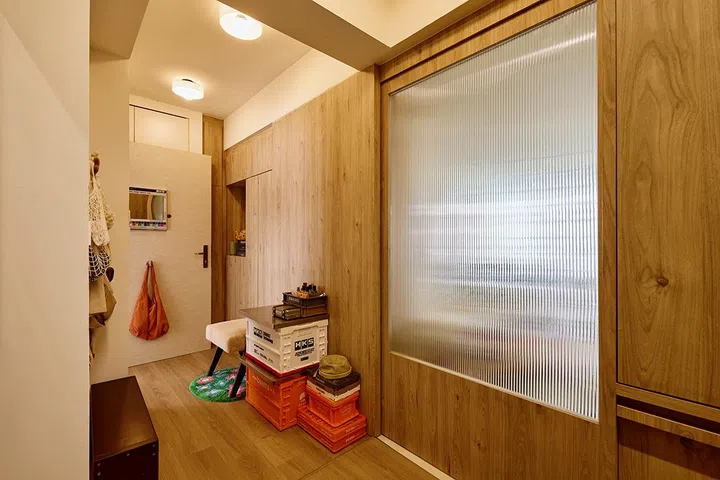
With the sliding door shut, the foyer reads as a self-contained buffer zone—warm, compact and visually distinct from the main living areas.
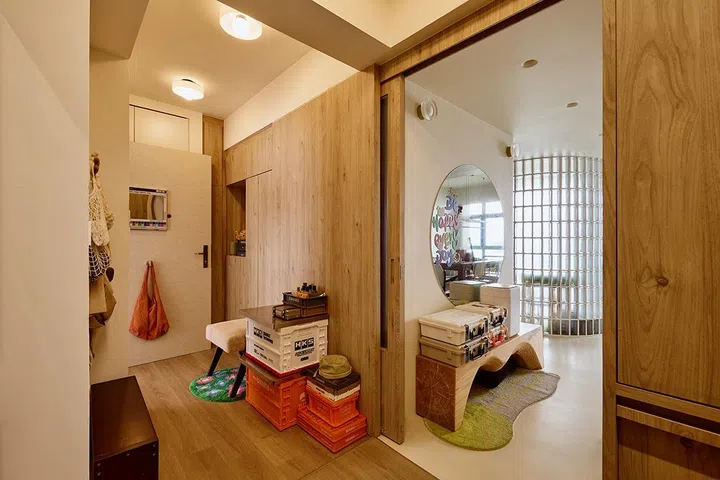
Opening the door reveals the sunlit living space beyond, where glass blocks and sea-facing windows contrast with the foyer’s enclosed calm.
Slide the door open, and the mood instantly shifts. Light spills in from the sea-facing windows beyond, the glass blocks come into view, and the living space expands visually in contrast to the compressed entry. The choreography is subtle but intentional—a sequence of compression and release, rather than an immediate reveal.
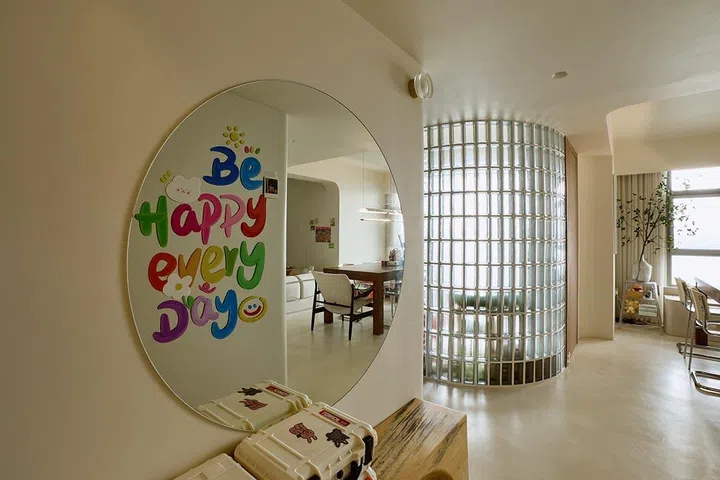
“The main feature of the space is the glass dome…” says Kai—a curved glass block volume that extends the balcony while preserving light.
The Glass Dome: Extending the Balcony, Legally
“The main feature of the space is the glass dome…” Kai says, referring to the curved glass block structure that anchors the living space. Positioned where the balcony once felt peripheral, it reframes the edge of the flat without removing the original sliding doors. “Just a ‘legal way’ to build a bigger balcony without affecting structural regulations.”
Rather than hacking away the façade, he worked within it. “We also wanted to create a private enclosure of sorts. The next best thing is to find a way without blocking out the light.”
The glass blocks allow daylight to travel deep into the home while maintaining enclosure, creating a semi-outdoor zone that feels protected but still open to the sea-facing horizon beyond.
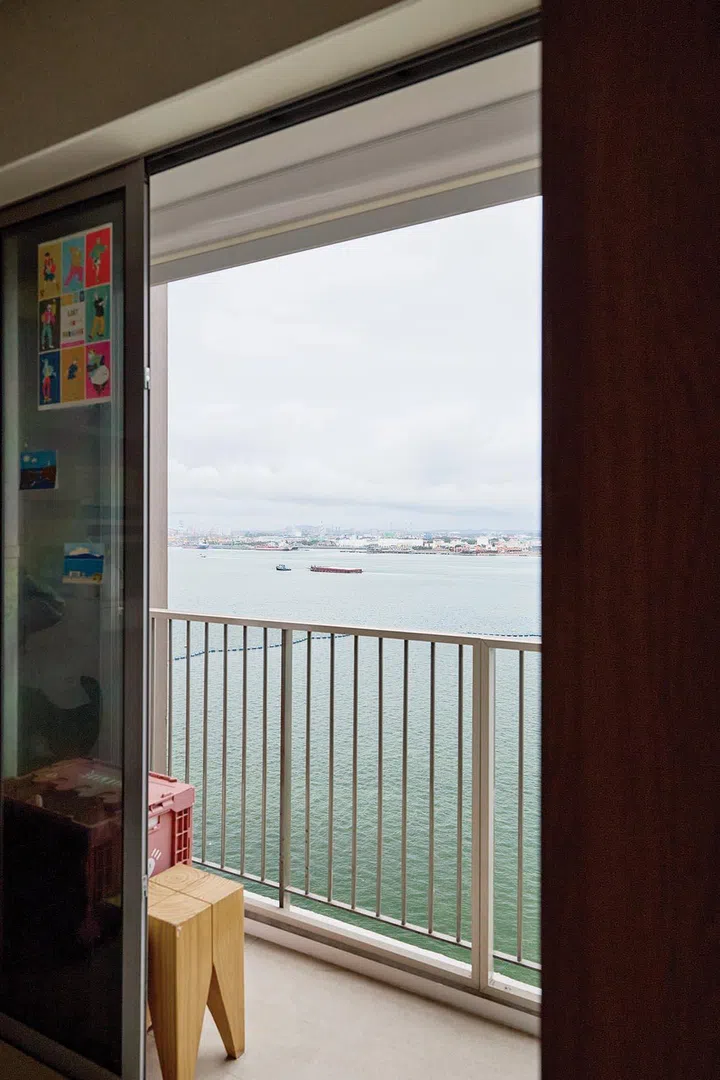
“When the shades are up, full view of the sea… we look directly towards Malaysia.”
The view here becomes the focal point. “When the shades are up, full view of the sea… we look directly towards Malaysia.”
From this vantage point, the high-floor outlook stretches uninterrupted across the water, turning what could have been a standard balcony into an everyday retreat, where Kai starts his day replying to emails, taking work calls, and enjoying his morning coffee.
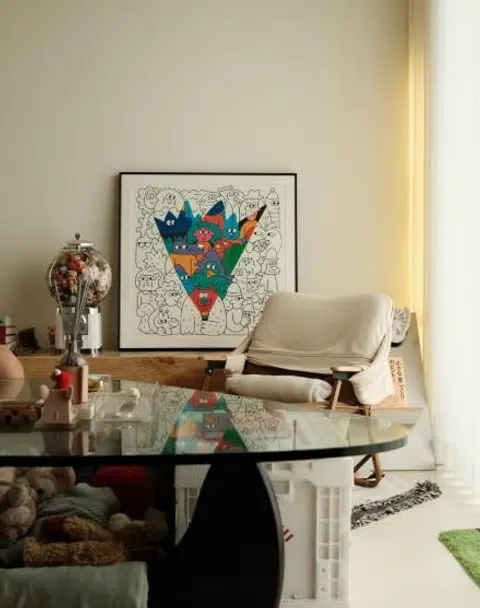
“It’s really the perfect spot in the house,” Kai says of his favourite space.
“Everyday the glass dome…” he smiles, “It’s really the perfect spot in the house.” The effect is architectural without being showy—a curved volume that softens the plan while preserving airflow, light and compliance. It is both a technical solution and an emotional one.
“The glass block wall, specifically the wavy part of the glass block, reminded me of my childhood, going to Bedok swimming pool with my dad,” Kai says. “The general flat wall is normal. The curving part is the tough one. That really showcases the craft involved.”
For him, the decision was not only about aesthetics. “Personally it resonates with me… I think design should be done that way. It helps you link to better emotions, an emotional place.” The curve is deliberate—not the standard straight glass block wall, but something that requires more precision and craft.
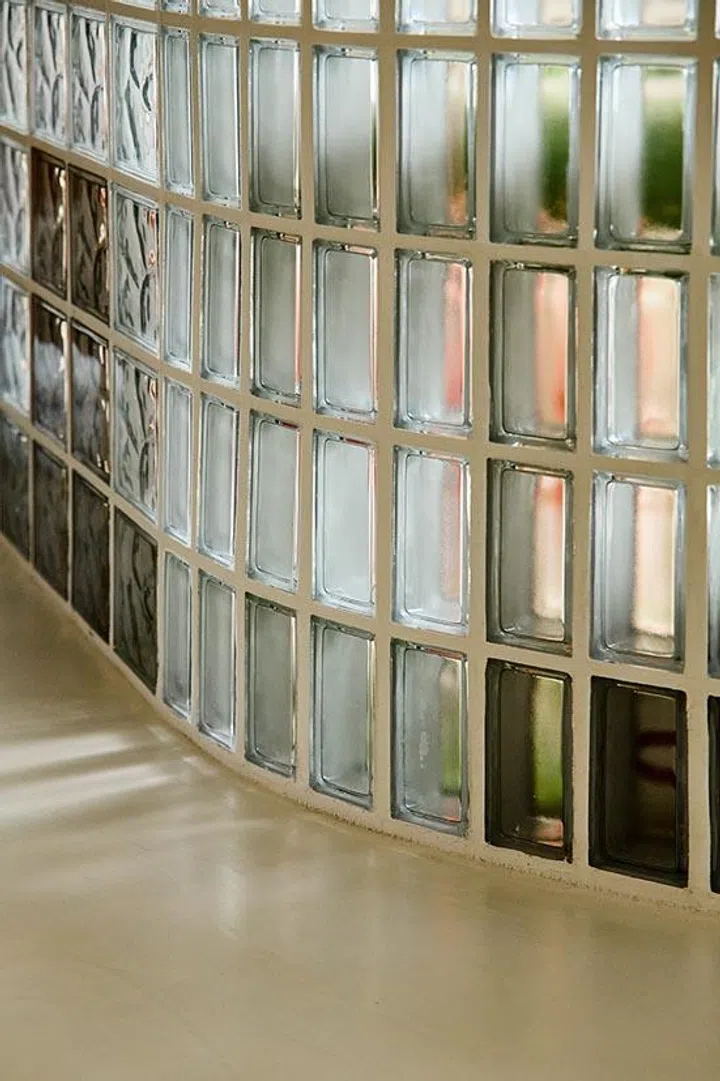
This curved glass block wall departs from the typical straight installation, showcasing the craft involved while echoing Kai’s childhood memories of swimming pool glass block walls built by his father.
Kai’s father was a masonry contractor for over 30 years, a wet works specialist. “My dad used to build this all the time… so a lot of these were built by him.” Originally from Ipoh, he came to Singapore “to find the Singapore dream.” Even earlier, Kai’s grandparents were also in the masonry trade in Ipoh. The material, in that sense, is generational.
“I always tell people the same thing all the time. Please choose materials that resonate with you.” For Kai, the glass blocks are tied to swimming pools, good memories, and watching his father work. What began as a “legal way” to extend the balcony became something more layered—a curved wall that carries craft, family history and a sense of continuity into his own home.
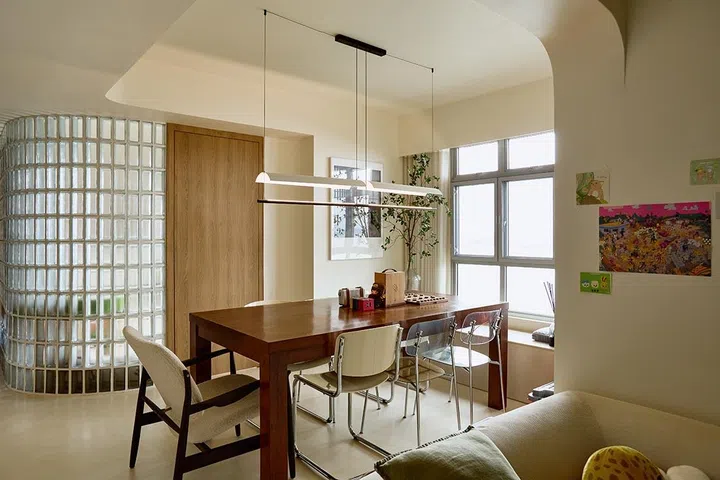
The dining area sits flanked by the curved glass dome and sea-facing windows, where soft corners and clear sightlines allow light to travel across the open plan.
Dining with a view
The curve of the glass dome gently releases into the dining area, where the plan opens up toward sea-facing windows.
Here, the architecture softens—rounded corners replace sharp junctions, and daylight washes across pale floors and warm timber. The dining table sits squarely between the dome and the view, acting as a quiet centre point rather than a formal showpiece.
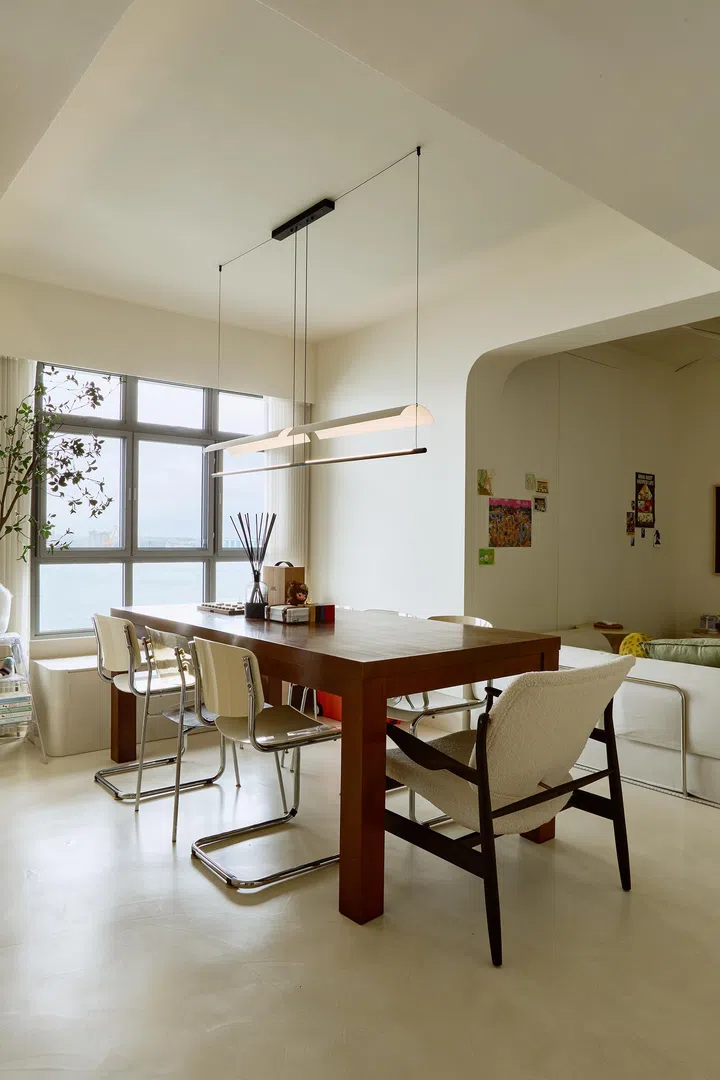
Positioned to face the horizon, the dining table captures uninterrupted sea views when the shades are raised, turning daily routines into a quiet ritual.
The openness was intentional. “When you come into the house, it’s really just wood to tell you you’re in a safe, warm space. Then you come in and it’s really just white, a comforting transition,” Kai says.
From the dining table, the horizon becomes part of everyday life—not framed theatrically but simply there, accompanying meals, conversations and work sessions. The curved wall remains visible at the periphery, anchoring the space without overwhelming it.
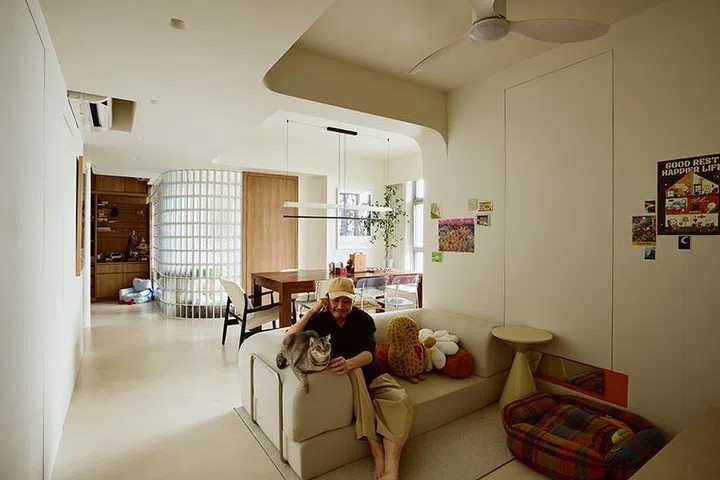
With the sliding door shut, the foyer reads as a self-contained buffer zone—warm, compact and visually distinct from the main living areas.
Living room: The 3 Fs in practice
From the dining area, the living room unfolds with a subtle shift in volume. The ceiling dips slightly before lifting again, a move that is entirely deliberate. “These curves keep you here,” Kai explains. He intentionally lowered parts of the false ceiling so that “you feel a release when the ceiling is lifted.”
It is a spatial compression and release he admires in the work of Tadao Ando—“he squeezes you in tiny places” before opening up into something larger. “I really love this kind of approach to building spaces. Space can be more than just beautiful furniture. Function, feeling, form—the 3 Fs.”
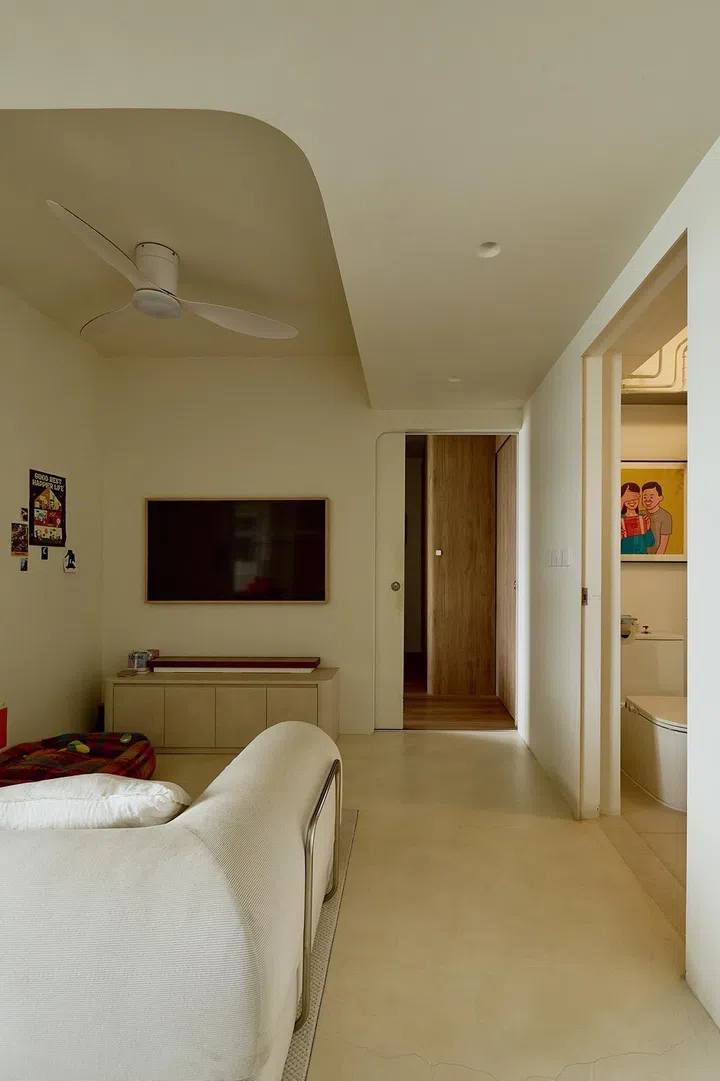
The curved ceiling echoes the glass dome, dipping to gently compress the space before lifting again in quiet release.
Within that framework, the furnishings remain pared back. Even the television was selected to support the architecture rather than distract from it. “The Samsung Frame TV is a banger,” he says. “Because we needed a TV that doesn’t look like a TV—easy product to choose.”
Mounted cleanly against the wall, it reads more like a framed piece than a screen, allowing the room’s proportions and light to take precedence.
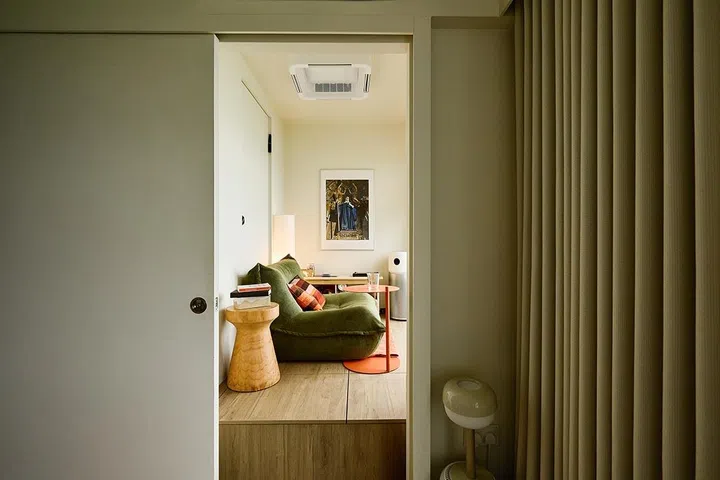
Raised on a timber platform, the compact room off the master bedroom is set apart as a quiet, elevated nook.
A room within the room
Connected to the master bedroom is a compact adjoining room, raised slightly on a timber platform. The change in level quietly marks it out as a retreat within a retreat—small in footprint, but clearly set apart.
Framed by the doorway, it feels deliberate and contained, with clean lines and full-height windows pulling the sea view close.
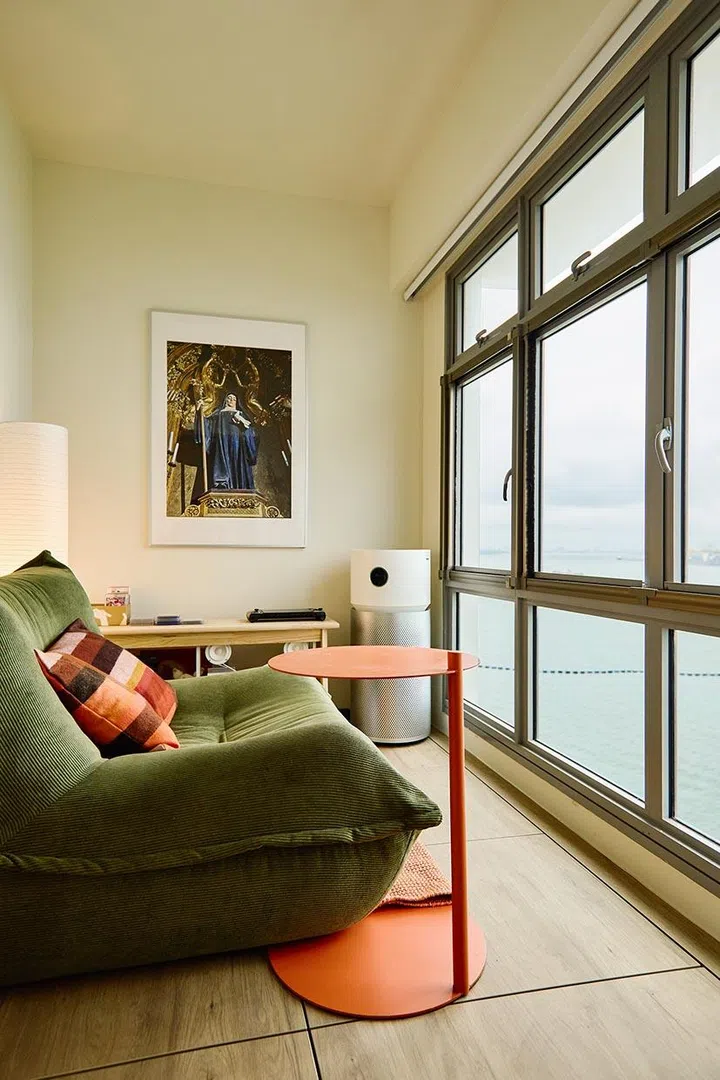
Chosen for its relaxed form and adaptable fabric, the green lounge chair overlooks the sea.
The deep green lounge chair gives the room its identity. Kai had considered a Togo, but felt it would make the space “look very modern… like any other room.”
Instead, he chose a similar low-slung piece for how it sits and feels, upholstering it in a fabric that can shift in tone. Set against the windows, it turns the platform into a comfortable perch for reading or watching the horizon.
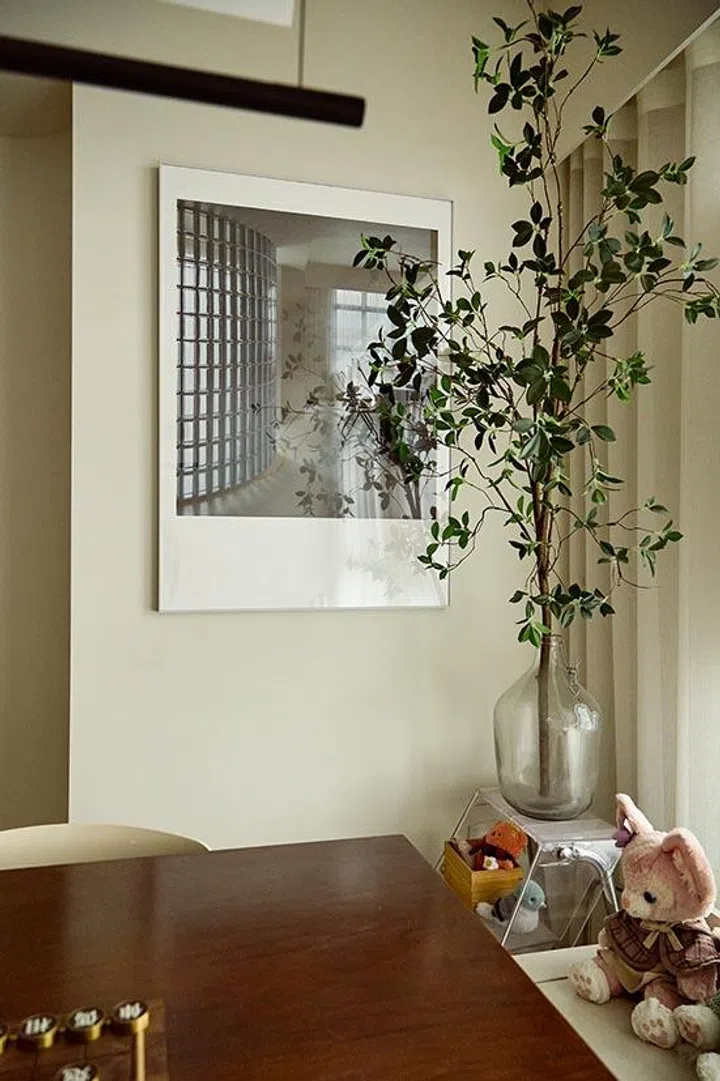
A framed photograph of the curved glass brick wall echoes the architectural feature that carries both craft and childhood memory for Kai.
$110,000 Renovation Cost
A framed photograph of the curved glass brick wall hangs by the dining area, its arc and texture quietly echoing the feature that defines the home. Even here, in a small corner, the gesture returns, not as a showpiece but as part of the everyday backdrop.
The renovation came in at about $110,000, including furniture. “My approach is Taobao, everything in,” Kai says, explaining that sourcing affordably allowed him to design the space holistically from the start. “The price is not very prohibitive so you can change.” For him, that balance between intention and flexibility is key.
“I chose this spot because I really enjoy the natural advantages of this place. I will be here as long as possible until circumstances change.” Between memory, material and view, the home feels less like a finished statement and more like a place designed to be lived in.
Can’t get enough of this home? We spoke with the homeowner to understand more about their design thinking and favourite home pieces here: