
Home Tour: $120,000 Warm minimalist renovation for an interior designer & financial advisor couple’s 4-room HDB in Northshore Drive
An interior designer and his partner completely overhaul their Northshore Drive HDB to create an open, curved, and carefully lit home shaped around hosting and everyday routines.
By Gwyneth Goh -

Share this article
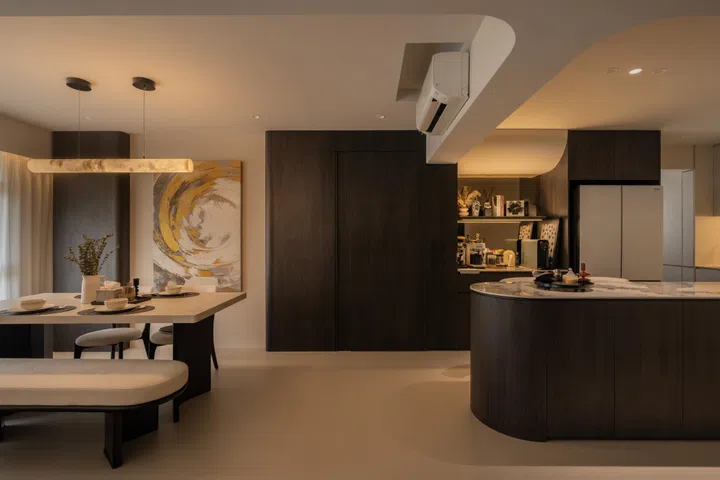
When interior designer Jeremy Lim and his partner April Cheok first stepped into their 4-room Sale of Balance HDB flat at Northshore Drive, they already knew the existing layout would not remain. “When we took a first look at the unit, we had the mind to hack one of the bedrooms to be the dining area,” they share. “We both agree that we like to host and we like open space.”
What followed was a complete overhaul of the 93 sqm flat. “We decided not to keep any HDB finishes,” they explain. “So, we overhauled the whole unit—removed the floor finishes, removed the kitchen-to-yard divide, removed the bedroom doors, bathroom doors, the whole frame. Everything was rebuilt up from scratch.”
The decision to start anew was shaped by how they wanted to live. “We wanted to keep a more open space, because there are just two of us,” they say. “We wanted it to be cosy, warm enough to host our friends and family. That’s why the living, dining and kitchen are all combined into one.”
Who Lives Here: Jeremy Lim, 35, an interior designer, and April Cheok, 38, a financial advisor
Home: A 4-room SBF HDB flat at Northshore Drive
Size: 93 sqm
Interior Designer: Jeremy Lim, Inizio Atelier
Built around openness
The open-plan layout reflects how the couple use their home daily. Jeremy, whose workdays are often hectic, sees the living room as his main retreat. “I enjoy watching shows and movies in my living room,” he says. “That’s my comfort zone.”
That focus shaped how the shared spaces were oriented. “The key idea is when we are sitting at the island, or in the living room, or dining area, we can watch TV,” April explains. “It all faces the TV. We could be just chatting and watching the TV.” Smart lighting reinforces this setup. “We have a movie setting—warm LED lights that will set the tone when we’re watching a movie sitting at the living area sofa.”
April, who works from home more often, describes a rhythm of activity followed by rest. “Usually I like to go out, then the next day I’ll be at home recharging,” she says. “We like to spend our quality time at home just watching shows, having meals together… cheese and crackers, a glass of gin.”
The home was planned with these routines in mind, prioritising shared spaces over additional rooms. “Basically we do not have any spare rooms,” April notes. “My mum came and said this is an entertainment house.”
Designing from scratch
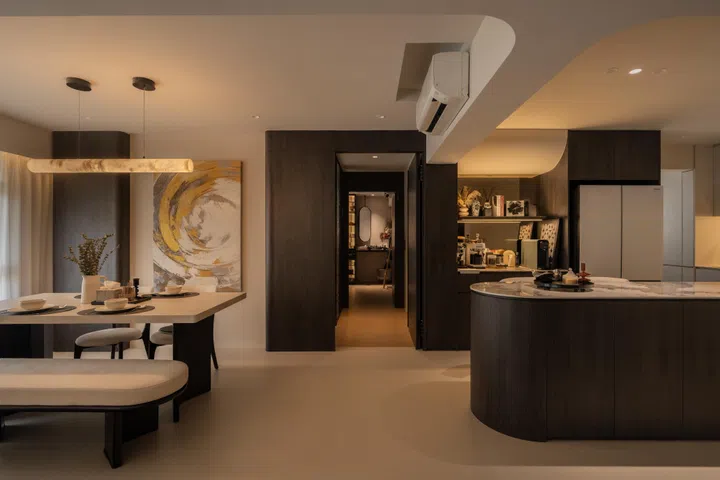
With the entire flat hacked, decisions had to be made deliberately. For Jeremy, designing his own home proved a little more challenging than working on client projects. “When I meet a client, the brief is pretty straightforward,” he explains. “With my own place, the main challenge is: what can I not do in my house?”
Having fewer constraints, however, created the luxury of time. “Because there’s no hard restriction or very tight budget” he says, “you tend to take things slow and easy to make sure it’s the right decision.”

From the outset, the couple were clear that they did not want the home to resemble a typical HDB. “We didn’t want it to look like HDB,” April explains. “We wanted it to have a bit more of a hotel concept.” Jeremy echoes this sentiment, noting that the completed space feels closer to “a two-bedroom serviced apartment.”
That distinction became especially apparent after they moved in. “When we first shifted in, after a few days, we woke up and felt it looked like a serviced apartment,” Jeremy recalls. For April, the experience marked a clear departure from their previous living arrangements. “It feels very different from staying with our parents,” she adds. “It breaks off the traditional concept of a traditional or typical home,” Jeremy agrees. “When you come into the house, it changes the vibe—it feels very conducive, cohesive, and cosy.”

Curves and calm
Curved elements appear throughout the home, softening the rebuilt layout. April observes that curves play a significant role in how the space feels. “Everything is already so square,” she says. “The curves really soften the vibe.”
Jeremy sees curvature as more than a passing trend. “It started off as a trend, but I see curvature as an important part of the house,” he explains. “Having curvature brings a soothing and calm feeling to the overall space. It mutes a lot of hard angles.”

In the living room, which is Jeremy’s favourite part of the house, a curved corner was introduced at the TV feature wall. “The whole TV feature wall is made out of partition,” Jeremy says. “At one of the corners, I decided to do a curvature.”
An initial mistake led to an unexpected solution. “They brought in the wrong mould—it was smaller and didn’t achieve the curve effect I wanted,” he recalls. “When I saw the wrong mould lying in the living room, I thought about where else I could use it.” The mould was eventually repurposed above the dry pantry, where it became a curved soffit concealing exposed aircon and water piping. “It fit perfectly.”

Daily rituals
The niche now functions as part of April’s morning routine. “The coffee counter is because I make my own coffee,” she explains. “I use the grinder.” Designed to sit openly within the kitchen, the pantry keeps everyday rituals visible and integrated into the living space. “I picked up reading,” she adds, “so I like the habit of drinking coffee and reading on my eReader.”

Openness and illumination
Lighting was also carefully planned. “Typically, people would like the living room to be very bright,” Jeremy says. “For me, I like to strategise the lighting position in a way that you turn it on when you need it.” He relied on LED lighting for ambience, noting that it “plays a very big part in the cosiness of the living room.”
That approach extends into the kitchen, where lighting works in tandem with layout. “I wanted an island,” April says. “I like the open concept, because I think a 4-room flat is not that big.” Positioned at the centre of the space, the curved island anchors daily routines while keeping sightlines open to the living and dining areas, reinforcing a strong sense of continuity across the home.

Thoughtful sourcing
Much of the loose furniture and décor was sourced online. “Most of the loose items are from Taobao,” April shares. “I spent a lot of time searching and reading reviews. We didn’t go for the cheapest—we went for the mid-tier price.”
Jeremy admits he was initially sceptical. “I thought it would be cheap quality,” he says. “But when it arrived and I touched it, it was actually not bad.”

Taobao Dining Table Set
At the dining area, every loose piece was sourced from Taobao. The dining table, chairs, and bench were purchased separately from three Taobao stores, allowing April to customise the details so that they looked harmonious. “I bought the table from one shop, the chairs from another, and the bench from a different shop,” she explains.
For larger investment pieces, however, the couple preferred to shop closer to home. “For bedframes, sofas, ottomans—those are better bought locally or in Malaysia,” Jeremy advises. “These are the pieces worth splurging on.”

Glass blocks, rethought
For this interior designer, designing from scratch extended beyond planning and into hands-on execution. That approach is most evident in the use of glass blocks, installed as a divider in the study and carried through into the master bedroom.
Rather than functioning as a solid wall, the glass blocks introduce separation while maintaining light and visual continuity across spaces.

The feature was completed as a DIY project. “We hacked the whole thing,” April says. “When we shifted in, it became his project.” Jeremy, who took the lead on the installation, adds simply: “I like to do things on my own. I’m quite hands-on.”

Set within dark timber framing, the glass blocks add texture and depth without closing off the home’s layout. Their translucent quality allows daylight to filter into the study while preserving privacy, reinforcing the couple’s intention to keep the flat open, calm, and visually cohesive.

A softened transition into rest
Carried through from the study, the glass block divider continues into the master bedroom, mediating between openness and privacy. Rather than fully enclosing the space, the translucent surface allows light to filter through while maintaining a clear sense of separation, reinforcing the home’s layered spatial planning.

Within the bedroom, the language of curves and calm persists. A gently curved ceiling detail traces the headboard wall, paired with warm cove lighting that softens the room at night. Storage is kept flush and restrained, allowing the focus to remain on comfort and rest rather than visual clutter.


Despite its openness, the bedroom feels distinctly intimate. The glass blocks provide a subtle boundary without closing the room off entirely, aligning with the couple’s intention to create a home that feels connected yet calm—where transitions between spaces are gradual rather than abrupt.

A bathroom designed for unwinding
Among all the spaces in the home, April finds herself most drawn to the master bathroom. “I played jazz music while taking a hot shower,” she recalls.
“The feeling was very soothing and comforting.” Designed as a place to slow down, the bathroom prioritises atmosphere over excess, with warm materials and carefully layered lighting setting the tone.

LED strips are integrated discreetly throughout the space, softening surfaces and reducing glare. “The lighting, especially the LED strips, make it feel very soothing,” April adds. Paired with muted finishes and dark cabinetry, the lighting creates a sense of enclosure without feeling heavy.

Details are kept minimal and functional. Built-in shower niches keep everyday items within reach, while a frameless glass screen maintains visual clarity. Together, the elements come together to form a bathroom that feels less utilitarian and more restorative—an extension of the home’s overall emphasis on calm and comfort.

$120,000 Renovation Cost
The renovation began in December 2024 and took about six months, with the couple moving in by June 2025. The renovation cost amounted to $120,000, excluding furnishings. Designed and executed with deliberation, the process allowed them to rethink the flat entirely—paring back excess, reworking the layout, and introducing curves and lighting as quiet, unifying elements throughout the home.
More than a visual transformation, the renovation reflects how the couple live day to day. Spaces were shaped around routines—watching shows together, making coffee in the morning, unwinding in the bathroom at night—resulting in a home that feels calm, cohesive, and personal. The outcome is not defined by scale or spectacle, but by atmosphere: a space that supports rest, connection, and a slower rhythm of living.
Can’t get enough of this home? We spoke with the homeowner to understand more about their design thinking and favourite home pieces here: