
Home Tour: Over $140,000 Japandi-inspired renovation for a software engineer’s 4-room HDB flat in Strathmore Avenue
Guided by Feng Shui and personal philosophy, this Strathmore Avenue flat reflects its owner’s vision for focus, calm, and long-term living.
By Gwyneth Goh -
Share this article
Andi, a 36-year-old software engineer, knew exactly what he wanted in his first home: a clutter-free, wood-toned sanctuary where every room served a clear purpose. Inspired by minimalist design and informed by Feng Shui consultations, his renovation journey was unusually well-prepared—complete with mood boards, Pinterest folders, and even guidelines from his Bazi chart. The result, realised with interior designer Siling of LXY Designers & Builders, is a home that embodies both philosophy and practicality: minimalism with meaning.
Who Lives Here: Andi, 36, software engineer, and his cat Yuki
Home: A 4-room resale HDB flat at Strathmore Avenue
Size: 1,055 sq ft (98 sqm)
Interior Designer: Siling, LXY Designers & Builders Pte Ltd

The entryway sets a calm tone with dark wood, warm lighting, and a touch of greenery.
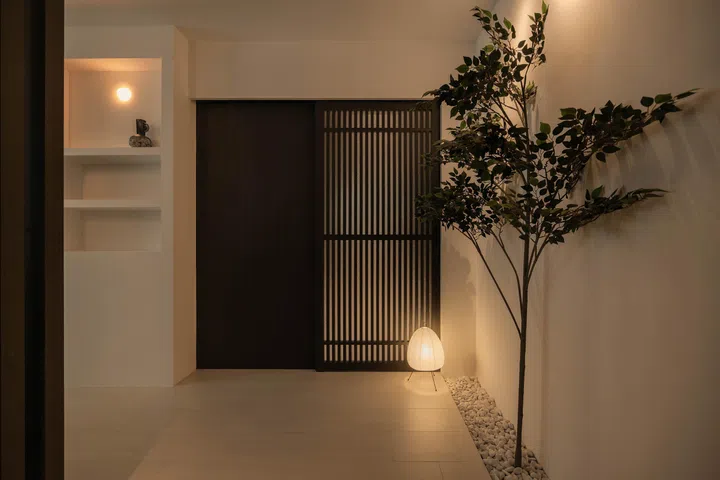
A pebbled strip and faux tree bring a Japanese sensibility to the entryway.
A home designed with clarity and intention
Even before buying the flat, Andi already had a clear vision of what it would look like. After consulting a Feng Shui master, he put together a design dossier of inspiration images and guidelines, and approached interior designers with it in hand—not to define his style, but to help him execute it.
“Minimalism is good because it balances out the earth element in my life,” Andi shares, explaining how minimalism ensures he doesn’t hoard, while simultaneously helping to restore the balance from a Feng Shui perspective. “The Feng Shui master also said I lack the wood element in my life, so most of the house is wood.”
Each room was designed with a specific purpose—the study for focus, the bedroom for rest, the living room for relaxation and the occasional late-night work call. The result is a home that reflects not only a love for Japandi-inspired minimalism, but also a philosophy of balance that shapes Andi’s day-to-day life.
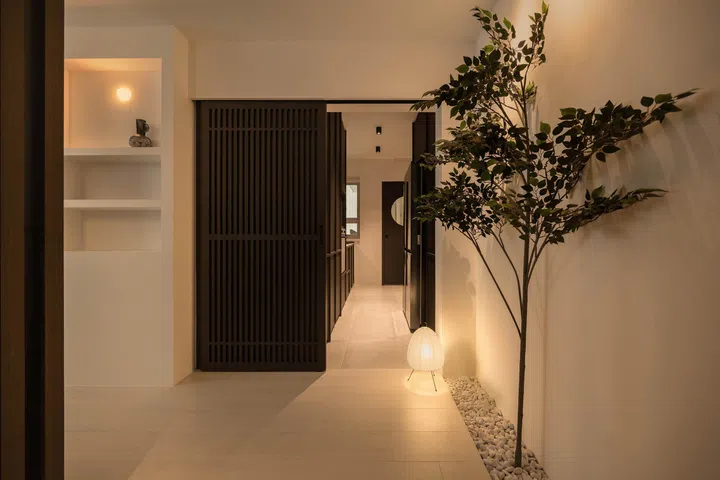
The dark wood slatted sliding door conceals the kitchen.
Finding the Right Designer
Andi had already met with four interior designers, but it was Siling of LXY Designers & Builders, recommended by a friend, who resonated most. He explained that out of the five, he chose Siling because their communication style and working dynamic felt like the best fit.
She had also presented a 3D plan early in the process, which gave him confidence in her approach. “That kind of helped me to make the decision,” he noted, adding that she proved to be reliable and went above and beyond throughout the renovation. “At the end of this project, I was very satisfied with the result.”
Siling remembers the first meeting just as vividly. “Andi’s mood board was as detailed as what we’d usually prepare for clients,” she says. “It was very concise and detailed… the dark corridor, the Japandi fluted sliding doors, he already knew what he wanted in his house.” What he needed was someone to execute it faithfully, while still refining the details. Their collaboration was rooted in mutual trust: Andi’s clarity of vision, and Siling’s ability to translate it into a home that felt both disciplined and warm.
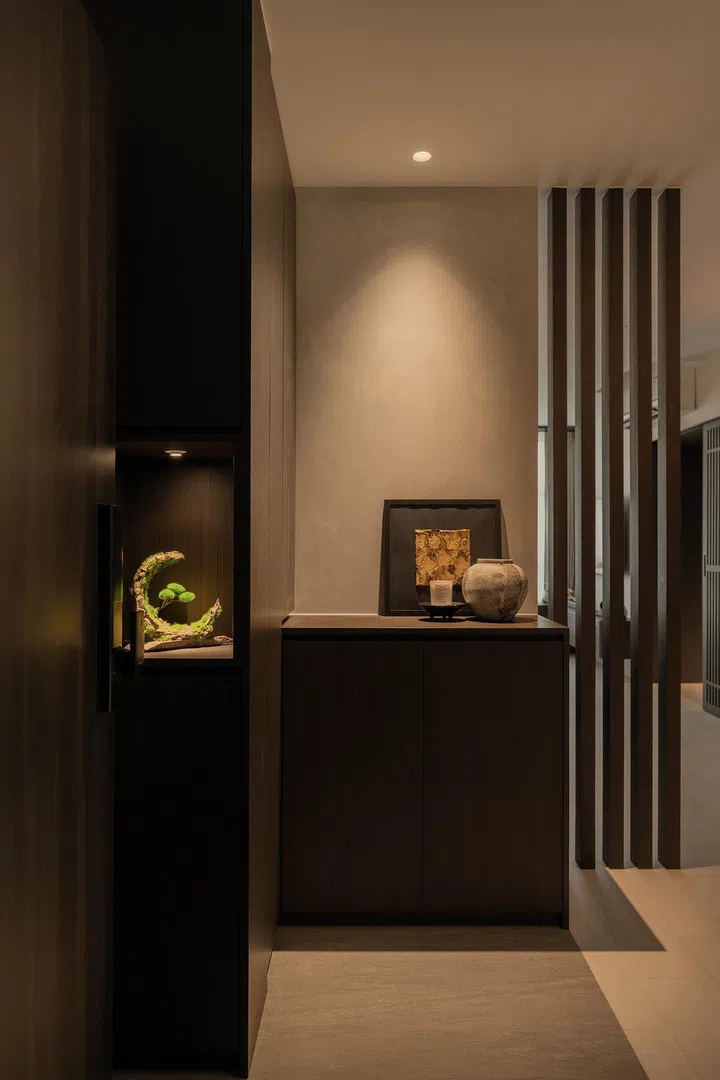
At the foyer, a preserved bonsai and curated objects introduce the home’s philosophy of calm and balance.
A bonsai for balance
For Andi, greenery was always part of the plan—his Feng Shui master had recommended live plants to bring balance into the home. But as a cat owner, he worried about insects and about Yuki nibbling on leaves. One of the solutions was a preserved bonsai, carefully placed at the entrance as a daily reminder of serenity. This is also one of Andi’s two favourite objects in the house.
“It’s uniquely shaped to feel serene and peaceful,” he says. “When I enter the house, it sends the message that I’m home.” This pragmatic yet meaningful choice reflects Andi’s overall approach to the renovation: balancing guidance, lifestyle needs, and aesthetics in equal measure.
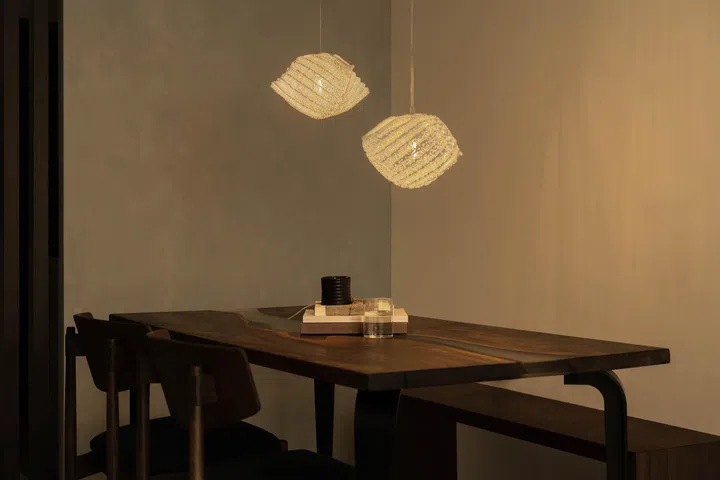
A dark walnut resin dining table became the home’s anchor piece, shifting the entire palette from light to moody Japandi.
The table that changed everything
If the bonsai anchors the entrance with serenity, this dining table is the object that transformed the entire design direction. Originally, Andi and Siling had worked around a lighter, Muji-inspired palette, but when he spotted a dark walnut resin table at Grace & Saunders, he simply couldn’t let it go. “He really, really, really liked it,” Siling recalls with some amusement how another customer’s interest in the one-of-a-kind piece spurred Andi’s decision to commit to it on the spot.
That single choice set off a chain reaction: the lighter woods were replaced with darker laminates, and the palette shifted towards a bolder, moodier Japandi expression. “I really like this dark walnut feel,” Andi says. “After we got this table, I asked Siling to change the lighter wood to a darker colour.” Today, the sculptural table remains the anchor of the open-plan living and dining area—a statement piece that captures both Andi’s decisiveness and Siling’s design flexibility.
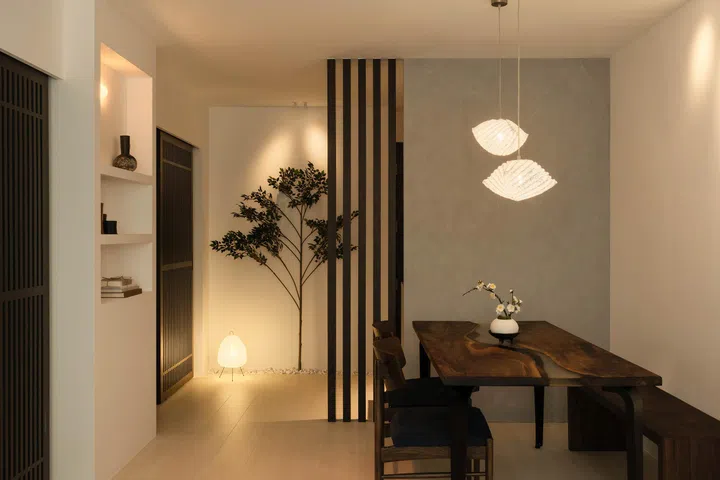
The walnut resin dining table defines the living and dining area, with pendant lights and slatted details completing the Japandi-inspired setting.
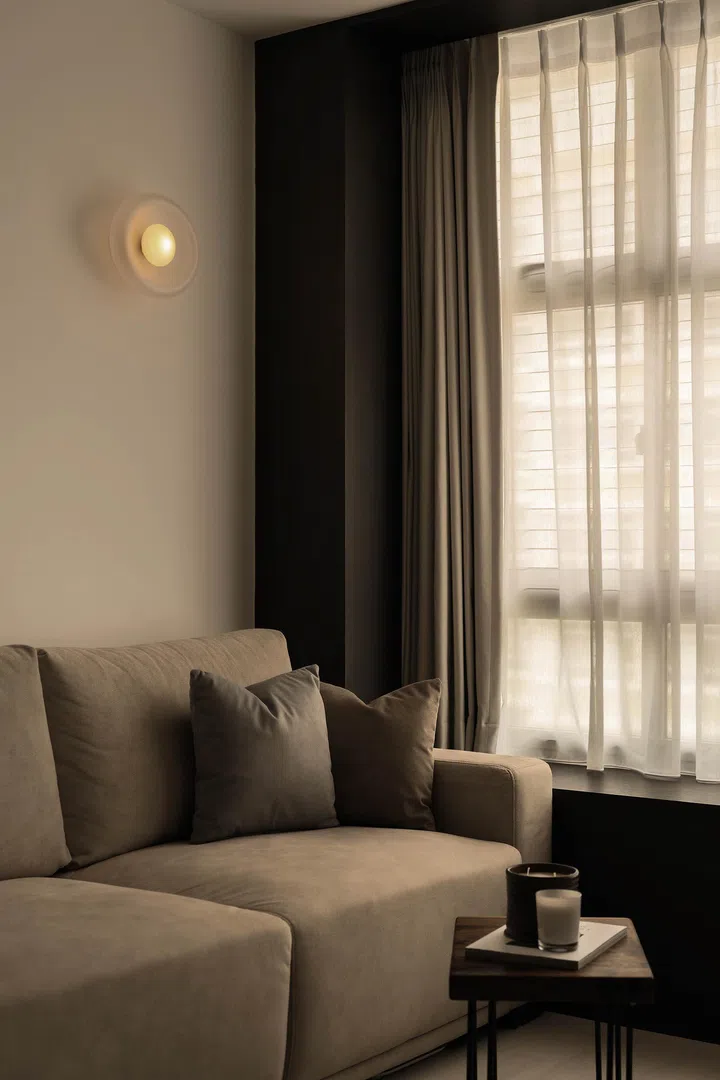
Soft lighting and muted tones give the living room a calm, serene quality—even when it becomes Andi’s late-night workspace.
Living Room
Although the living room was conceived as a place of calm, it also doubles as Andi’s late-night workspace. With meetings often scheduled on US time, he shifts here after hours while Yuki sleeps undisturbed in the study. “Sometimes I have meetings at 10 – 11 pm… so my living room has been tweaked to support my working at night,” Andi shares.
“The living room’s Zen-like atmosphere really helps me in my work.” This space is intentionally designed for serenity: soft lighting, muted tones, and the quiet rhythm of slatted doors create a tranquillity that helps him focus without distraction—whether it be on work or relaxation.

Another dark slatted sliding door keeps the corridor shrouded, allowing the living area to feel calm and composed.
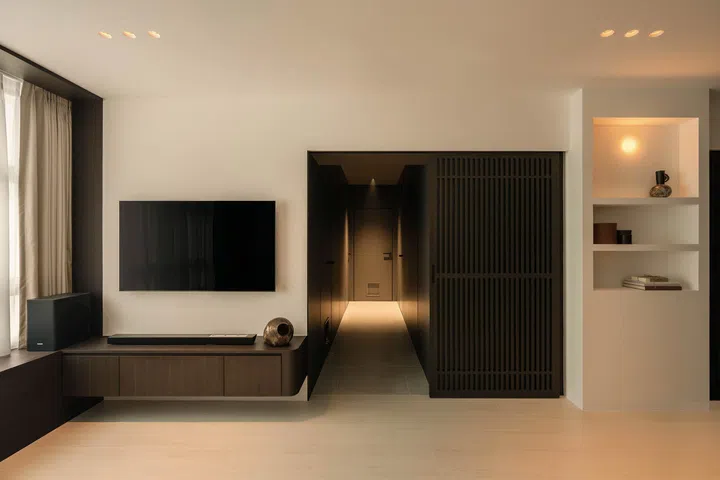
When opened, the corridor reveals a darker palette that creates a calm, Zen-like transition between rooms.
The transition zone
The corridor is more than a passageway—for Andi, it’s a transitional space that helps him shift gears between activities. Clad in consistent dark panelling, the long stretch becomes a moment of calm when the sliding doors are shut. “When all the doors are closed, it’s very silent and very peaceful,” he says. “When I move from the study to the living room, I can leave my work thoughts behind, and stop thinking about work.” By concealing multiple doorways within a uniform dark laminate feature wall, the corridor reads less like a thoroughfare and more like a meditative zone.
Siling notes that this was also one of the project’s more challenging features. To achieve the seamless effect Andi envisioned, she sourced specialised concealed doors that could blend into the wall cladding. The installation required multiple rounds of rectification, but the final result delivered the quiet, uninterrupted look they were after. She also added Japanese-patterned glass to the sliding door—a thoughtful detail that prevents cooking smells from seeping into the bedrooms while still keeping the aesthetic light and refined.
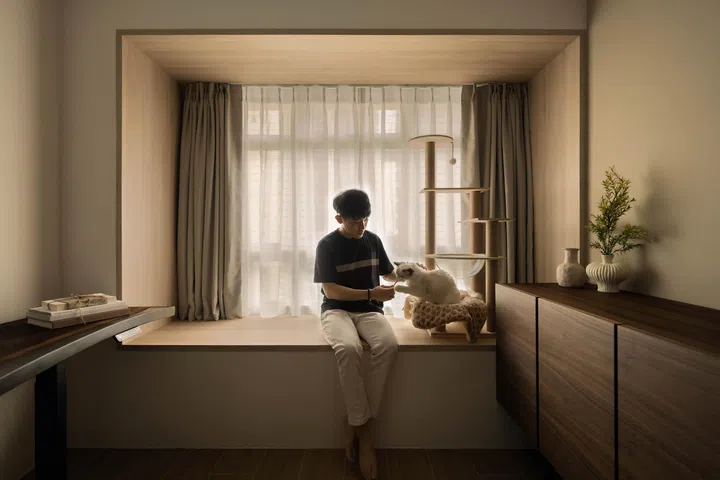
The study doubles as Yuki’s play zone and sleeping area, with a cat tower and bay-window perch integrated into the clean, minimal layout.
Study and cat tower
By day, the study is Andi’s main workspace. Designed for long hours of hybrid work, it combines a standing desk, ergonomic chair, and clutter-free layout to support focus. He had requested soundproofing, and while the HDB structure meant the windows couldn’t be altered, the walls have now been filled with dense insulation to minimise noise.
The bay window, another structural constraint, has been cleverly turned into a feature. “We managed to incorporate it into the design,” Andi explains how in the master bedroom, the bay window has been concealed within a king-sized platform bed with built-in storage, and how in the study, the bay window has become Yuki’s corner, with a cat condo placed there.
The home’s design even extended to custom details for Yuki. Cat flaps were added to the doors so he could move freely between room—although, as Siling recalls, they weren’t without their challenges. The openings were initially fabricated smaller than drawn, and had to be redone on site. It was one of many rectifications that required persistence, but the final outcome ensures that both Andi and Yuki can enjoy the home as intended.
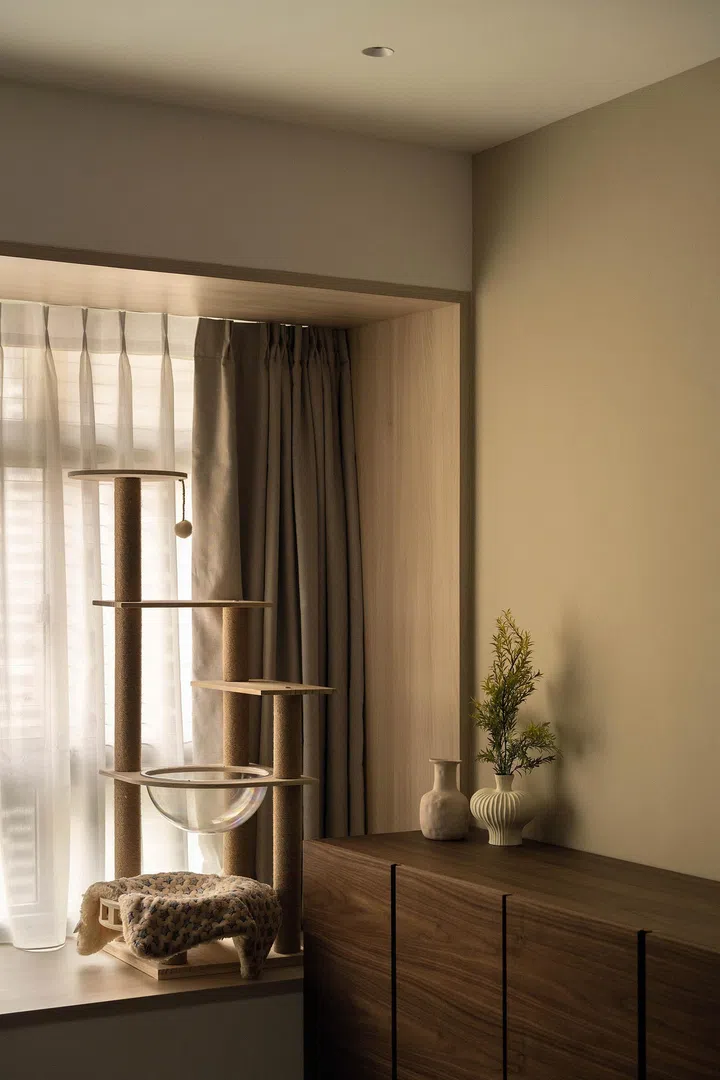
A tall cat tower by the bay window turns the study into a shared space for focus and play.
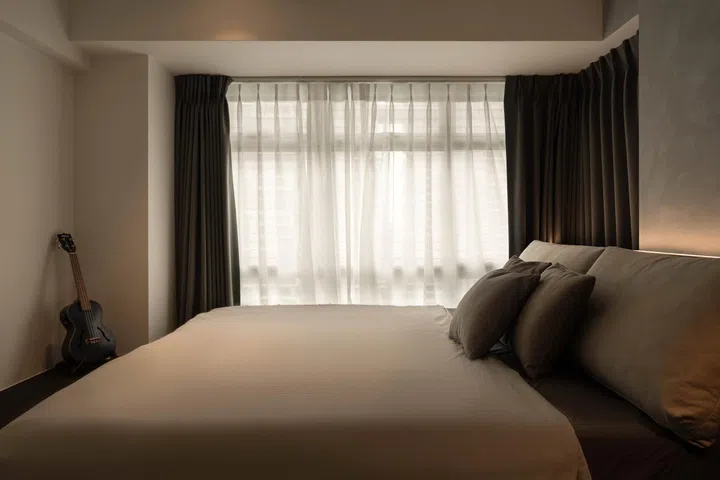
The master bedroom is a tech-free retreat, with a platform bed concealing the bay window and muted tones for rest.
Master bedroom
The master bedroom was designed as a retreat, deliberately kept free of tech and distractions. A platform bed conceals the bay window while providing generous storage underneath, keeping the space clutter-free. For Andi, the room’s dark palette and soft lighting create the conditions for real rest.
Siling explains that the darker palette here wasn’t just an aesthetic choice, but a Feng Shui requirement. “The Feng Shui master said the kitchen, master bedroom and master bathroom needed to be darker, while the rest had to be lighter,” she says. The result is a cocoon-like space defined by deep tones and heavy curtains, with a subdued glow that gives the room its quiet, almost meditative appeal.
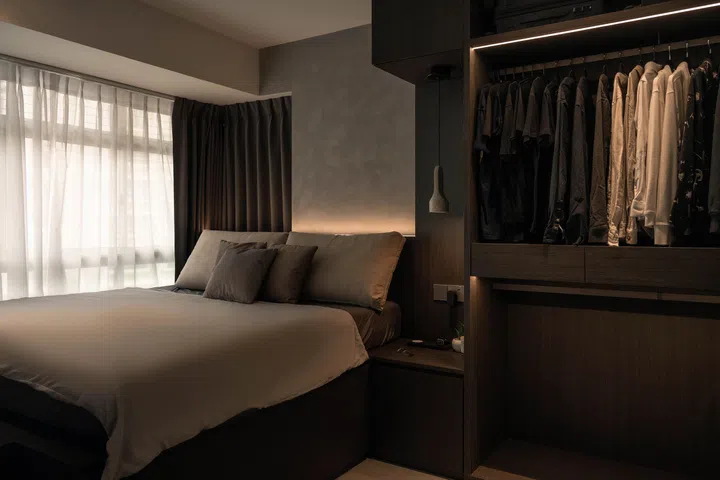
An open wardrobe adds practicality to the master bedroom while keeping the space uncluttered.

The darker master bathroom, clad in moody tiles and warm wood accents, creates an enveloping and intimate feel.
Bathrooms
The Feng Shui master’s advice carried through to the bathrooms as well, where one was designed to be light and the other dark. The lighter guest bathroom, finished in pale tiles and warm lighting, feels open and spa-like. In contrast, the darker bathroom features moody stone-effect tiles and wood tones, creating a space that feels grounding and intimate.
For Andi, the contrast between the two reflects the same balance sought throughout the home. One is bright and uplifting, ideal for starting the day, while the other is enveloping and calm—a place to wind down. Together, they echo the philosophy of minimalism with meaning: every space intentional, every detail aligned.

In contrast, the lighter common bathroom uses pale tiles and soft lighting for a spa-like openness.
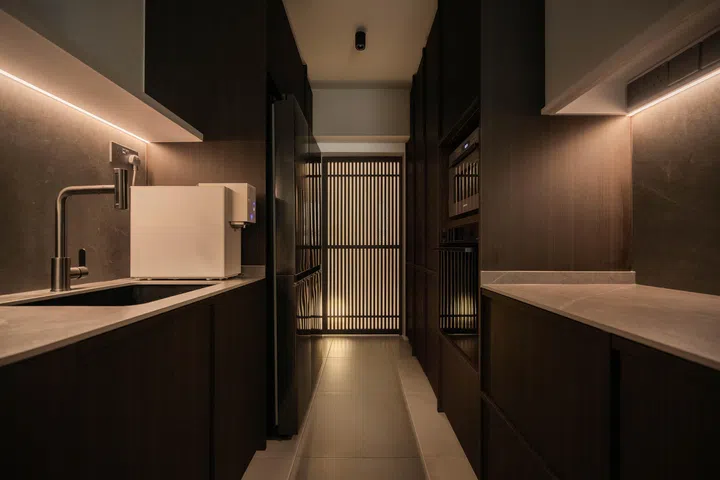
The galley kitchen was designed with a darker palette, as advised by the Feng Shui master, giving it a sleek and dramatic presence.
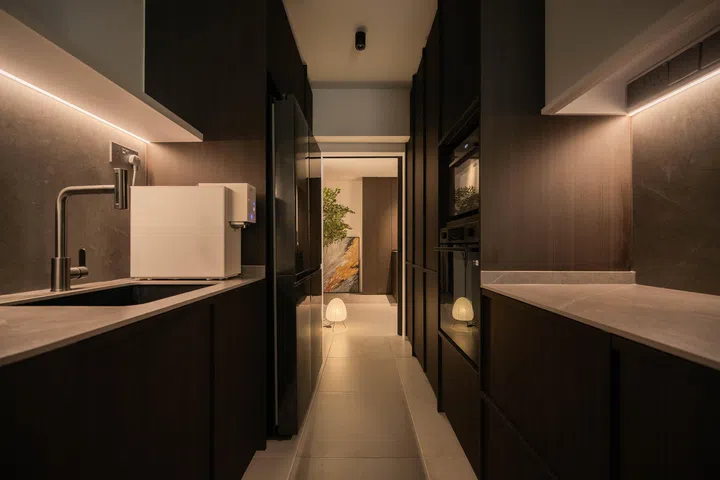
Flush cabinetry conceals the bomb shelter and generous storage, keeping the kitchen streamlined and clutter-free.
Kitchen
The galley kitchen was one of the spaces that had to be kept dark, as advised by the Feng Shui master. Finished in deep-toned cabinetry with stone-look counters and under-cabinet lighting, it now feels sleek and quietly dramatic. Storage is concealed behind flush panels, with the bomb shelter hidden seamlessly within the run of cabinetry—a detail that keeps the space visually streamlined.
For Andi, the kitchen has been a pleasant surprise. Though he doesn’t cook often, it has become one of his favourite parts of the home. “I like how clean and clutter-free it feels,” he says, noting that the space comes alive when his parents visit to prepare meals. What was once just a functional necessity has become a space that reflects the same clarity and calm as the rest of the flat.
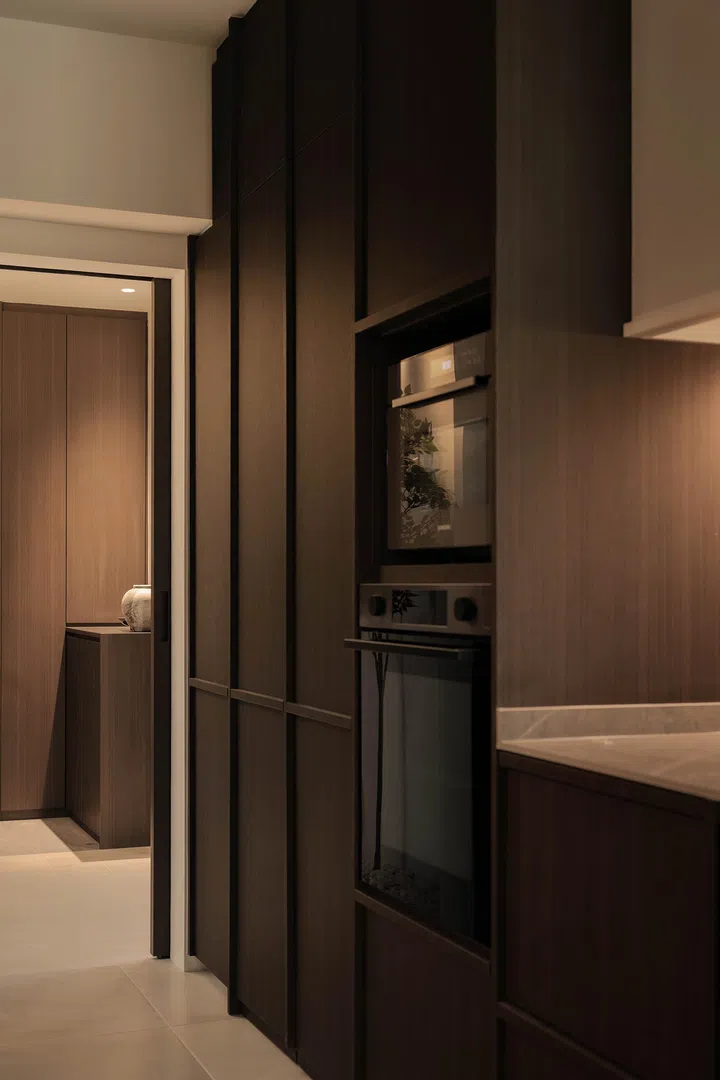
Under-cabinet lighting highlights the stone-look counters, adding warmth to the dark, minimalist kitchen.
$142,632 Renovation Cost
The entire renovation took about four months from start to finish. At a cost of $142,632, it reflects not just the scope of carpentry and finishes, but also the level of detail needed to realise Andi’s clear vision—from concealed doors and custom platforms to Feng Shui–guided palettes of light and dark.
For Andi, the investment was well worth it: each space now serves a distinct purpose, whether for work, rest, or play with Yuki. Coupled with Siling’s persistence through countless rectifications and her respect for his ideas, the collaboration delivered a home that feels both disciplined and personal.