
Home Tour: A long-held family 5-room HDB flat reimaged in Kim Tian Road
Careful planning and architectural interventions improve light, circulation, and everyday usability for a family home held over decades.
By Gwyneth Goh -
Share this article
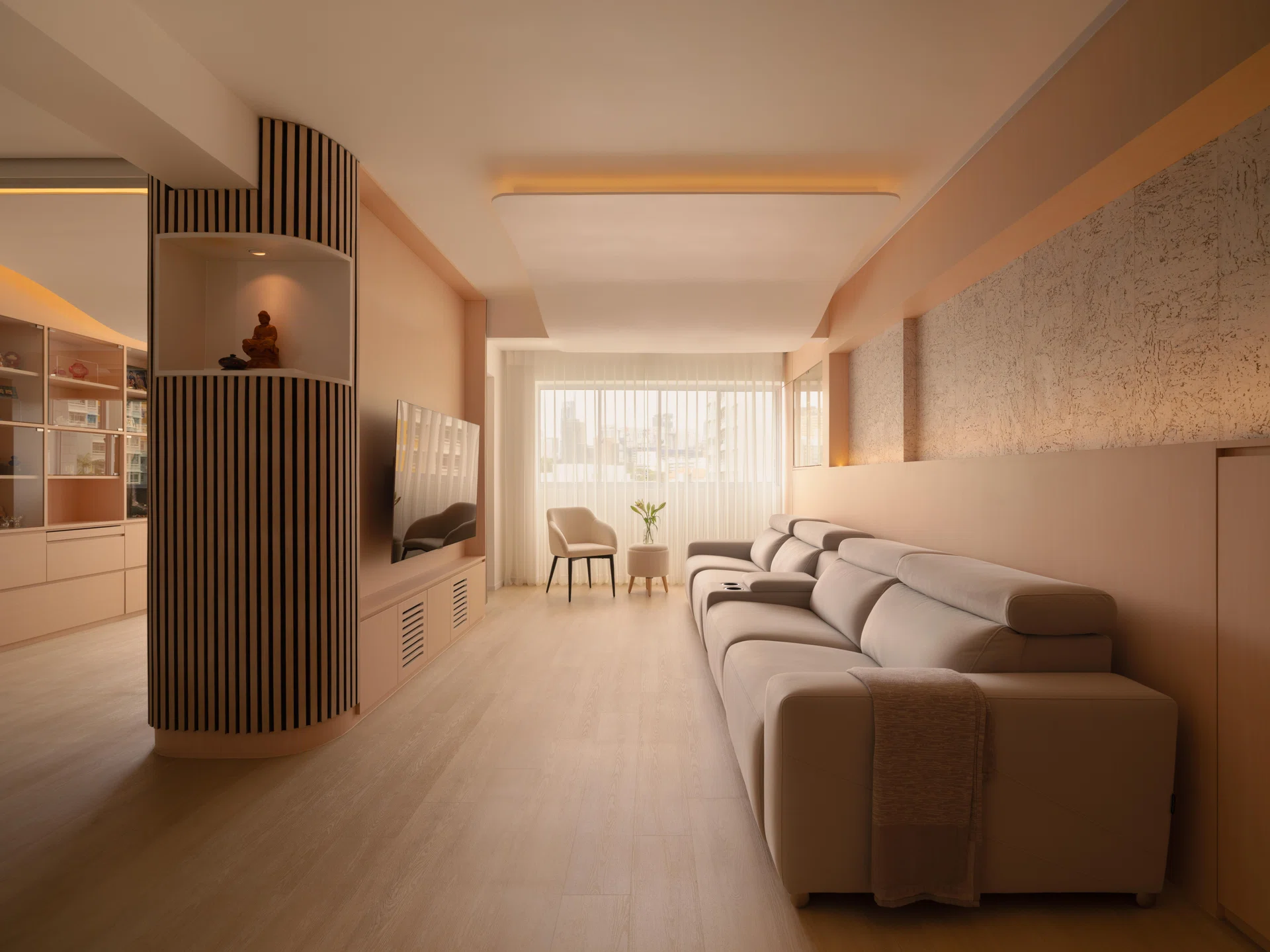
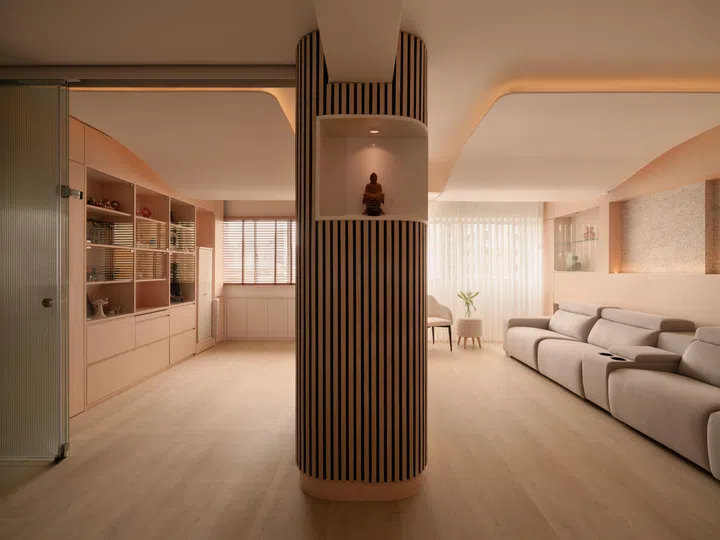
The living room stretches quietly toward the windows, drawing the eye past the sofa to the skyline beyond. Overhead, a floating ceiling plane resolves a once-prominent structural beam in a gentle curve.
A cylindrical column clad in vertical slats introduces texture and houses a recessed display niche, while built-in storage runs cleanly along the wall. The room feels deliberate rather than decorative, shaped by proportion and alignment rather than embellishment.
Bought this HDB over 20 years ago
Lim and Joanne have lived in this HDB flat since 2002. Purchased as a resale HDB unit when it was still relatively new, it required little intervention at the time. More than two decades later, with their two children grown and years of accumulation behind them, the couple felt it was time to rethink the space. “We want a house where we can come back to and relax, and things are kept in place,” Joanne says.
Storage and spatial clarity became central priorities—not simply to contain belongings, but to reduce the need for constant upkeep. At 125 sqm, the 5-room HDB layout offered generous proportions, yet its previous configuration did not fully capitalise on light or sightlines. The renovation reorients the living area toward the façade, removes visual breaks, and integrates storage into walls and joinery so circulation is clearer and movement more direct.
The result is a layout that works harder, with fewer visual interruptions and more usable floor area.
Who lives here: Lim and Joanne, in their fifties to sixties, both in the civil service, with their two grown children
Home: A 5-room HDB flat in Kim Tian Road
Size: 125 sqm
Interior Designer: Khai Toh, KTarch
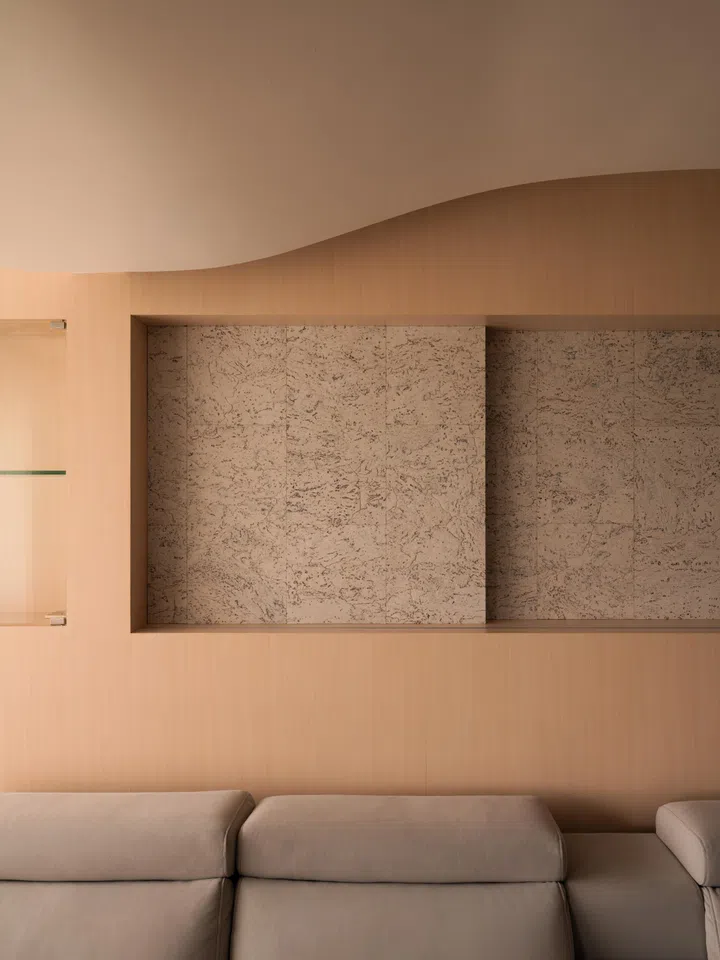
A recessed niche is set within the feature wall, framing the seating area while keeping surfaces visually quiet and uncluttered.
Living room: Turning constraint into form
A structural beam once ran across the centre of the living room, both visually dividing and weighing down on the space. For Khai Toh of KTarch, the issue was not simply concealment but perception. The earlier condition created “a sense of visual and spatial heaviness, effectively splitting the room in two, especially if one is seated below it,” he explains.
Homeowners Joanne remembers it more intuitively. “I think his design is that curved wall on top of the ceiling. It’s like two parallels—this curved thing has a parallel in the study also. He used it to cover up the beam across.” What she describes as a defining gesture began as a structural constraint.
Rather than box the beam up, interior designer Khai chose to reframe it. It was “resolved by applying an S-curvilinear plane to conceal the beam and at the same time act as a floating design feature.” With the curved plane introduced, “the living room is now perceived as a single, defined environment,” allowing the family to gather without the sense of weight pressing down overhead.
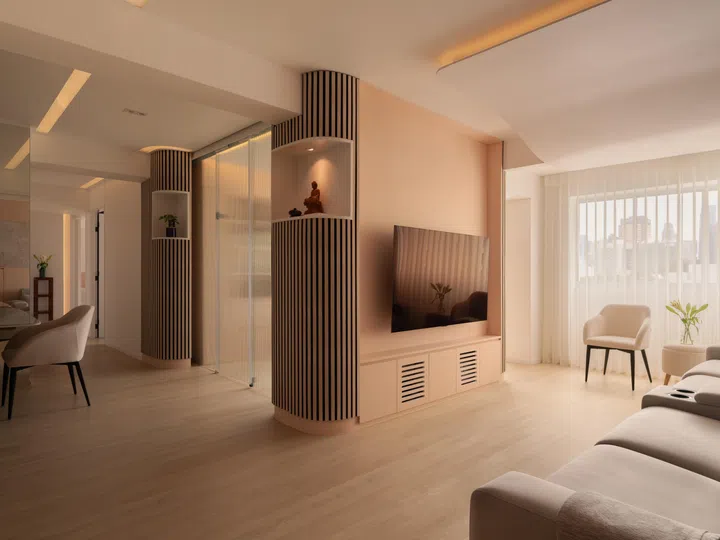
Reversed to face the façade, the living room now allows both television viewing and uninterrupted sightlines toward the skyline beyond.
Reconfigured HDB Layout
The reconfiguration also addressed orientation. According to Khai, although the HDB flat offered “clear sightlines from the living area toward the Tanjong Pagar skyline, the previous living and sitting room orientation was turned ‘backward’”, facing neighbouring blocks instead.
By reversing the living room’s orientation, the new plan now allows the family to “enjoy both television viewing and the expansive city view simultaneously, including the distinctive terracotta roofscape of the low-rise Tiong Bahru neighbourhood.”
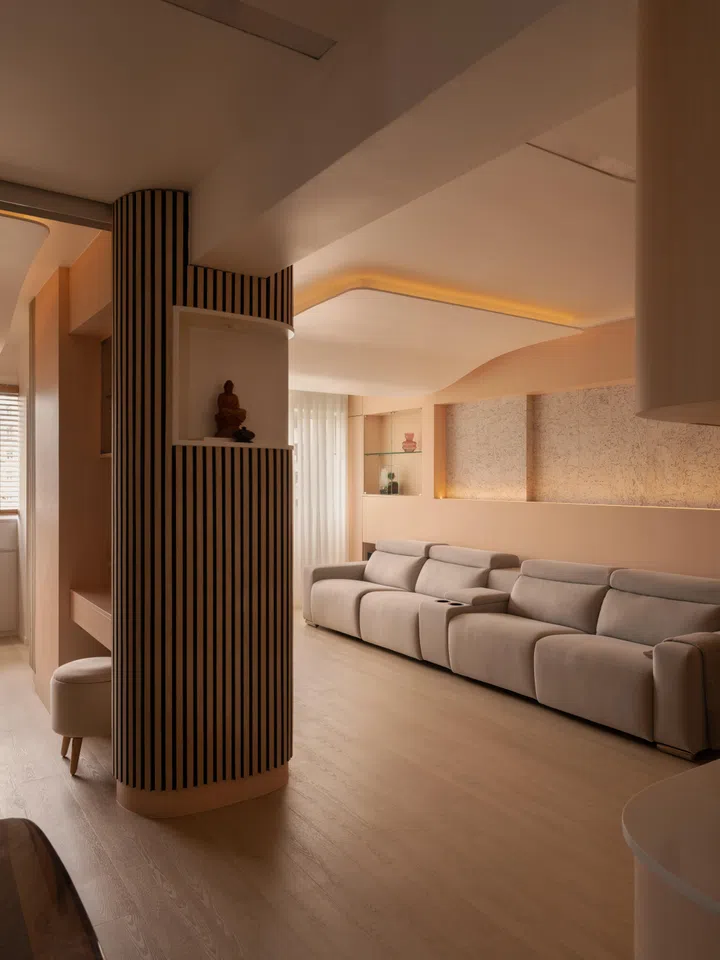
Integrated joinery lines the living room, with recessed niches and flush panels keeping storage and display contained within the architectural envelope.
Built-In Cabinets
Beneath the ceiling, the discipline continues through joinery. “Previously our place we did not have many built-in cabinets. Now we have done up a lot of built-in cabinets which reduces clutter,” homeowner Joanne says. “No more leaving things on the tabletop and shelves... As we age, it’s less to clean and easier to clean. Very dusty otherwise, and you need to keep cleaning.”
Storage has been integrated rather than added on, and display is contained within recessed niches—decisions that align homeowner Joanne’s practical concerns with interior designer Khai’s emphasis on spatial clarity.
A fluted glass sliding door allows the study to be fully opened up to the living room, creating a larger shared space for entertaining while maintaining the option for separation when needed.
Study: A room that stays connected
The ceiling curve does not end at the living room. It continues in the adjacent study, repeating the S-curvilinear plane to conceal another section of beam. As homeowner Joanne noted, “this curved thing has one parallel in the study,” reinforcing that the two spaces were conceived together rather than treated separately.
Where the original layout enclosed the study, the renovation opens it up. Interior designer Khai explains that a wall was hacked to “let light travel deeper into the home,” improving both visual connection and natural illumination. The study now sits within the same spatial field as the living area, yet retains the ability to be closed off when needed.
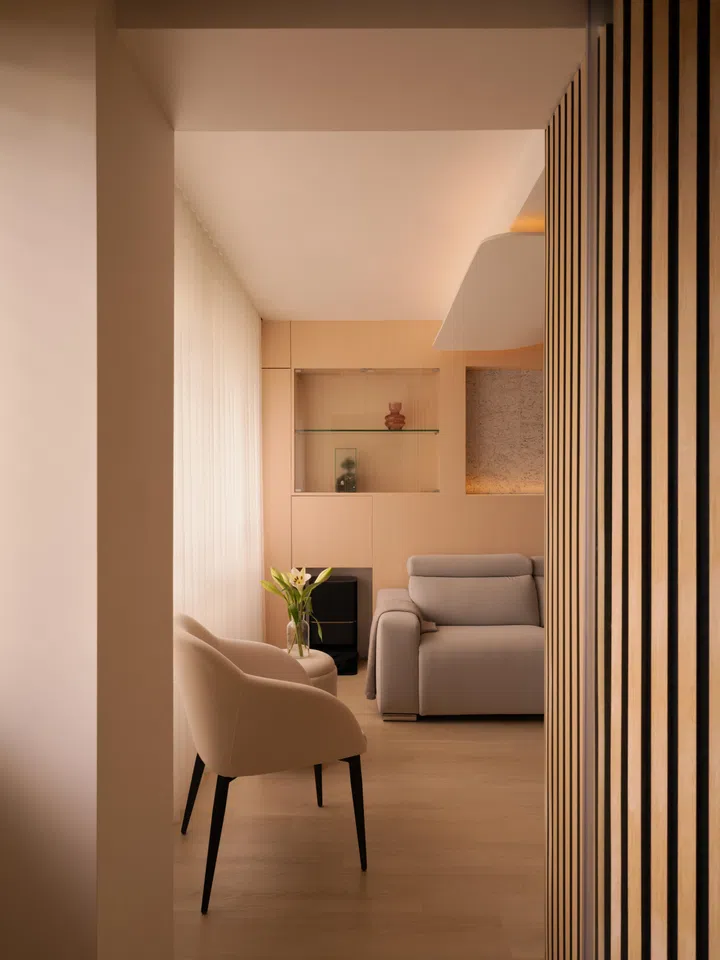
Paired sliding panels allow the study to be closed off, or opened for light and visual connection.
Fluted Sliding Door
Two doorways frame this flexibility. On one side, a fluted glass sliding panel allows light to pass through while softening views between rooms. On the other, a secondary opening near the windows creates a direct connection to the living area. Used together, the paired openings allow the study to function as either an extension of the living room or a more private workspace.
The vertical slatted motif, first introduced at the cylindrical column in the living room, reappears here. It lines the edges of the openings and continues along adjacent walls, maintaining a consistent architectural rhythm across both spaces. What reads as decorative detailing is in fact structural continuity, tying the two rooms together visually.
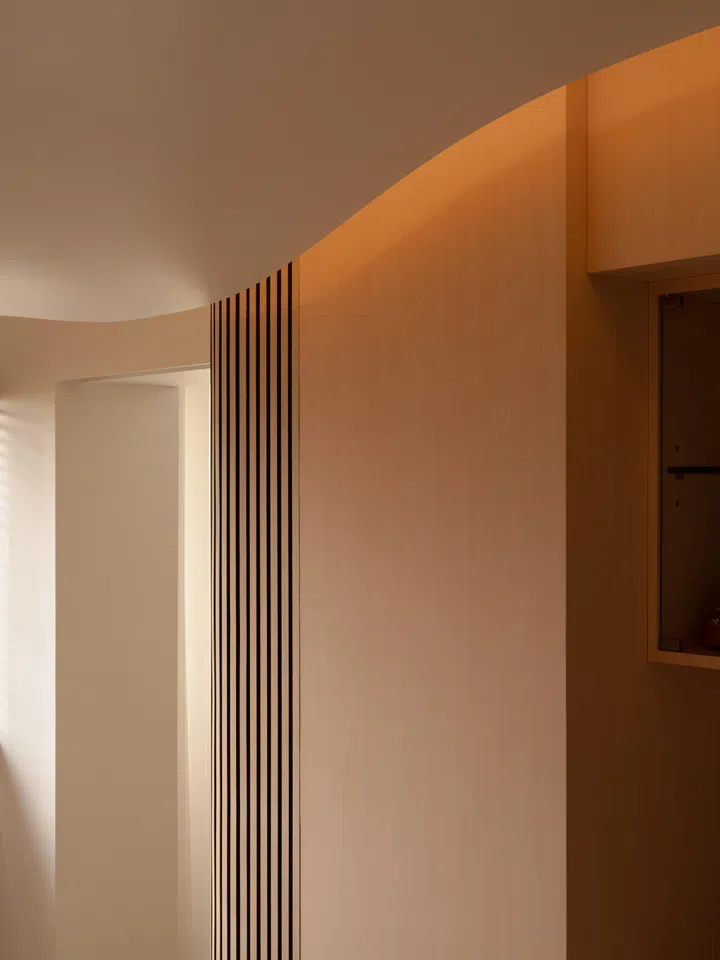
The S-curvilinear ceiling is repeated in the study, while the vertical slatted detailing echoes the cylindrical column in the living room.
With the ceiling plane repeated and circulation opened up, the study becomes less of a separate room and more of a transitional zone—integrated yet adaptable.
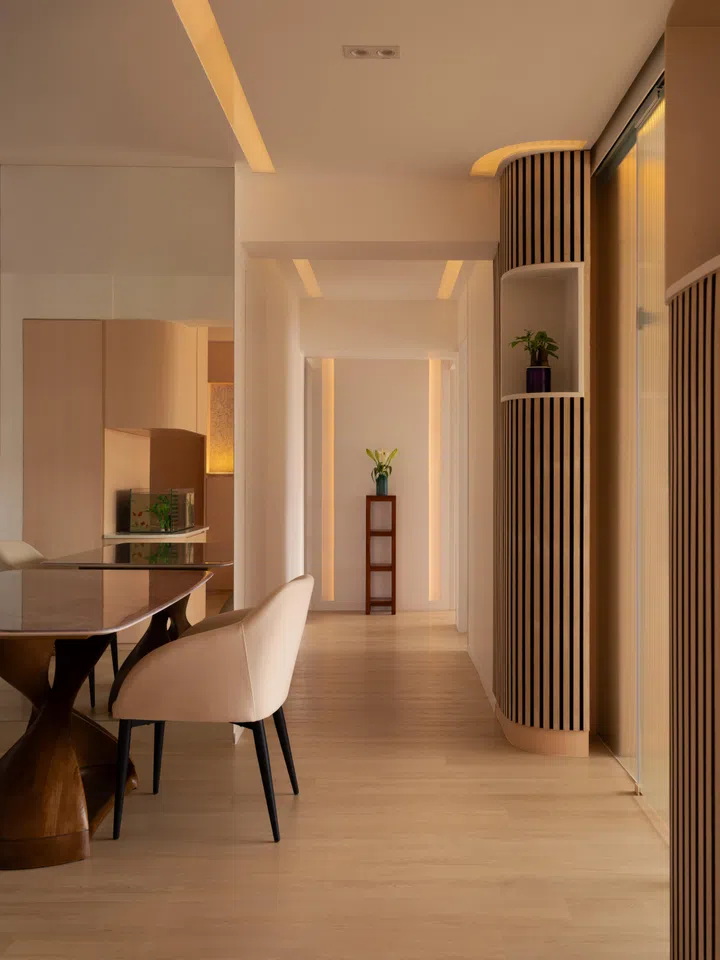
The dining area sits along a widened corridor, with slatted columns marking transitions while keeping spaces visually connected.
Dining and Circulation: Planning for the years ahead
Beyond the study, the plan opens into the dining area, where movement through the flat has been deliberately reconsidered. What reads as visual openness is, in fact, the result of careful space planning.
“A key priority in space planning was to improve circulation in anticipation of future elderly needs,” says Khai of KTarch. “Wider passageways and clearer movement paths were introduced to enhance accessibility, openness, and long-term usability, ensuring the home remains comfortable and functional as the owners age.”
In this case, the homeowners are a young senior couple with two adult children. “The brief called for a home that supports both active adult living and the realities of aging-in-place,” interior designer Khai explains. Instead of viewing constraints as obstacles, “existing structural conditions, circulation requirements for ageing-in-place, and fixed openings were treated as guiding parameters rather than limitations.”
The result is subtle but evident. Alignments are straightened, corners softened, and passageways widened so walking from one end of the flat to the other feels uninterrupted. “It used to be quite dark at the corridor,” homeowner Joanne recalls, “The place now looks much warmer and cosier.”
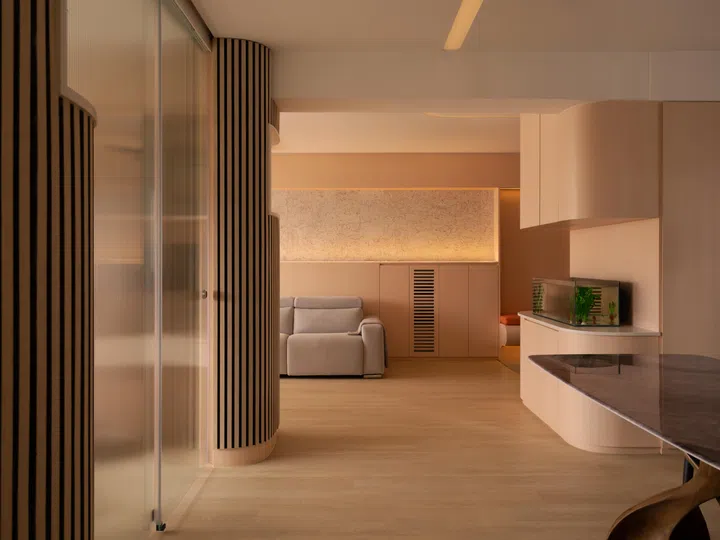
A curved shelf between dining and living is designed to house the family’s aquarium, allowing it to be enjoyed from both sides.
Curved Console
Personal preferences surface along the curved built-in ledge beside the dining area. “I like floral arrangement whereas my husband is more into plants and has an aquarium,” Joanne shares.
A curved shelf between dining and living is designed to house the family’s aquarium, positioning it between both spaces so it can be enjoyed from either side. It introduces movement and life into the otherwise restrained material palette, reflecting the couple’s differing but complementary tastes.
Together, these adjustments demonstrate how planning for the future need not feel clinical. Circulation is clearer, materials are legible, and the home remains adaptable, supporting daily life now while anticipating the years ahead.
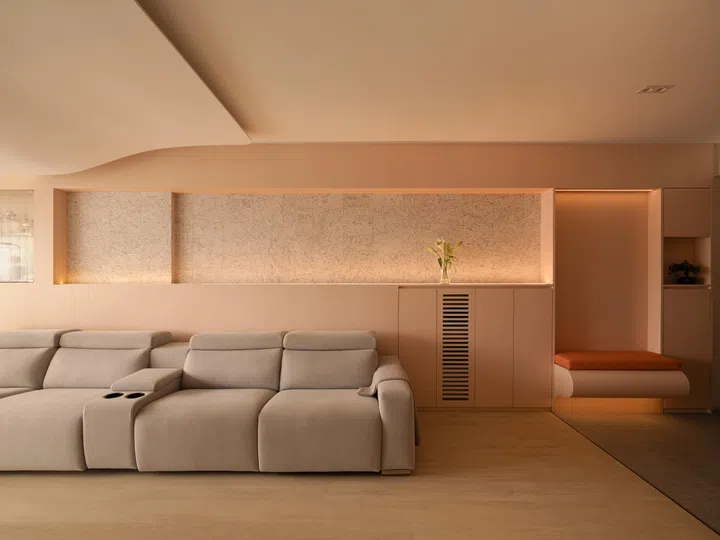
A tiled threshold differentiates the entry zone, while a built-in bench introduces a gentle pause within the open plan.
Threshold and Arrival: A gentle pause
The renovation also introduced a custom shoe-changing niche at the home’s entrance that remains visually part of the living room—a subtle threshold, but one given deliberate spatial emphasis.
“When you come in, we wanted to have tiles because they’re more hardy,” Joanne explains. “Also to have a differentiation.” The bench was a practical decision. “We can sit there and wear our shoes before we go out. Also for our guests—if there’s not enough seating they can sit there. It’s still part of our living room.”
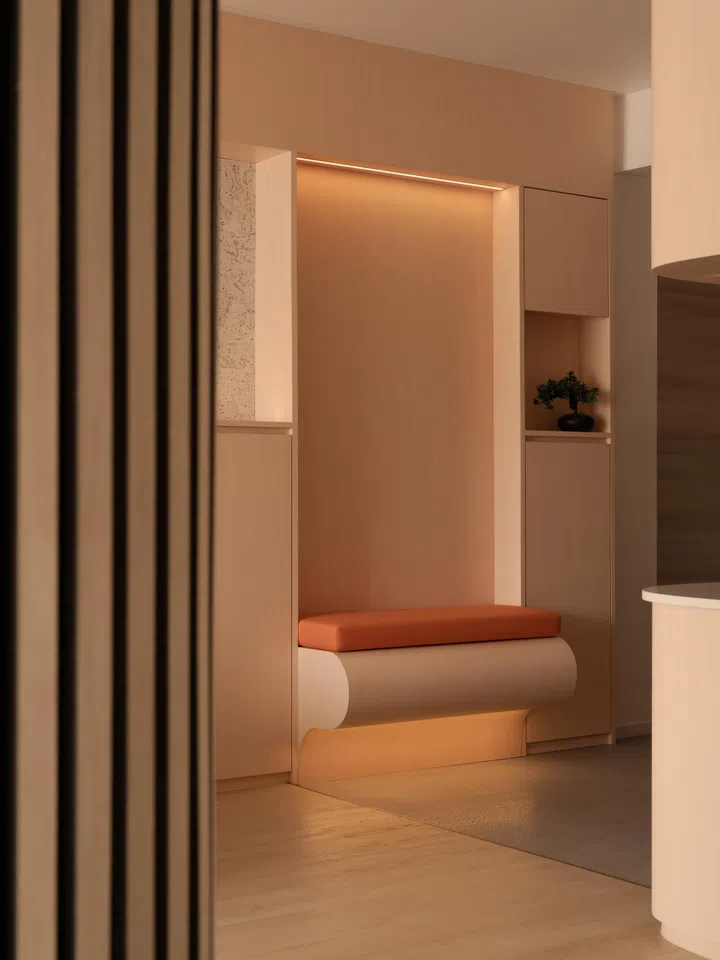
The custom shoe-changing niche incorporates seating and subtle under-seat lighting, giving everyday routines spatial clarity and comfort.
Custom-Built Settee
For interior designer Khai, this everyday moment was worth shaping carefully. “One example of a bespoke element in this project is the custom-designed shoe-changing niche at the entrance. Rather than treating this as a purely functional area, the act of putting on shoes is intentionally given spatial importance and dignity.”
The seating element is designed to allow one to sit comfortably while changing shoes, with under-seat lighting that softly illuminates the floor to support visibility when tying laces—a considerate move that improves safety and ease of use.
As interior designer Khai notes, beyond anticipating elderly needs, this design “avoids the common discomfort of balancing on one foot or struggling with shoes while standing.” A small intervention, but one that sets the tone for the rest of the home.
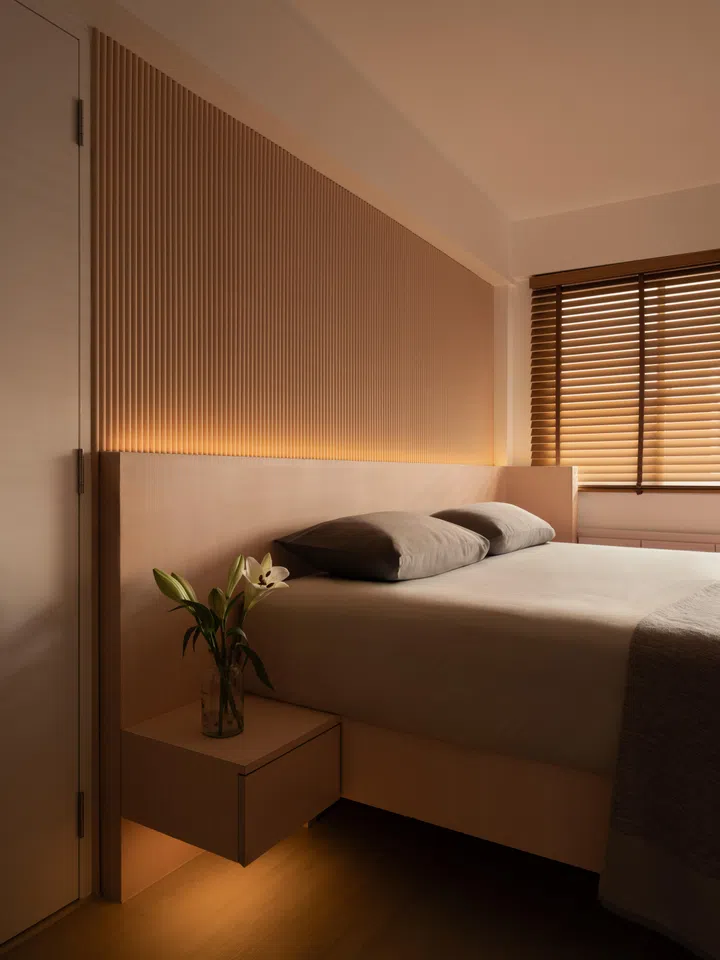
Fluted timber panels form a continuous bedhead wall, softly backlit to introduce depth without the need for artwork or overhead fixtures.
Master Bedroom: Continuity and quiet
The master bedroom continues the language established in the living areas, but in a more distilled form. A fluted timber wall runs the length of the bedhead, softly backlit to create depth without adding objects or ornament. The palette remains consistent—light timber, warm neutrals, and controlled lighting—so the room feels connected to the rest of the home rather than set apart from it.
“This is the master bedroom, and next to the bed is the toilet door,” homeowner Joanne says matter-of-factly. “I like the fluted panels. I told him, I don’t like to hang things above my head, so we use the fluted panels again to repeat that feature wall.” Instead of artwork or shelving, texture becomes the focal point. The vertical lines lend rhythm and warmth, while keeping the wall visually calm.
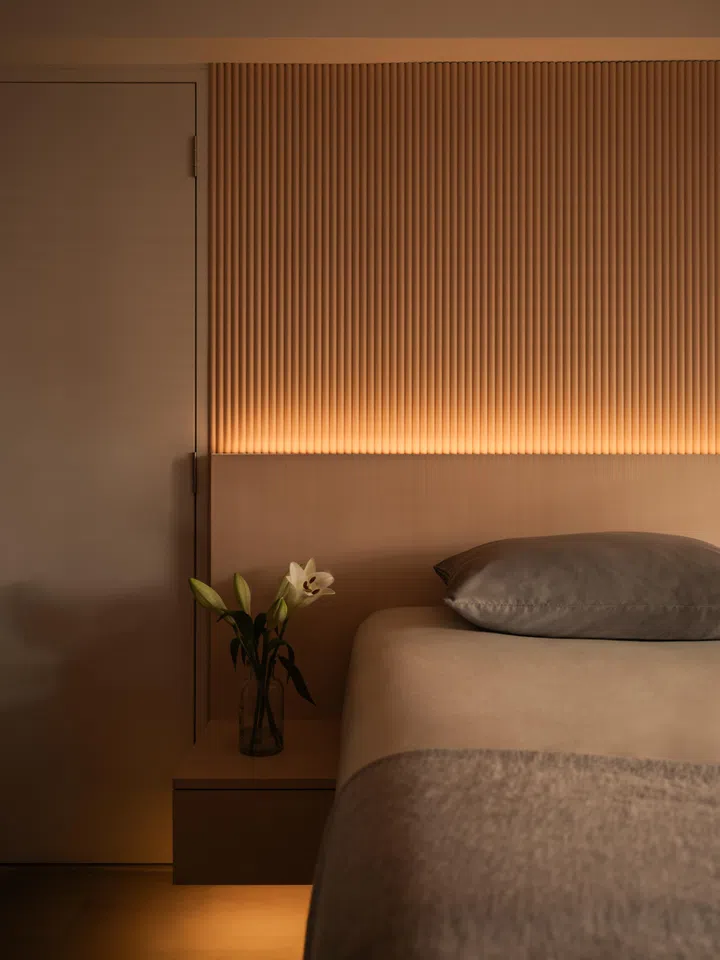
A restrained palette of timber and warm neutrals carries through into the master bedroom, creating a calm, unified backdrop that Joanne finds most restful.
The restraint is deliberate. “Throughout the whole house the colours are uniform,” homeowner Joanne adds. “Some people may not like it because they think it’s boring and they may want to have more colours, but I like it this way. The simplicity and not too many colours—I feel very relaxed under such colours.”
In the master bedroom, that preference translates into a space defined less by decoration than by consistency, proportion, and a controlled wash of light.
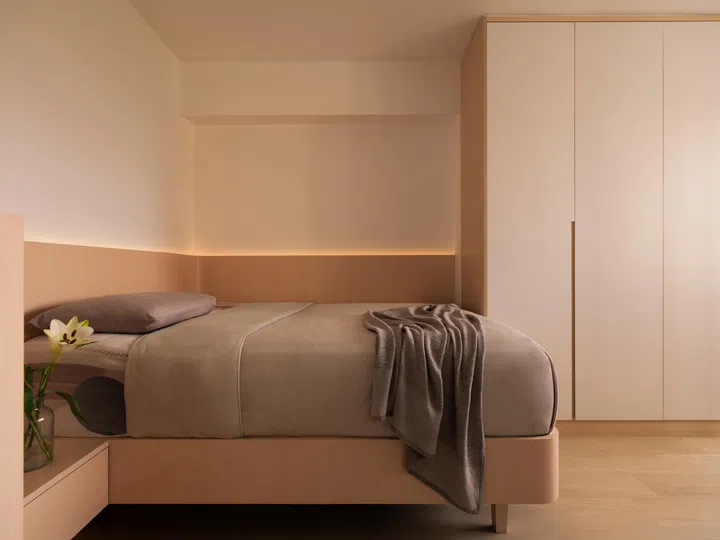
An existing cabinet from a previous renovation was retained, with the customised bed and built-in bedside drawer designed to align neatly around it.
Eldest Son’s Room: Designing around what stays
In the eldest son’s room, the interior design began not with demolition, but with an existing piece. “This is my eldest son’s room. Actually, the cabinet was done in 2021. When I renovated my kitchen then, I did this cabinet,” homeowner Joanne says.
The unit remained in place, and the new layout was developed around it. “This cabinet stays where it is, so he designed the room around this.”
Working within that fixed condition, interior designer Khai adjusted the proportions and detailing of the rest of the room to align visually with the cabinet. The bedframe was customised to sit neatly against the wall, paired with a built-in bedside table that incorporates a drawer for storage. “The bedframe is customised together with this drawer,” Joanne notes.
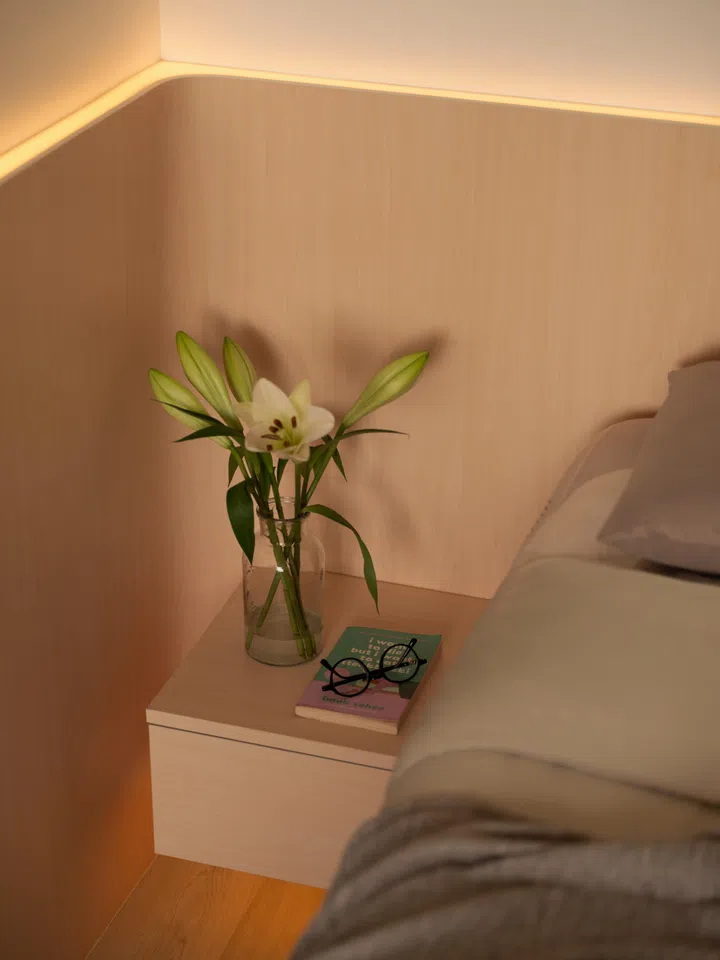
Concealed lighting above the headboard introduces warmth without adding visual clutter, maintaining the home’s restrained material palette.
Above the bed, concealed ambient lighting adds warmth without introducing additional fittings. “He put the ambient lighting above the bed which I think is quite nice,” she adds. This gesture echoes the rest of the home—clean, controlled, and visually quiet—while allowing the retained wardrobe to sit comfortably within the updated scheme.
The S-curvilinear ceiling is repeated in the study, while the vertical slatted detailing echoes the cylindrical column in the living room
Second son’s room: compact, adaptable
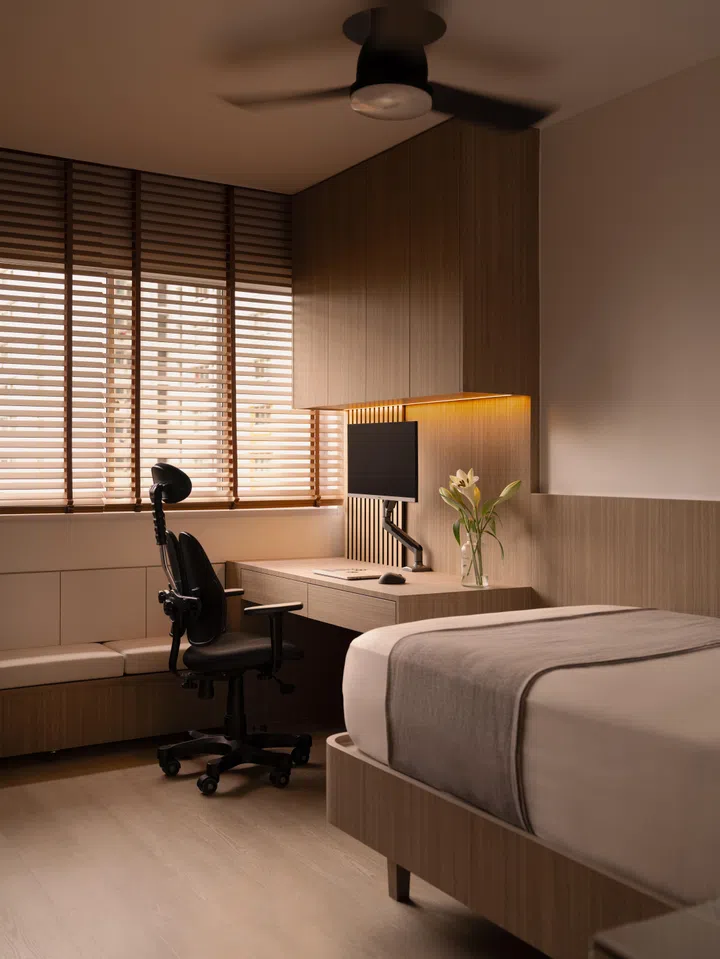
Joanne’s second son’s room is smaller, requiring a more compact arrangement. “This is a super single bed because this room is smaller,” she explains, “so we can’t fit in a queen-sized bed.”
Storage is built carefully into the perimeter. “There’s a cabinet and a built-in under the window—we have storage space. When you open it up, there’s also some storage space there.” The under-window platform continues a strategy seen elsewhere in the home: concealment without clutter.
Flexibility also features here. “When we have guests, we can actually push this whole thing out for additional seating. The bench is on wheels, so you can push it out.” The movable custom bench and integrated storage allow the room to shift function when needed. “That brown thing—you can also store things inside.”
What began as a tighter footprint becomes a room that performs beyond its size, serving as bedroom, storage hub, and occasional overflow seating when family gathers.
The renovation in brief
While the kitchen cabinetry had been updated in 2021, this renovation reworked the living areas, study, circulation, and bedrooms to improve long-term usability and cohesion. Structural beams were resolved through ceiling interventions, passageways widened, and bespoke elements such as the entrance niche and integrated storage introduced.
“One aspect of the project that I am especially proud of is how design decisions were shaped by constraints rather than working against them,” says Khai. Existing structural conditions and circulation requirements were treated as guiding parameters rather than limitations.
For Joanne, the outcome is straightforward. “We’re very happy that this is the house we wanted,” she says. “I think it’s our retirement home… maybe if my kids move out, we might think of downgrading to a smaller place, but not for the time being. Maybe not for the next 10 years.” For now, this home suits exactly the stage of life they are in.