
Home Tour: $99,000 Warm renovation for a HDB Executive Apartment in Choa Chu Kang
Ovon Design transforms a once-compartmentalised HDB EA layout into a calm, family-centric home shaped by warmth, flow, and soft curves.
By Gwyneth Goh -
Share this article
Most executive apartments are generous in size but rigid in layout. When Ridzwan and Yayu first stepped into this unit at Choa Chu Kang Central, what they saw was not just square footage, but potential—even if it wasn’t immediately obvious. The original plan was heavily partitioned, with walls slicing up the living, dining, and kitchen areas, and a study awkwardly wedged between the communal spaces.
“We viewed around eight to ten houses,” Ridzwan shares. “But we kept coming back to this one.” Set on a high floor with unblocked views and just two units on the level, the apartment felt quiet and private, a rare find in the neighbourhood where the couple hoped to stay close to family and their children’s school. More importantly, the layout hinted at what it could become.
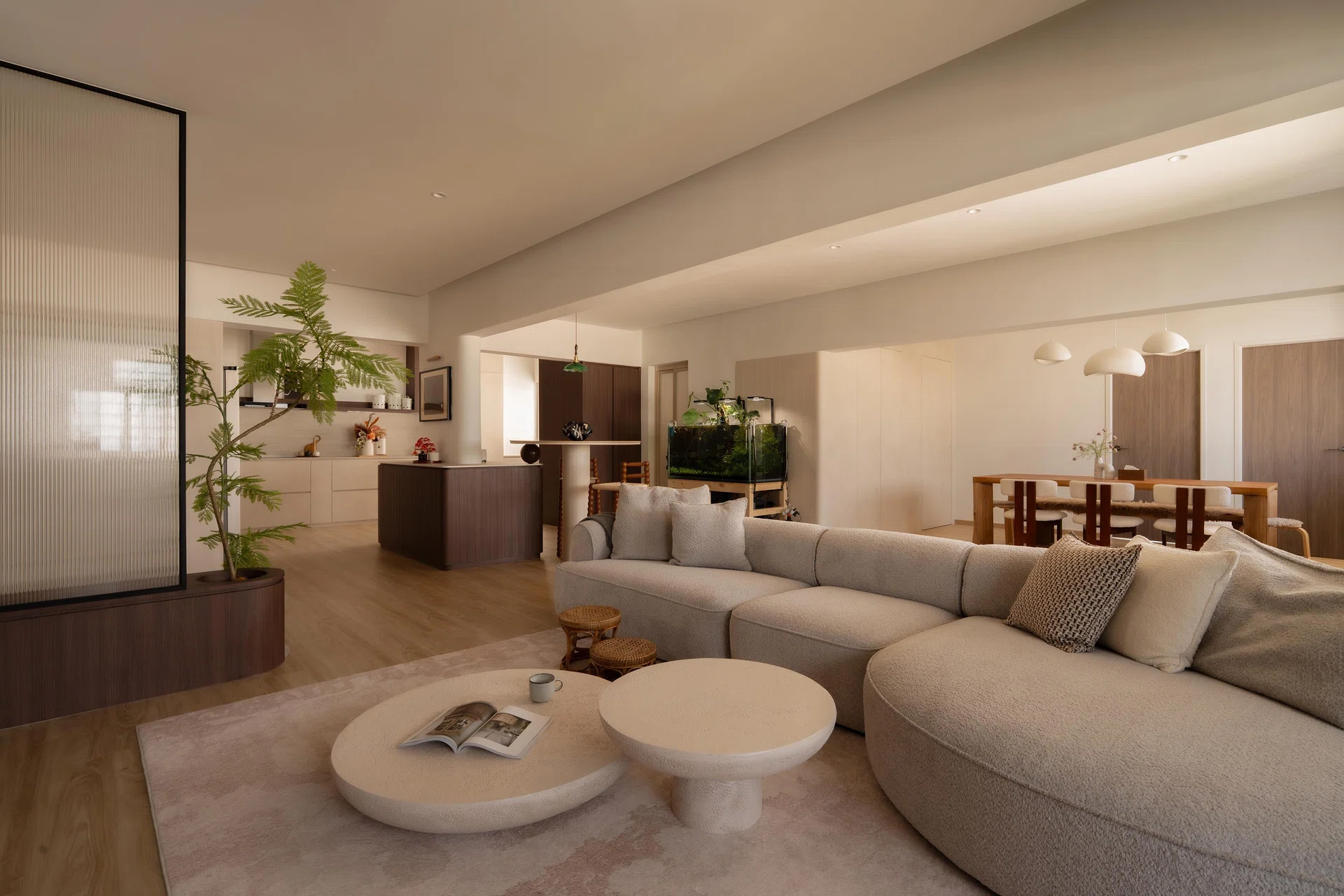
This was their second home, and the contrast with their first was intentional. Where their previous apartment leaned darker in mood, this time they wanted something lighter, warmer, and more open. “We still chose an open concept,” Yayu says, “but the original layout was very blocked. The living room and dining were separated by another room, so we tore that down to make one big space.”
Who Lives Here: Ridzwan, in the ship supply industry, his wife Yayu, a pre-school teacher—both in their thirties, and their two children aged eight and six
Home: A resale HDB Executive Apartment in Choa Chu Kang Central
Size: 1,571 sq ft
Interior Designer: Gary Chong, Ovon Design
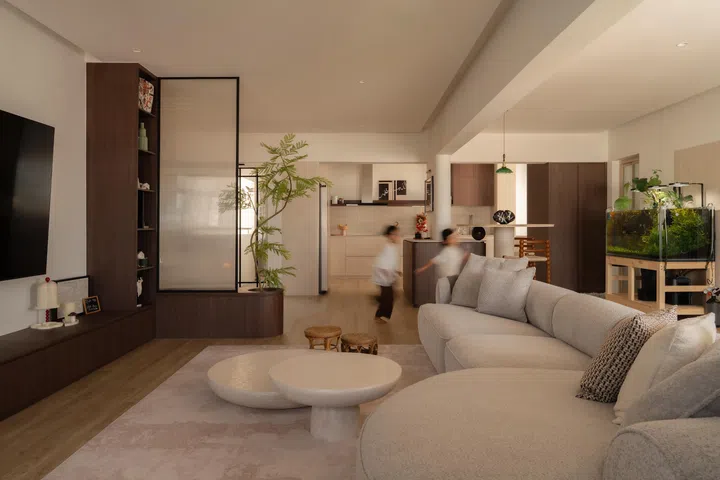
With walls removed and circulation freed up, the central living area becomes a shared zone where children can run, play, and move easily between spaces.
Choosing the right interior designer
For Ridzwan and Yayu, choosing their interior designer might have begun with visuals but was ultimately decided by trust. “Portfolio is one. Their design is one,” Ridzwan says of Ovon Design, “And most important, the chemistry with the ID.”
From the first meeting, Gary Chong’s approach felt open and responsive. “He was open to ideas and also adding on to our ideas. He actually catered for us… and thought outside the box, like what can be done.”
That collaborative dynamic mattered, especially given the apartment’s original layout. “Previously the layout was quite compact because of all the walls,” Gary explains. “They had an extra room built up, and the storeroom was in the middle of the kitchen. That’s why they wanted to open up the whole area to create a bigger space for living and kitchen.”
For a family with two young boys, openness was not just an aesthetic preference but a practical one. “Because they have two kids who always run around, the theme was comfort,” Gary adds.
The solution was to remove the storeroom entirely and rework the plan as a single, continuous living, dining, and kitchen space. “We hacked away everything so there’s no storeroom left,” Ridzwan recalls. “He (Gary) came up with a few proposals and one of it worked for us.”
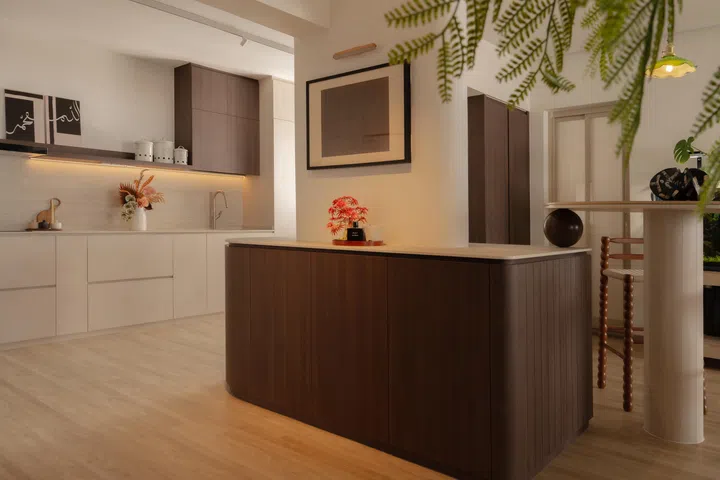
The curved kitchen island anchors the open-plan layout, designed to wrap around an immovable structural beam rather than conceal it.
Unique kitchen island and bar
One request in particular became a focal point of the home: a sculptural, curved kitchen island that sits artfully connected to a higher round bar table. “We wanted a specific round bar table connected to the island,” Ridzwan says.
When designing for this part of the brief, Gary managed to turn a structural challenge into a strong stylistic opportunity.
The complication was that a structural pillar sat right at the centre of the kitchen, immovable and unavoidable. Rather than working around it discreetly, Gary chose to integrate it into his kitchen island design.
“In the middle there’s a structural beam which cannot be removed,” Gary explains, “So I just built around it. It’s actually a rectangular beam—I curved the corners and made two rounded edges.”
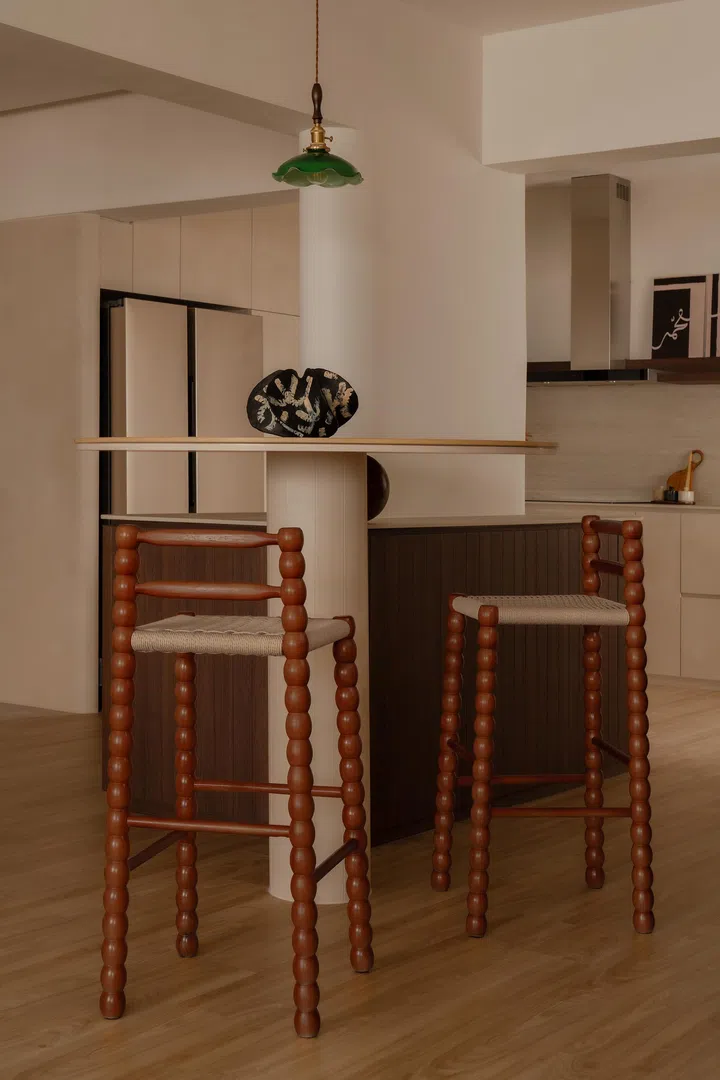
The round bar table connects directly to the island, with softened edges and custom detailing, paired with matching bar stools Yayu sourced from Taobao.
The result is an island-and-bar configuration that feels intentional rather than compromised. The bar table wraps lightly around the beam, its rounded profile softening the structure and allowing it to read as part of the design rather than an obstruction.
The high bar table sits adjacent to it, joined by a solid wooden ball. Matching bar stools, sourced by Yayu, further echo the rounded language through their turned, ball-like detailing.
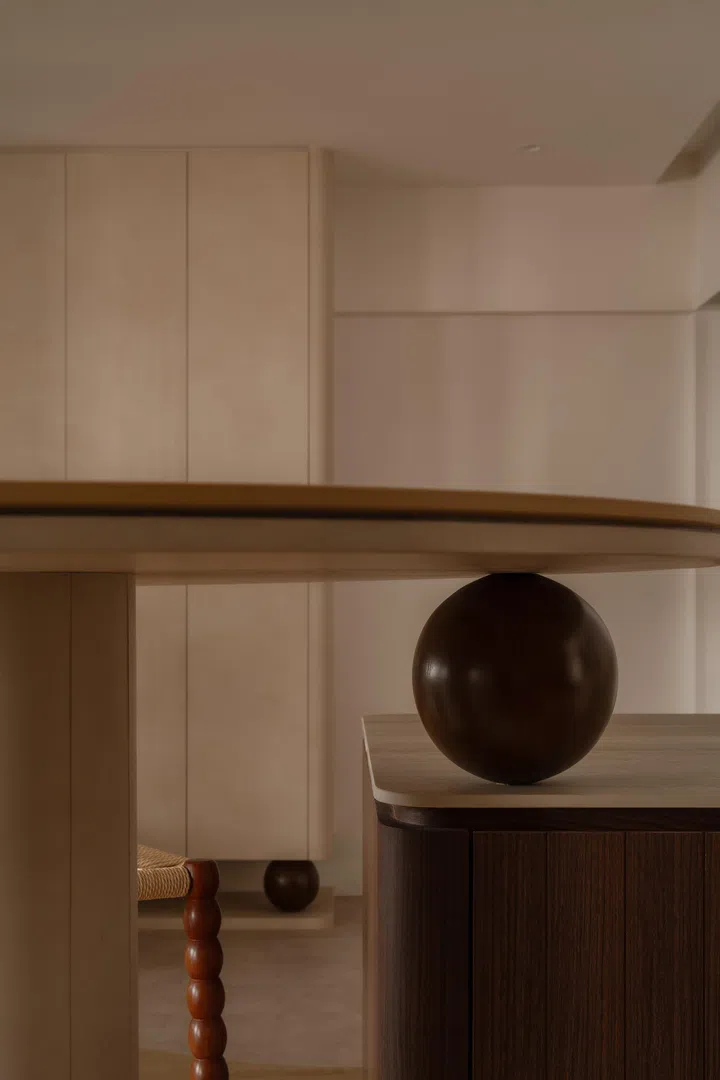
A wooden sphere physically and visually links the island and bar table, reinforcing the home’s curved language.
“He wanted an island connected to a bar,” Gary says. “So the idea was that the island and bar table had to be connected.” To visually and physically link the two, he introduced a rounded, ball-like connector beneath the bar—a playful yet grounding detail that gives the structure its distinctive character.
For Ridzwan, the bar has also become his favourite spot in the house. “I would spend most of my time at the chair,” he says. “I drink coffee there, feed my fish, sometimes we do our work there also.”
Positioned between the kitchen and living area, it allows him to stay connected to the rest of the home. “Sometimes we eat there instead of using the whole dining area,” he adds. “We’ll be there, and the kids will be playing at the sofa area watching TV.”
Integrated into the pillar beside the bar is an art piece the couple bought during their honeymoon. Yayu shares: “It’s the map of Middle-earth from Lord of the Rings. We bought it from Hobbiton in New Zealand, so when we see this picture it will take us back to the place.”
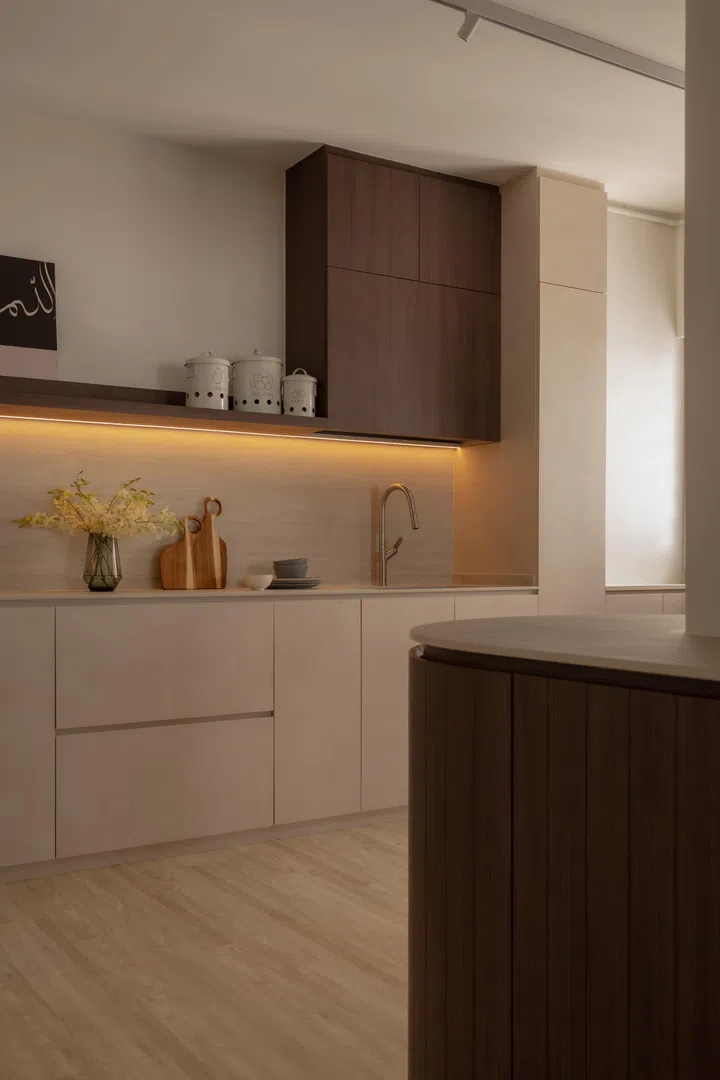
In the kitchen, open shelving replaces heavy upper cabinets, keeping the space light and visually connected to the rest of the home.
Light and airy kitchen
Behind the island, the kitchen continues this sense of openness and restraint. Full-height cabinets are kept to a minimum, with upper storage replaced by open shelving.
“They don’t like a heavy top,” Gary notes. “That’s why there’s only shelving at the top. Instead of a full cabinet, we only do shelving.” This pared-back approach allows light to travel more freely through the space, keeping sightlines open between kitchen, dining, and living areas—an important consideration for a family with two young children.
Functionally, the kitchen was also rethought from the ground up. The original layout had included a storeroom awkwardly positioned within the kitchen. As part of the reconfiguration, Gary managed to relocate the storeroom and align it neatly with the shifted master bedroom door.
Storage, while generous, is deliberately kept low and unobtrusive.
“We wanted minimal, but still needed the storage,” Ridzwan explains. “We didn’t want tall units around, and he managed to make storage in the low shelves instead.”
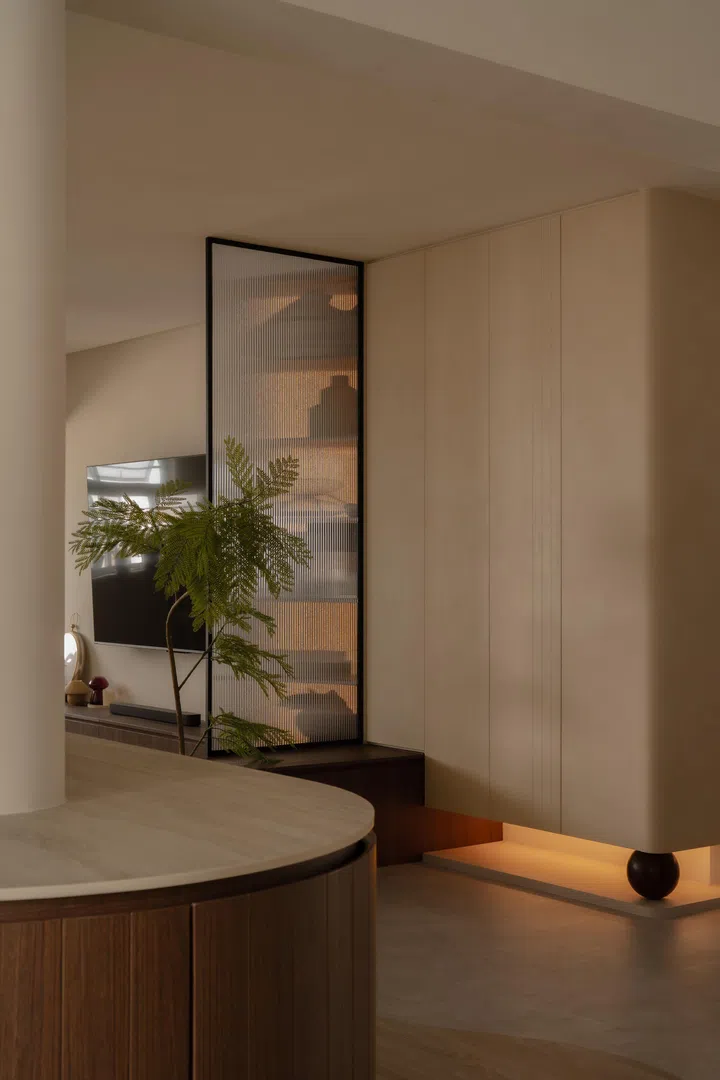
The same rounded motif reappears at the foyer shoe cabinet, creating a subtle design thread between arrival and living spaces.
Reinforced curved motif
The rounded language introduced at the island does not stop there. Once the bar design was resolved, Gary chose to repeat the same ball motif at the shoe cabinet in the foyer. “From here, it’s a bit weird to have only one ball,” he says. “So I added another ball at the shoe cabinet so the whole area is one theme, connected together.”
While one is fixed into the island to stabilise its structure, the other sits loosely beneath the foyer cabinet, moveable and decorative in nature. Together, they create a quiet visual thread between arrival and living space—a detail that reveals itself slowly rather than announcing itself upfront.
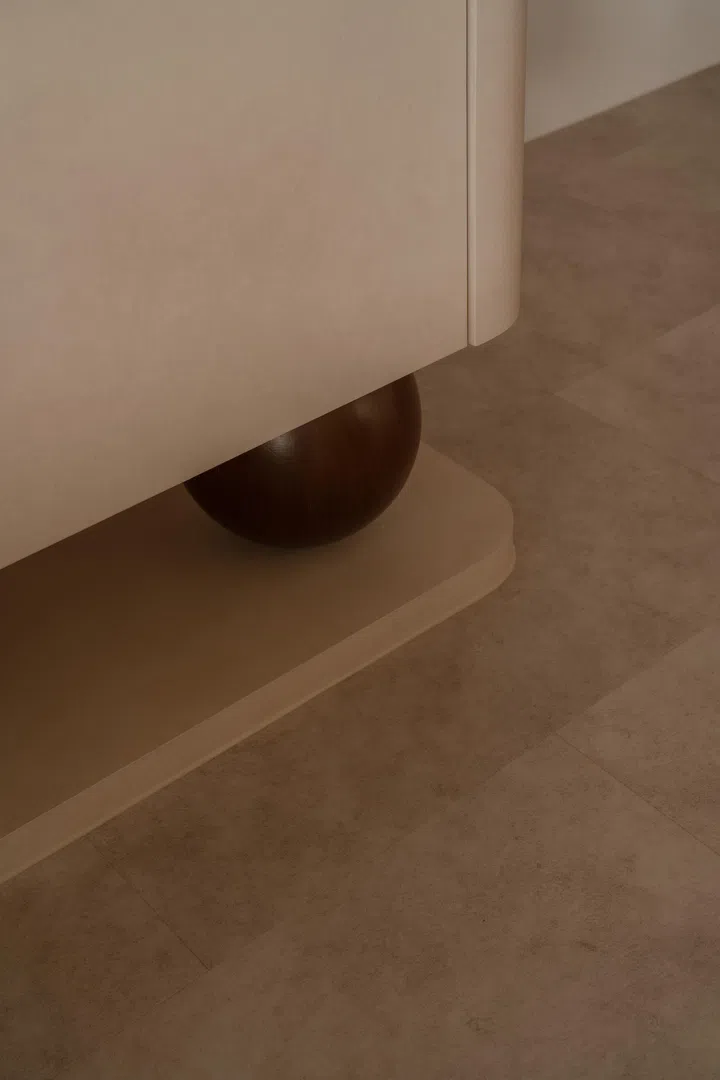
Seen up close, the timber sphere grounds the cabinetry while adding a tactile, sculptural detail to the otherwise restrained palette.
Taken as a whole, the living, bar and kitchen are less about making a statement than about resolving multiple needs at once: openness, safety, storage, and warmth. It is a space shaped as much by how the family moves and gathers as by the constraints it had to work around—and in that balance, the design finds its ease.
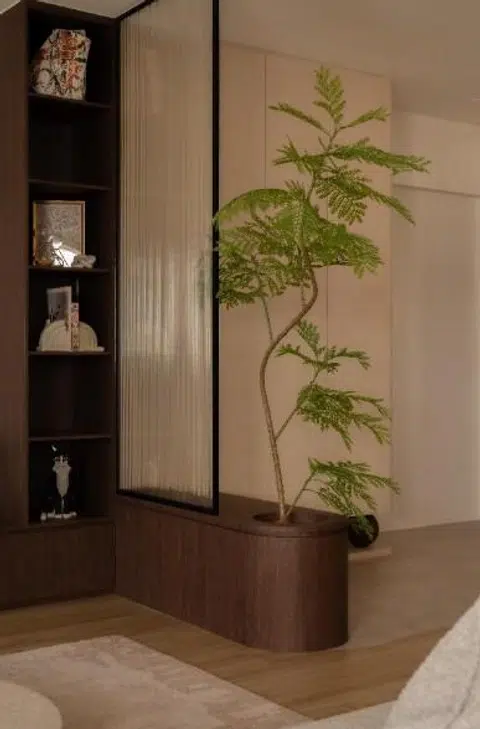
A curved planter and fluted glass screen define the foyer as a soft threshold, allowing light and greenery to filter gently into the living space beyond.
A thoughtful threshold at the entry
For Yayu, the entrance is one of her favourite parts of the home. “I like the entrance area,” she says. “There’s two-toned flooring. I told him I wanted an area at the entrance where we can wear shoes and not dirty the floor.” Rather than separating the space physically, Gary proposed defining it through materials instead.
“Even the vinyl flooring, we created a curved design at the foyer,” Gary explains. “Different material—here is wood pattern, here is cement pattern—to give a foyer feeling. It’s still vinyl, it’s just a different texture of vinyl.”
The shift is subtle but deliberate. The curved junction between the two finishes softens the threshold, allowing the entry to feel distinct without being closed off from the rest of the home.
Practical in use yet gentle in expression, the flooring transition quietly signals arrival, grounding the foyer as a functional zone while preserving the openness of the overall plan.
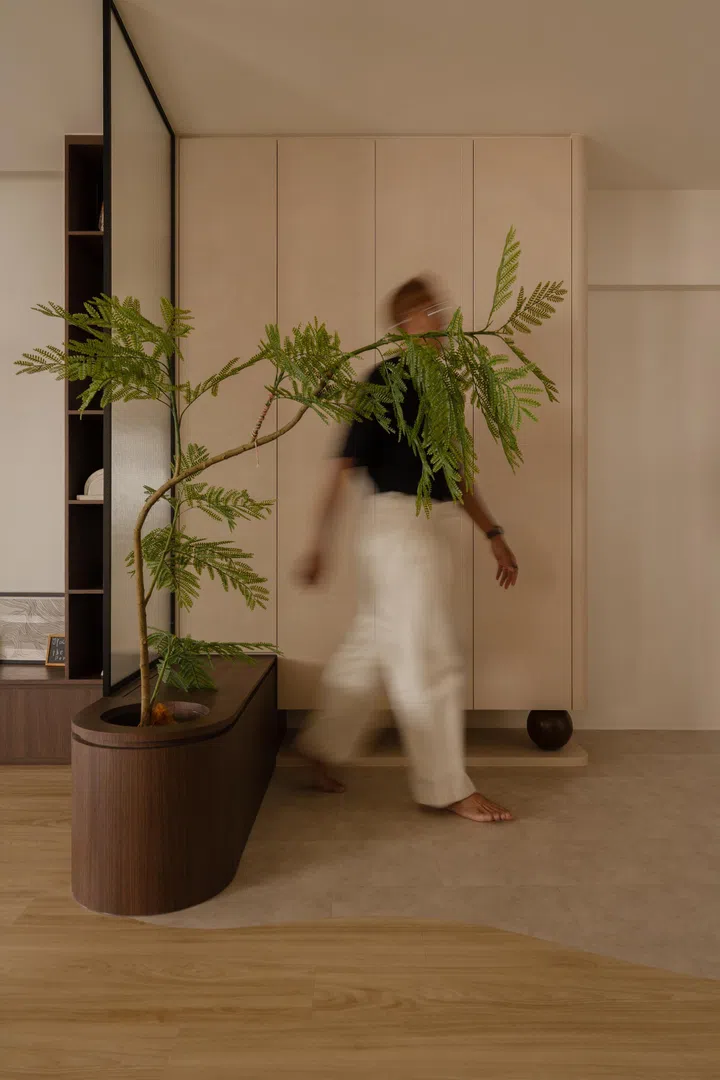
A curved transition in vinyl flooring defines the foyer as a practical shoe-on zone, subtly separating the entry from the rest of the home.
Just beyond the flooring transition, a built-in planter anchors the entry. The inclusion of greenery was intentional from the start. “The plant there was also what we wanted,” Ridzwan says. “I said I wanted to put a big plant there and he came up with this design.”
For Ridzwan, who spends his free time aquascaping and caring for fish and plants, greenery was never meant to be decorative, but part of how the home is lived in.
A fluted glass panel frames the planter, offering a degree of separation without blocking light or views. “We really like the fluted glass,” Ridzwan adds. “Because in the evening, the light will cast a shadow with the plant.” As daylight fades, the entry takes on a softer character, with shifting silhouettes that subtly mark the transition from outside to inside.
Together, the two-toned flooring, built-in planter, and filtered light create an entry sequence that is both practical and expressive—one that reflects the homeowners’ routines as much as their sensibilities, setting the tone for the spaces that follow.
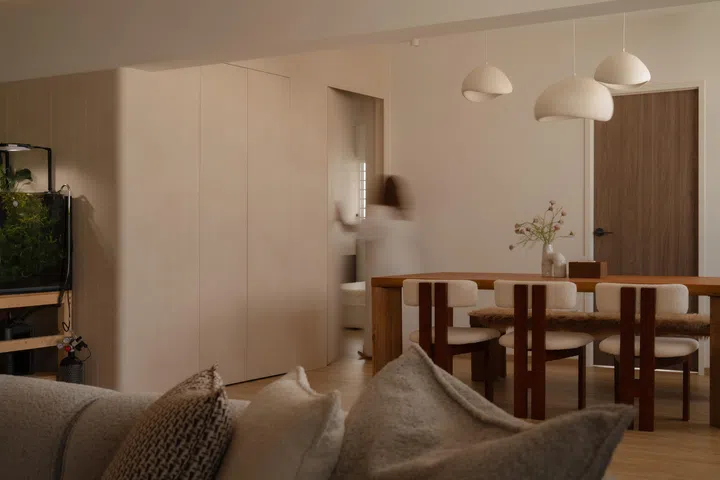
The dining area is framed by pale timber joinery that conceals doors and storage, keeping the space visually calm and uncluttered.
Everyday dining, centred on routine
Set between the bedrooms and living area, the dining space is where the family’s day most predictably begins. For them, it anchors a daily rhythm that feels simple and grounding.
“On a normal day, we’ll wake up and eat breakfast together, then send them to school,” Ridzwan and Yayu share. “Breakfast is in the dining area.” The table is positioned to stay visually connected to the rest of the home, allowing the space to feel active and lived-in rather than reserved or restrictive.
Visually, the dining area is kept deliberately calm. Pale timber joinery wraps the wall beside the table, concealing doors and storage in plain sight so that circulation remains unobtrusive. When closed, the doors to the master bedroom and storeroom read as part of a continuous timber surface, preserving a sense of serenity even during the morning rush.
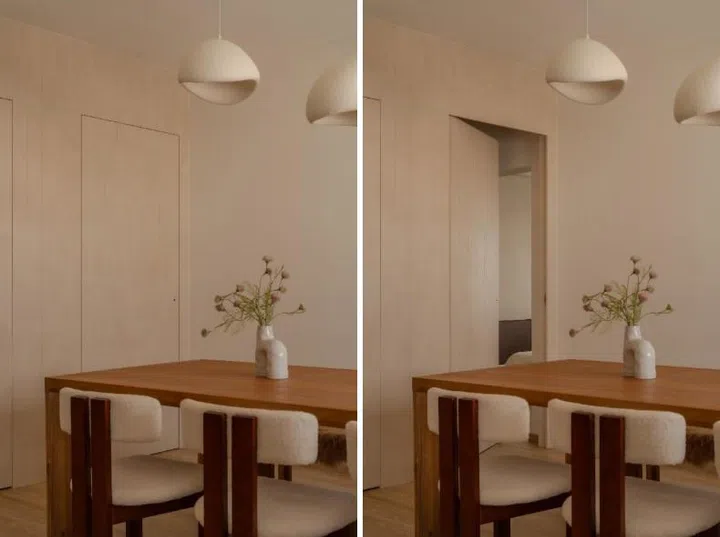
Concealed doors recede into timber walls, while rounded furniture and sculptural pendants create a calm, everyday dining setting.
Furniture choices reinforce this sense of ease. Softly upholstered dining chairs and rounded pendant lights introduce warmth without visual weight, while the table’s generous proportions allow it to accommodate family meals, homework, and occasional gatherings.
In keeping with the rest of the home, nothing here is overly fixed or formal—the dining area is designed to adapt quietly to how the family moves through each day.
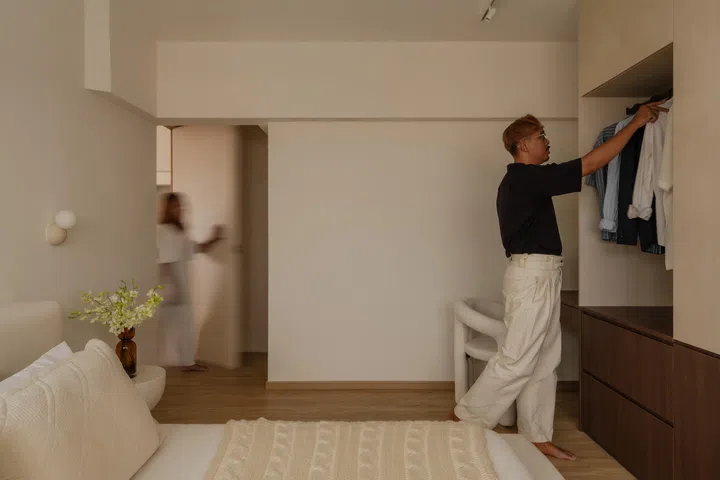
In the master bedroom, a long wardrobe wall conceals storage, with an open hanging zone designed for jackets worn once.
Master Suite
The master bedroom design began with a clear, simple brief. “We just told him we want a long wardrobe, and a king-sized bed,” Ridzwan shares, explaining that they left the rest to Gary.
“We love it. We love the colour scheme. It matches throughout the whole house—a continuous design.” The result is a room that that sits comfortably within the overall home, guided by proportion and material consistency rather than overt decoration.
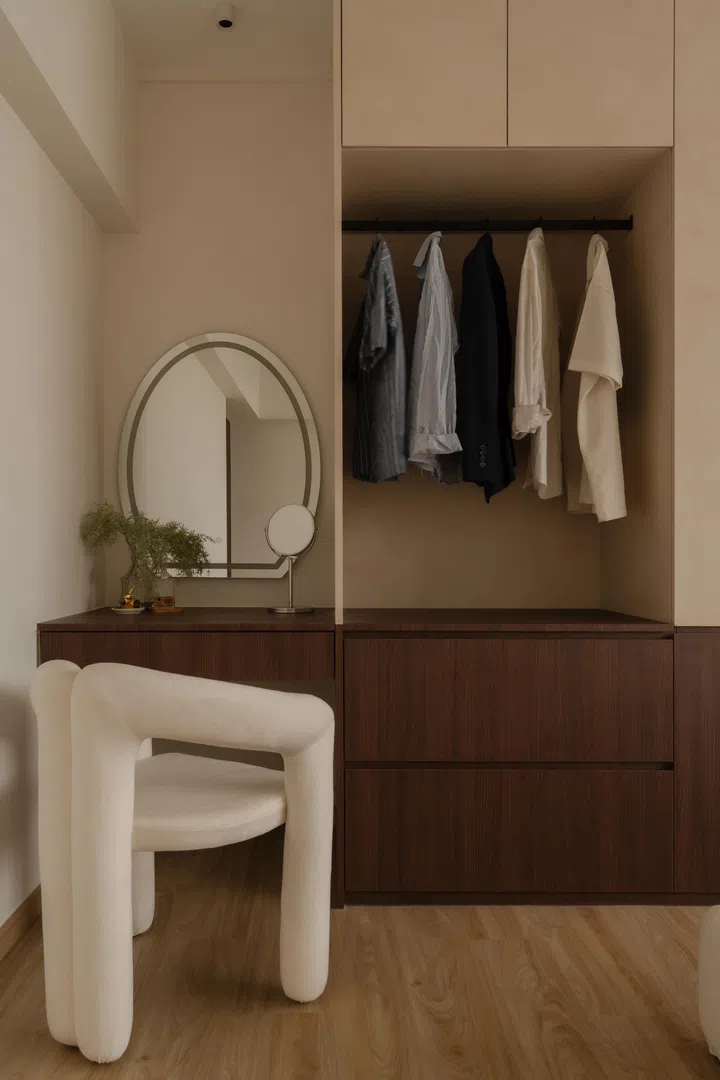
A one-piece wardrobe door maintains visual continuity, aligning with the home’s calm, unified colour scheme.
One detail Yayu points out is the wardrobe frontage. “The door is one piece even though it looks like two doors,” she says, referring to the full-height treatment that keeps the wall visually calm.
Within this, Gary introduced an open hanging zone as a practical layer. “Ridzwan always wears a jacket,” he explains. “They’re quite fashionable, so I created an open wardrobe for them to hang the jackets, when only worn once.”
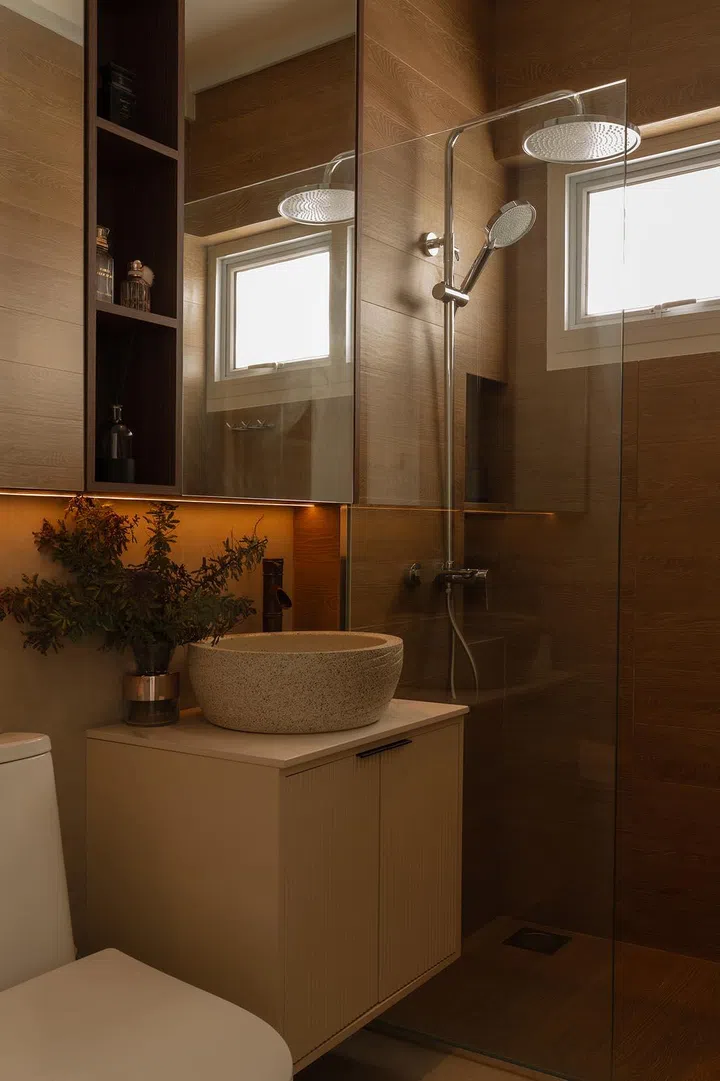
Wood-look tiles, built-in niches, and concealed storage behind the mirror maximise function within a compact master bathroom.
Master Bathroom
The master bathroom continues the same restrained language, adapted carefully to a compact footprint. “A bit japandi feeling for the bathroom,” Gary notes. Ridzwan explains that space was a key constraint. “Our toilet is actually quite small, but he managed to come up with this design to suit what we wanted.”
Material choice plays a central role. “We like the wood-look tiles. Looks like wood but they are actually tiles,” Ridzwan says. Storage is handled discreetly through built-in solutions.
“He managed to put a niche area in the false wall for our toiletries, to make it look as neat as possible… behind the mirror is all storage too.” Within a tight layout, the bathroom balances warmth, functionality, and visual order without feeling crowded.
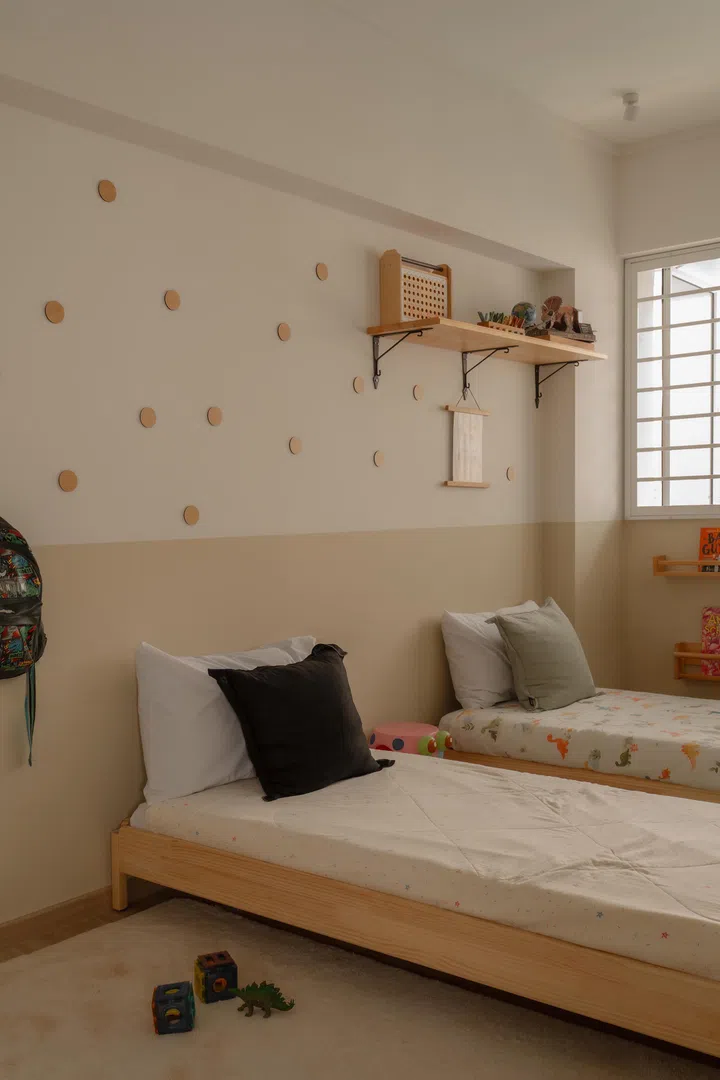
A simple children’s bedroom is kept light and flexible, with low beds and open wall shelving for everyday play and rest.
$99,000 Renovation cost
The renovation took approximately three months from the start of hacking to completion. The $99,000 budget covered core renovation works, including hacking, carpentry, rewiring, and the reconfiguration of the kitchen and storeroom, as well as works to the bedrooms and bathrooms.
Much of the investment was directed towards layout changes and tailored built-in solutions, rather than feature finishes.
Taken together, the completed home reflects a considered allocation of resources—one that prioritises comfort, openness, and continuity over feature-driven statements. For Ridzwan and Yayu, that clarity was always intentional. “This is our retirement house,” Ridzwan says. “We’ll see, because our kids are quite small, but we can see ourselves living here for the next 15 years.”