
Books, booze, broads and billfish - not necessarily in that order - were central to Ernest Hemingway's way of life. A constant supply of each was available to the Nobel prize-winning author in Cuba, the Caribbean island where he felt most at home.
Hemingway was machismo personified, roaming war zones and exotic destinations in search of prey, perspective and like-minded people. In 1939, after shuttling between his home in Key West, Florida and a hotel room in Havana (where he could write in relative peace), Hemingway and his soon-to-be third wife, war correspondent Martha Gellhorn, rented a single-storey colonial house set in large grounds in the quiet suburb of San Francisco de Paula, about 12 kms southeast of Old Havana.
The following year, they bought it for US$18,000, reportedly with royalties from For Whom the Bell Tolls. The hilltop house, named Finca Vigia (Lookout Farm), was built in 1886 and surrounded by 10 acres of gardens with a long, tree-lined driveway and views of Havana in the distance.
Hemingway spent the last two decades of his life here. His time in Cuba was bookended by tumultuous events (a World War and a Communist Revolution) but in between, the man locals called 'Papa' wrote, fished, drank and entertained a stream of friends - from ordinary Cubans and Spanish bullfighters to Hollywood stars and fellow titans of the literary world.
He met Fidel Castro only once, when the Cuban leader was guest of honour at Hemingway's annual billfish tournament in May 1960. In July, the writer left for Key West, and he never recovered his good form: plagued by depression and thoughts of suicide, he shot himself in Idaho in 1961.
Fellow author Graham Greene visited Hemingway and made a comment about the difficulty of writing while surrounded by so many dead animals
The house was appropriated by the Cuban government and left uninhabited - still filled with Hemingway's belongings - until it was restored and turned into a museum in 1994. Valuable items such as paintings by Miro, Klee and Braque and autographed books by his contemporaries are long gone but even though visitors are not permitted to enter the home, they can peer into the rooms through open windows and doorways for a rare glimpse at the author's home life.
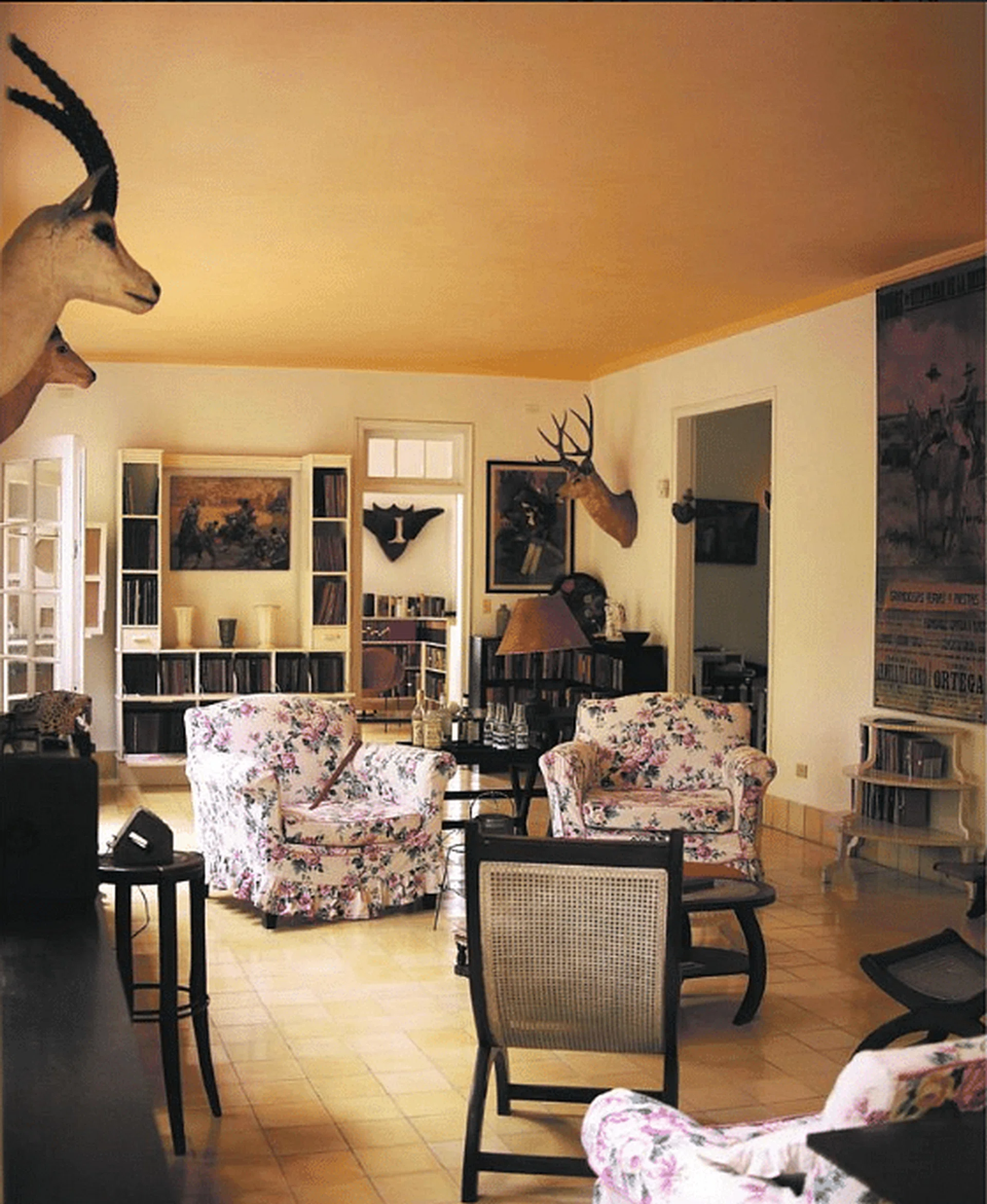
As befits a literary legend, books played a major role in Hemingway's home life - there were once an estimated 9,000 of them in Finca Vigia on subjects ranging from history and geography to biographies, fiction and fishing. He was an avid reader and book-filled shelves still line the walls in every room. Random books and period magazines are scattered throughout while trophy antelope heads - souvenirs from his African safaris - hang from the walls.
A record player and vinyl collection (classical and jazz) are stashed in a corner of the high-ceilinged living room, while bottles of liquor are visible on a table between two armchairs. A large library, a dining area and Hemingway's bedroom and study form the core of the main house. Hemingway was an early riser who liked to write (in longhand) standing up and dressed in his trademark floppy cargo shorts, using the bookcase next to his bed as a desk. Occasionally, he also used a typewriter. On average, his output was between 400 and 700 words daily, perhaps 1,000 on a good day.
His white-tiled bathroom wall is marked (in his barely-legible handwriting) with detailed records of his weight during his final years in the house. He was a big, burly man but in later years he was hampered by poor health and chronic back pain - a legacy of too much adventuring and two airplane crashes in Africa.
In a separate tower building adjacent to the main house, a study on the top floor (built during fourth wife Mary Welsh's tenure), gave Hemingway a private space where he could write undisturbed and enjoy the view, which often involved gazing through a telescope at the parade of beautiful women who graced his pool. The actress Ava Gardner was a regular guest - possibly because she was partial to swimming in the nude.
At the bottom of the garden, near the swimming pool and in a spot where there was previously a tennis court, is Hemingway's beloved wooden sport-fishing boat, the Pilar, up on blocks and in dry dock. During his lifetime, it was berthed in Cojimar, a small fishing village just east of Finca Vigia and the setting for The Old Man and the Sea.
Hemingway pilgrims who make their way to Cojimar (ideally in a classic convertible) will stop at El Torreon, a small 17th-century fort that guards the entrance to Cojimar Bay. Behind it is a small pavilion with a bust of Hemingway, cast from melted-down brass fittings donated by local fishermen. A plaque reads, in part: "In grateful memory from the population of Cojimar to the immortal author of The Old Man and the Sea."
Written by Geoffrey Eu for The Business Times