
Home Tour: $220,000 Monochrome renovation for a 4-storey terrace house in Jalan Tari Piring
A former single-storey home is rebuilt into a four-level house shaped by personal involvement, material intent, and a deeply lived-in sense of comfort.
By Gwyneth Goh -
Share this article
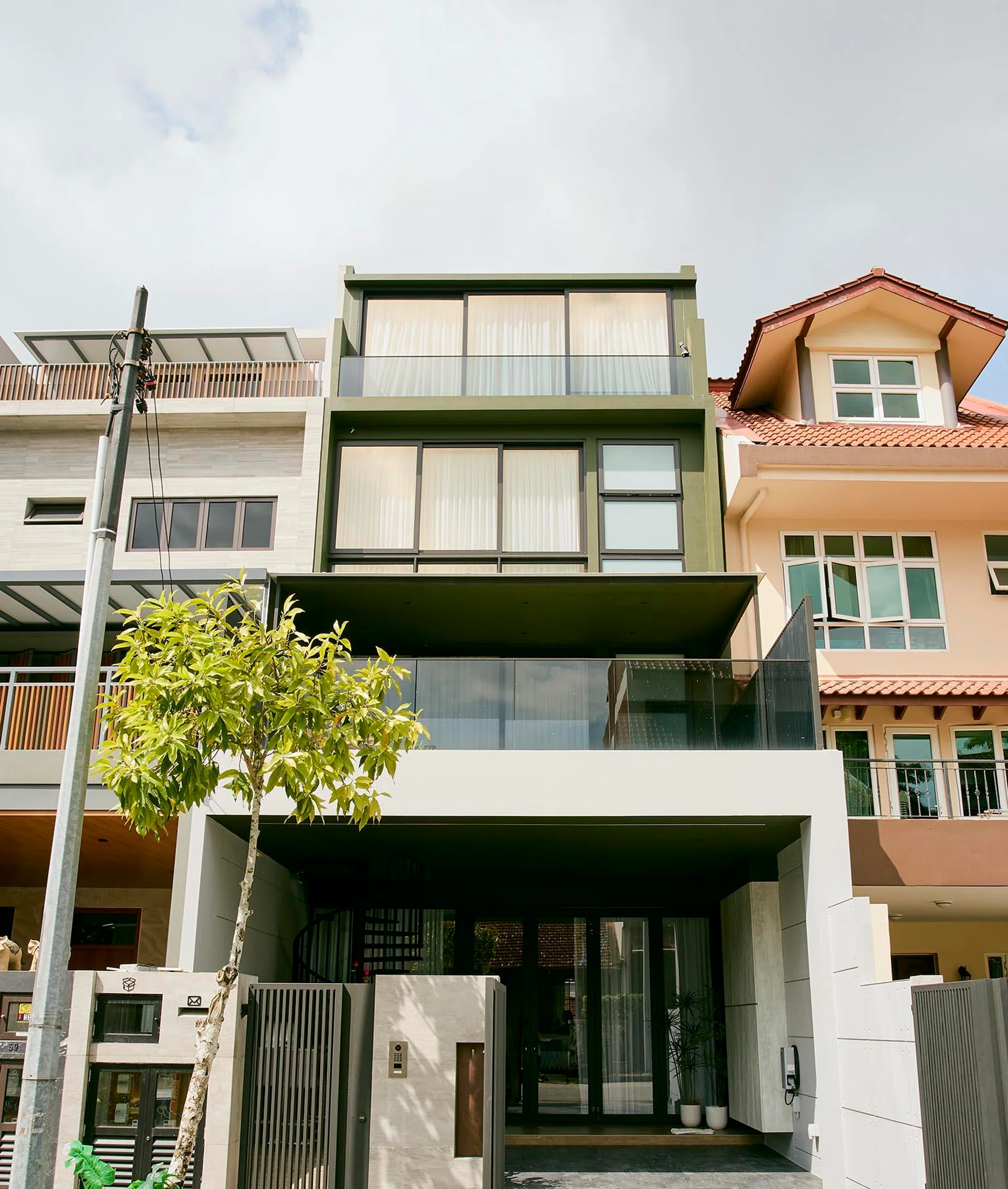
The decision came first, long before the design. What began as a single-storey home became, over two and a half years of rebuilding, a four-level house shaped by circumstance, commitment and an unusually hands-on process.
“We were caught off guard… if we didn’t go along, we would be in the middle of two high-rise houses,” the homeowners recall. “So we had a deep thought and decided to bite the bullet.”
What stands today is a sharply defined, boldly angular structure—but inside, the experience is deliberately more measured. Designed by Kelvin Teo of Space Sense Studio as “a dark, monolithic interior… to create a sleek yet warm architectural living experience,” the home balances bold material expression with a sense of calm that unfolds gradually through light, proportion and movement.
The pairing came about through Christine. “She came across Kelvin through Home & Decor—his own house,” Winston shares. “We saw his work and felt we could relate to him… we wanted to connect on almost the same level.”
Who Lives Here: Winston Loh (59) and his wife Christine (48), both self-employed and working from home in the oil and gas trading industry
Home: 4-storey terrace house in Jalan Tari Piring
Size: Approx. 4,500 sq ft
Interior Designer: Kelvin Teo, Space Sense Studio
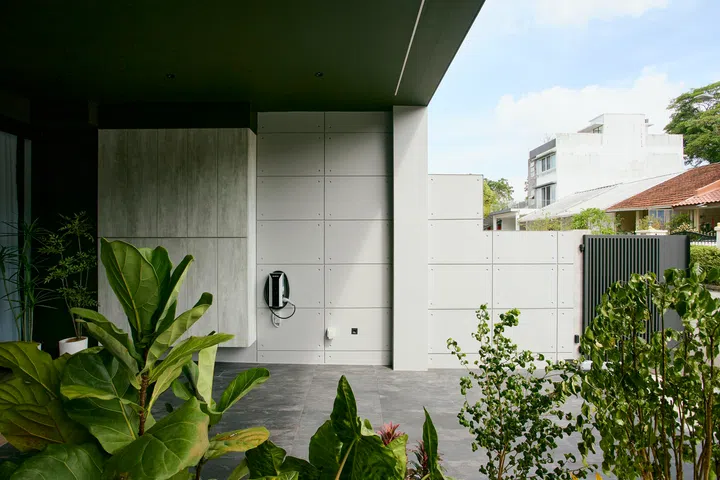
A sheltered front court introduces the home with a restrained palette of concrete, greenery and clean-lined surfaces, setting up a quieter transition from the street.
Rebuilding Under Pressure
The house began not as a design brief, but as a decision shaped by circumstance. For years, Winston and Christine had been living in a single-storey home on the same site, “small, cosy, comfortable,” with “no intention to rebuild at all for as long as possible.”
That changed when their neighbour initiated a rebuild, setting off a chain of considerations the couple had not anticipated. What followed was a two-and-a-half-year process marked by uncertainty, adjustment and sustained involvement. “This journey… is not easy, and we underwent quite a lot of obstacles, challenges, delays,” Winston shares.
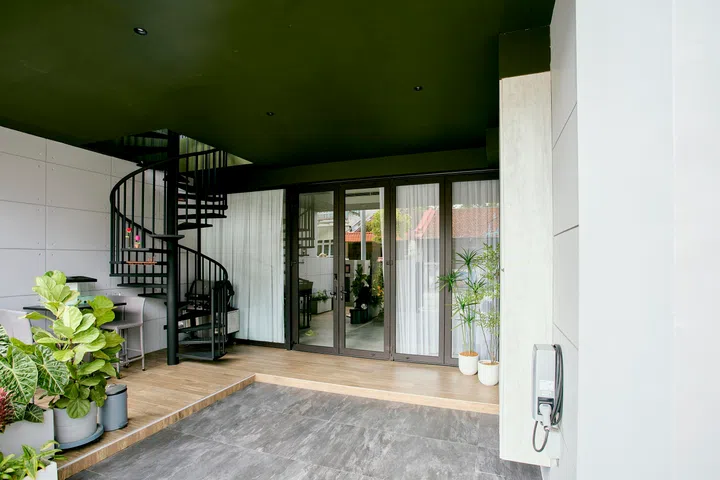
A spiral staircase anchors the semi-outdoor entry zone, where sliding glass doors and full-height curtains mark the shift from exterior to interior.
Getting Hands On
The project was undertaken alongside their neighbouring house, with a contractor who was relatively new to landed builds. As a result, the couple took on a more active role than expected. “We have to sort of speak up a lot to tell them what we really wanted,” he says, explaining that many elements, including windows and finishes, were sourced independently rather than through standard provisions.
That level of involvement became central to how the house eventually took shape. “We got ourselves deeply involved… there’s really a fair bit of personal involvement,” Winston notes. “Then things can turn out to be the way you want it to be.”
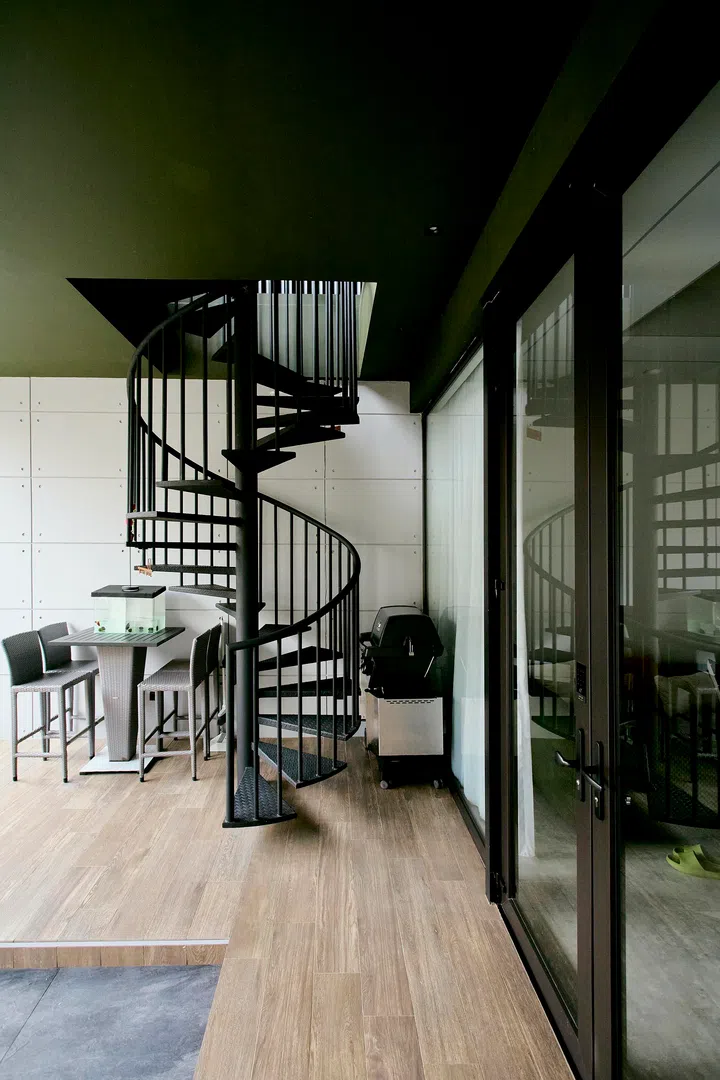
The spiral staircase at the car porch provides direct access to the second floor, allowing the upper level to function independently as a future rental space without passing through the main home.
Beyond the build itself, the process also extended into day-to-day logistics. The couple had to find temporary accommodation during a period of tight rental supply, eventually securing a place close enough to remain hands-on throughout construction. Unexpected conditions also surfaced along the way. “They found out our pipe is from the first generation… so corroded and degenerated… we had to replace,” he recalls.
From the outset, however, the rebuild was not approached as a purely technical exercise. The intention was always to create a home that could support how they live and work, with the first level designed as a primary, all-in-one space for daily use. What emerged is a house shaped not just by design decisions, but by a continuous process of evaluation, problem-solving and personal commitment.
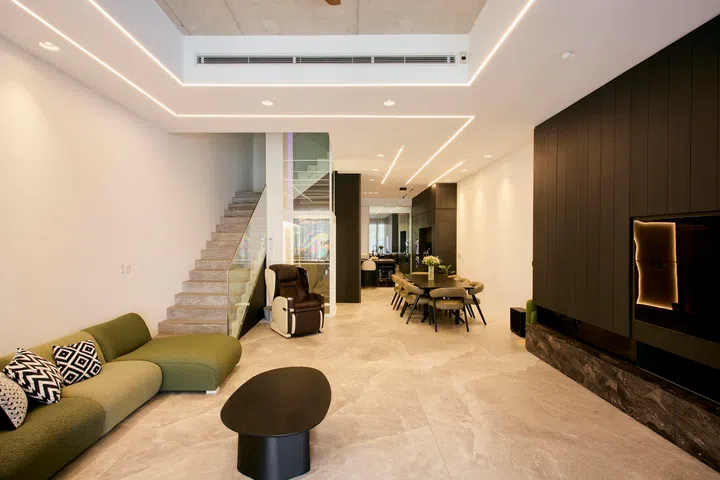
The ground floor unfolds as a single, continuous space, with the living, dining, and kitchen aligned along a clear axis that emphasises openness and ease of movement.
The Ground Floor: Where They Spend Most of Their Time
Stepping in from the shaded car porch, the house opens immediately into a long, continuous living space where the boundaries between functions are deliberately softened.
The living room sits at the front, anchored by a low, curved sofa and a pared-back palette that keeps the focus on volume rather than objects. Beyond it, the dining area and kitchen unfold in a straight line, creating a clear visual axis that draws the eye all the way through the home.
For Winston and Christine, this level is where the rhythms of daily life settle. “We spend most of our time here,” they share, describing how work, meals, and downtime all revolve around this open-plan space. The decision to keep it largely unobstructed reflects both practicality and preference. The environment feels easy to move through, rather than formally arranged.
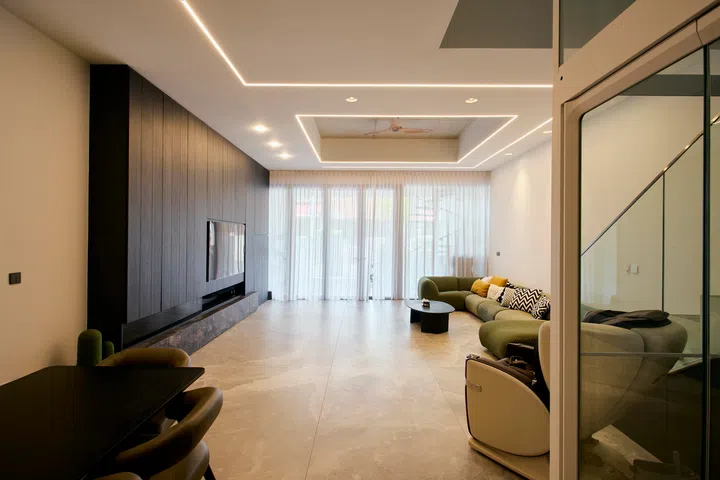
At the front, the living area is kept minimal and uncluttered, allowing natural light filtered through full-height curtains to soften the space throughout the day.
Large Format Stone-Look Slabs
Underfoot, large-format stone-look slabs unify the entire floor, anchoring the space with a quiet sense of weight and continuity.
“The large-format stone-look flooring was chosen to anchor a strong natural visual,” says Kelvin Teo of Space Sense Studio. “Because the rest of the interior language is quite controlled and linear, the flooring introduces a more organic and natural movement through its veining, which prevents the space from feeling too flat or overly rigid.”
That subtle variation softens the geometry of the architecture, while the scale of the slabs reduces visual breaks across the floor plane.
“It also complements the dark carpentry and industrial-inspired palette by adding weight, texture and a slightly raw quality,” Kelvin adds. “On a practical level, large-format flooring helps the main zones feel more expansive and seamless, which was important in maintaining the clean architectural flow of the house.”
Kelvin approached the rest of the ground floor with similar restraint, allowing proportion and lighting to do the work. Instead of layering decorative elements, he focused on clarity—aligning ceiling lines, concealing services, and maintaining a consistent material language throughout.
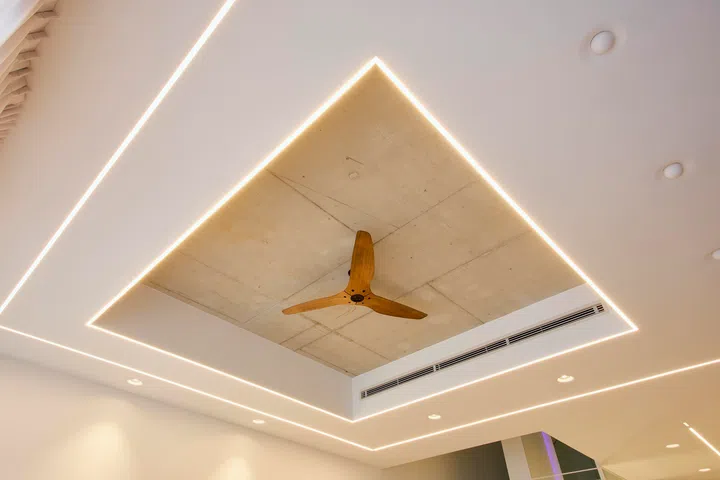
A recessed ceiling detail reveals the raw concrete slab above, framed by linear lighting that defines the space while keeping the overall palette restrained.
Recessed Ceiling
The ceiling becomes a defining gesture here. Linear lighting traces the perimeter and extends across the length of the space, while a recessed panel reveals the raw concrete slab above—an intentional contrast that introduces texture without overwhelming the room. This balance between refinement and rawness carries through the entire level, giving the space depth without visual noise.
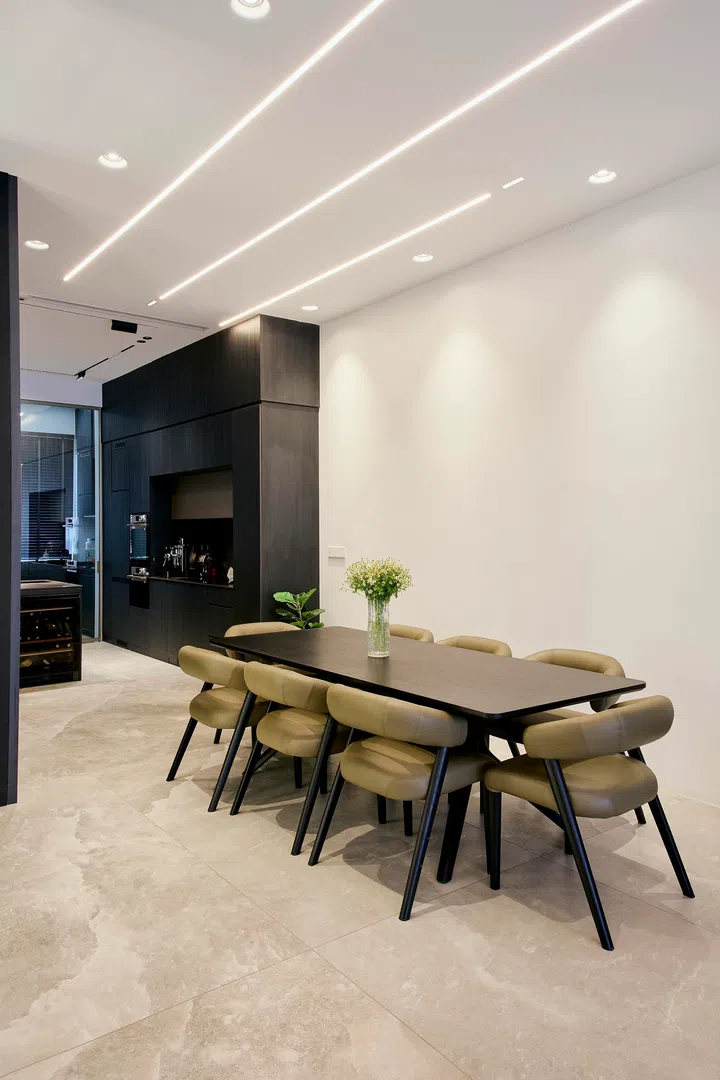
The dining area sits within the open-plan layout, defined by alignment and lighting rather than partitions, establishing a seamless connection between the living room and kitchen.
Dining: A Natural Extension of the Living Space
Set within the same uninterrupted plane, the dining area sits between the living room and kitchen, defined by placement rather than partitions. A long table aligns with the linear ceiling lights above, reinforcing the clarity that runs through the ground floor.
For Winston and Christine, this is a space that supports how they use the home throughout the day. Positioned along the main circulation path, it accommodates meals, work, and casual gatherings without requiring a shift in setting. The restrained palette continues here, allowing the dining area to remain visually connected to both ends of the home.
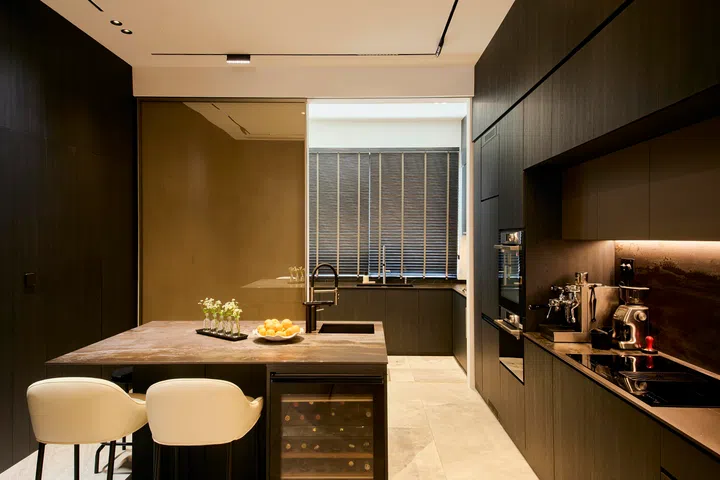
A long island anchors the kitchen, combining preparation, casual dining, and storage within a compact, highly efficient layout.
Kitchen: Concealed, Controlled, and Highly Functional
Beyond the dining area, the kitchen shifts into a more enclosed and deliberate zone, where darker tones and tighter detailing create a sense of focus. Full-height carpentry wraps the space, concealing storage and appliances behind a consistent façade that keeps visual clutter to a minimum.
At its centre, an island introduces a more tactile counterpoint to the surrounding cabinetry. Its surface carries a subtle, worn texture that complements the stone flooring, reinforcing Kelvin’s preference for materials that feel grounded and slightly raw within an otherwise controlled interior language.
“The idea was to keep everything clean and integrated,” Kelvin explains. The cabinetry reads as a continuous volume, while lighting is kept precise and understated, ensuring that function takes precedence without compromising the overall calm of the space.
At the back, a secondary preparation area sits by the window, bringing in natural light while maintaining separation from the main living zones. This layered approach allows the kitchen to support heavier use without disrupting the visual order of the ground floor.
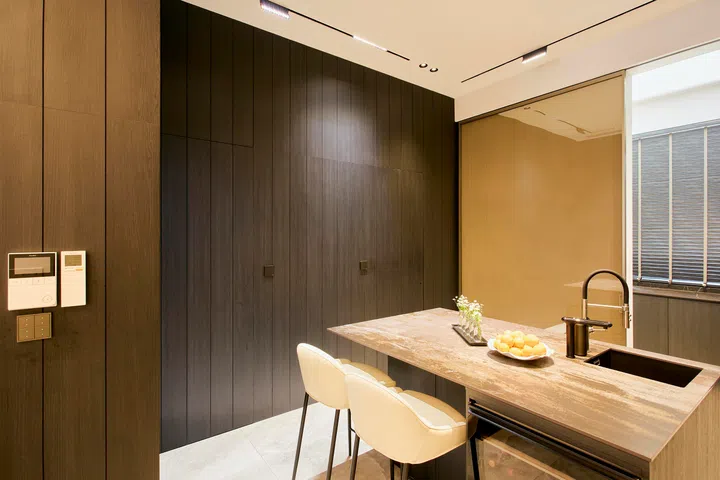
Full-height carpentry conceals appliances and storage, allowing the kitchen to read as a continuous, uncluttered volume.
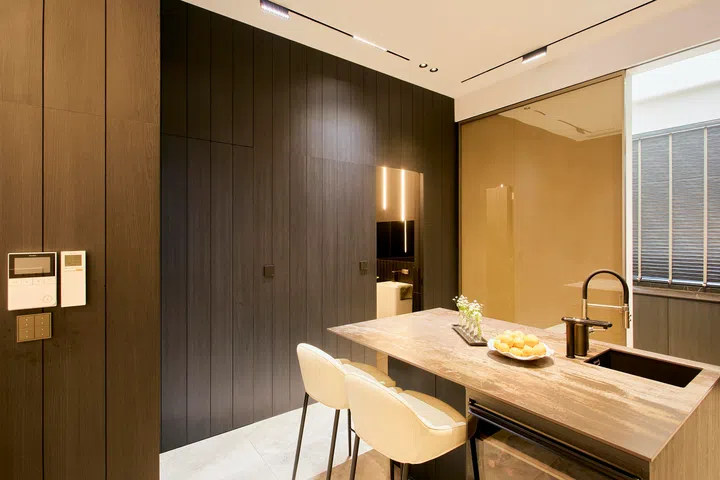
A concealed door within the dark carpentry discreetly reveals a powder room, keeping the kitchen façade clean and uninterrupted when closed.
Concealed Bathroom Door
Integrated seamlessly into the kitchen wall, a concealed door reveals a compact powder room, tucked discreetly within the run of dark panels. When closed, it disappears entirely into the carpentry, preserving the clean lines of the space.
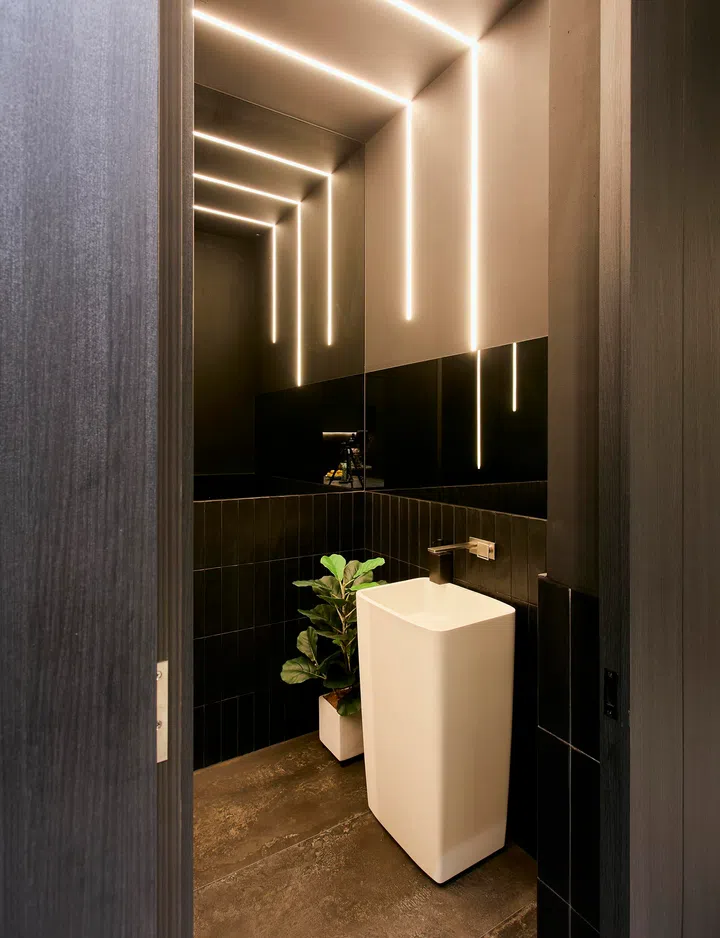
The compact powder room features dark finishing and vertical lighting for a more intimate, contrasting atmosphere.
Inside, the mood shifts. Dark surfaces and vertical lighting create a more intimate, almost dramatic atmosphere, contrasting with the openness of the ground floor. The detailing remains precise, but here it is distilled into a smaller, more enclosed experience—functional, but with a clear sense of intent.
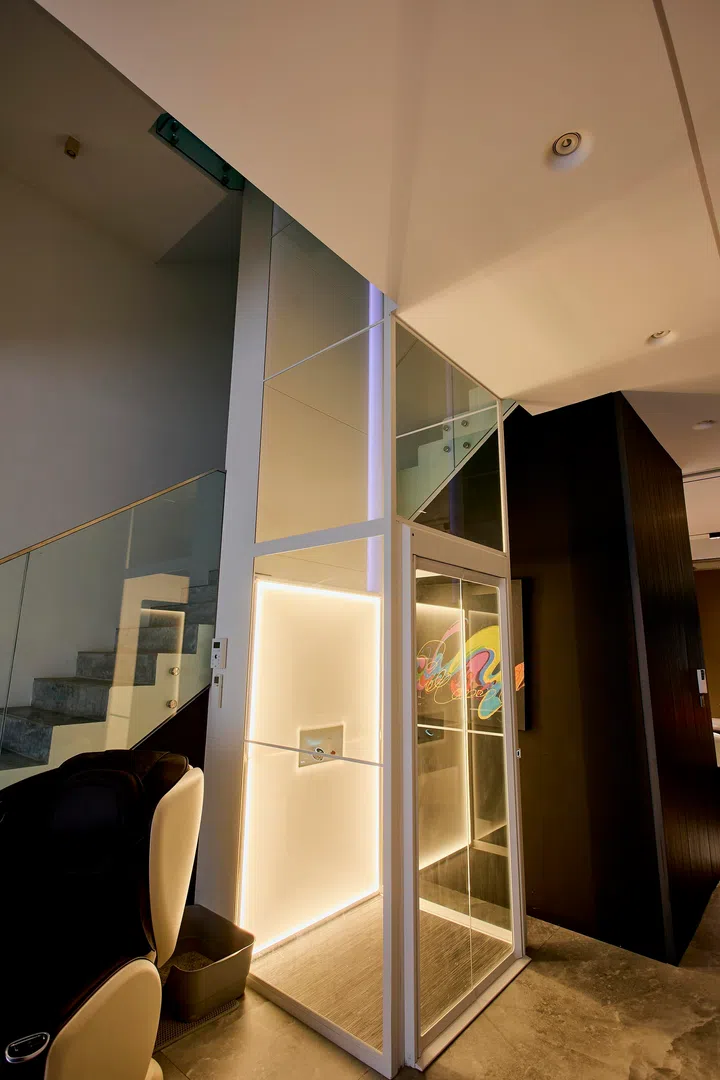
On the ground floor, the three-sided glass lift is designed as a visible feature, with integrated lighting that turns it into a focal point within the space.
The Lift: A Defining Feature
Positioned along the main circulation path, the lift is one of this home’s most distinctive features, and a part of its entire spatial experience.
“The lift—most conventionally would be behind a concrete wall type of lift,” says Winston. “So we decided to have the lift like a showpiece for the house. We went for an all-glass lift. It comprises three-sided glass; only the backing is a metal panel. With three sides all glass, it really stands out.”
Rather than treating it as purely functional, the couple leaned into its presence, enhancing its visibility with integrated lighting.
“This kind of lift also comes with special LED lighting, so when it’s lit up it can be a showpiece,” Winston adds. “Those conventional lifts—when you are inside and travelling, you cannot see anything. It’s a different feeling when you are in an all-glass lift, when you can see and be seen.”
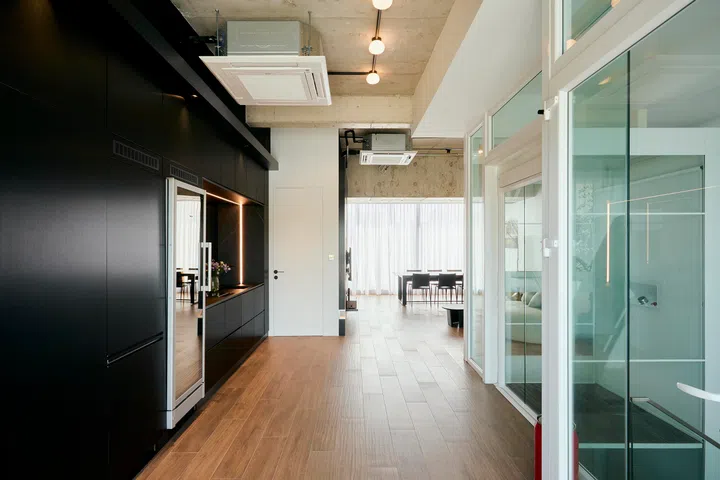
The glass lift offers a different experience from conventional enclosed lifts, with transparency that allows movement to remain visually connected across levels.
Kelvin supported this approach by positioning the lift where it could remain fully visible without disrupting the openness of the plan. The glass enclosure keeps sightlines intact, allowing the structure to sit lightly within the space while still holding its presence.
More than just a visual feature, the lift also shapes how the house is used. With four storeys to navigate, it offers a direct and efficient way to move between levels, reinforcing the home’s emphasis on long-term liveability while doubling as a focal point within the interior.
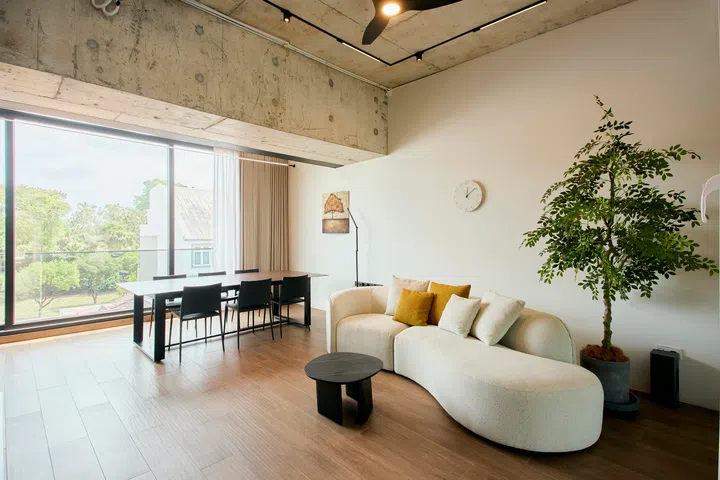
On the fourth floor, a secondary living area is designed as a more relaxed, informal space, with full-height windows opening out to greenery..
Level 4: A More Relaxed, Industrial Expression
At the top of the house, the atmosphere shifts. Where the lower levels are more controlled and linear, this floor opens up into a looser, more relaxed environment—used as a secondary living and entertainment space.
“The fourth level comprises of a study, entertainment, pantry, toilet and an open-air terrace which is located at the back of the house. So this open terrace serves as quite a chill area, especially in the evening when the sun sets,” says Winston.
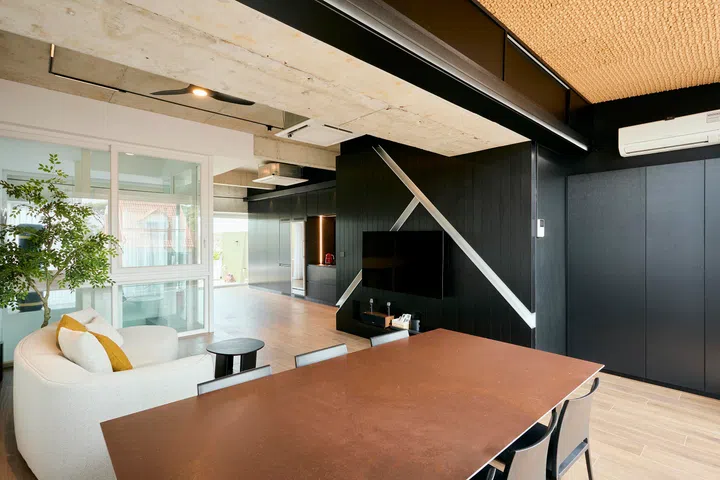
The fourth-floor space combines lounging and dining within an open layout, with the glass lift maintaining visual continuity across levels.
The material palette reflects this change in mood. Exposed concrete ceilings run across the space, left deliberately raw, while darker carpentry and black metal details introduce a more industrial tone.
“Although the home adopts a strong and darker material palette, the spatial scale of the house allowed it to carry these tones comfortably, Kelvin explains. “At the same time, the darker elements were always balanced with lighter surfaces such as the walls and ceilings.”
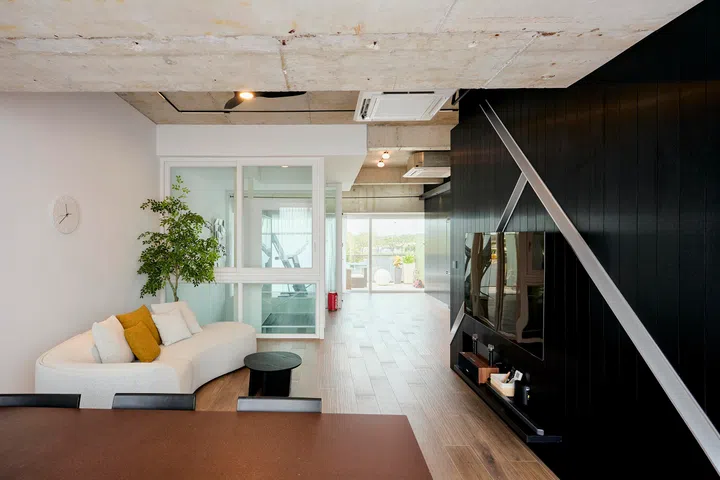
Seen from the dining area, the space extends toward the lift core, keeping circulation clear and unobstructed.
The room is also balanced by natural light and softer furnishings. Full-height windows open out to the surrounding greenery, while light curtains diffuse the daylight, preventing the space from feeling heavy despite its darker elements.
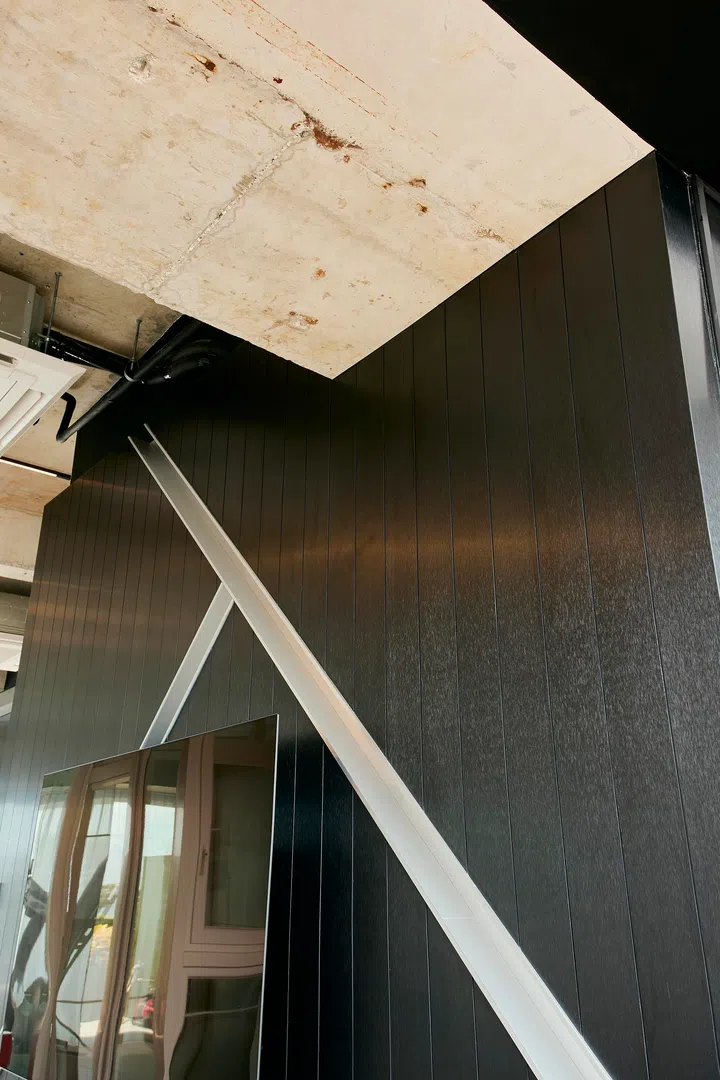
A dark feature wall with vertical detailing and a diagonal metal element introduces a stronger, more graphic expression to the space.
One of the defining features here is the feature wall behind the television. Finished in dark, vertically lined panels and intersected by a diagonal metal detail, it introduces a sharper, more graphic element into the otherwise restrained palette.
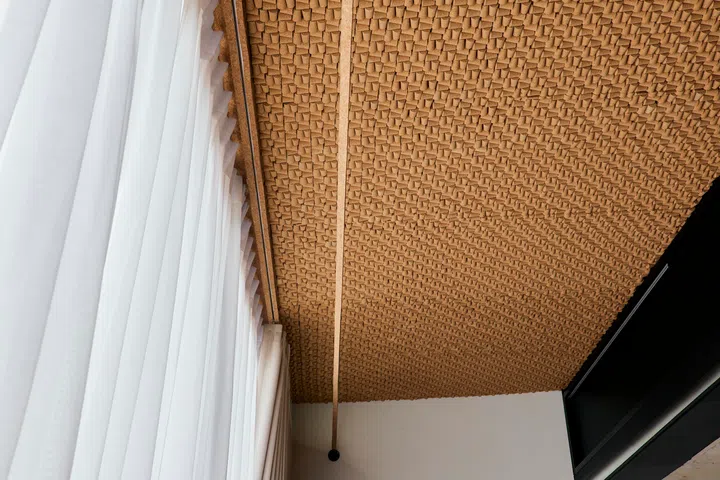
A 2-by-6 metre section of ceiling is lined with 12,500 wine corks, individually placed and glued by the homeowner into custom-built trays.
12,500 Wine Corks
One of the defining features here is the ceiling treatment near the front balcony, a feature that carries both personal and professional significance.
“On the fourth level, near the front balcony facing the road, we have an area of about 2 by 6 metres laid with wine cork,” Winston explains. “It takes 12,500 bottles—in order to have the 12,500 wine corks laid on top.”
Rather than leaving it to the contractor, he took it on himself. “The real work was not done by the contractor. The real work was done by me. I spent the last Hari Raya weekend completing that space. I had to lay it out, place it, and glue it one by one.”
To make it feasible, the corks were set into custom-built trays. “I asked our carpentry guy to build shallow trays so that I can sit the wine corks and put them in place, one by one myself. This whole area comprises about 10 trays, so over the weekend I glued it myself so it could dry in time for installation.”
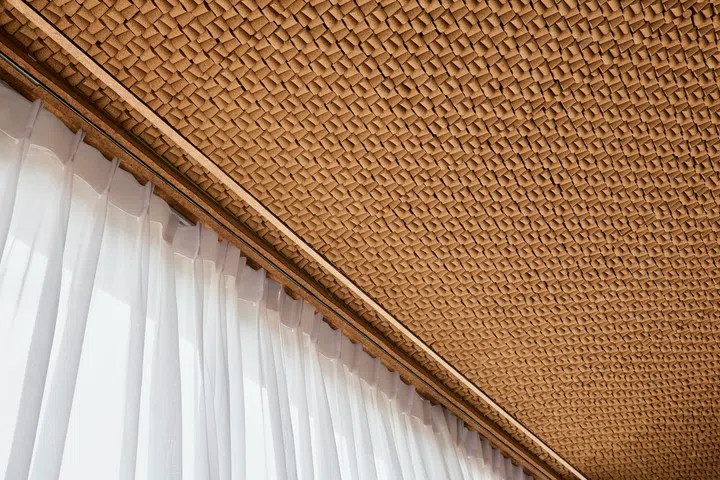
Wine cork panels form part of a layered ceiling system, paired with rock wool insulation to reduce heat gain from the roof and dampen noise from rain on the polycarbonate awning above.
Beyond the labour, the installation carries a deeper meaning tied to the couple’s work. “We supply this bottle cork to the refinery, so this is related to our work,” Winston says. “They use it as a closure for their glass bottle to collect oil samples. This cork has been used for the past 15 years, until they changed to screw caps. That’s where we had leftover stock.”
Rather than discard it, the material was repurposed into the home. “To put it into better use, and as a remembrance as well, this idea surfaced.”
The choice is also practical. “The cork not only has its aesthetic look, it also serves as a good heat barrier. This ceiling is next to the roof that the sun shines on. Soundproofing is also a good factor—when it rains, the roofing is polycarbonate, not very thick. So after that awning, I put trays of cork.”
Additional layers were built into the assembly. “Even before I put the trays of cork, I requested them to put insulated wool—the rock wool. So this makes up the layers of our roof. They really can insulate.”
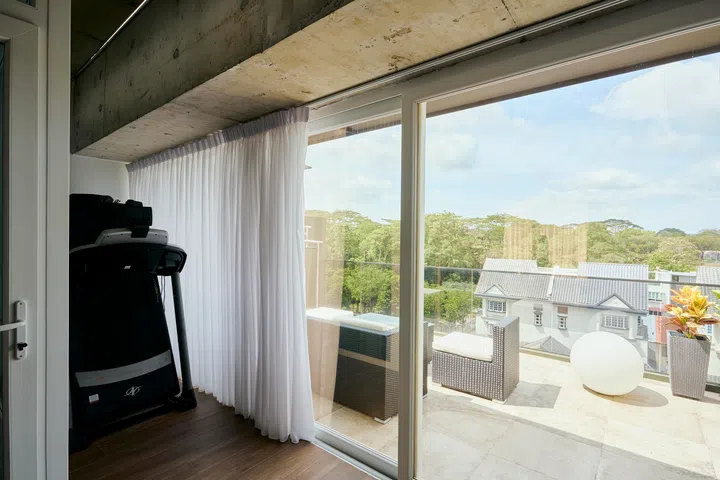
Sliding doors open to a terrace, extending the fourth-floor living space outward and framing viewas of the surrounding neighbourhood.
Home Gym
Tucked beside the terrace, a small gym area keeps to the same restrained approach. “We also have a small little gym, with a full-sized treadmill and a punching bag. So that’s about all it has—we always have in mind to keep it as minimalistic as far as we can,” says Winston.
Kept deliberately spare, the space prioritises function over excess, extending the floor’s quieter, more relaxed character.
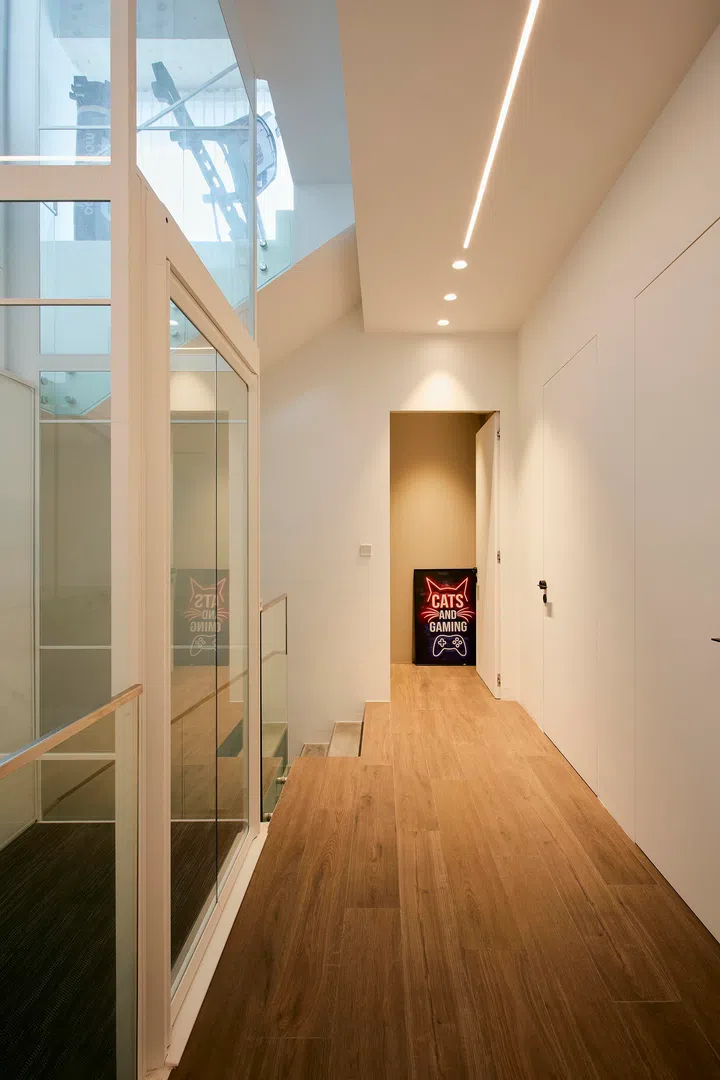
A pared-back corridor beside the glass lift keeps circulation clear and visually connected.
Circulation: A Clear, Connected Descent
Moving down from the fourth floor, the transition into the bedroom level is deliberate but understated. Circulation is kept visually clean, allowing the architecture to guide movement rather than compete with it.
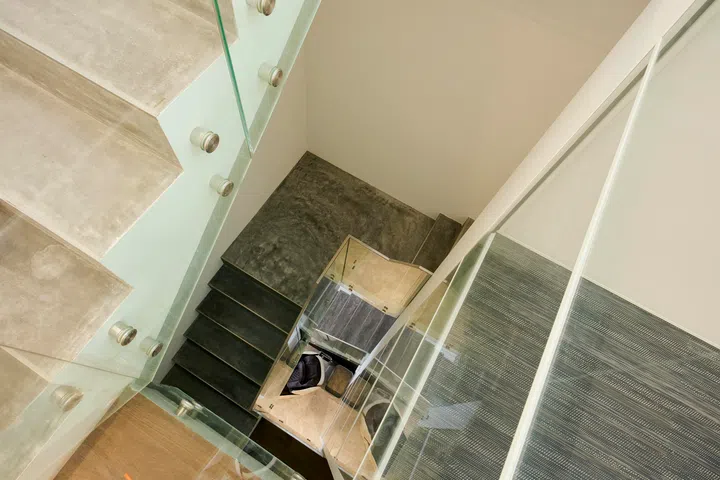
Viewed from above, the stair and lift work together to maintain visual continuity across levels and keep the interior feeling open rather than compartmentalised.
Kelvin explains that “the circulation strategy was designed to make movement through the house feel clear, fluid and visually connected.” This is most evident in the stair core, where glass and light are used to maintain openness across levels.
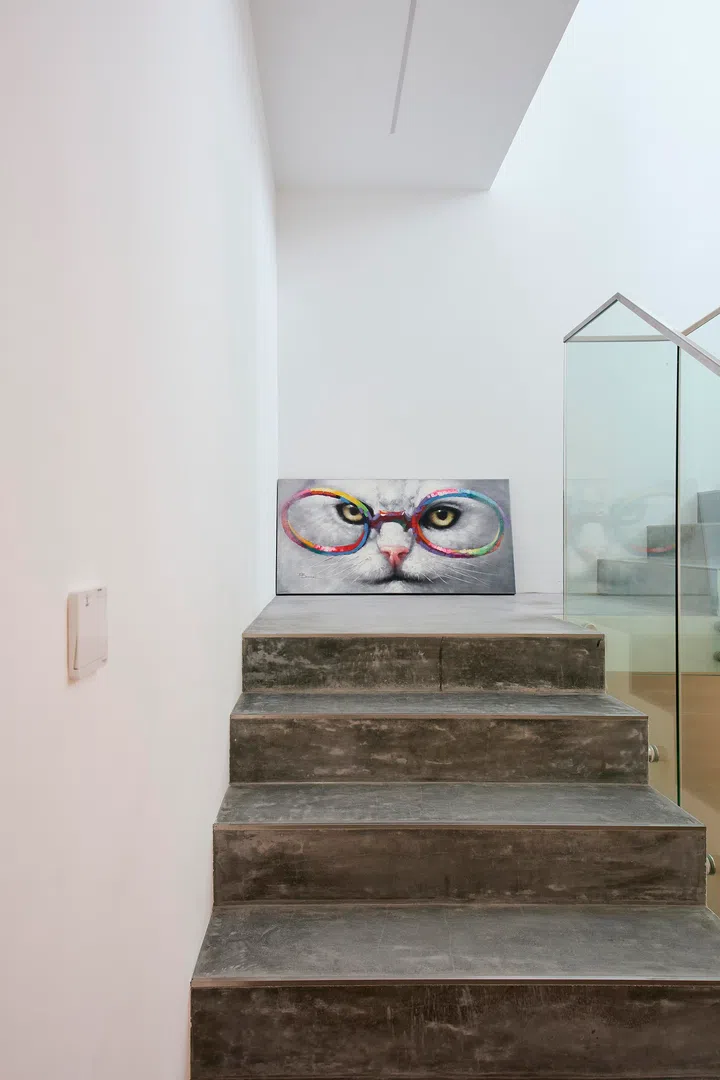
A single artwork marks the landing, introducing a moment of pause along the descent.
The staircase, in particular, is treated as more than a connector.
“It helps organise the journey through the home and contributes to the vertical openness of the space,” Kelvin adds—something that becomes apparent as the stair opens up to views across floors while descending.
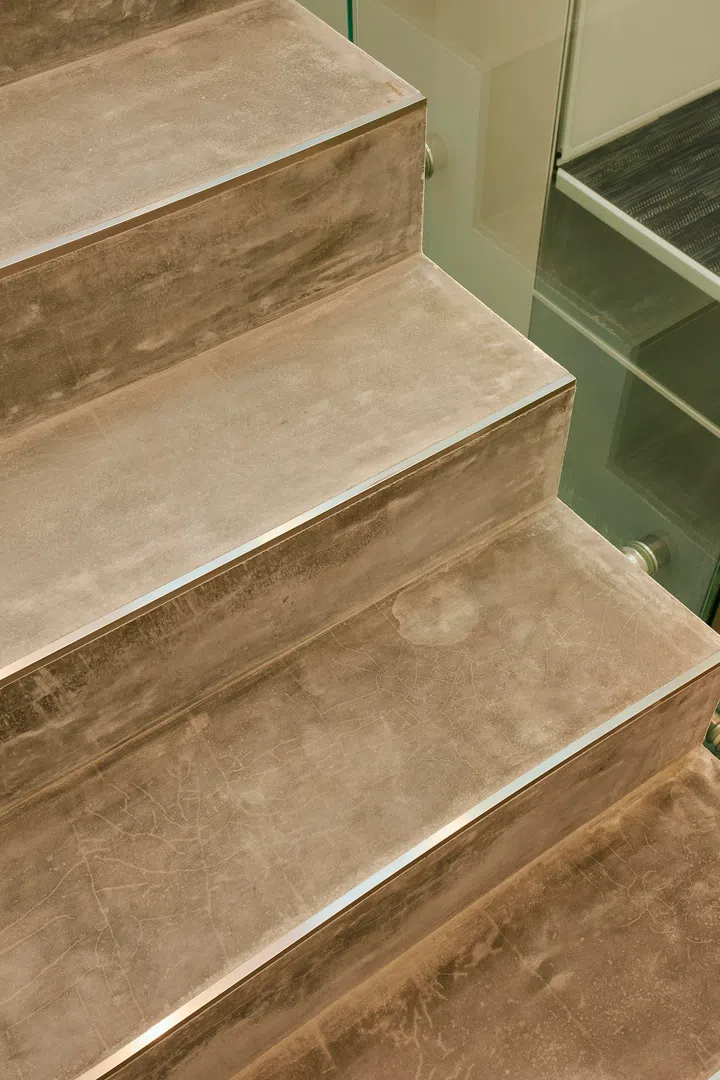
Concrete-look treads and glass balustrades balance weight and lightness, helping the stair read as an important spatial marker rather than just a connector.
That sense of openness is reinforced by the glass lift and balustrades running alongside the stair.
“The glass elevator plays a similar role. Beyond function, it introduces lightness and transparency into what could otherwise become a heavy central element,” Kelvin says. “This helps maintain visual continuity across levels and keeps the interior feeling open rather than compartmentalised.”
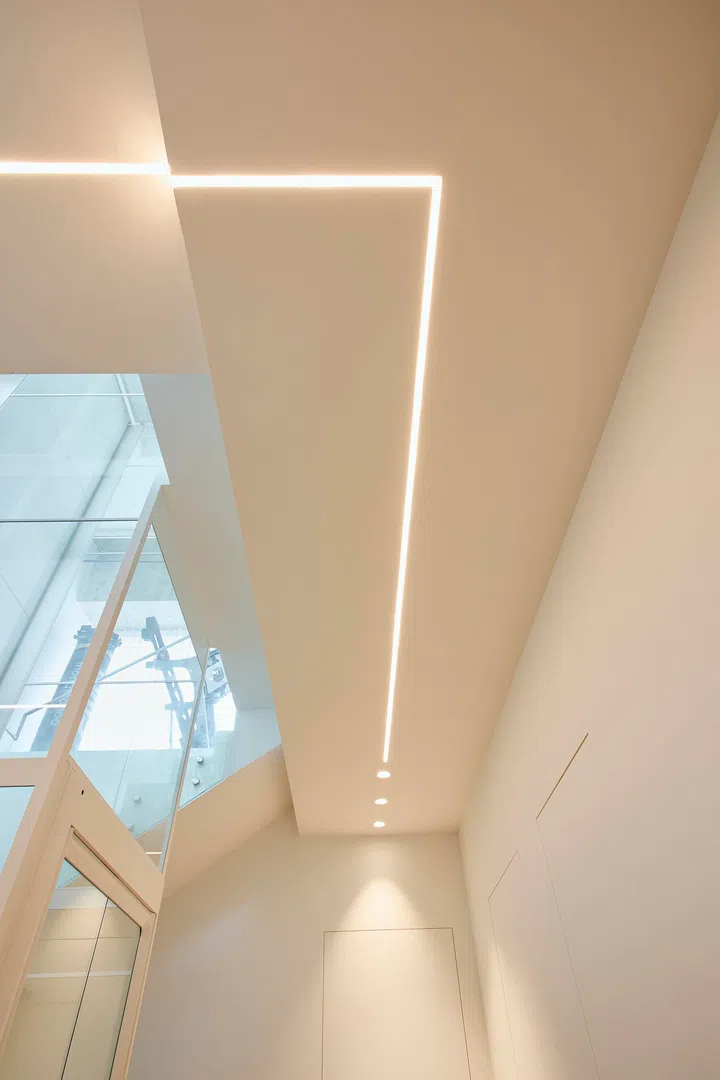
Linear recessed lighting follows the direction of movement, reinforcing a clean and controlled flow.
Light
Light is part of that experience too. Kelvin notes that “the full-length glass windows were equally important in extending the sense of space, bringing in natural light and strengthening the connection between inside and outside.”
Together, these moves make the journey between floors feel considered rather than incidental, setting up a gentler transition into the more private rooms on the third level.
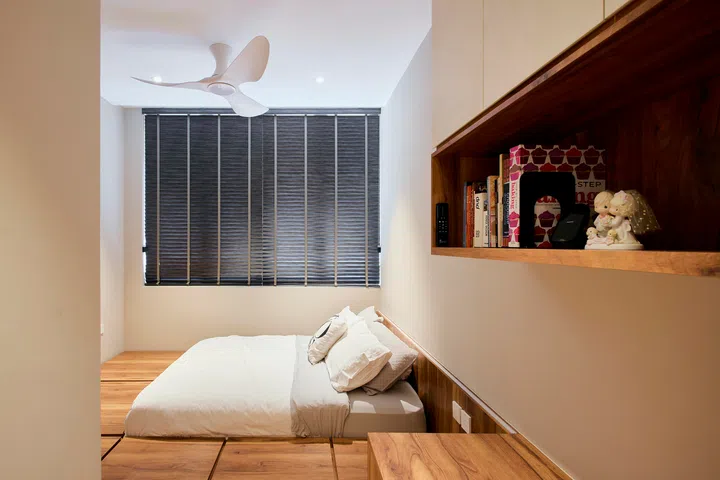
A low platform bed and integrated shelving keep the room pared back, with warm timber tones softening the space.
Common Bedroom
In contrast to the more defined spaces elsewhere in the home, the common bedroom is kept deliberately simple. A low platform bed, built-in carpentry, and a restrained palette create a space that is quiet and unobtrusive, allowing it to function flexibly as needed.
The material language remains consistent—warm timber tones against light walls—but without the heavier, more monolithic elements seen in the main areas. The result is a room that feels practical and easy to use, aligned with the home’s overall intent without drawing attention to itself.
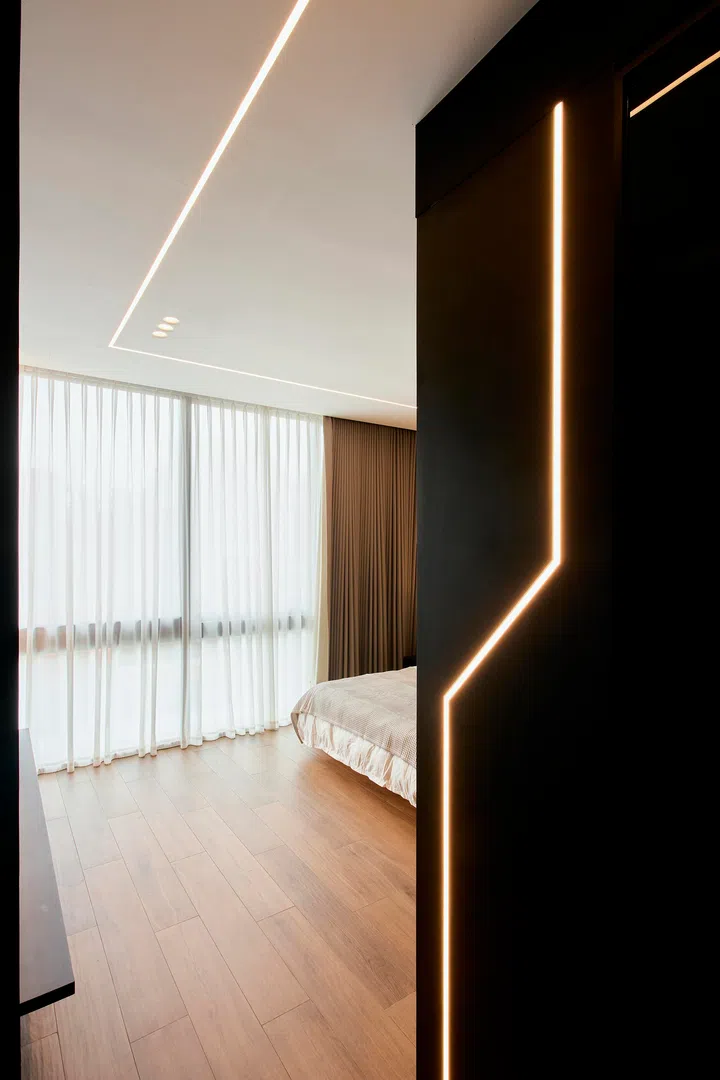
A linear-lit partition marks the transition into the master bedroom, creating a subtle threshold from the corridor.
Master Bedroom: A Controlled Retreat
On entry, a dark, linear-lit partition defines the threshold into the master bedroom, creating a clear sense of separation from the circulation spaces outside. The transition is subtle but deliberate, marking a shift into a more private, enclosed setting.
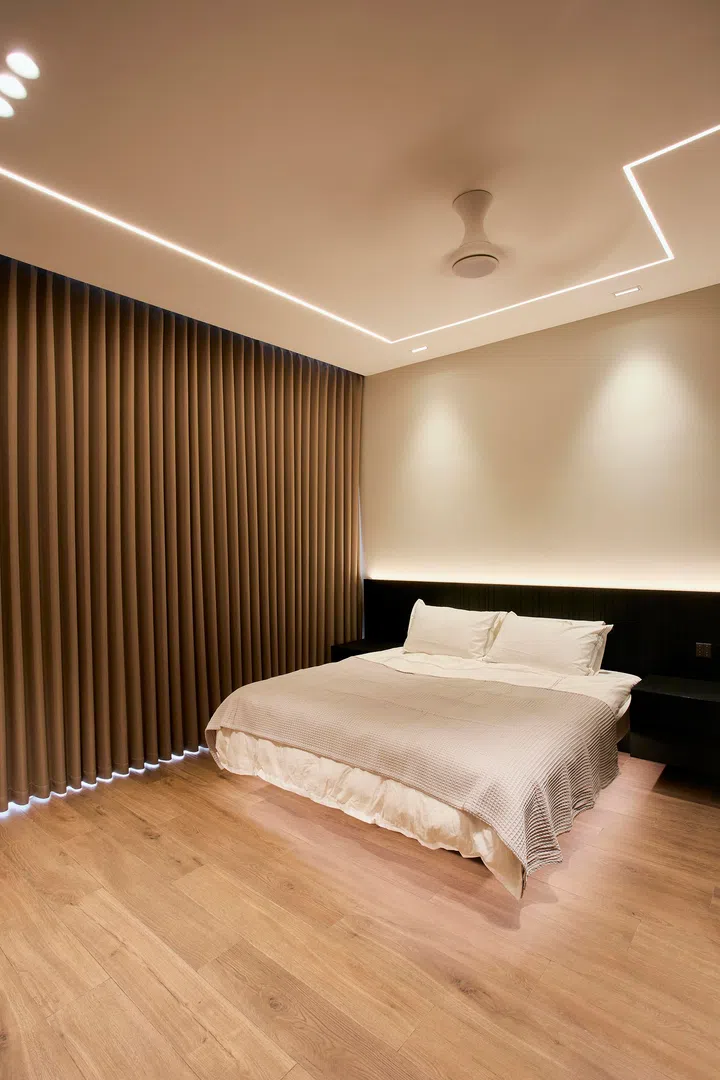
The bedroom is kept deliberately restrained, with soft lighting and a pared-back palette for rest and privacy.
Here, restraint becomes the defining gesture. The material language remains consistent with the rest of the home, but is pared back—dark timber, soft neutrals, and concealed lighting working together to create a sense of calm. Kelvin notes that the approach across the home was to keep the interior “controlled and linear”, allowing each element to sit cleanly within the overall composition.
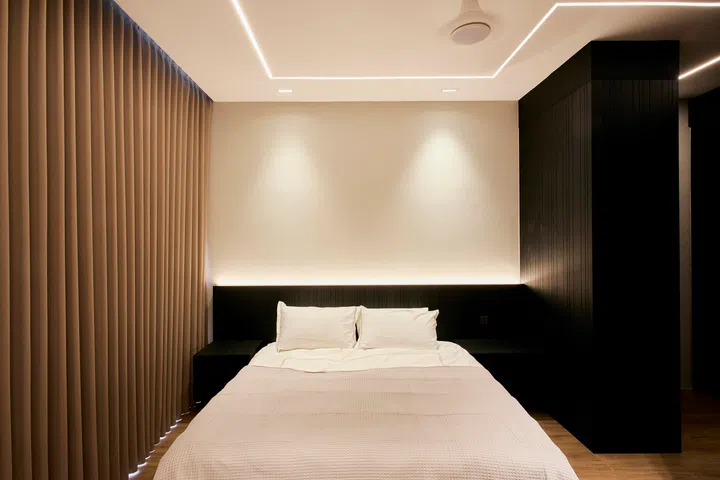
Concealed LED lines trace the ceiling and headboard, providing ambient light without visual clutter.
Instead of visually competing with the rest of the house, the bedroom functions as a place to step away from it. The lighting is deliberately subdued, with concealed LED lines tracing the ceiling perimeter and a soft wash along the headboard wall, avoiding visual clutter while maintaining warmth.
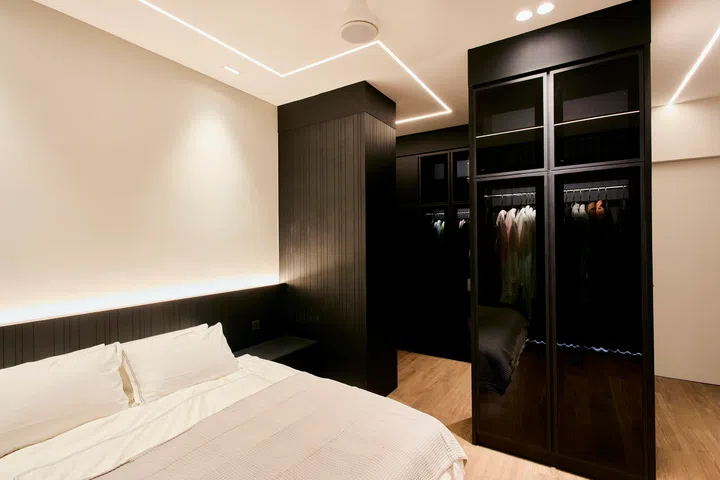
Wardrobes return to a dark, fully integrated treatment, blending seamlessly into the bedroom architecture.
Wardrobe
Storage is integrated into the architecture, with the wardrobes returning to the same ebony, monolithic treatment seen elsewhere in the home. Conceived as continuous volumes rather than standalone pieces, they read as part of the spatial envelope, reinforcing the sense of order while keeping the room visually uncluttered.
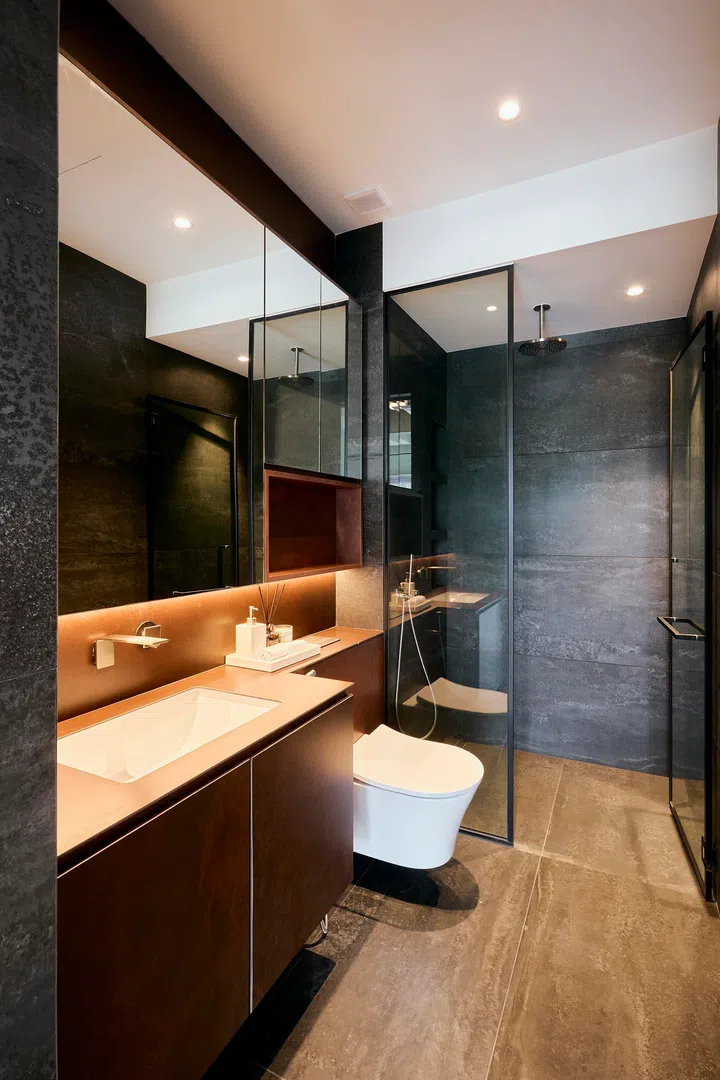
The master bathroom combines darker textured tiles with warm lighting, balancing depth with clarity.
Bathrooms: Refined and Consistent
The bathrooms follow the same material discipline seen throughout the home, with darker finishes, clean lines, and controlled lighting shaping the spaces. In the master bathroom, a mix of textured wall tiles, glass partitions, and warm under-cabinet lighting creates a setting that feels composed without being overly styled.
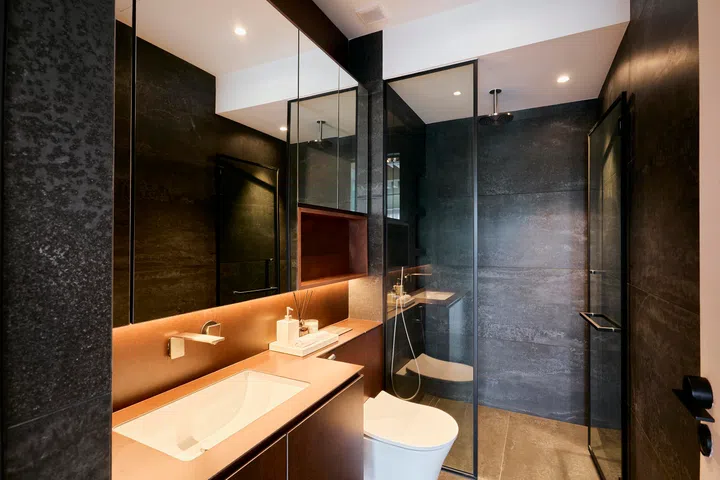
Glass partitions and mirrored surfaces keep the space visually open while maintaining clear zoning.
Details are kept precise and restrained—fixtures are integrated, storage is concealed, and the palette remains tightly controlled. The use of darker surfaces adds depth, while mirrored panels and glass help maintain a sense of openness within the compact footprint.
The common bathroom continues this approach in a lighter tone, ensuring consistency across the home while remaining practical for everyday use.
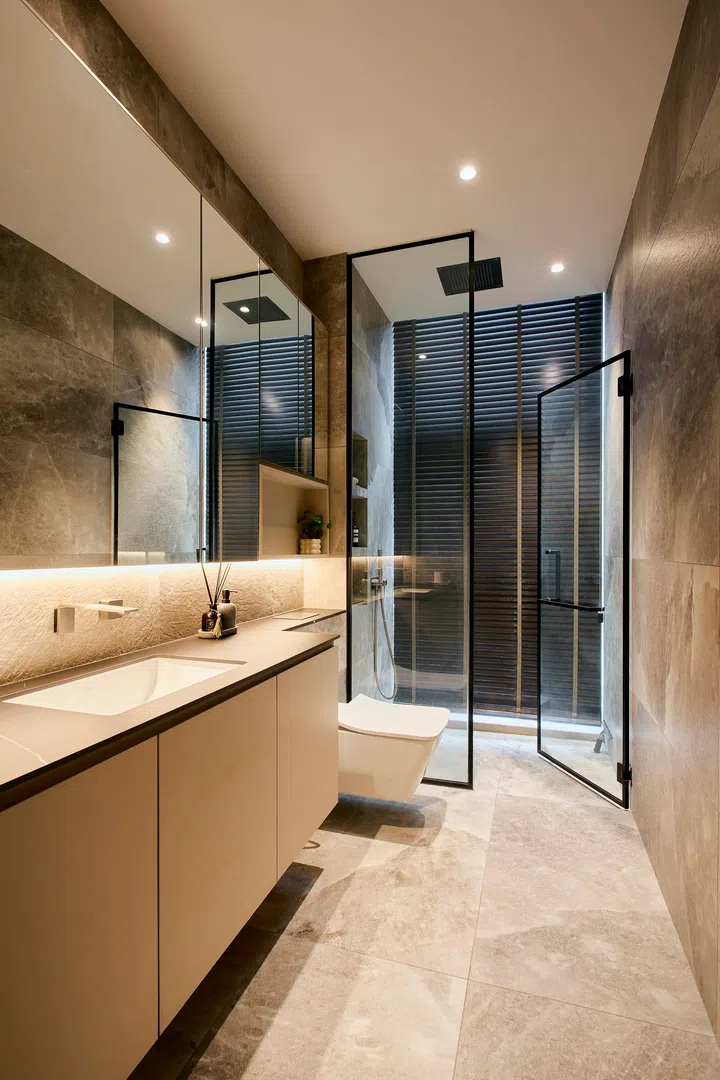
The common bathroom adopts a lighter palette, maintaining material consistency in a more understated form.
$220,000 Renovation Cost
The renovation was completed over approximately 15 to 16 months, while the full rebuild of the house took about 2.5 years. “If Space Sense, we’re talking about $220k. It’s more than a bargain. And we’re contented,” says Winston.
The process was not without its challenges. “This was at the end of 2022, so this journey of around two and a half years is not easy… we underwent quite a lot of obstacles, challenges, delays, and we also put in a lot of hands on,” he adds.
Kelvin attributes how the home came together to the strong level of trust from the owners.
“I genuinely love every part of it because the project came together in a very coherent and honest way… We were very much on the same wavelength from the beginning.” “Emotionally, that kind of alignment is very meaningful, because it allows the ideas to be realised more fully and with less compromise.”