
An architect’s $400,000 renovation for his 3-storey terrace house in Ming Teck Park
An architect reworked his 3-storey house around its pitched roof, legacy staircase and green rear outlook, using timber, curves and layered lighting to create a warmer, more personal home.
By Gwyneth Goh -
Share this article
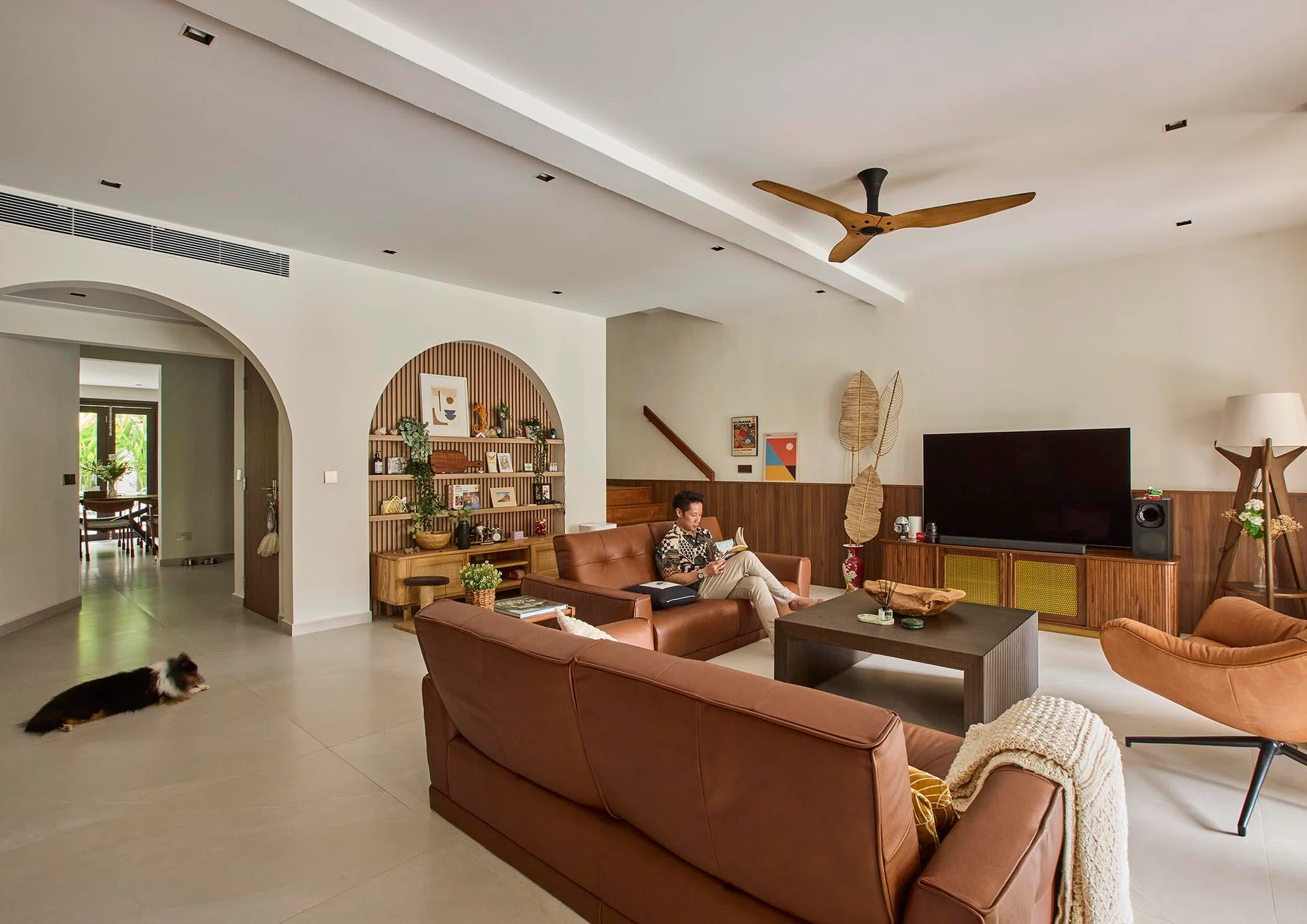
Stepping into the home, the living room opens out in a quiet sweep of warm timber and soft light. A low-slung leather seating arrangement gathers around a dark coffee table, while to one side, an arched niche lined with fluted panels holds an evolving collection of objects. Beyond, the space stretches towards the dining area, setting up a clear sense of movement through the home.
The staircase, often a dominant feature in multi-level homes, is handled with restraint here. Rather than becoming a focal point, it reads as an extension of the timber wall, its proportions carefully integrated into the living space without adding visual weight. The result is a room that remains calm and cohesive, even as it accommodates movement between levels.
For homeowner and architect Liam Seow, the intent was clear from the outset: “The core vision for this home: A classy tropical mid-century modern retreat on Sixth Avenue.”
Who Lives Here: Liam, an architect
Home: A 4-bedroom terrace house in Ming Teck Park
Size: Land area 187.5 sqm; approx. 3,300 sq ft built-up
Interior Designer: The Project No.
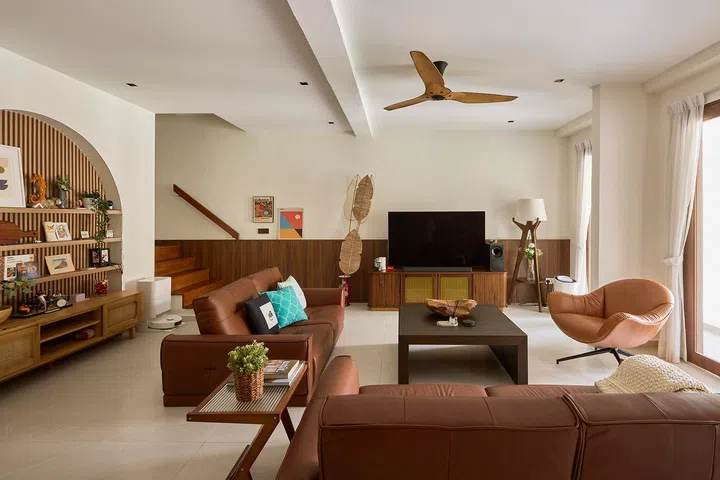
A low, conversational seating arrangement keeps the living room open and relaxed, while the staircase and timber-lined wall recede quietly into the background.
A canvas for living
Rather than treating the living room as a finished composition, Liam approached it as a space that would take shape over time. The palette is deliberately restrained—timber, cream walls and warm lighting—so that objects can come to the fore without overwhelming the room.
“I like to think of homes as canvasses that reflect the personality of their inhabitants,” Liam says. “It’s really nice to see the spaces slowly fill up and evolve over time.”
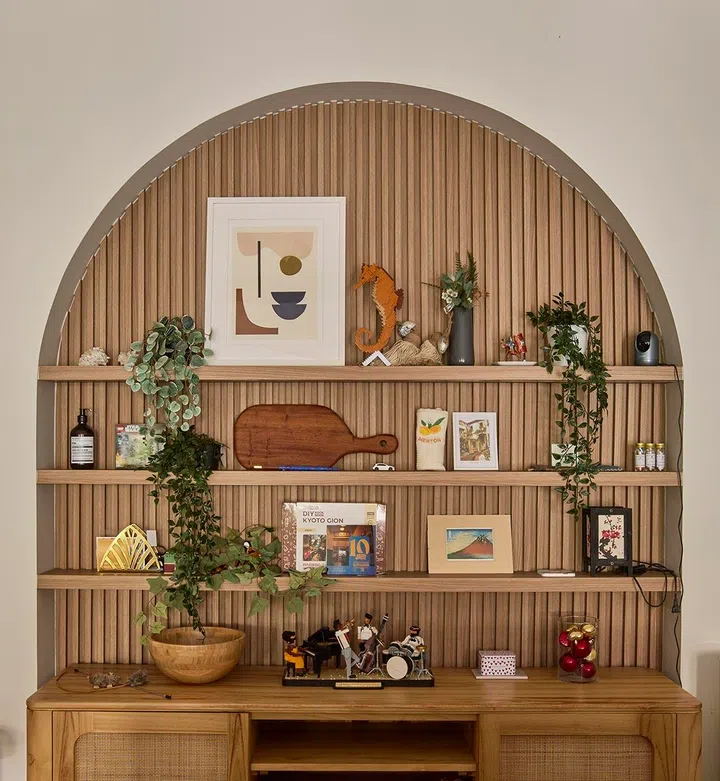
The arched niche, lined with fluted timber, doubles as display and storage, where personal objects and collected pieces bring warmth and character to the living room.
This thinking plays out most clearly in the display areas. The arched niche and long timber ledge are not styled as fixed features, but left open to accommodate books, travel finds and artworks that shift with time.
A watercolour picked up in Santorini sits alongside seashells collected from a beach in Wales, while smaller objects gathered online or on trips are arranged more instinctively than formally.
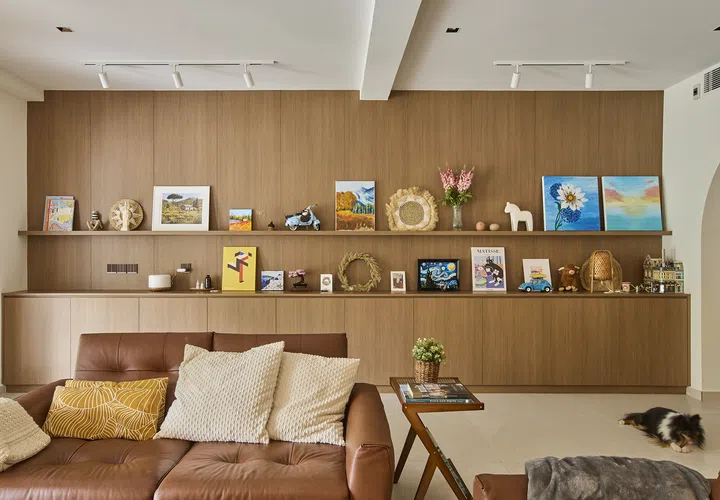
A continuous timber wall with a long display ledge allows the space to evolve over time, with artworks and keepsakes arranged informally against a muted backdrop.
“The display always evolves,” Liam explains. “I think it’s important for the space you live in to evolve and grow as you go through life.”
The effect is subtle but important. Instead of feeling staged, the space carries a sense of familiarity, one that comes from use rather than intention.
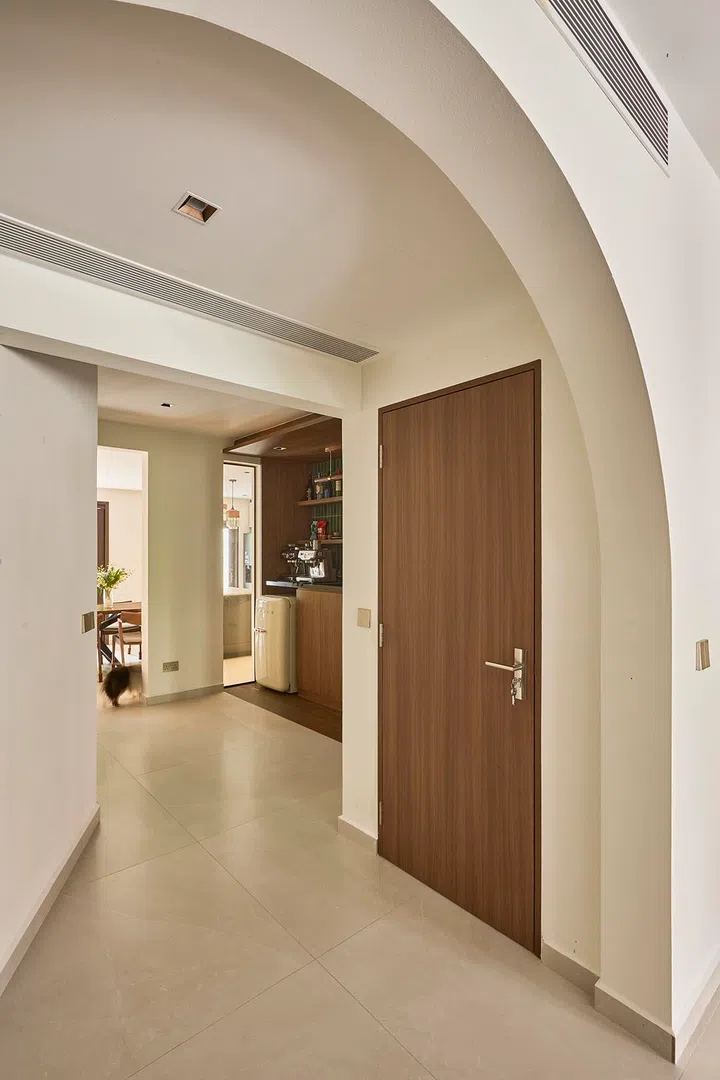
An arched opening elegantly frames the transition from living to dining, with the bar tucked neatly into a recessed niche along the way.
A bar shaped by memory and ritual
Just beyond the living room, the transition into the dining area is marked by a recessed niche, recast here as a compact bar. Lined in timber and set neatly along the circulation path, it feels less like an add-on and more like part of the home’s everyday rhythm, supporting both quiet routines and moments of hosting.
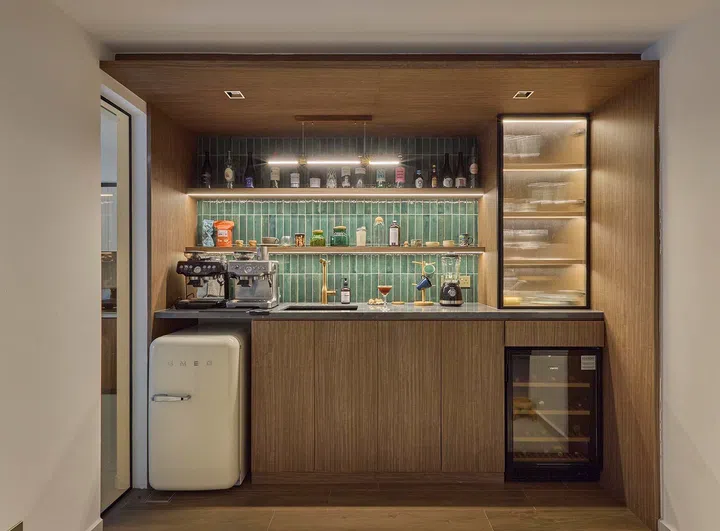
Set within a timber-lined alcove, the bar combines coffee, drinks and storage in a compact, integrated zone between living and dining.
At first glance, the composition is simple: green ceramic tiles, open shelving, and a clean run of cabinetry. But the upper shelf reveals something more personal.
“If you see the top row, it’s a bunch of wine bottles and liquor bottles,” Liam says. “Those are the bottles I have consumed and find interesting. I didn’t expect it to fill so fast.”
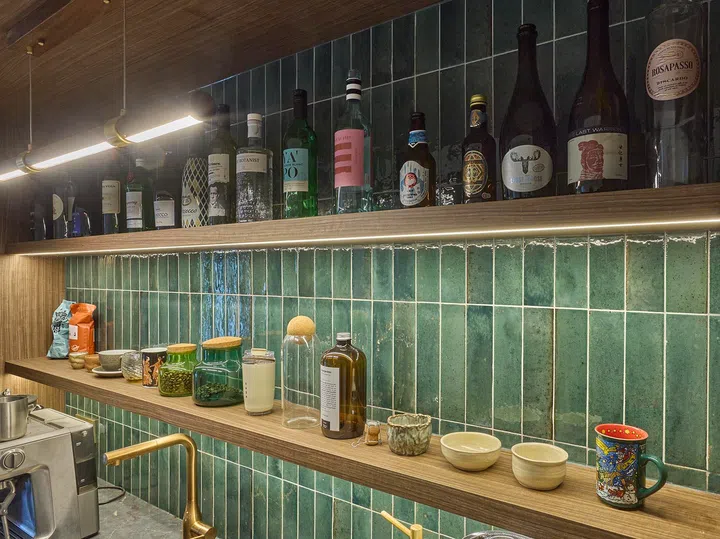
Green ceramic tiles and warm lighting set the backdrop for a collection of memorable bottles, arranged alongside glassware and everyday objects within easy reach.
What began as storage has become something closer to an archive. “It’s very nice to go there and look at… you remember what you had, who are the friends you hosted that day, your mental space that day. It’s a nice trip down memory lane when I look at it. It’s a sentimental thing for me.”
That sense of memory is balanced with a strong visual instinct. “If I really like the taste, and the bottle is ugly, I will not keep it,” he laughs. “Usually it has to taste and look good, then I will keep it.” The result is a display that feels curated but never staged, objects chosen as much for their stories as for their form.
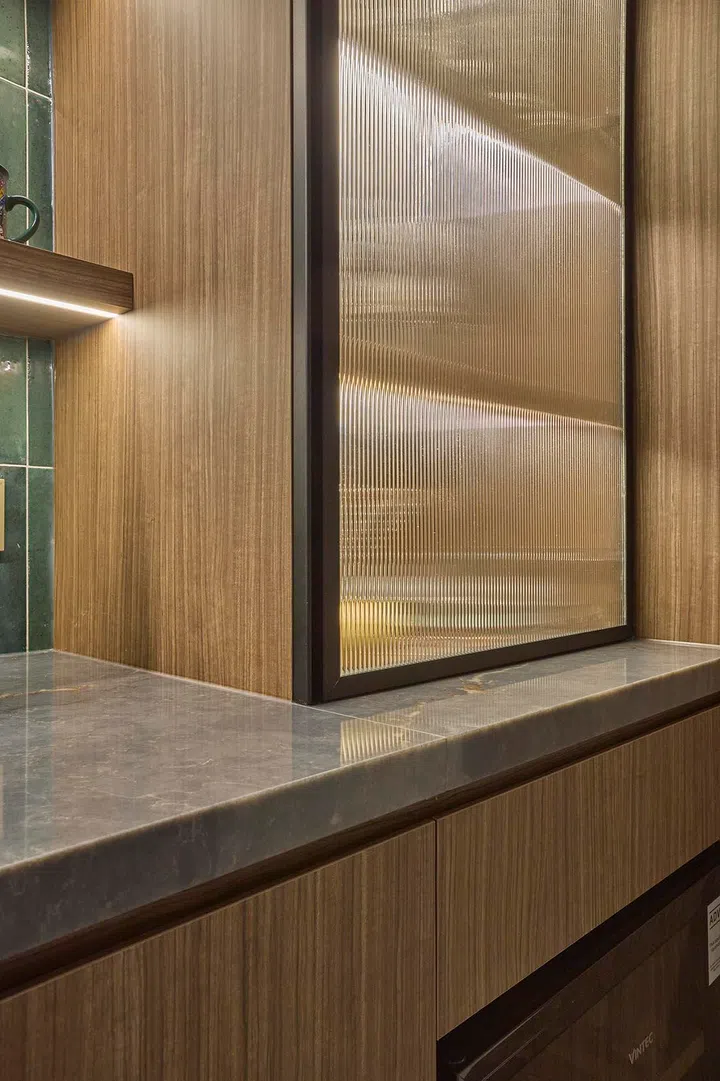
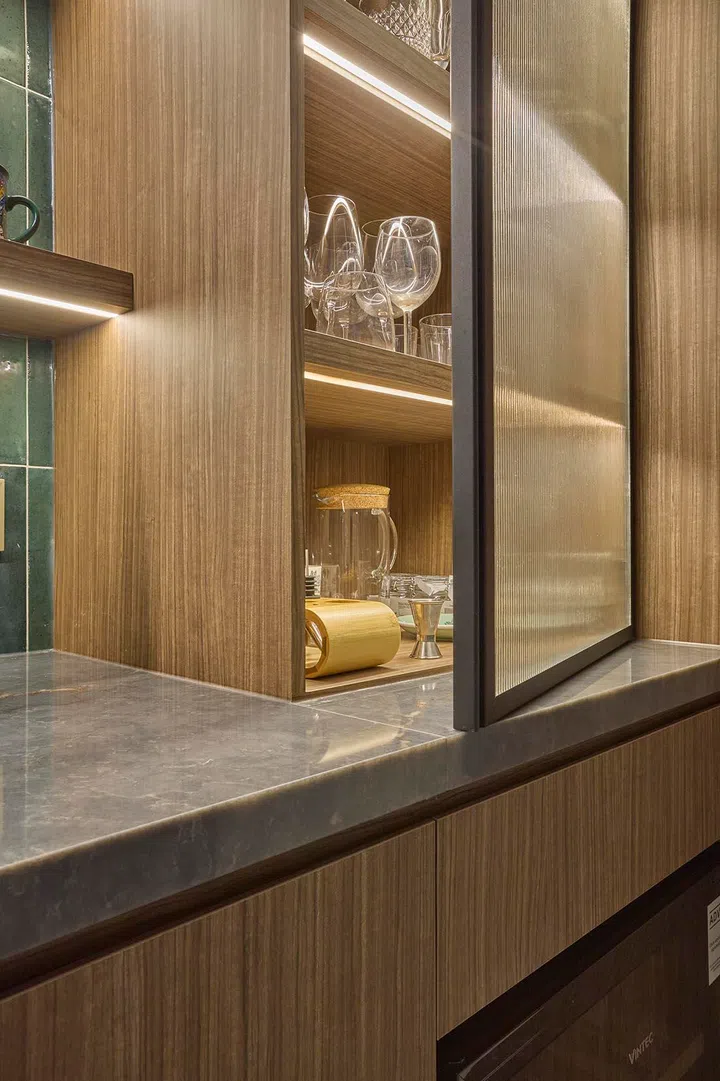
Fluted glass panels soften the display, partially concealing glassware while maintaining a sense of depth and texture.
Elsewhere, the details are handled with the same clarity. Glassware and tools are tucked behind fluted panels with integrated lighting, “so it becomes a bit more abstract,” he explains, while a wine fridge sits neatly below, contained within a clean rectangular composition. “The idea was to keep everything in a neat rectangle.”
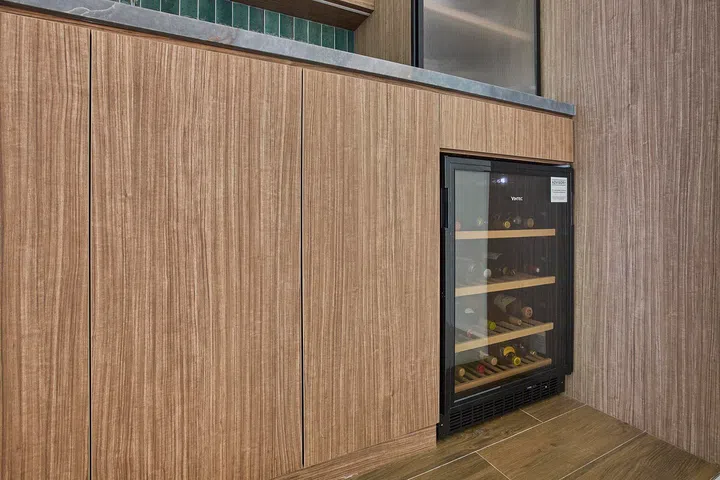
A built-in wine fridge is tucked seamlessly below the counter, maintaining the clean, continuous lines of the cabinetry.
More than anything, the bar has become a point of interaction. “When people come and ask me questions, then I can tell them a story of why I put the bottle,” Liam adds. “I think it’s very important… there’s a bit of storytelling, about things that represent what you like, or activities you like—then it becomes a conversation starter.”
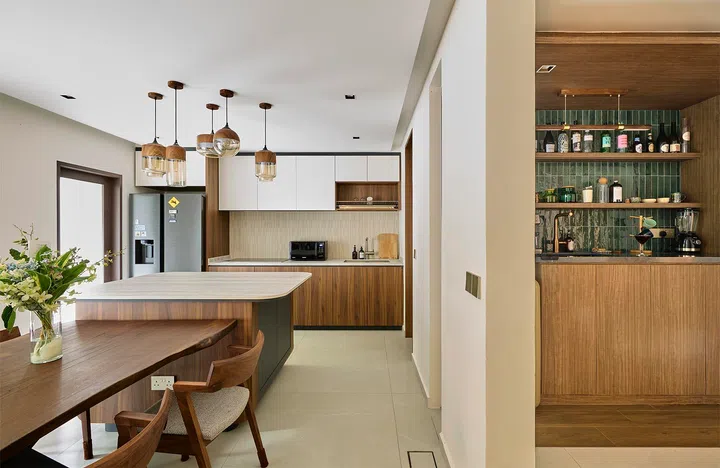
The kitchen sits just beyond the bar, continuing the timber palette while opening up into a brighter, more expansive space.
Kitchen and dining: reworking the plan
From the bar, the home opens into a long kitchen and dining space—one that, at first glance, reads as open and straightforward, but is in fact shaped by a series of constraints.
“The peculiar thing is because it’s a very long space, I didn’t really have a lot of kitchen counter area,” Liam explains. “Once you have the sink and fridge, and then the hob, you don’t have much working space left.”
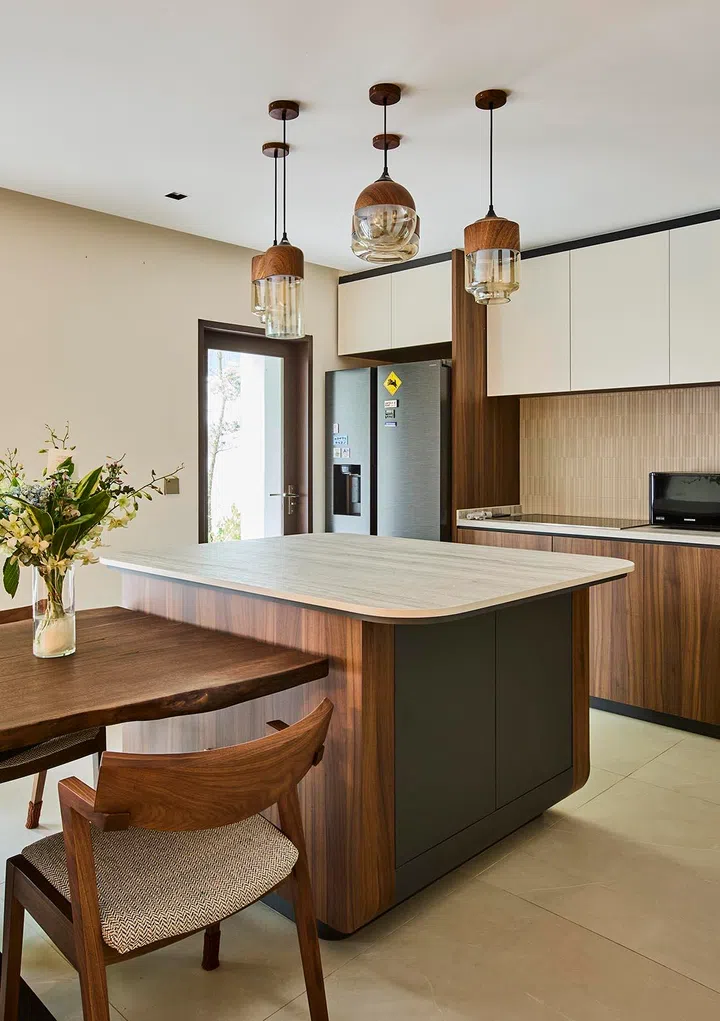
The cubic island forms a central working surface, paired with warm-toned pendants that add visual interest overhead.
Instead of forcing a conventional layout, he reworked the proportions of the room. What emerged was a compact, almost cubic island positioned at the centre of the space. “Because of the shape, it looks more like a cube. I thought it was very cute,” he says. “It’s a limitation of the space, but it turned out quite nicely.”
Rather than functioning as a typical elongated island, this square form becomes a pivot between cooking and dining. “It’s a kitchen island not in the traditional sense,” Liam adds. “I don’t really cook, but I make a lot of smoothies… cut my fruit here. And when I have people over, usually we’ll put the food here.”
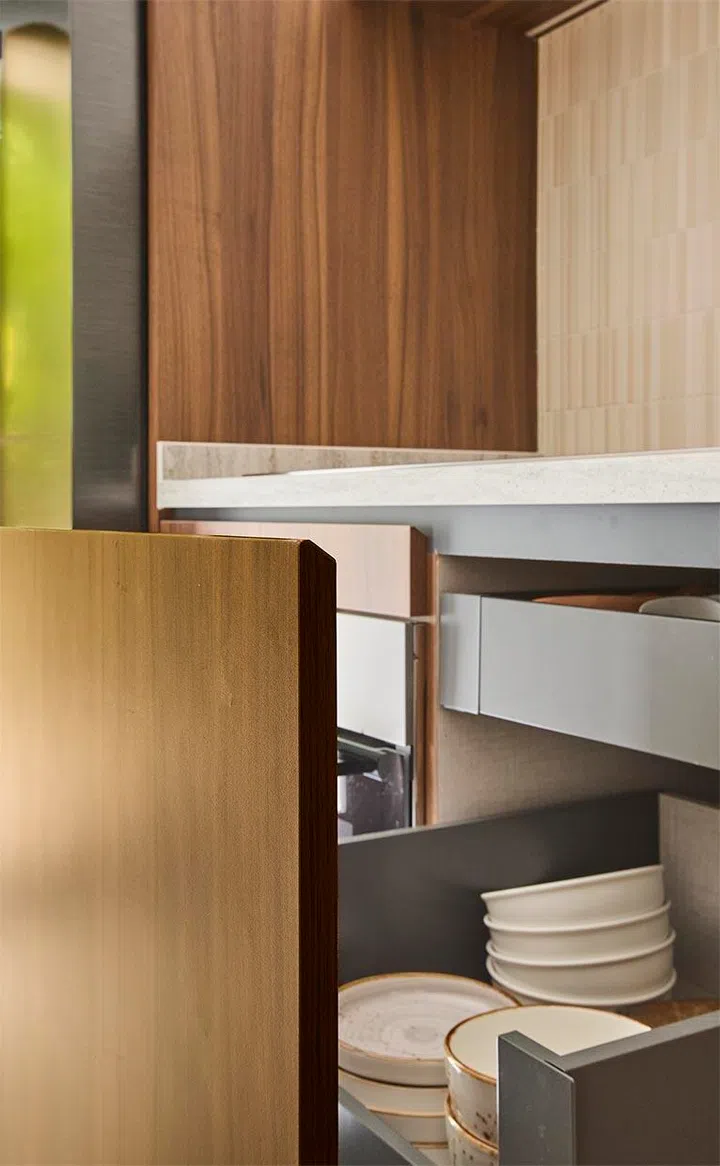
Integrated drawers and compartments keep everyday items within easy reach, maintaining the kitchen’s clean, continuous lines.
Its compact footprint also allows it to work harder. “If you look at the bottom of this cube, that’s where I hide my dishwasher… and storage,” he notes, keeping the surrounding cabinetry clean and uninterrupted.
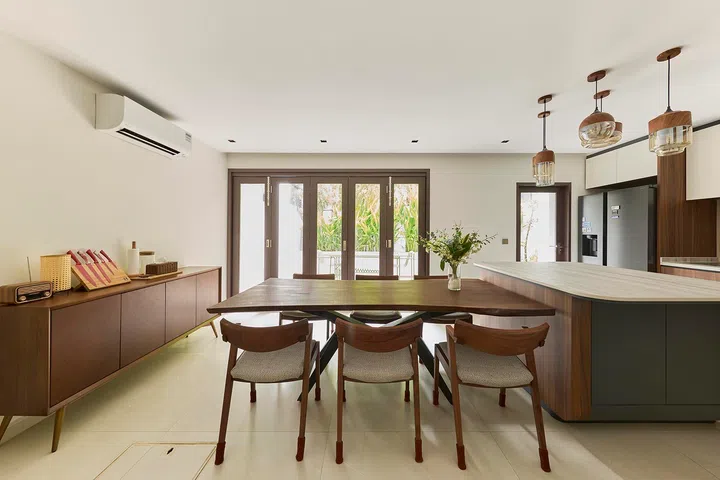
A row of windows draws in natural light and greenery, softening the warmth of timber across the dining and kitchen areas.
Above, the lighting shifts the mood of the space. A cluster of acorn-shaped pendants hangs over the island, deliberately arranged without symmetry. “I’ve seen a lot of people buy pendant lights, but I like to get this type that don’t look the same,” Liam says. “They’re asymmetrical—it brings a lot of visual interest.”
Crucially, their placement resists order. “I don’t put them in a grid… it looks more organic, more natural if you don’t order things in a grid. Because everything else looks very ordered.”
The result is a kitchen that balances structure with looseness—where constraints have been absorbed into the design, and small decisions in form and placement quietly shape how the space is used.
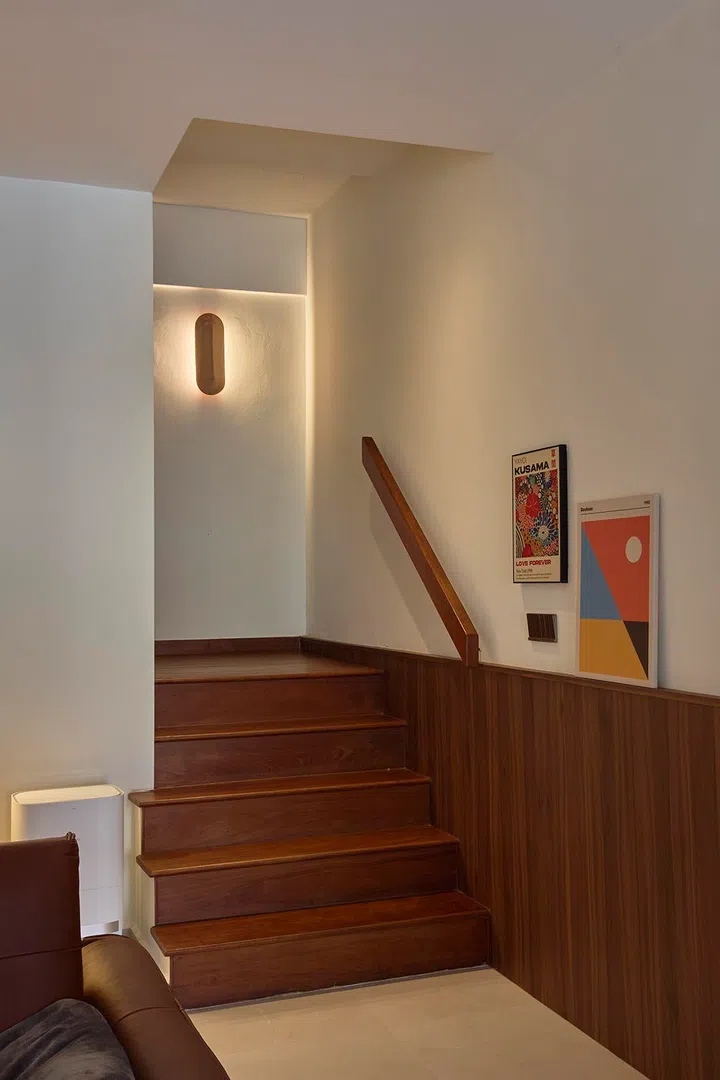
The original staircase is retained and refinished, with timber treads softening its metal structure.
Moving upwards: from public to private
The shift upstairs begins at the staircase, a retained element that Liam chose to refine rather than rework. “The stairs are original but newly finished. I didn’t change much,” he says. The existing metal structure is now wrapped with timber treads, allowing it to sit more comfortably within the home’s material language.
But more than a functional link, the staircase sets up a sequence. “Most people keep their master bedroom on the second floor,” Liam notes, “but for me it was very much a go from public to private narrative that I wanted to have.”
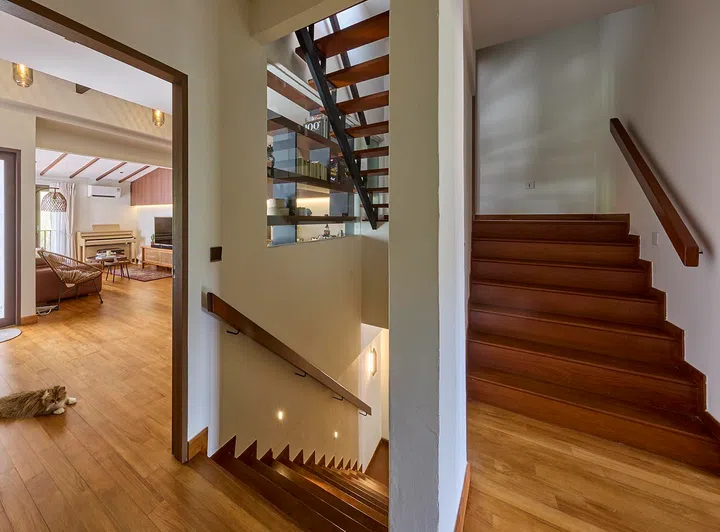
A split-level transition leads from the main living areas to the upper floors, setting up a gradual shift from public to private spaces.
From the first floor’s open, communal spaces, the atmosphere tightens as one ascends. “As you go up, it becomes more personal… maybe for my closer friends, we will come up and hang out. As you go up one more flight, the feeling gets more and more intimate, more exclusive.” This progression culminates at the attic level, where the master bedroom sits at the most private point of the home.
The intermediate level, however, takes on a different role. Rather than a corridor or transitional space, it functions as a second, smaller living area—part study, part retreat.
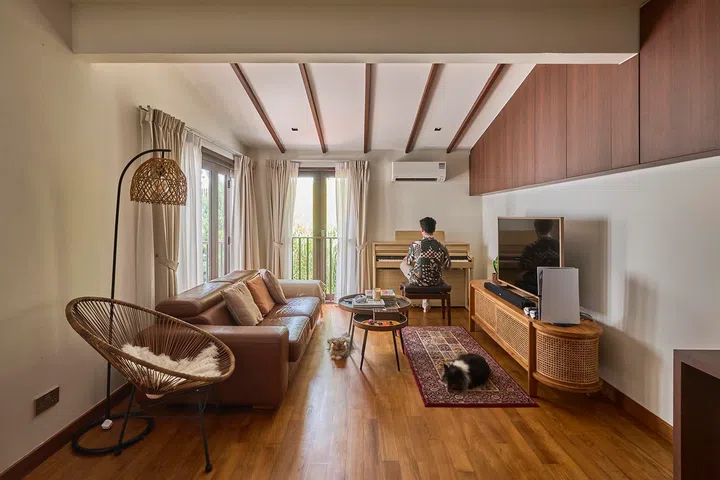
The upper-level room functions as a second living area, combining music with lounging.
“This space actually functions like a second living room, but small scale,” Liam explains. Originally an extension built over what used to be an outdoor dining area, it has been reworked into a flexible zone for work, reading and downtime.
Structural elements that were once concealed are now brought into view. “Those beams were actually not there—they were covered by the ceiling. We decided to expose them… they’re just a nice feature to look at.” Their presence introduces texture and rhythm overhead, subtly defining the space without enclosing it.
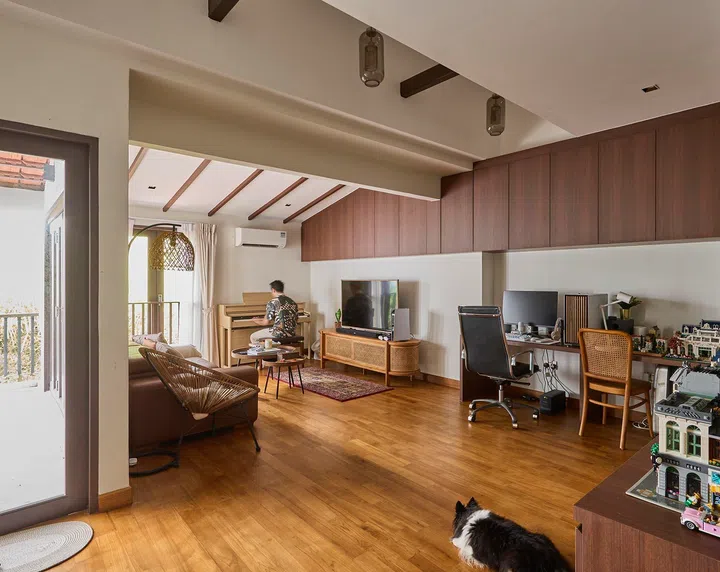
Part study, part retreat, the space incorporates a work desk and a long display ledge that houses books and a Lego collection.
Along one side, a long display ledge carries a mix of books and objects, including a personal collection that stretches across its length. “This whole bottom of the display wall is my Lego collection,” Liam says. “I have a Lego city that runs across the whole length of this ledge.”
Behind it, a glass partition continues to draw light into the core of the home. “The glass is a legacy thing… it was already there leading to the staircase. I thought it was very effective at getting natural light into the stairwell. I didn’t want to interrupt that—just made it a display space.”
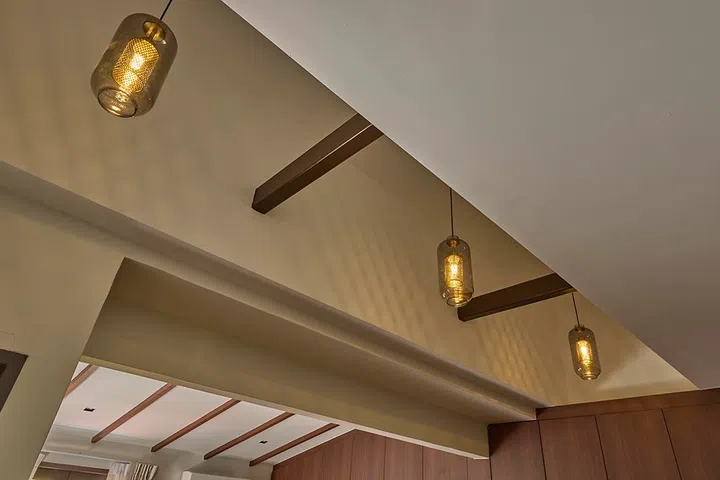
Previously concealed beams are exposed to introduce rhythm and texture overhead, paired with warm pendant lighting.
Even the ceiling carries a story. A concealed void, discovered only after hacking works began, is now quietly emphasised. “When we hacked, we discovered this huge hollow across the ceiling… I was wondering how to utilise this thing we just found,” Liam recalls.
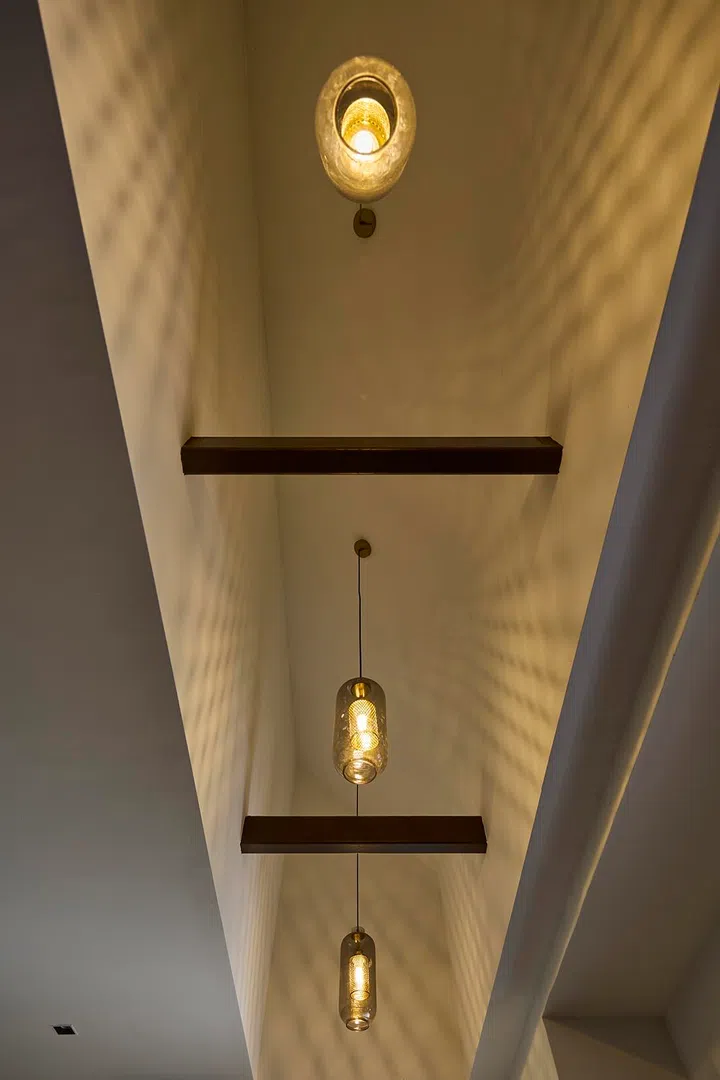
A discovered ceiling void is highlighted with accent lighting, casting patterned shadows that add depth and visual interest.
“I decided to redo the entire ceiling and plan it around showcasing these angles and beams,” he continues. “Added some additional pendant lights in there, reworked the carpentry slightly just to highlight all these elements. It turned out very beautiful and I am very pleased with the result!”
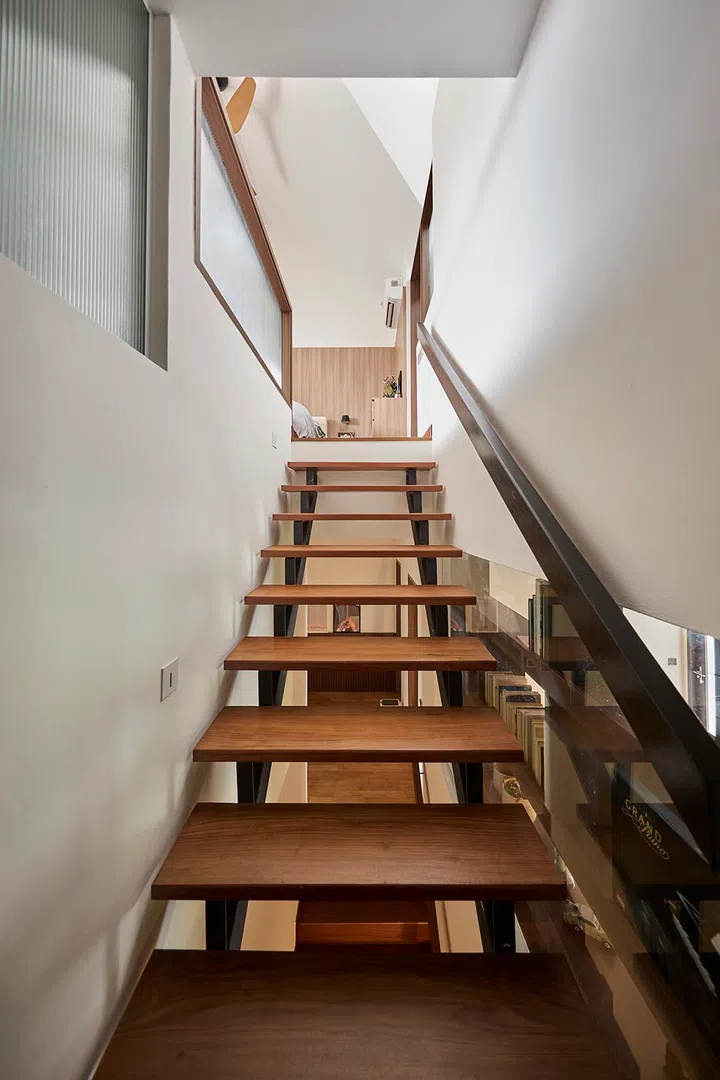
Timber treads and a glass balustrade allow light to filter through the stairwell as it rises to the attic.
At the top: a room shaped by the roof
The final ascent leads into the attic, where the character of the home shifts once more. “This is the master on the attic floor,” Liam says. “The main feature of this space is actually the roof, the ceiling—almost like a cathedral.”
It was this volume that first defined how the room would be used. “When I first came in, it already had this cathedral quality, and I thought wouldn’t it be so nice to put my bed here and wake up to this every morning.”
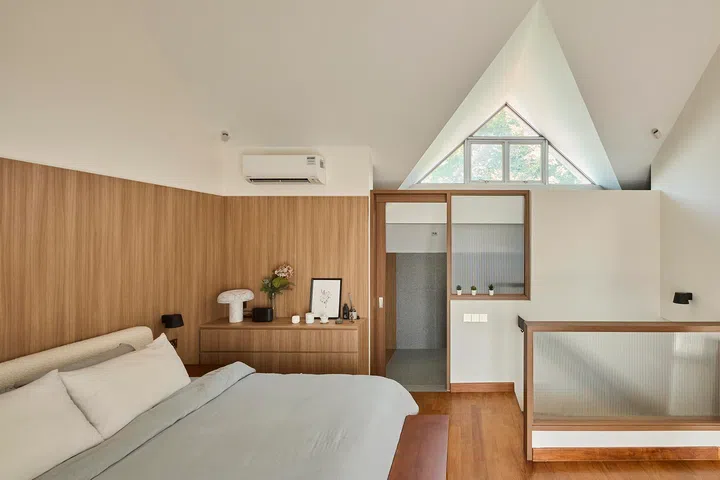
Set beneath a pitched roof, the attic bedroom is kept deliberately minimal to emphasise volume and calm.
At the far end, a triangular window draws the eye outward. “The triangular window actually goes towards the hill at the back,” he explains. It becomes a focal point on entry—both a visual anchor and a quiet connection to the landscape beyond.
Rather than filling the space, Liam chose restraint. The bed, cabinetry and lighting are all kept low, forming a quiet horizontal line beneath the pitched ceiling. “The idea is to keep it very minimal… so you feel you are sleeping in a very large space. If you have too many things here, it disturbs your peace.”
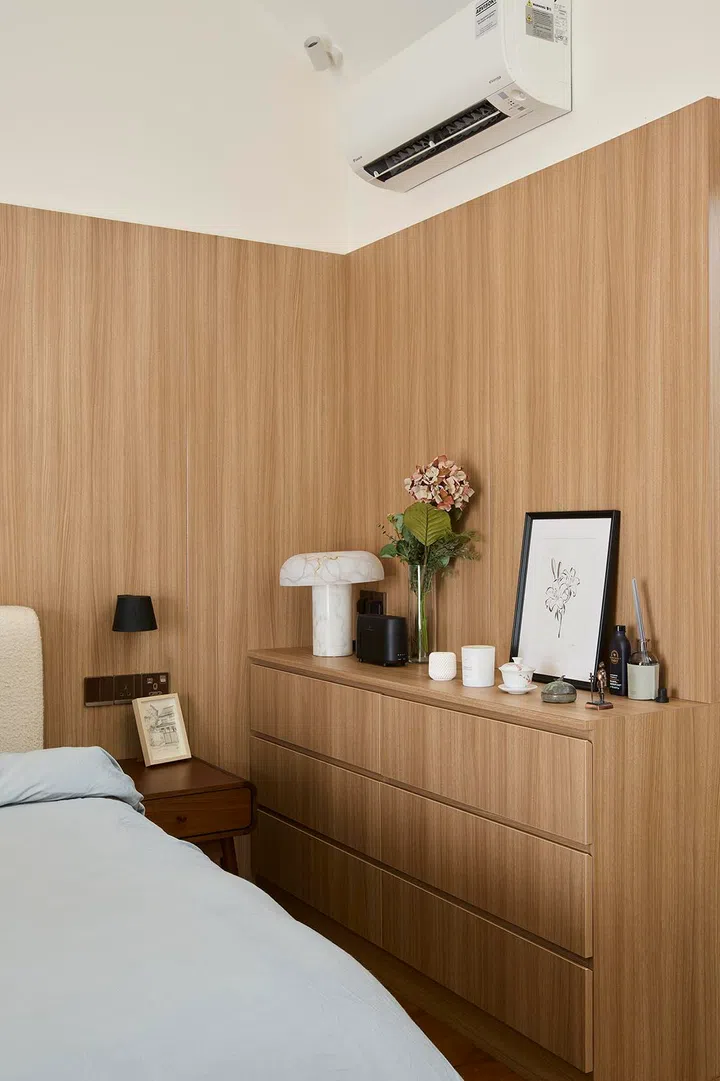
Morning light occasionally casts a golden glow across this display—an unexpected detail Liam describes as “very beautiful to wake up to.”
Light plays an equally important role. Two discreet spotlights are angled upwards, washing the ceiling and allowing the geometry of the roof to read more clearly. “When I turn them on, they accentuate the cathedral pitch… and the light reflects down.”
Even the smallest moments are left to unfold naturally. “In the mornings when I wake up… recently the sun has been casting light through the curtains onto this display,” Liam reflects. “You wake up and see a ray of golden light on the wall. It’s something I didn’t consider at all—it just happened.”
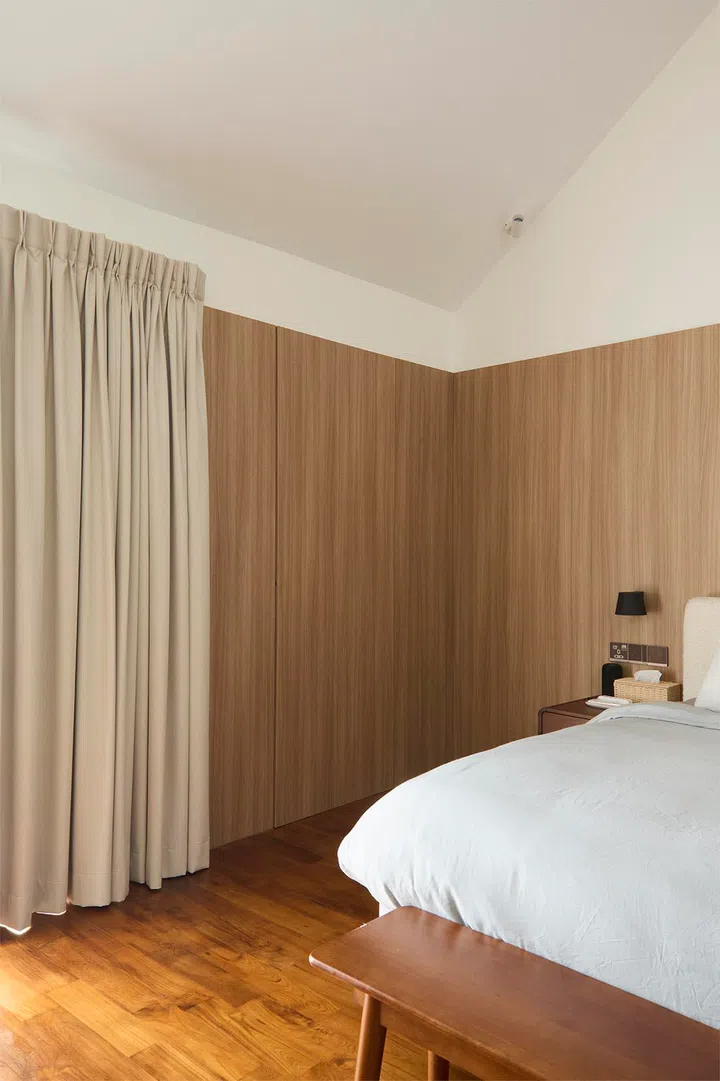
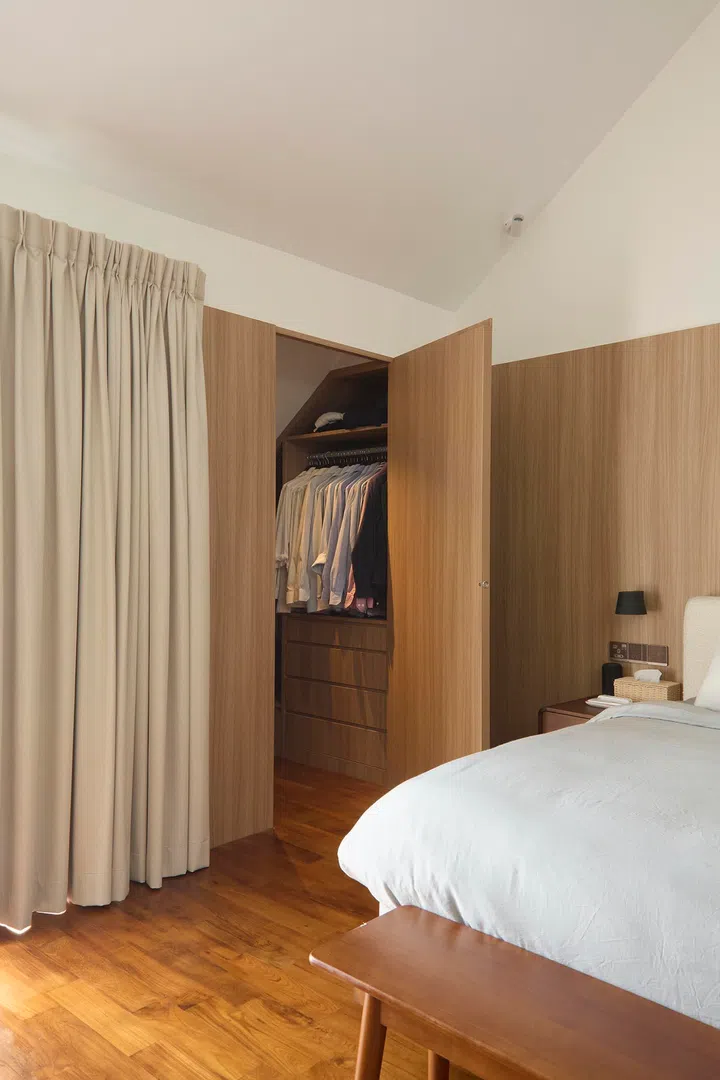
A seamless timber wall conceals the wardrobe, maintaining a clean and uninterrupted surface.
Storage is handled with the same clarity. What appears as a continuous timber wall conceals a hidden wardrobe. “This is actually a door that leads to the wardrobe. There’s no handle—you push and it opens. I thought it should be very clean and minimalist.”
Behind it, the space expands rather than interrupts, maintaining the sense of calm established in the bedroom.
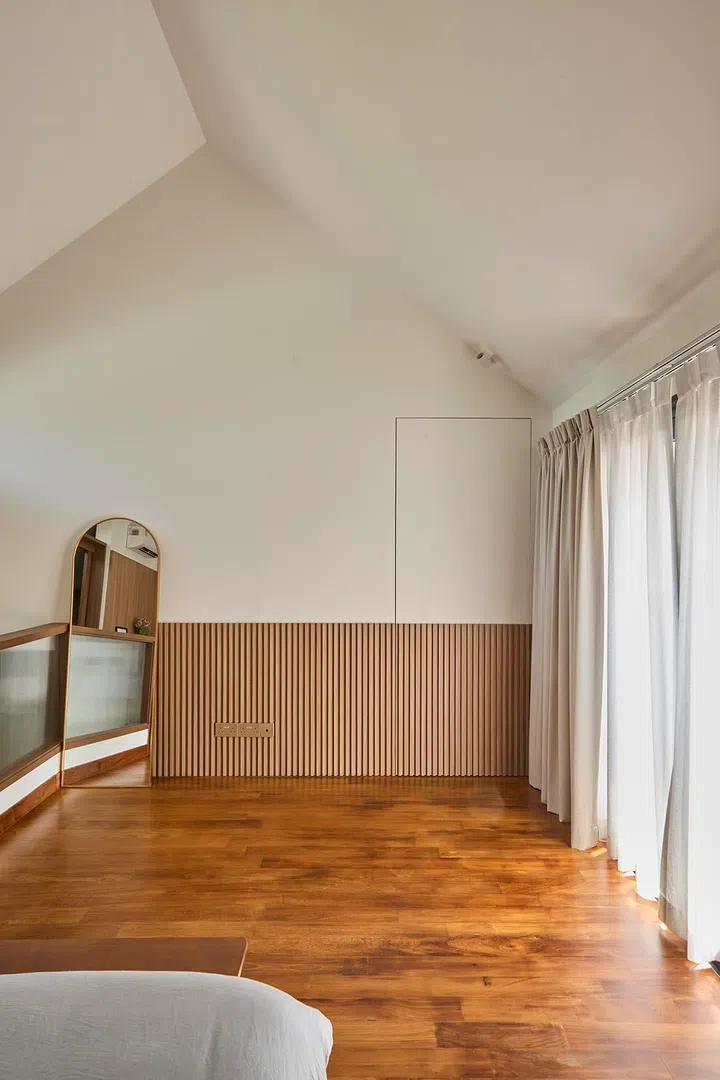
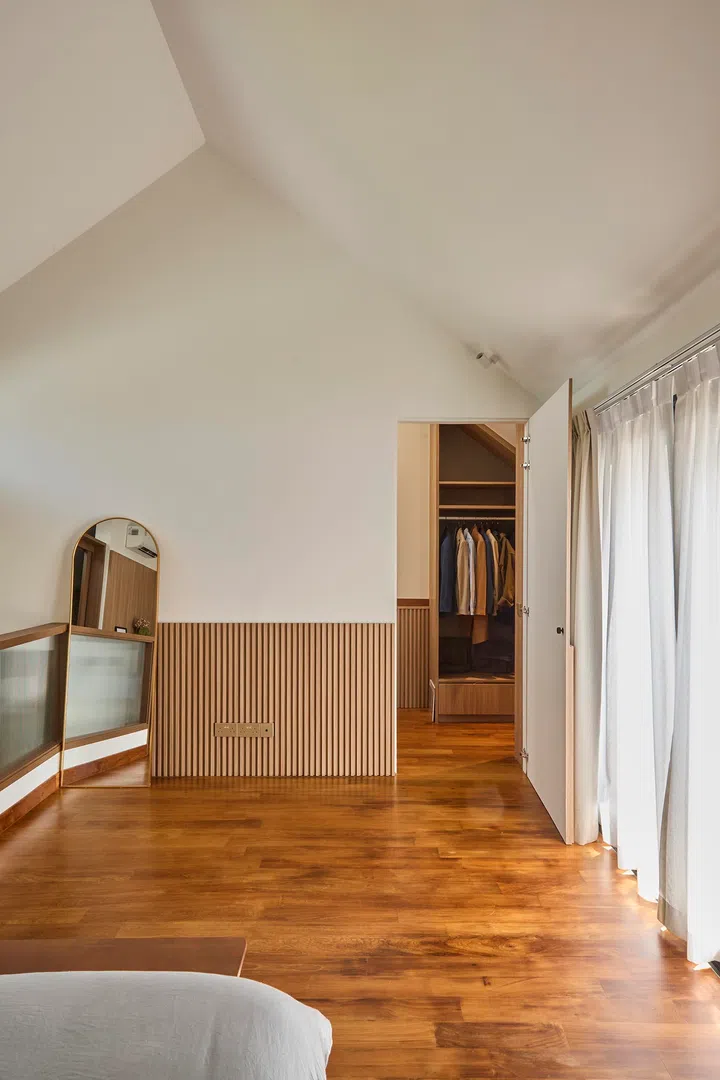
Openings are kept discreet, allowing the attic to read as one continuous volume.
The last room
“My favourite space in the home is the little hidden attic space that’s accessed through a concealed door in the master bedroom,” Liam shares.
“I call this space the reading nook, and this is a little cosy corner at the top of my house filled with books, soft carpets, floor cushions, fairy lights. After a long tough day, I like to retreat to this hidden sanctuary just before I sleep and find my inner peace, maybe unwind with a book or watch some videos.”
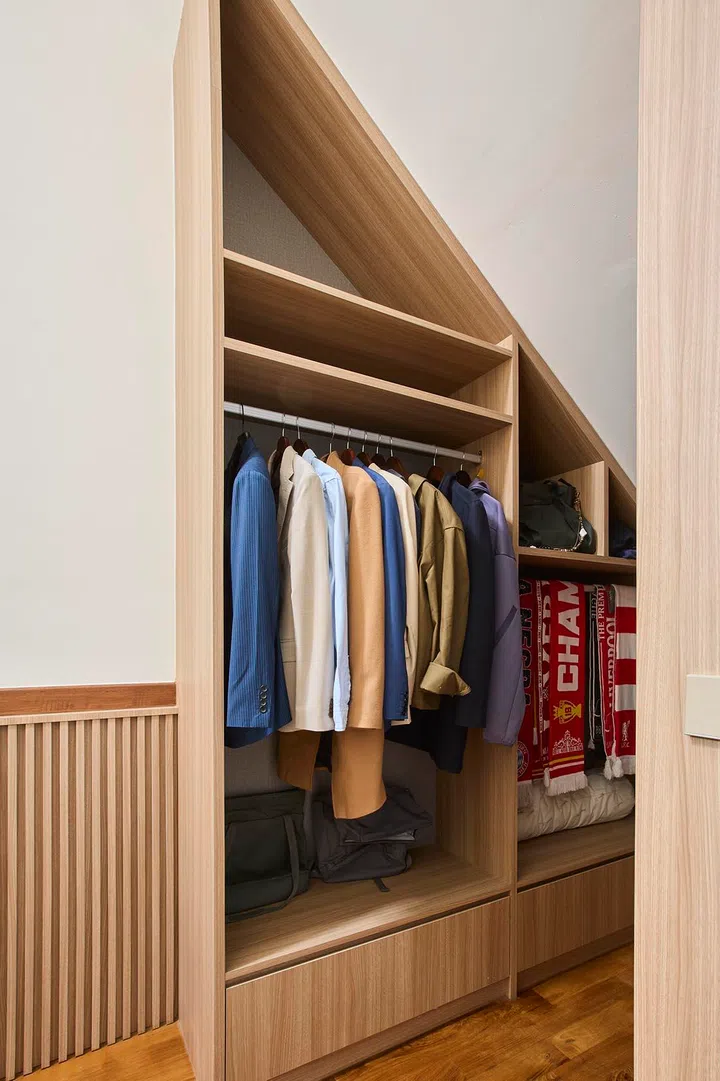
Custom shelving and hanging space are neatly integrated within the concealed nook.
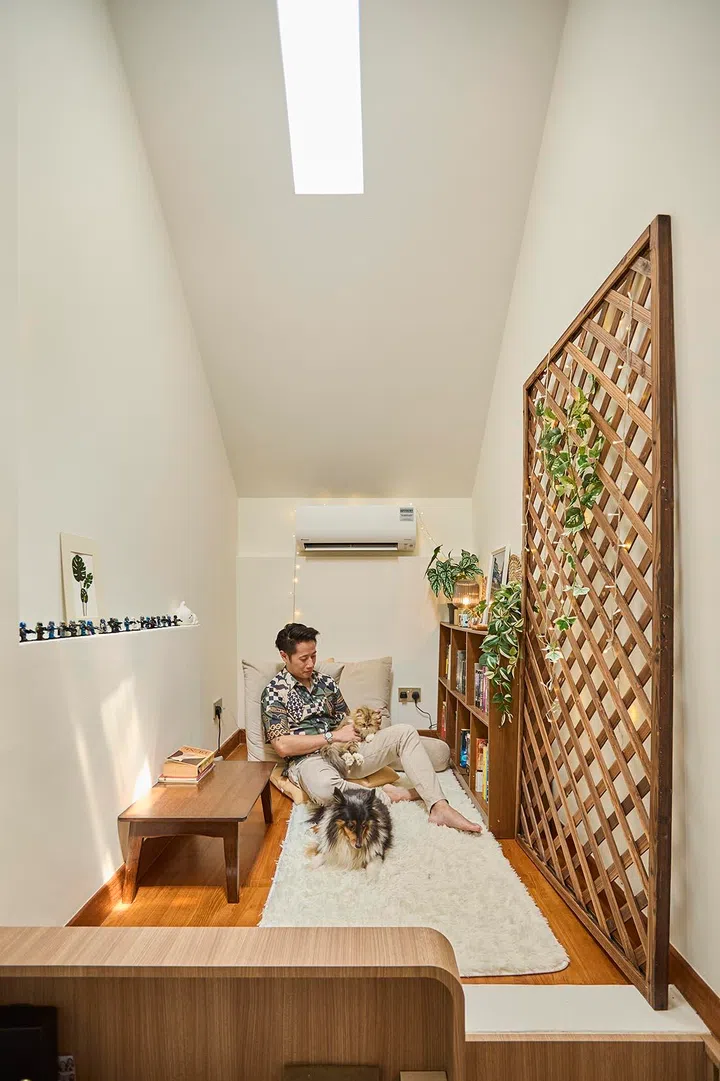
The hidden attic space is left intentionally simple—a quiet corner for reading and retreat.
Set beneath a long skylight, the nook is intentionally pared back. There are no built-ins, no strong gestures—just a low table, a soft rug and a narrow ledge that runs along the wall. The restraint is deliberate. After the more considered interventions elsewhere in the house, this space is left open to use, mood and time.
Light becomes the defining element here. It filters in from above, shifting across the walls through the day and giving the small room a quiet, almost chapel-like quality.
It is, in many ways, the most personal space in the home. Tucked behind the bedroom and hidden from view, it operates as a retreat within a retreat—a place to read, pause, or simply to sit without distraction.
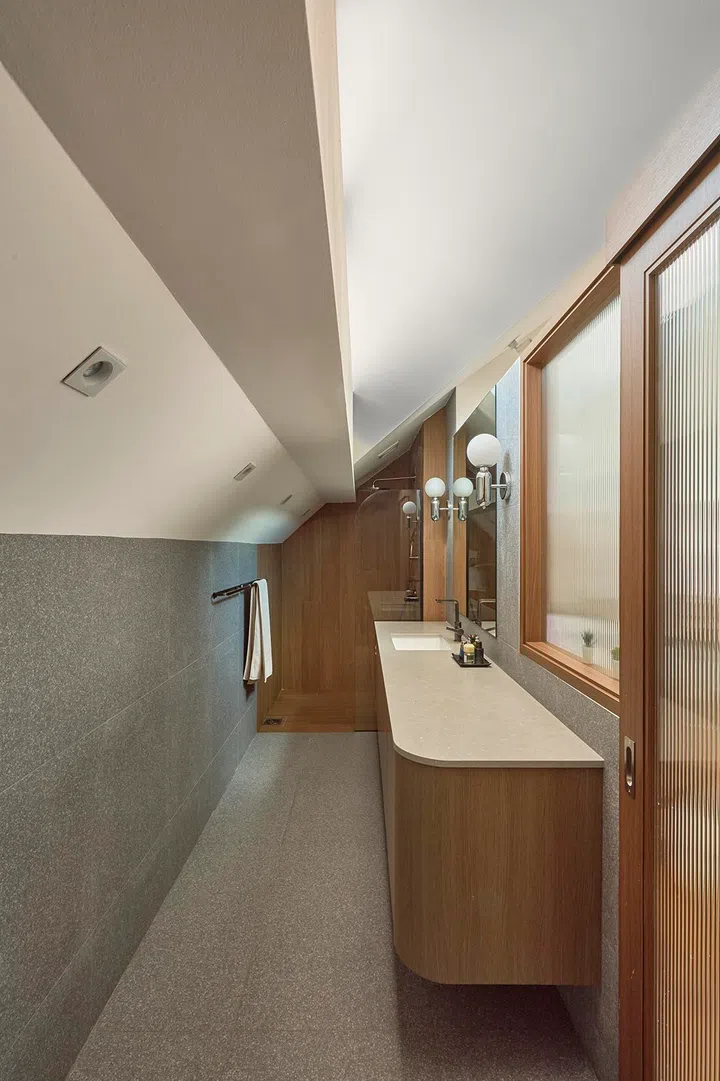
A long vanity runs the length of the bathroom, with material changes subtly dividing the space into zones.
A long bathroom, carefully broken up
The master bathroom follows the geometry of the attic, stretching out as a long, narrow volume beneath the sloping roof.
“This is the long bathroom,” Liam says. “This actually is a legacy issue… when I took over the space, they already had a shower in that area and a WC in this area, so that really dictated the decisions for this space.”
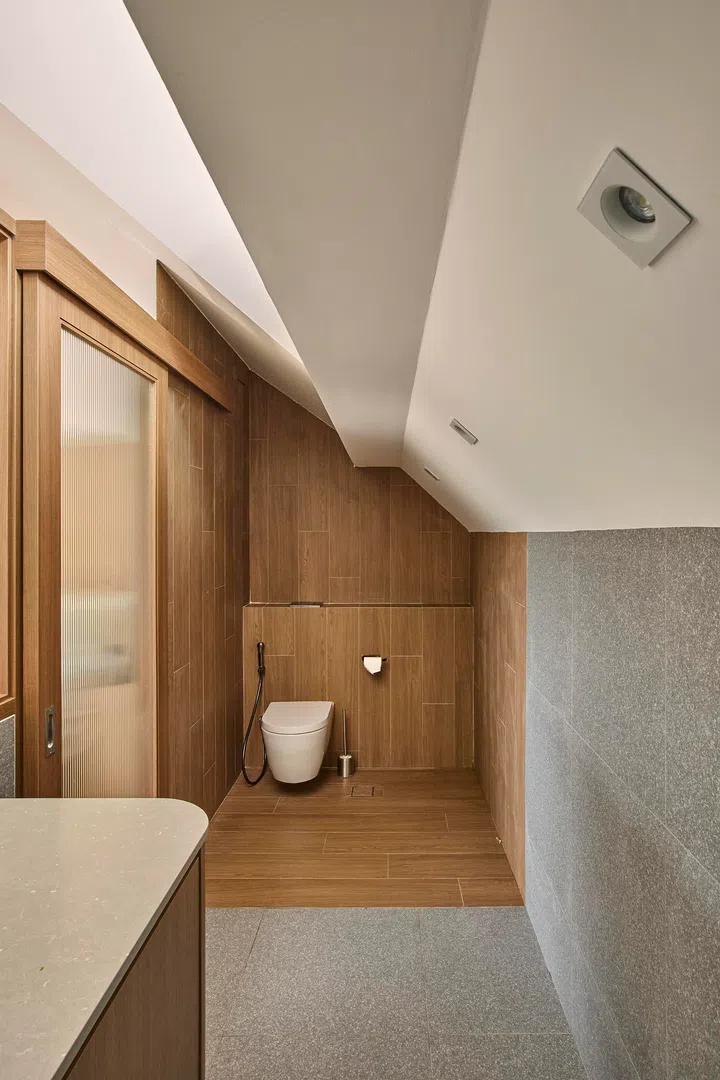
The WC is defined by wood-look finishing, creating a warmer contrast against the cooler stone surfaces elsewhere.
Rather than resist it, the layout is clarified through zoning. The room is split into two distinct halves—the wet area and the WC—each defined not by walls or doors, but by a shift in material.
“So you break down the space by zoning,” he explains. “You don’t really want to introduce doors, so you introduce a change of materiality.”
Underfoot, the flooring transitions from grey stone to wood-look tiles, while the walls echo this contrast—cool and tactile on one side, warm and continuous on the other. The effect is subtle but effective, softening what could have felt like a corridor into something more considered and balanced.
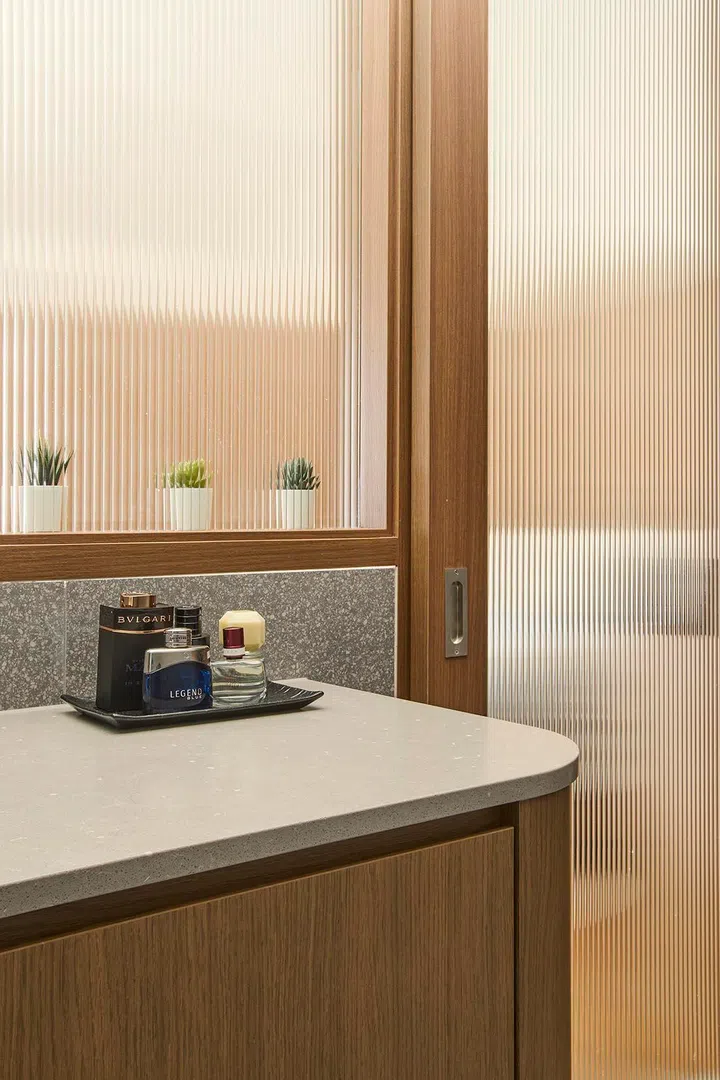
Fluted glass panels filter light while maintaining privacy between zones.
Along one edge, a long vanity runs almost the full length of the room, its rounded corners easing circulation while maintaining a continuous line. Above, fluted glass panels filter light between spaces, preserving privacy without closing the room off entirely.
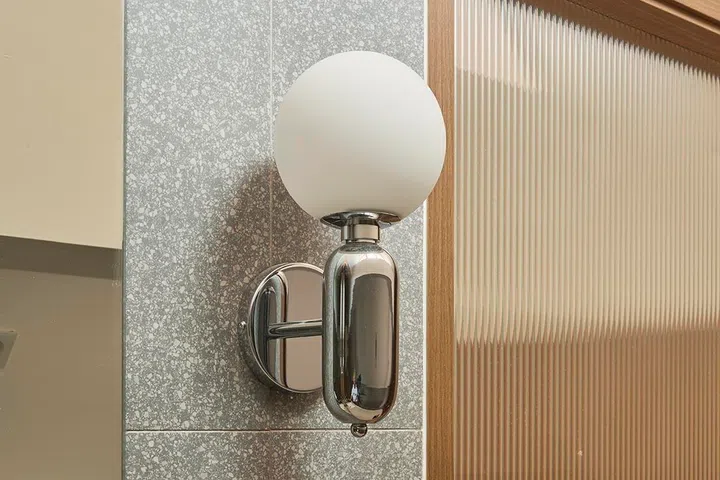
A globe wall light introduces a subtle contrast of form and finish against the textured wall surface.
The result is a bathroom that works with its constraints rather than against them, quietly resolving proportion, function and flow. Thoughtful details like the globe wall lights add a subtle contrast of form within the long, narrow space.
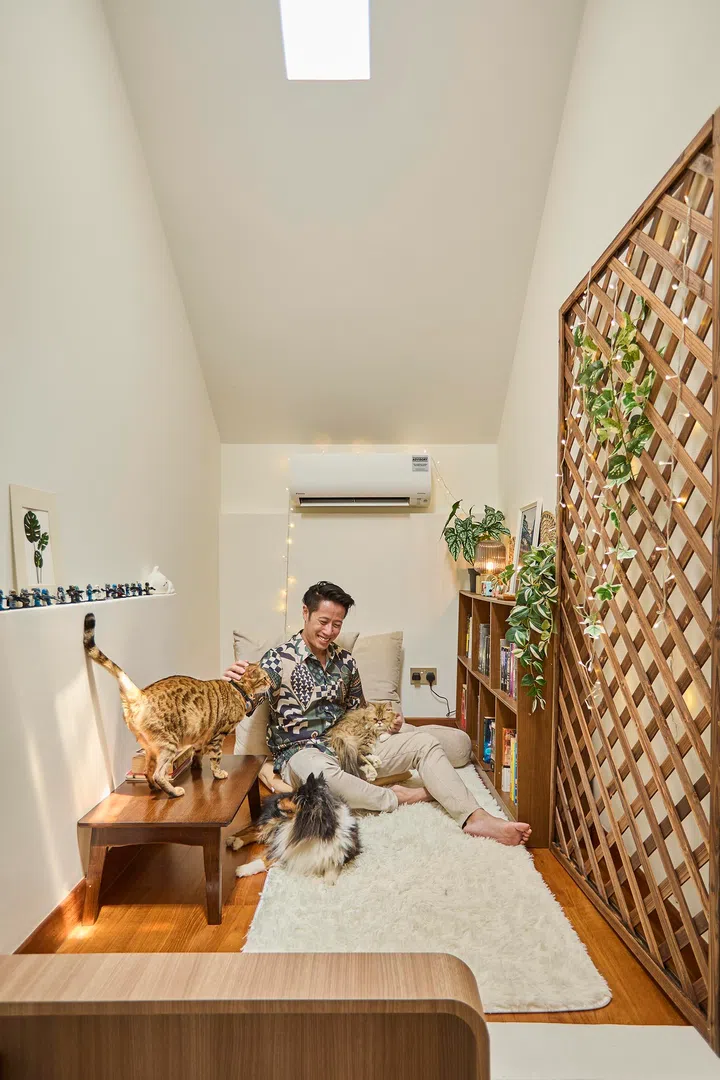
The originally unplanned reading nook has become a quiet, lived-in corner, where Liam’s home is felt most simply—and most fully.
$400,000 renovation cost
For Liam, the project does not end with completion, but with how the space is lived in over time.
“I think as an architect, you can sometimes be your harshest critic,” he reflects. “We’re always looking at buildings and spaces and thinking about how it can be improved… this sort of criticism extends to our own designs.”
Even so, the distance between intention and outcome has, in this case, resolved into something more personal. “I’d say I’m very satisfied with the final outcome, but there are always things I wish I’d approached and done differently. That said, the house feels like home to me—which is the most important thing!”
Completed over about six months, with a renovation cost of around $400,000, the house reflects a series of careful decisions shaped by both constraint and instinct. More importantly, it continues to evolve—through daily use, through memory, and through the small, unplanned moments that settle into place over time.