
CPF Income Ceiling increased to $8,000 in 2026. Are you affected?
For example, if you are earning a monthly salary of $8,200 in 2026, only $8,000 of your salary will be taken into account for CPF contribution
By Hilary Fong -

Share this article
CPF is a compulsory contribution but do you know what you are contributing to and how it works? If you are new to the workforce and not sure what the CPF is all about, we have listed out some questions and answers that would help you to better understand what CPF is all about. Also, we have included some upcoming changes in your CPF contribution that kicked in this January 2026.
In Singapore, CPF stands for the Central Provident Fund. It is a mandatory savings scheme (you cannot opt out) that helps Singaporeans and Permanent Residents (PRs) save for retirement, housing and healthcare.
How does CPF work?
If you are a Singaporean or PR working in Singapore, both you and your employer contribute a percentage of your monthly salary into your CPF account. The CPF account is split into 3 different types - Ordinary Account (OA), Special Account (SA) and Medisave (MA).
- Ordinary Account (OA) is used for housing, loans and education.
- Special Account (SA) is used for retirement and investment in retirement-related financial products.
- Medisave (MA) is used for healthcare and medical insurance premiums.
At the age of 55, SA will be moved into Retirement Account (RA) which will provide your monthly payouts after retirement.

What is the CPF contribution rate in 2026?
Different CPF contribution rates apply for different age groups. The rates will apply from the next month after your 55, 60, 65 and 70th birthday.
For example, if your 55th birthday is on 20 March 2025, your CPF contribution is 37% in the months of January to March, and 32.5% from April onwards.
The current CPF contribution rates:
| Age | Total CPF Contribution | Employer | You |
|---|---|---|---|
| 55 and below | 37% | 17% | 20% |
| Above 55 to 60 | 32.5% | 15.5% | 17% |
| Above 60 to 65 | 23.5% | 12% | 11.5% |
| Above 65 to 70 | 16.5% | 9% | 7.5% |
| Above 70 | 12.5% | 7.5% | 5% |

What is the CPF allocation rate?
Your monthly CPF contribution will be split and allocated into the different accounts. The allocation rate differs by age group and needs during that life stage. For example, when you are younger (below 35), you are getting ready to buy your first flat and have the capacity to earn and save more. Hence, the higher OA contribution.
As you move towards your 50s and above, you will see an increase in MA contribution to prepare for medical needs. After the age of 55, the SA will be closed and contributions are channelled to RA to prepare for retirement instead.
The percentages of your CPF contribution allocated to the different accounts:
| Age | OA | SA | MA | RA |
|---|---|---|---|---|
| Below 35 | 62.17% | 16.21% | 21.62% | - |
| Above 35 to 45 | 56.77% | 18.91% | 24.32% | - |
| Above 45 to 50 | 51.36% | 21.62% | 27.02% | - |
| Above 50 to 55 | 40.55% | 31.08% | 28.37% | - |
| Above 55 to 60 | 36.94% | - | 32.30% | 30.76% |
| Above 60 to 65 | 14.90% | - | 44.68% | 40.42% |
| Above 65 to 70 | 6.07% | - | 63.63% | 30.30% |
| Above 70 | 8% | - | 84% | 8% |

When do I have to start paying CPF?
In general, when you earn a monthly wage above $750, you will have to start contributing to CPF. Not just your basic salary, commissions, overtime pay, incentives, allowances and bonus offered by your employer are also considered wages that are CPF deductible.
Termination or retrenchment compensations, claims and reimbursement, and non-cash rewards or benefits are exclusions that will not attract CPF contribution.
Your salary is classified into Ordinary and Additional Wages.
Ordinary Wages are the payment given for the work you have done in the month and payable by the 14th of the following month. Monthly basic salary, monthly allowances and overtime pay are considered Ordinary Wages. If you earn a basic salary of $3,000 for the month of August and you are being paid in August or by 14 September, that is considered the Ordinary Wages for August.
Additional Wages are extra wages that are not classified under Ordinary. For example, performance or variable bonuses.
There is also an Ordinary and Additional Wage Ceiling imposed so if you are earning more than a specific amount, not the full wage will be taken into consideration for CPF deductions.
The 2025 Ordinary Wage Ceiling was $7,400 which means that even if you are earning above $7,400, only up to $7,400 of your wage is considered for contribution. In 2026, the figure will increase to $8,000 (read more explanation below).
Additional Wage Ceiling is applied on a per employer per calendar year basis. The Additional Wage Ceiling is calculated using the formula:
$102,000 minus Total Ordinary Wages subject to CPF for the year.
You may also use the Additional Wage Ceiling calculator here.
CPF Contribution Changes from 1 Jan 2026
Increase in CPF Ordinary Wage Ceiling
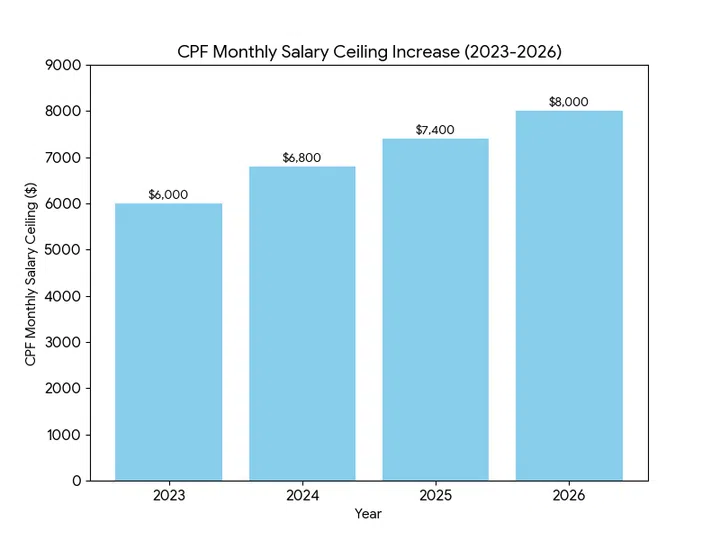
Since 1 September 2023, the CPF monthly salary ceiling has been increasing primarily in four gradual increments per year from $6,000 in 2023 to $8,000 in 2026. These increments are put in place to keep up with rising wages and help you to achieve your retirement goals quicker.
From 1 January 2026, the Ordinary Wage Ceiling will be increased from the current $7,400 to $8,000. What does this mean?
The Ordinary Wage Ceiling is a cap or a maximum amount of salary that can be deducted for CPF. For example, if you are earning a monthly salary of $8,200 in 2026, only $8,000 of your salary will be taken into account for CPF contribution, and the remaining $200 remains as your take home pay in cash.
So how will the new Ordinary Wage Ceiling affect you?
If your salary falls below $8,000, the change will not have much impact on you since your monthly income is fully up for deduction. However, if you are earning between $7,400 to $8,000, you may find your disposable income reduced from 2026.
For example:
| Year | Gross income | CPF Contribution | Disposable income after CPF deduction |
|---|---|---|---|
| 2025 | $7,500 | $7,400 x 20% = $1,480 | $7,500 - $1,480 = $6,020 |
| 2026 | $7,500 | $7,500 x 20% = $1,500 | $7,500 - $1,500 = $6,000 (-$20) |
| 2025 | $8,000 | $7,400 x 20% = $1,480 | $8,000 - $1,480 = $6,520 |
| 2026 | $8,000 | $8,000 x 20% = $1,600 | $8000 - $1,600 = $6,400 (-$120) |
From the comparison above, we can see that those who earn $7,500 will see a $20 reduction and those who earn $8,000 will see a $120 reduction in their monthly disposable salary in 2026. It may sound painful to have some of your cash flow cut but ultimately, the money is channelled into your CPF account which means you will have more savings at the end of the day.

Increase in CPF Contribution Rates
Again, this update will not affect everyone across the board but only those aged above 55 to 65. In 2026, the total CPF contribution for those above 55 to 65 will be increased by 1.5%. If you fall within this age group next year, it means that your employer will be paying you more (0.5%) for your CPF contribution and you will have more savings in your CPF RA.
Updated CPF contribution rates:
| Year | Age | Total contribution | Employer | You |
|---|---|---|---|---|
| 2025 | Above 55 to 60 | 32.5% | 15.5% | 17% |
| 2026 | Above 55 to 60 | 34% | 16% | 18% |
| 2025 | Above 60 to 65 | 23.5% | 12% | 11.5% |
| 2026 | Above 60 to 65 | 25% | 12.5% | 12.5% |
With the new updates announced, we can see that the government is striving towards strengthening savings and retirement funds especially amidst inflation and housing concerns. If you fall within the income group and age group affected by the changes in 2026, you may wish to plan ahead and make any necessary financial adjustments ahead of time.