
Invest in Property or Shares in Singapore: Should you buy REITs vs real estate?
Property investment in Singapore is a popular wealth-building strategy, and it can be done through real estate ownership or participating in S-REITs. Here’s everything you need to know.

Share this article
Real estate has long been a favoured asset class for portfolio diversification, given its low correlation with the stock market. And coupled with Singapore’s seemingly untamable real estate prices, it’s no wonder property investing remains a popular choice among investors.
Broadly speaking, property investment in Singapore can be split into two major categories:
- Property ownership
- Singapore real estate investment trusts (S-REITS).
Property Investment in Singapore
In the table below, we’ve summarised the key differences between property investment via ownership and investing in REITs.
| Landlord | Invest in shares, stocks (REITS) |
|---|---|
| High starting capital | Low starting capital |
| Long-term financial commitment | No commitment, can sell off shares any time |
| Low liquidity, may have to wait for the right buyer | High liquidity, can trade shares on exchanges |
| Have to manage issues that may crop up | Pays a fee for fund management |
| Can only invest in a few properties at a time | Can invest in different property types and across different segments, depending on the REIT you choose |
| Potentially high cash flow | Steady, passive cash flow |

Image from Freepik
Property Investment: Home Ownership
The first, more traditional method is simply to buy a house, and become a landlord. This means buying or renting a property unit, and renting or sub-letting it out to collect rental income.
The idea is straightforward but the execution may be a little less so. That’s because being a landlord isn’t the passive income play that many think it is.
You’ll need to be ready to deal with all sorts of problems and issues ranging from tenant troubles to property wear-and-tear to maintenance, replacements and even housekeeping, depending on the terms of your rental contract.
Also, while landlords are currently rolling in it given record-high rents, things may not always stay this way. When the rental market corrects, you may find yourself barely breaking even or even sitting at a loss.
Calculate Rental Yield for your property
The most important metric to know as a landlord – the rental yield. Here’s a simple formula to calculate it:
- (Net annual income / total cash outlay) x 100
Additionally,
- Net annual income = annual income - yearly cost - first-year mortgage interest
- Yearly costs may include property tax, maintenance fees, agent’s commission etc
- Total cash outlay = downpayment + stamp duties + renovation and furnishing cost + taxes + other legal costs etc
Note that you’ll want to use the net annual income for a more accurate picture of your rental yield.
When shopping for an investment property, you will most likely be told the gross rental yield – this figure will be higher and more attractive, as it uses the gross rental income, which doesn’t include maintenance and other running costs.
Hence, it’s important to run your own figures instead of simply trusting what’s written on the brochure.

Image from Freepik
How to choose an investment property?
There are 5 steps you can follow when choosing an investment property:
First, decide what type of property you want to invest in.
If you choose a residential property, you may have to pay Additional Buyer’s Stamp Duty (ABSD), which will increase your investment outlay. On the other hand, commercial properties such as shophouses and industrial buildings are not subject to ABSD.
Next, find out what is a realistic annual rental income you can expect from the property.
Besides the costs mentioned in the section on calculating rental yield above, you may also have to look into additional factors such as zoning requirements for commercial units, proximity to MRT stations, etc.
Contact the property agent or seller for a house viewing.
You will need to ascertain the condition of the unit including likely issues or potential improvement works required. You should also observe the environment and its characteristics, such as noisy neighbours, obstruction issues, etc. – anything that may impact your chances of getting and retaining tenants.
If satisfied, negotiate a suitable purchase price with the agent or seller. Arrange suitable financing, including looking for a mortgage loan with a favourable interest rate.
Sign the paperwork, pay the downpayment and other fees, and embark on any renovations required. Once complete you’ll be able to start viewing your unit to potential tenants, and hope you quickly get a bite!

Image from Freepik
Invest in REITs Singapore
Real estate investment trusts (REITs) are a distinct class of investment fund that focuses purely on real estate. As an investor, you will purchase shares in a REIT that deals in the types of property you want to invest in.
As a shareholder, you are entitled to dividend payments paid out by the REIT. This is generated mainly from the rental income collected from the properties held by the trust.
REITs may potentially offer capital returns over the long term, but typically at moderate rates. What REITs are designed to do, rather, is to provide a passive income stream via dividends.
Calculate REITs ROI
Working out Return on Investment (ROI) on REITs is a lot more straightforward compared to figuring out rental yields. You simply need to look at the dividend paid per share and/or the dividend yield, which in most cases is provided by default.
Take note of the management fee when choosing a REIT. A higher-than-average management fee will eat into your returns, and it may be worthwhile switching to a REIT with moderate yield but a lower management fee.
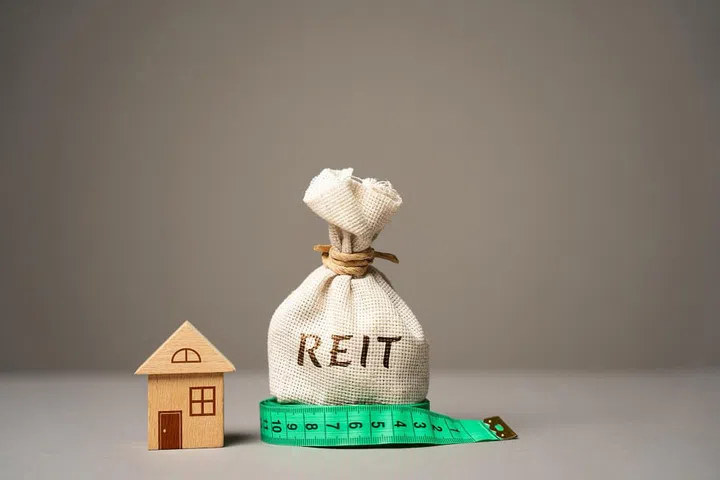
Image from Freepik
How to choose a REIT?
Look up the list of REITs offered by your online broker to understand what types or properties they are focused on. You can also view their top holdings, past dividend yield, management fee and other bits of important information.
For more in-depth information, obtain a copy of the REIT’s prospectus. You may also contact the management team directly if you have more questions, such as on future plans.
If you’re ready to proceed, purchase units or shares of the REIT you want via your online broker. Once you do so, you will be a shareholder and be accorded any prevailing entitlements, including the right to collect dividends.
Hold your shares and wait for the next round of dividends to be paid out.

Image from Freepik
Buy Property vs Property Shares Stocks
Generally speaking, being a landlord can potentially provide high cash flow, as you will collect rental income directly from your tenants.
In exchange, you will need to manage any number of issues that may crop up, ranging from regular maintenance to badly behaved tenants who trash the place or flout the rules.
And let’s not forget the most imposing obstacle – the high capital outlay required, and if you’re taking a mortgage loan, the long financial commitment.
Also, while your property may see significant capital appreciation, getting rid of your tenants and flipping your unit for a quick profit is likely easier said than done. This reality makes real estate ownership a low liquidity play, and you should consider if this fits your needs as an investor.
Meanwhile, property investment via REITs comes with much lesser hassle, and a much lower bar to entry. Instead of putting down hundreds of thousands of dollars, you can start investing with a far smaller capital sum.
And when required, REITs can be sold much more quickly and easily, you can sell them on the stock exchange via your brokerage account during trading hours. This makes REITs a much more liquid investment in comparison.
This article was first published in Value Champion.