
Buying Small, Renovating Smart: 6 Things to Consider Before You Fall in Love
In compact homes, small decisions can have a huge impact. A property agent and the designers behind mono.poly’s Aloft share what buyers should really look for before committing.
By Gwyneth Goh -
Share this article
This article is part of Home & Decor’s monthly editorial topics series — crafted around real, current problems that many Singaporean homeowners face. Jam-packed with personal recounts, opinions, and expert takes, we hope that these weekly pieces will inspire you, and bring you solutions that you can take into your own home.
March’s topic: ’Living Big in Small Spaces’. Article 3/4.
Most of us know the feeling.
You step into a small, beautifully renovated home and immediately begin imagining your best life inside it—morning coffee by the window, friends gathered around the island, soft evening light bouncing off fresh paint. In that moment, the finishes speak louder than the floor plan.
But as Glenice Toh, Division Associate Director at OrangeTee & Tie, often tells her clients, “It’s better to walk away from a beautiful home than to be stuck in a location (or layout) that doesn’t work for you.”
In compact homes, where every square metre must earn its keep, buying decisions matter even more. What looks charming during a 20-minute viewing can become frustrating after months of daily use—and very expensive to rectify once renovation begins.
To unpack what truly makes a small home worth renovating, we spoke with Glenice and the team at mono.poly, led by architects and interior designers Chio Wen Tian and Chua Yi Xi. Their 764 sq ft condo project Aloft demonstrates how the right spatial conditions—and the right decisions—can transform a compact unit into something far greater than its footprint.
So before you fall in love, here are six things worth considering.
Home: A 2-bedroom condo in Bukit Timah
Size: 764 sqft
Interior Designer: Chio Wen Tian & Chua Yi Xi, mono.poly
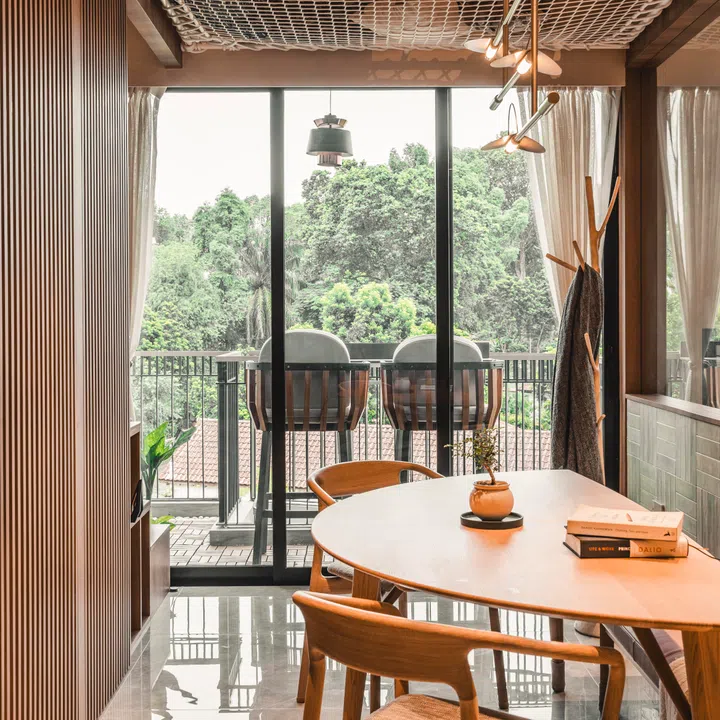
Full-height glazing at the balcony draws daylight deep into the dining area, demonstrating how orientation and window placement can make a compact home feel open and expansive.
Read the light before the layout
When the mono.poly team first steps into a small unit, they aren’t looking at finishes. They’re looking for light.
“Light is usually the first thing we notice,” says Yi Xi. “Not just the windows, but whether we can pull that light further in. If there are non-structural walls that can come down, it’s usually a good sign that the space can transform.”
In compact homes, a dim room doesn’t just feel dark—it feels smaller. During viewings, notice how light travels through the home. Does it reach the dining space? Does it spill into corridors? What happens in the afternoon?
At Aloft, light and volume were immediate signals of potential. “What immediately captured us was the airspace and the slanted ceiling,” says Wen Tian. “Being on the highest floor made the unit rare, almost like a hidden attic apartment waiting to be discovered.”
It wasn’t decoration that made the difference. It was the bones.
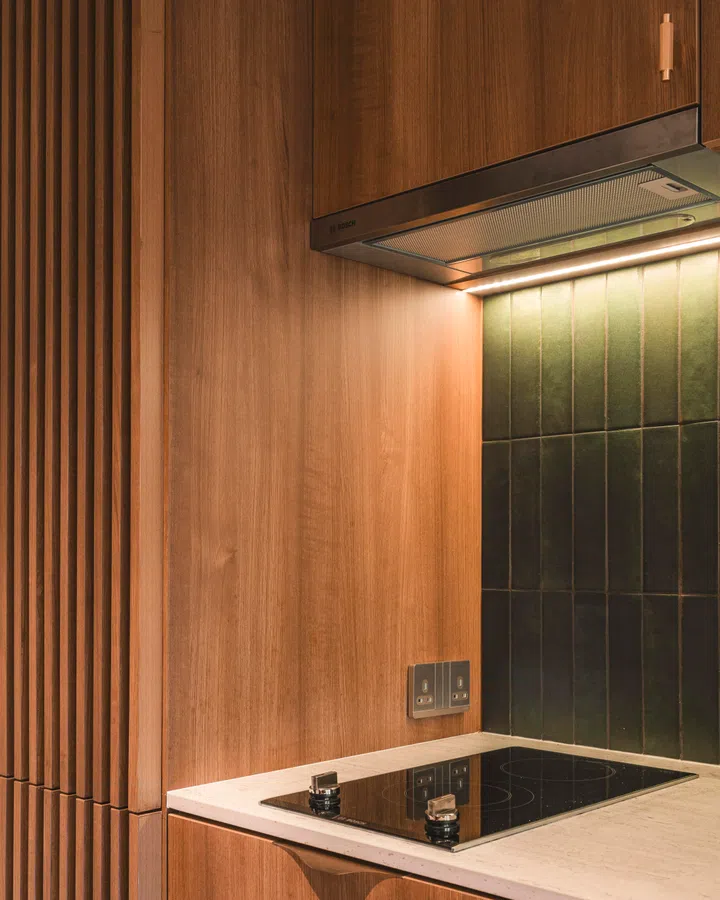
The position of the hob, hood and electrical points may look interchangeable, but in reality they are anchored by service lines and ventilation routes—fixed elements that quietly shape what a small home can (and cannot) become.
Know what can’t be moved
While designers look for potential, property agents look for constraints.
“When evaluating condos, I always look out for ‘space-eaters’ like bay windows that reduce usable floor area and walls that restrict layout flexibility,” says Glenice Toh, Division Associate Director at OrangeTee & Tie. “I also highlight potential lifestyle hurdles, such as windowless bathrooms prone to moisture or open kitchens that lack the ventilation required for heavy ‘wok hei’ cooking. Even a large unit can feel cramped if it’s plagued by odd, acute angles and inefficient corners.”
It’s a reminder that what looks generous on paper can behave very differently in reality. A bay window might seem charming, but it quietly eats into usable floor space. An open kitchen may look sleek, but without proper ventilation, everyday cooking becomes a compromise.
Buyers often assume renovation can fix anything. In reality, some elements are stubbornly fixed—and in compact homes, these really matter. Plumbing stacks dictate where toilets can sit. Gas lines and water points cannot be shifted freely. Exhaust routes determine where a hob and hood must go.
At Aloft, the clean-lined kitchen feels effortless, but its layout is anchored by these practical constraints. What appears flexible is, in truth, carefully aligned with what cannot be moved.
“You live the climate and sound of a home every day,” Glenice gently reminds buyers. Afternoon heat, airflow, moisture and cooking smells may feel minor during a short viewing, but over time they shape how comfortable a home truly is.
In a small unit, those realities matter even more. While designers look for potential, agents look for constraints.
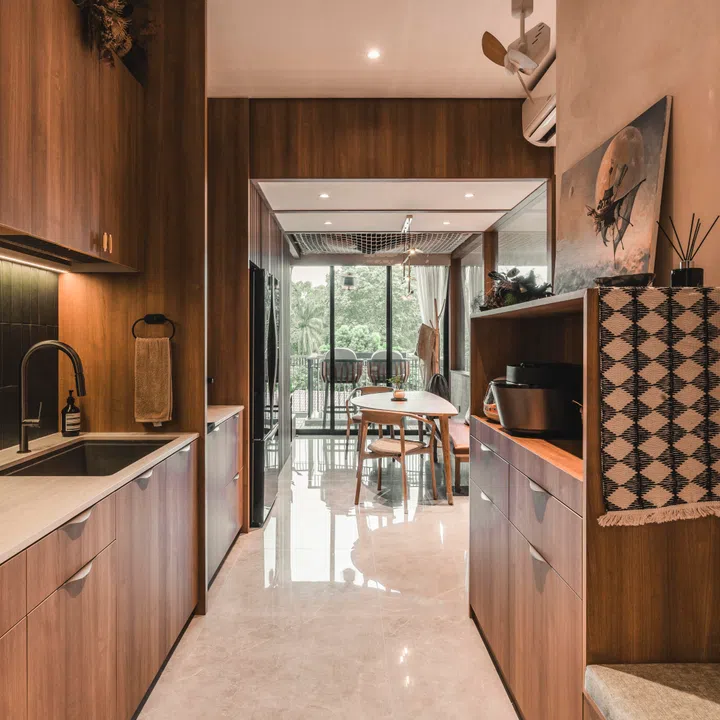
The alignment of kitchen, dining and balcony creates a natural progression through the home, demonstrating how adjacency shapes daily flow in a compact layout.
Bigger Isn’t always better
A common reflex when faced with a tight layout? Hack the walls.
But mono.poly cautions against blind openness. “Knocking down walls without enough thought gives you more space,” says Yi Xi, “but if it’s not considered, the layout can feel disjointed or off balance. More square footage does not always solve the problem.”
What matters more is adjacency.
“In small homes, adjacency is everything,” Wen Tian advises, “what sits next to what, what shares light, what borrows privacy, and how one zone transitions into another.”
It’s not simply about removing partitions. It’s about understanding how zones relate.
Folding doors, for instance, promise flexibility and the ability to combine rooms—but often disappoint. “They sound good in theory,” Yi Xi notes, “but they are often clunky to use and the folded stack still needs to go somewhere. In a tight space, it is rarely convenient.”
Glenice has seen the consequences of misjudging flow. She recalls a buyer who insisted she could adapt to a mirrored layout, preferring the kitchen to sit on the opposite side upon entry. “She felt it would just be a matter of getting used to,” Glenice says. But once she moved in, the daily flow proved otherwise. Circulation felt awkward, movement wasn’t intuitive, and the space never quite settled. Eventually, she chose to rent the unit out and moved back in with her parents instead.
In compact homes, layout is not a backdrop. It’s daily choreography.
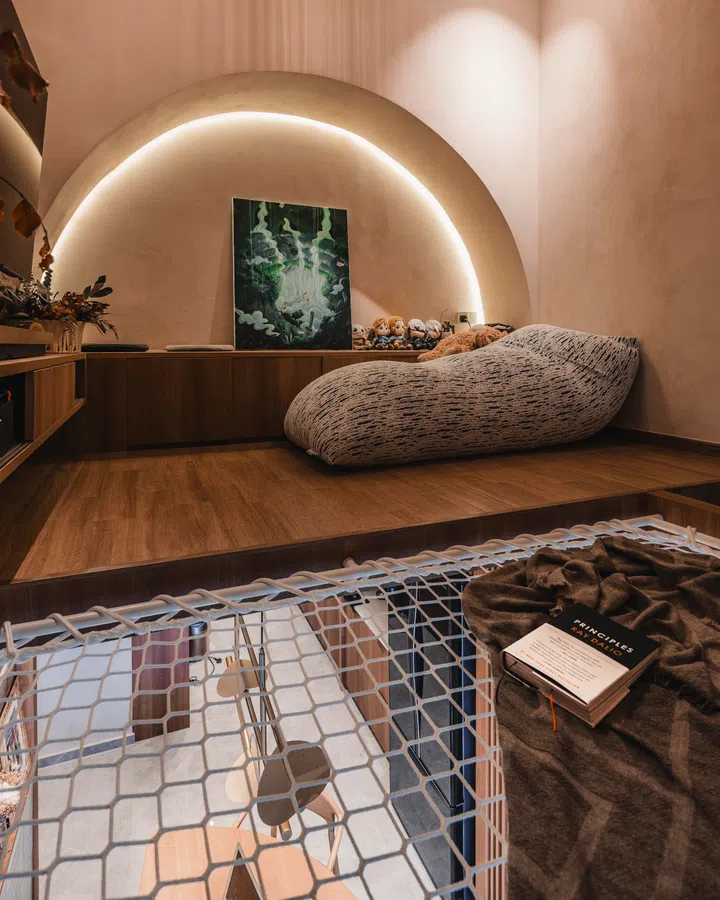
The loft at Aloft succeeds because ceiling height and circulation were carefully studied, transforming vertical space into usable living area rather than an awkward add-on.
Make bold moves—but only when they make sense
If hacking walls isn’t always the answer, what about building upward?
At Aloft, the most dramatic decision was to introduce a loft—a move that could easily have overwhelmed a 764 sq ft footprint if misjudged.
“The turning point came when we evaluated the travel needed to gain height,” says Wen Tian. “Any loft demands space to move upward, and if that journey is too long or too steep, it can feel like a burden rather than a benefit.”
In other words, vertical expansion only works when circulation remains comfortable. Ceiling height must be generous enough. The climb must feel intuitive. The homeowners’ daily habits must justify that additional level.
“For a loft to work, ceiling height, circulation comfort and the client’s physical habits must align, otherwise, it risks becoming beautiful but impractical.”
What made Aloft different was not simply the decision to build upward, but the precision behind it. The team worked within a tight 1.8 m length constraint to achieve a climb height of 2.42 m, thereby unlocking the approved 5 sqm loft space safely and comfortably.
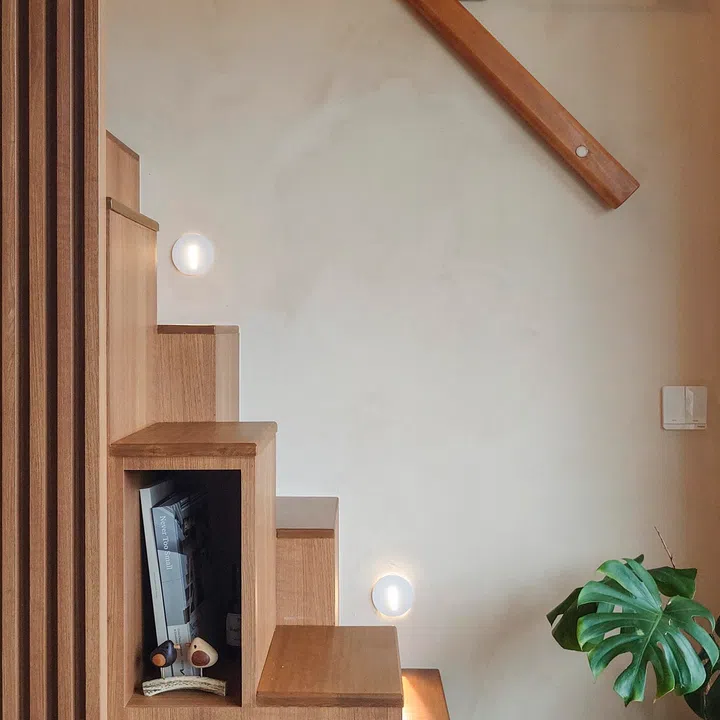
A dimensioned study helped mono.poly map out the climb and storage volumes precisely, ensuring the loft would be safe and comfortable to access within a strict length constraint.
Before fabrication, every millimetre was resolved in a detailed model to communicate the exact geometry to the carpenter. Rather than installing a conventional staircase that would consume precious floor area, mono.poly designed compact storage “witches stairs”, splitting each 302.5 mm rise into more manageable 151.25 mm increments. This created a gentler, more natural ascent within a highly compressed footprint.
The first step was designed as a lift-up storage compartment, and all steel elements were deliberately concealed within the structure to keep the composition visually clean. At the top, the slanted ceiling and airnet form a triangular enclosure that lends a stronger sense of safety, rather than leaving the loft feeling exposed.
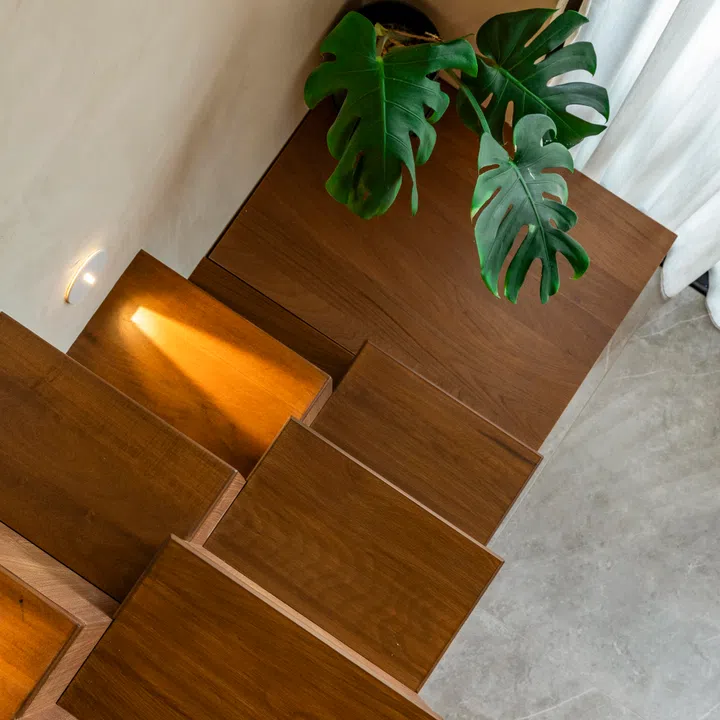
Designed as storage “witches stairs”, the compact steps combine access, display and deep storage in one element, helping the loft feel earned rather than space-hungry.
“In compact homes, every element must work harder,” Wen Tian says. “The staircase was prime real estate, so letting it serve only one function would have been a missed opportunity. By turning it into storage, access and a fluted feature, we condensed multiple needs into a single footprint.”
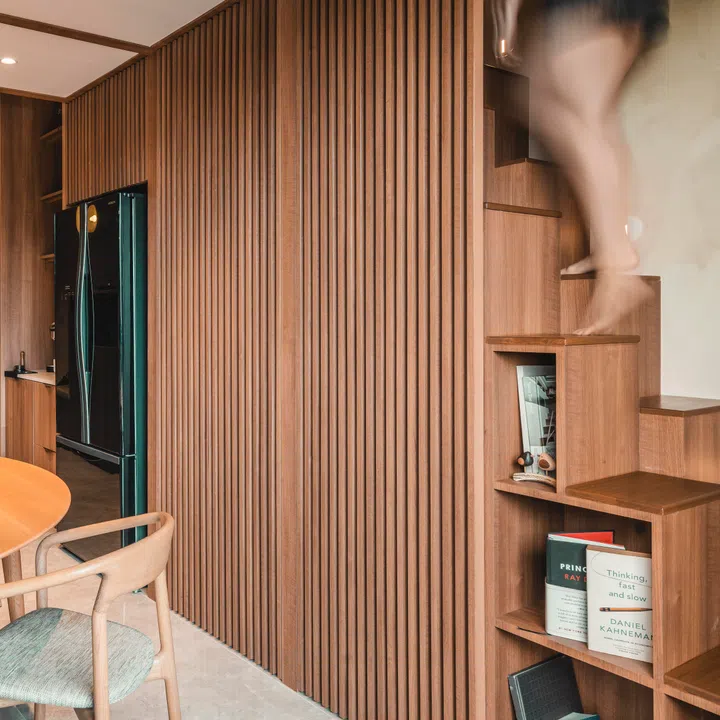
The witches stairs split the vertical climb into alternating steps, allowing the owners to reach the 2.42 m loft safely within a tight 1.8 m run—while doubling as storage and display.
Here, the loft works not because lofts are fashionable, but because the ceiling height, circulation comfort, and the homeowners’ physical habits aligned. The television was relocated to the loft, freeing up the main level. Storage was consolidated along one side of the unit. The owners accepted a lift-up first step that doubles as concealed storage. Each decision made the next one possible.
The lesson is simple: bold design decisions only make sense when they solve something real. Otherwise, they risk becoming expensive gestures that disrupt more than they improve.
In small homes, bold moves must be calculated—and earned.
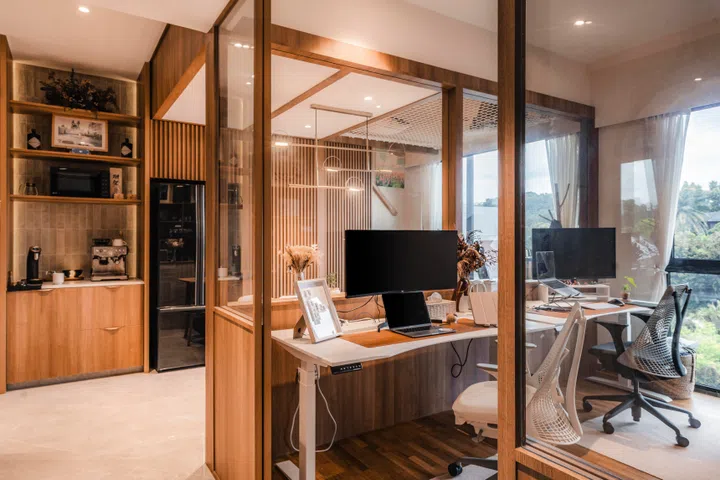
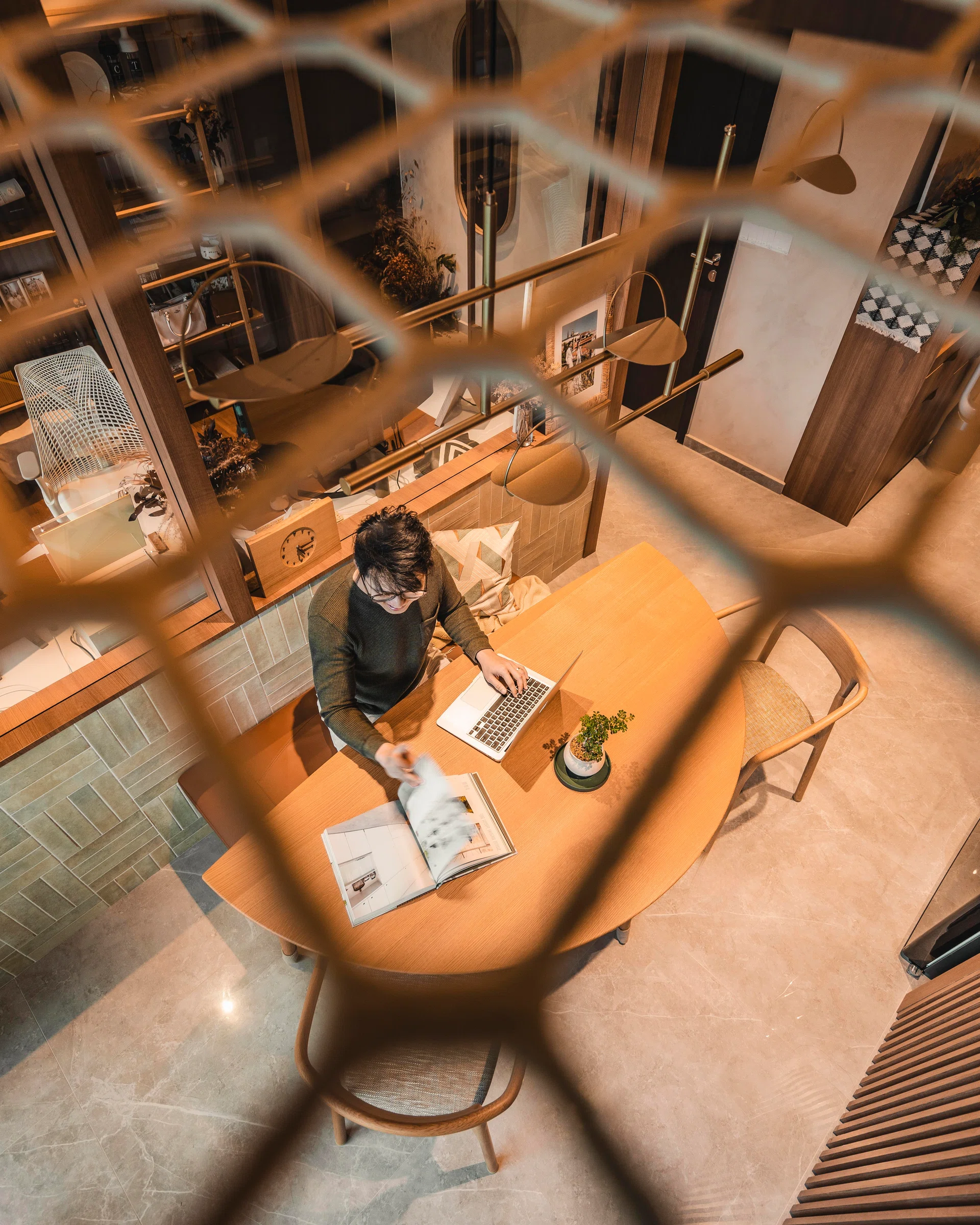
A half-height wall with glass defines the work zone while preserving light and connection—proof that in compact homes, daily habits should shape the layout and not the other way around.
Design for daily life
Perhaps the most important lesson from Aloft is this: the layout followed lifestyle, not trends.
Working from home was not an occasional need but a daily reality. Instead of squeezing a desk into a corner, mono.poly carved out a dedicated study zone separated by a half-height wall with glass. The partition maintains visual connection and allows light to travel, while still offering a sense of focus and boundary.
The homeowners were also clear about what they did not want: no television on the main level. That single decision reshaped the home. Entertainment shifted upward into the loft, freeing the living area to become calmer, more conversational and less screen-driven.
Even the balcony was reimagined with intention. “When the owners spoke about unwinding with sunset views, we knew the balcony had emotional value beyond square footage,” says Wen Tian.
Rather than treating it as overflow space, it became an everyday breakfast and lounging spot, extending the home outward and making it feel larger without increasing its size.
In small homes, the most successful layouts are not the most dramatic. They respond to the rhythms of daily life.
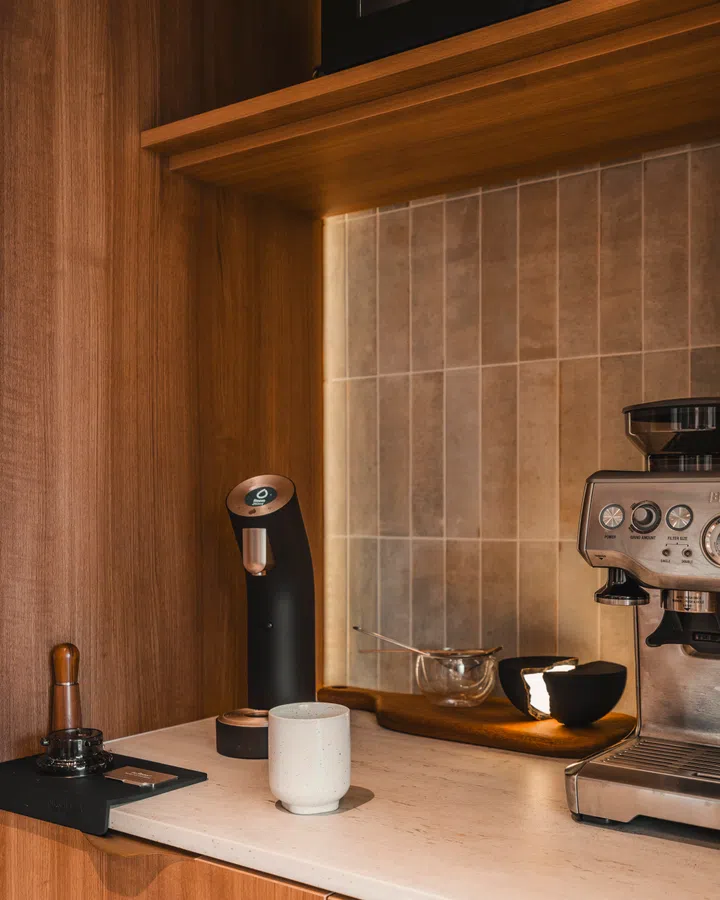
Thoughtfully planned shelving and counter depth ensure that even the smallest daily routines feel effortless in a compact home.
The little things matter most
Finally, pay close attention to the daily details.
Switches and sockets, for instance. “It sounds minor,” Yi Xi says, “but it’s something you interact with constantly. If it is off, it becomes both an eyesore and a daily inconvenience. If it is right, you hardly notice it at all.”
That is the paradox of good design. The best decisions disappear into routine.
Storage logic matters just as much. Where do clothes dry? Where does luggage go? Is there a place for appliances that won’t permanently crowd the counter? Can the layout evolve as life changes?
“Prioritise a regular, functional layout that can evolve with your needs,” Glenice advises.
A small home doesn’t need to impress. It needs to support you.
And sometimes, the smartest renovation decision is made long before any hacking begins—during that quiet moment in a viewing, when you pause, imagine your daily rituals, and look again.Finally, pay close attention to the daily details.