
Share this article
In the early days, the HDB’s mission was “shelter at all costs” to clear slums and squatter settlements. These flats were basic, functional, and often built in “slab blocks” with long common corridors.
There were separate toilet and shower (to save space), no master bedroom bathroom, and a shared refuse chute located inside the kitchen.
In 1966, the HDB 3-Room Improved (3I) was introduced. It was slightly larger and eventually featured the Main Upgrading Programme (MUP) in the 90s, where many owners “bought” an extra utility room at the back, expanding the flat to about 65 sqm.
As Singaporeans became more affluent, they wanted privacy. The New Generation (3NG), built from roughly 1976 to 1989, was a game-changer. For the first time, 3-room flats had two full bathrooms, with one attached to the master bedroom. A slightly later, “leaner” 3-Room Simplified (3S) version (approx. 64 sqm) that still kept the two-bathroom layout but reduced the overall footprint.
In the 1990s, the HDB almost stopped building 3-room flats entirely. The government believed Singaporeans’ aspirations had shifted toward 4-room, 5-room, and Executive flats. During this decade, the 3-room flat was seen as a “stepping stone” rather than a permanent home, leading to a decade-long supply gap that makes 3-room flats from the 90s quite rare today.
The 3-room HDB flat FINALLY made a comeback in 2004 via the Build-To-Order (BTO) scheme. This was driven by shrinking household sizes and the rising number of singles.
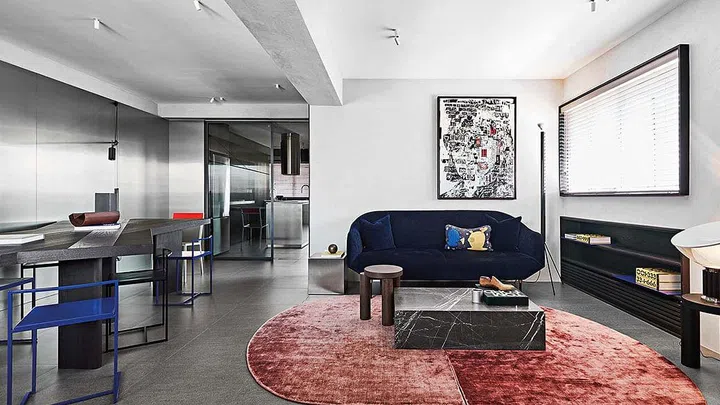
A 40s bachelor’s 3-room BTO renovation in Jalan Besar
This renovation of an 819 sq ft, 42-year-old 3-room HDB flat in Jalan Besar transforms a once-congested resale unit into a sophisticated, Bauhaus-inspired bachelor pad.
Designed by Joey Khu, the project radically reconfigured the layout by removing one bedroom to create an expansive, open-plan living and dining area.
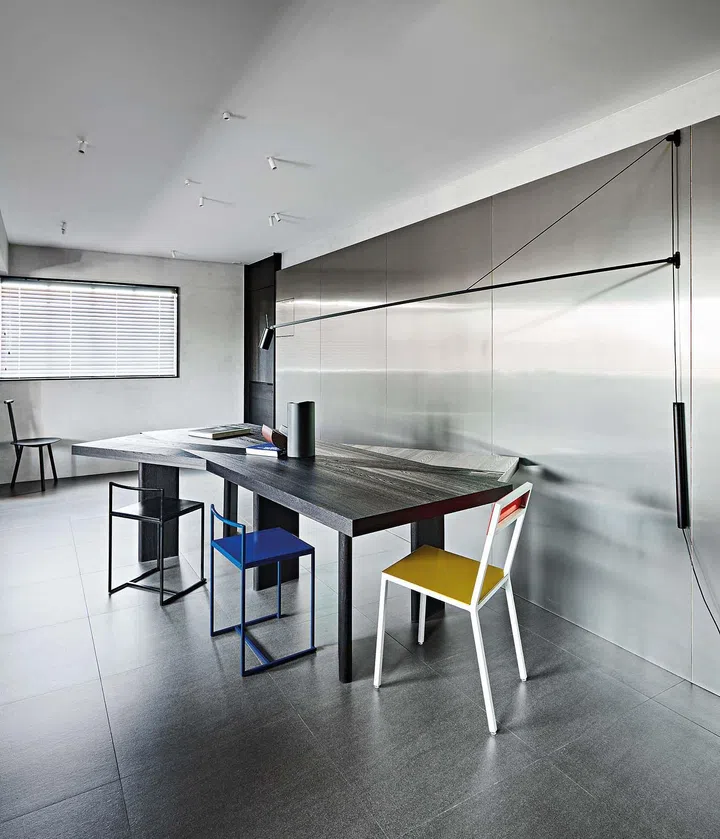
The home’s design focuses on unity and visual depth, using repeated materials and custom furniture to create a sense of order. The centrepiece of the living space is a bespoke 2.5-metre-long angled dining table that serves as a versatile hub for dining, working, and meetings.
Pops of cobalt blue and playful geometric shapes—such as half-circle rugs and avant-garde artwork—contrast with the industrial textures of the kitchen’s stainless steel and rippled quartz. By prioritising balanced proportions and layered textures over purely expensive materials, the renovation successfully modernises the aging 3-room footprint into a luxurious, art-led sanctuary tailored for a single occupant.
View more here for the full feature.
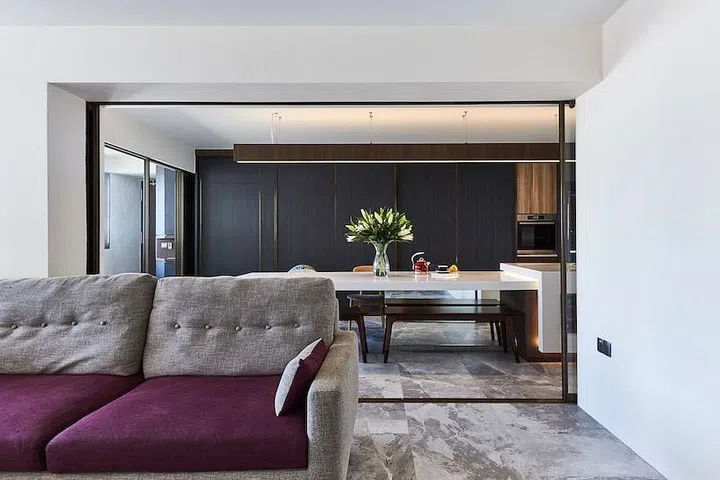
A $150,000 3-Room BTO Design
This $150,000 renovation of a 3-room resale HDB in Bishan transforms a previously dingy and poorly ventilated flat into an expansive, light-filled haven.
Designed by architect Liew Kok Fong of Studio Super Safari, the renovation centres on a massive 5-metre-long multi-functional counter that integrates the kitchen and dining areas.
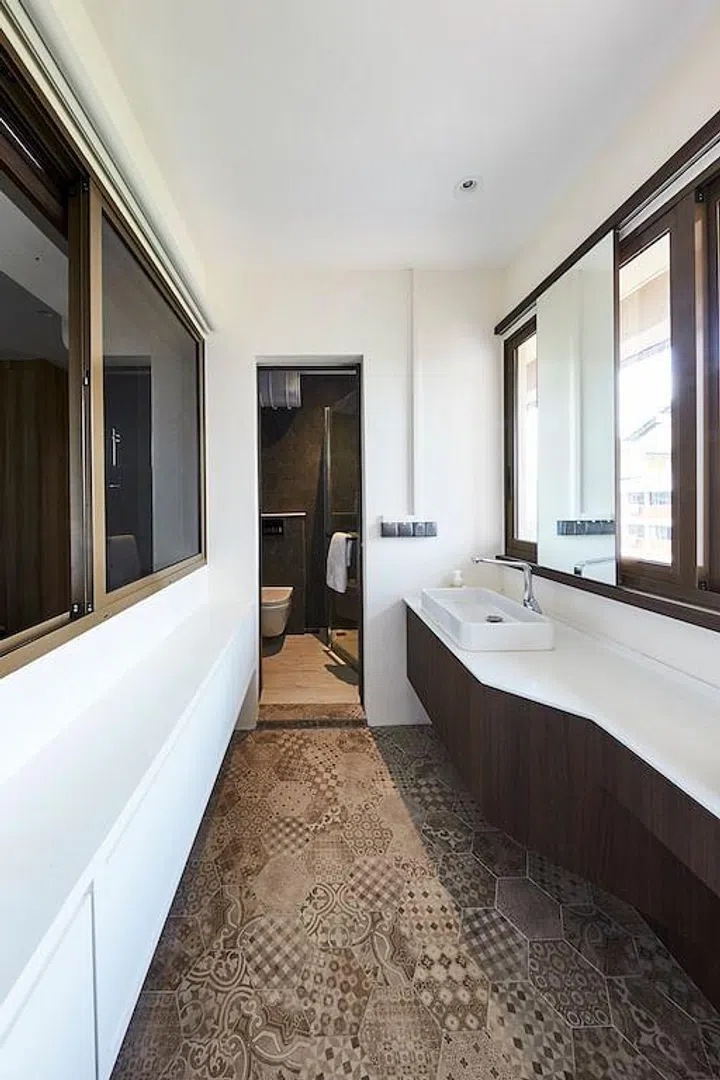
This solid white acrylic table is uniquely mounted on mirror cabinets to create a “floating” effect, visually lengthening the 7-metre kitchen and providing ample space for the homeowners’ passion for cooking and hosting.
Beyond the kitchen, the design utilises a warm, earthy palette punctuated by bold bursts of colour, such as a signature purple sofa and custom-coloured dining chairs.
View more here for the full feature.
A Lady’s 3-Room BTO Renovation at Dawson
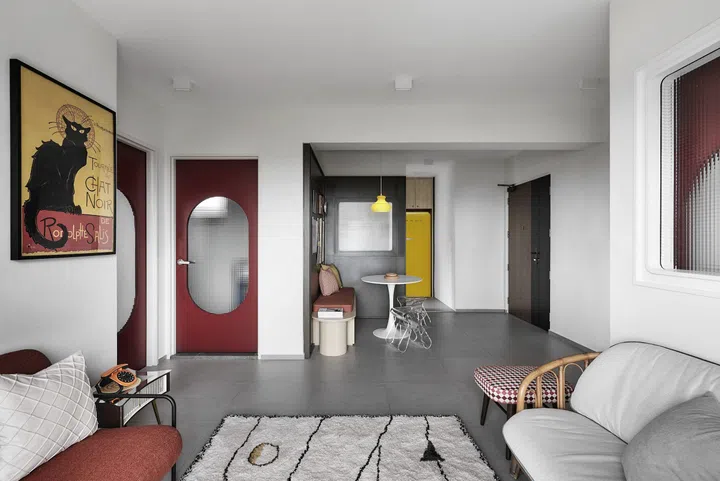
This renovation of a 710 sq ft 3-room HDB flat at Dawson Road presents an eclectic “bachelorette pad” that prioritises nostalgia and the reuse of cherished belongings.
Designed by Happe Design Atelier, the home was tailored for an educator, Quek Hui Hui, who wanted to give her existing furniture and art collection a new lease of life.
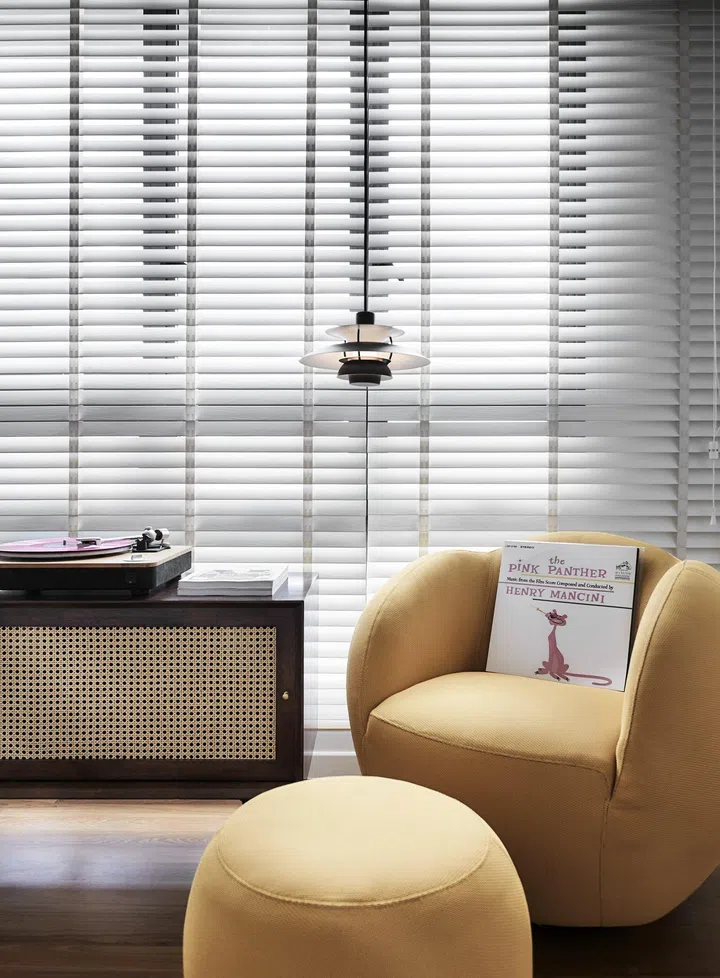
The standout feature is the creative reupholstering of old furniture, such as a sentimental rattan sofa and a basketball-themed lounge chair, which are integrated into a harmonious blend of contemporary Nordic design and vibrant pop accents.
View more here for the full feature.
A bachelor’s $108,000 DIY 3-Room BTO Design
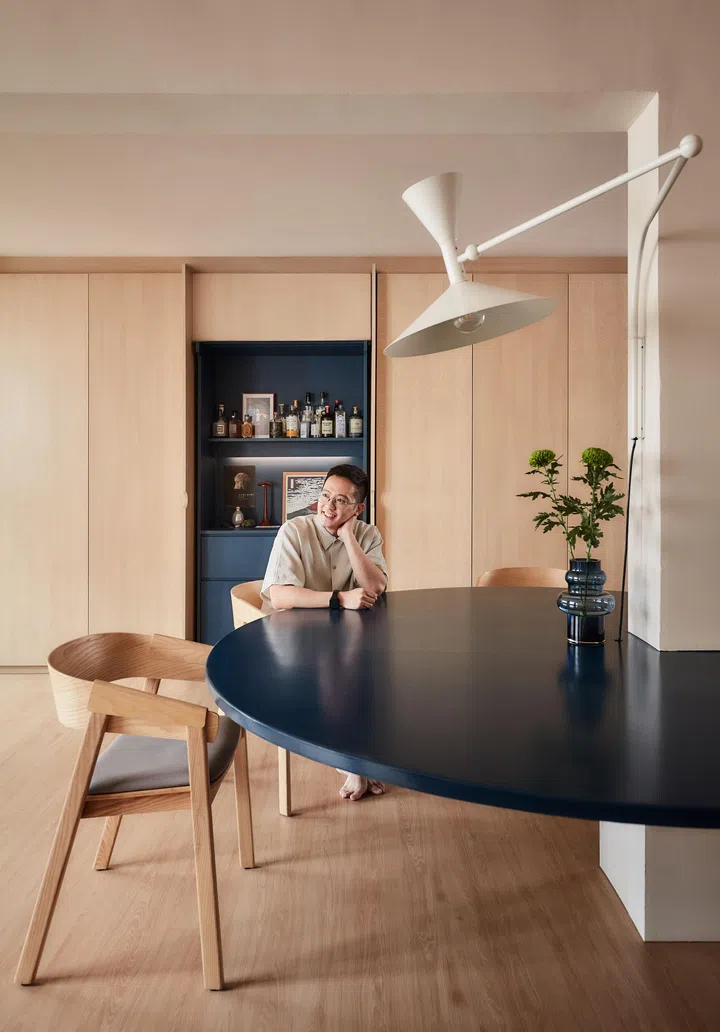
This $108,000 renovation of a 743 sq ft 3-room resale HDB flat in Serangoon Avenue 2 showcases the power of a DIY approach to interior design.
The homeowner, marketing manager Jeremy How, bypassed traditional interior designers to work directly with a contractor, using 3D modelling software to realise a vision of “calm and quirky” minimalism.
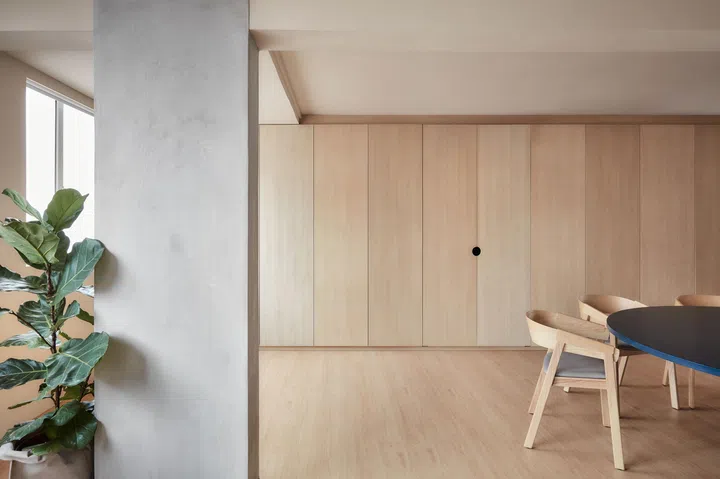
With the existing walls separating the two bedrooms and the living and dining rooms demolished, what used to be compartmentalised spaces now form one large, multi-purpose, living area.
The project involved a total overhaul of the 37-year-old HDB 3-room unit, most notably the demolition of internal walls to merge two bedrooms and the living area into a singular, vast multi-purpose space that prioritises flow over compartmentalisation.
View more here for the full feature.