
Nanoleaf Lines Review | #CheckItOut with Young
Fancy an electric neon glow for your activity spaces? Or a light-and-sound show for your man cave? Nanoleaf Lines are modular backlit smart light bars that can be connected together to make your room feel one-of-a-kind.
By Young Lim -
Share this article
Nanoleaf’s new generation of customisable LED bars offers a dizzying array of lighting options for the millennial home.
So I was at a friend’s place some days back singing up a storm on his home karaoke system, when he dimmed the living lights and whipped out a tacky-looking contraption that projected garish, swirling lights onto the ceiling. “Ta-dah. Mood lighting”, he exclaimed. “
I recoiled judgmentally, and immediately knew that I had to get his pad some decent ambient lighting options. A quick online search led me to Nanoleaf – a brand of smart décor and lighting products that I saw was garnering rave reviews from a younger generation of homeowners. I decided to put in an order for the Nanoleaf Lines – a set of modular backlit LED strips capable of casting over 16 million (gosh) colours that pulse and dance to sound or music.
I had the package shipped to my friend’s home. Eager to prove rid him of the gaudy projection light orb, I turned up on delivery day to help with unboxing and assembling the Nanoleaf Lines.
The first thing we did was to go through the website to see the various configurations we can come up with using the basic kit, and I have to say that the possibilities really are endless!
Here's what you can do if you want to use the Nanoleaf Lines in your bedroom.
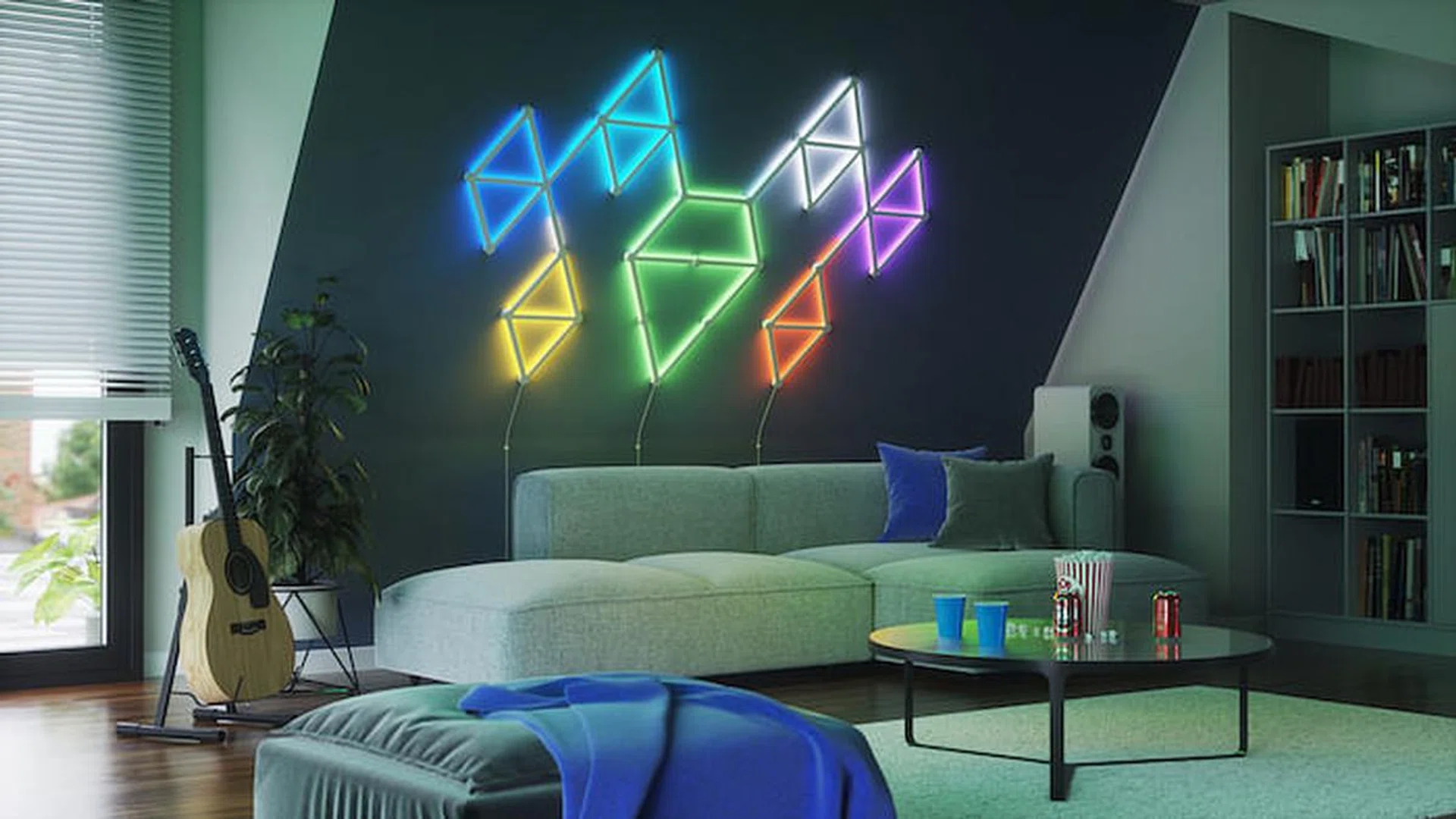
We were thinking of using the Nanoleaf Lines for the Living or Entertainment area, and these were the ideas we found.
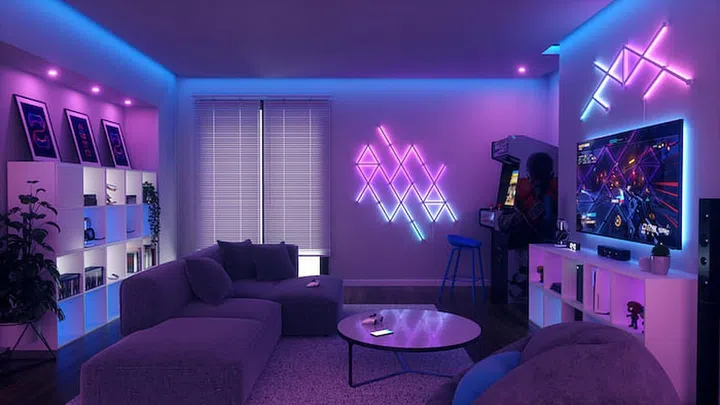
Of course, these Lines would be perfect for e-gaming as well, and here's what you can do if you want the lights to pair up with your gaming scenes.
After we had a rough idea of what we wanted to do, we decided to unbox the kit.
The product comes packed in a sturdy and respectable box, which makes it a very presentable as a gift (even without gift wrap).
Nanoleaf Lines’ basic starter kit comprises nine light lines, which you can customise and connect to your own liking. If you are gunning for bigger and bolder shapes and patterns, there is the option of purchasing an expansion pack, each of which gives you three additional light lines. The light modules and its accompanying accessories are uniformly decked in a subdued, matt-white finish. Which helps the final setup blend easily into any home, and to remain unobtrusive in the day or when the lights are not turned on.
As you can see from above, there are myriad ways to configure your Nanoleaf Lines into your desired shapes. If you need a little inspiration, you can refer to some of the configuration ideas printed on the back of a card that comes with the bundle. In the spirit of friendship and love, we settled on the geometric heart!
Next up: assembling the lights. At first glance, the constituent parts (in their disparate form) may look like a feat to assemble (especially for someone who is mildly spatially challenged, like myself). But fret not; you can scan a QR code that takes you to an online instruction manual, which gives very clear, step-by-step instructions that were intuitive and easy to follow.
What we essentially needed to do was to first form the nine light strips into the structure we wanted on a wide, flat surface. We chose to do this on the floor. The strips join up with one another at an angle by snapping onto hexagonal nodes. The nodes can then be capped up to conceal the joints, and to create a smooth, seamless surface across the final structure. All you need to get your desired pattern fixed up is some patience (in aligning the modules at the right angle before snapping them into the connectors) and some steady hands.
The Nanoleaf Lines works on a wired connection. One of the connector nodes doubles up as a power module, so the last step in the assembly process lies in attaching this module to your structure and hooking it up to the provided power plug.
Quick tip: you should plan to have your light displayed on a wall or surface with a close-by power outlet. Also, when assembling the lights, you should orientate your design in a way that places the power module closest to the power outlet you intend to use.
Time to mount! The instructions strongly recommend that you put up the entire assembled structure at once, so it would help to have an extra pair of hands help with the mounting. Again, the process was simple. The rear surface of each connector node comes with mounting tape, which you can expose by peeling off a protective layer. Make sure you turn your structure over and remove the protective peel from all the connector nodes before mounting your structure. The adhesive tape is strong, and the light strips are, well, fairly light (pardon the pun), so the whole mainframe stays on well if mounted properly. We used measuring tape and the iPhone’s nifty measure app to ensure that the lights were level and centralised.
Done with the hardware; now the software. Download the Nanoleaf app onto your phone (available for both iOS and Android), then pair your lights with the app. The pairing process is incredibly quick and straightforward. Power up the app and the lights, then either hold your phone near the lights, scan the QR code on the light’s power line, or manually enter your light’s unique eight-digit code into the app. Once done, voila, your lights should instantly come to life!
When pairing is complete, the app automatically detects the pattern in which you fashioned your light strips (what sorcery!). It presents you with a graphical representation of the pattern, and asks you to rotate the graphic on your phone’s screen to match the orientation of your light installation.
The Nanoleaf app is your one-stop control pad for your rigged-up lights. You can pick colours, control brightness, schedule on/off timings from the app. If you are patient enough, you can customise colours for each light strip in your installation. And with nine strips for starters, the lighting possibilities are almost endless.
Those who are less hands-on can choose from download colour “templates” (called “scenes”) designed either by Nanoleaf or by other users around the world. They range from pulsating neon hues to gently-flickering pastel palettes. You can programme your light scenes to be static, to flash dynamically, or to pulsate rhythmically to music or sound playing in the vicinity (which is by far my favourite function, whether in tandem with a soppy ballad or throbbing to a sick party beat). Nanoleaf is also compatible with Google Homes and Apple Homekit, so if you have a smart-home system powered by these AI platforms, you can control the lights using voice commands.
The Nanoleaf Lines starter kit (with nine lines) retails for $339. Additional light lines, if you want to create bigger or more intricate light installations, retail in expansion packs of threes for $109. On top of its iridescent party function, we tried it out as a task light by setting it on a uniform, white colour. In that mode, it was surprisingly bright and functional, and I was able to read a book comfortably by dimming the lights to an appropriate level. We also tried it as a source of ambient lighting by having it cast a soft, sunset glow across the living room. The result was pleasantly warm and soothing.
Using the Nanoleaf Lines in the bedroom is a great idea if you don't have a lot of space for a desk or floor lamp but want to add some ambient lighting in the room. You can even have the Nanoleaf Lines on the ceiling to create a unique art installation. Thanks to the intuitive dimming feature, the intensity of the lights can be easily adjusted to suit your needs.
In all, I am happy I got the Nanoleaf Lines for my friend. After watching it in action at his place, I am definitely buying my own home a set. And the last I heard, my friend has already put in an order for an expansion pack!