
New home renovation, no kids yet? 7 Ways to make your home child-friendly now and save you time later
By Shannon Osztonits -
Share this article
A home renovation is no small matter. It takes careful planning, a lot of consideration and a proper budget to complete.
Your home is a place for you to retreat, enjoy, grow and evolve in. And for many, this means an expansion of family life, too.
When buying a home in Singapore, most homeowners foresee themselves living in that apartment or house for at least 10+ years. After all, the Minimum Occupation Period (MOP) for an HDB is five years anyway.
During your upcoming, current or past renovations, have you considered design decisions around your children?
This isn’t just limited to first-time parents or those with another baby on the way. Grandparents, if your grandchildren spend a lot of time at your home and you’re planning a long-anticipated and deserved home renovation, some of these tips can be applicable to your home, too. The same goes for newlyweds who don’t have children yet, but plan on having them one day in the future.
Incorporating these design features and ideas can end up saving you in the long-run. Avoid reconfiguring rooms into bedrooms, replacing furniture, or, better yet, accidents!
1. Curve-edged furniture
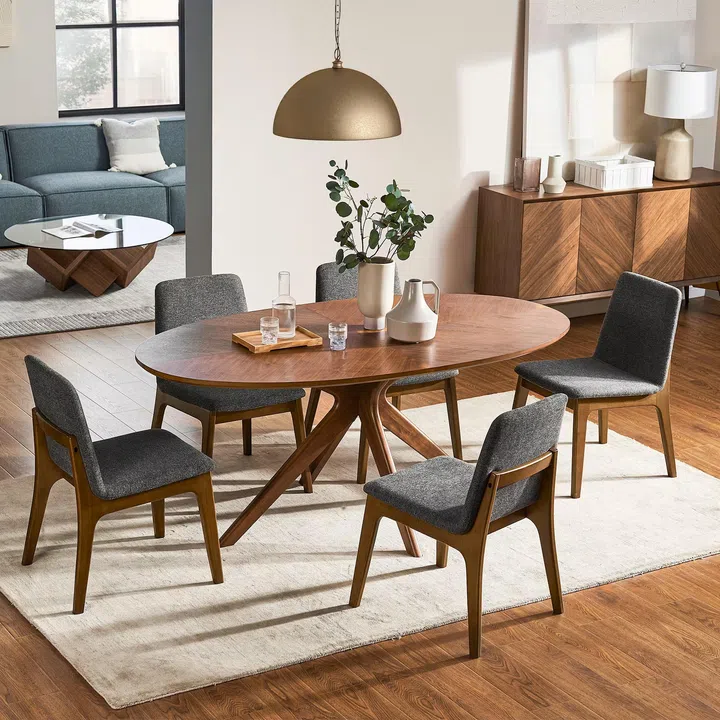
A simple design choice like curved-edged furniture can save you from silly accidents, especially in a household with young, active toddlers or busy teens running around. Curved furniture and finishes eliminate sharp edges.
“We requested curves throughout our home when thinking about our future children. This is why we opted to design the walls, countertops and cabinets all with slight curves,” – A Singaporean couple in their early 30s, Sam and Jian Hao.
- Opt for round-edge kitchen countertops and islands.
- Choose a round dining table (a round extendable dining table is available in Singapore).
- If you want a home bar, go with bar edges that are rounded.
- Choose round door and cupboard handles over straight or vertical ones.
- Buy a kid’s bed with an arched frame and headboard.
2. Interconnecting doors
We chatted with architectural designer couple, Tyler Lim and Zhengyu, who self-designed their current home with an interconnecting door between their master bedroom and their future nursery. After moving in, they welcomed their firstborn.
“We have a concealed flush connecting door to segregate the master and the baby room,” the couple explained. “When we’re in the master bedroom, we always keep the door open. It’s easy at night to go right into his room. We also feel that in the long run, as he grows up, he will probably want his private space, so that’s why we decided to lock out the two rooms. For now, this setup suits our current lifestyle.”
3. Platform bed with built-in drawers
Platform beds with extra storage underneath have become a popular kids furniture Singapore item for households with younger children, doubling as extra storage. The bed base is raised off the ground and has built-in drawers underneath the bedframe. You also find tatami-style beds with built-in storage, which some parents prefer as they find it safer for young children.
Interior designer Carmen from Wolf Woof designed a family home with three children (varying from middle to adolescence) in Sentosa. For the two daughters’ bedrooms, she had platform beds custom-built, incorporating extra storage beneath them and even a workspace at the end of one.
Many furniture stores in Singapore sell platform beds and day beds with storage drawers beneath.
4. Rooms that can evolve
Need a secondary room for your extensive wardrobe, guests or a work-from-home office? But what happens when little ones suddenly come along, and you have no nursery?
Any couples planning parenthood in the near future? If you’re not yet ready to welcome a newborn, but you know you want to have kids of your own one day, think about planning your home renovation with a room that can easily convert and evolve into a baby’s room.
Design tips for a seamless switch:
- Hold back on overly designing this room.
- Don’t overspend on fancy furniture that will be replaced once the baby comes along.
- Opt for a neutral paint wall colour or wallpaper.
- Choose furniture and decor that is easy to move out, like a desk on wheels.
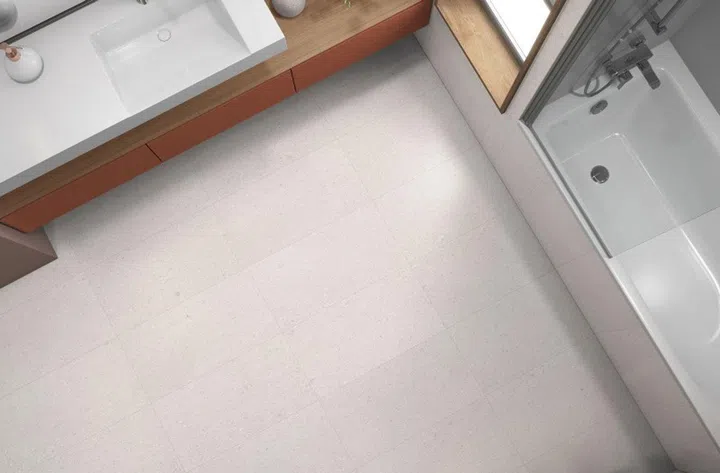
Hafary Anti-Slip Lime Art Gris Mate Rect
5. Non-slip flooring
Anti-slip floors should be at the top of your priority list when sitting down with your interior designer and planning your home renovation for you and your family. Toddlers are extremely active, especially in those early years when they start to find their feet and move around a lot.
If you work long hours or are a busy super mom or dad and cannot always have your eyes on the ground, installing non slip ceramic floor tiles, anti-slip vinyl floors or laminates and non slip bathroom floor tiles will save you peace of mind.
For example, non-slip vinyl floors contain a textured surface overlay that makes the floor less slippery. Rooms like the kitchen and bathroom, where tiles are favoured over vinyl and laminate, are high-risk areas for accidents. Chat to your design team or studio about non slip bathroom flooring ideas in the earliest stages, even if it’s for future preparations.
6. Extra home storage and compartments.
Kids accumulate a lot of things, from toys to bicycles to school bags. Many Singaporean homes are already limited in storage space. As you’re designing your new home, consider requesting extra storage on top of what you envisioned in your design for your future family.
“We opted for a theme that was a bit more modern and clean…Finally, we have two young kids, so we really wanted more compartments and storage to keep the house clean and uncluttered,” say parents of two, Zheng Cong and Helen Chin.
Storage solutions:
- Ask for extra cabinets during your home renovation design journey
- Consider storage beneath stairs
- Buy a sofa with built-in storage
- Add storage cabinets beneath your kitchen/dining island
- Wall hooks never fail. Hang bags, hats, etc., on these
- Opt for modular shelving that you can move around
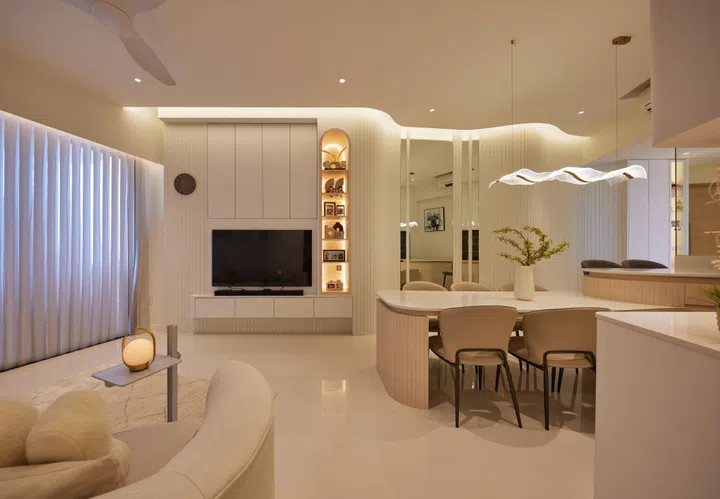
Lee Zeng Cong & Helen Chin’s all-white living room in a 3-bedroom condominium apartment in Leedon Heights.
7. Cushion beds flush against the wall
It may seem like an obvious one, but you would be surprised how many parents place beds in the middle of the room for aesthetic reasons.
Position your child’s bed or cot flush against the wall so there are no gaps and room for accidents.
Further, avoid bashing heads by fixing a cushion permanently on the wall where the bed is positioned to avoid your little one knocking their head when sleeping or playing.
“Our kids are very active, so we customised their headboards with a cushion. It’s right at the edge of the wall, so we tried to cover this up so that they don’t knock their heads on it,” informs Zheng Cong and Helen Chin.