
You Don’t Need A Bigger Home to Host, Just Better Planning
A home that works beautifully for everyday life can quickly become awkward when guests arrive. Interior designer Verena Lim of Naim Design Studio and furniture expert Jeremy Berghman of Soul & Tables share the layout decisions and practical rules that make hosting easier, even in smaller homes.
By Gwyneth Goh -
Share this article
Your home might feel spacious enough—until people come over.
Suddenly, the dining chairs are blocking the walkway. Guests drift into the kitchen and just stay there. Someone carrying drinks has to carefully sidestep around the island. The foyer becomes a traffic jam the moment two people arrive at once.
It is a familiar frustration, particularly in Singapore homes where space is often limited and every square foot has to work harder. Many homeowners tend to assume that these hosting challenges boil down to size—that a larger living room, bigger dining table, or more open layout would naturally solve the problem. Yet in reality, homes often struggle not because they are too small, but because they were never planned around how people actually move, gather, and interact.
“Hosting in a space, the space has to be friendly for all-around interaction,” says Verena Lim, interior designer and owner of Naim Design Studio. “The space must be versatile for human movement and flow.”
That means thinking beyond whether a dining table technically fits, or whether an island looks appealing in the render. From circulation bottlenecks to unrealistic seating expectations, the smallest planning decisions can have an outsized impact once guests arrive. Here are the ones our experts say matter most.
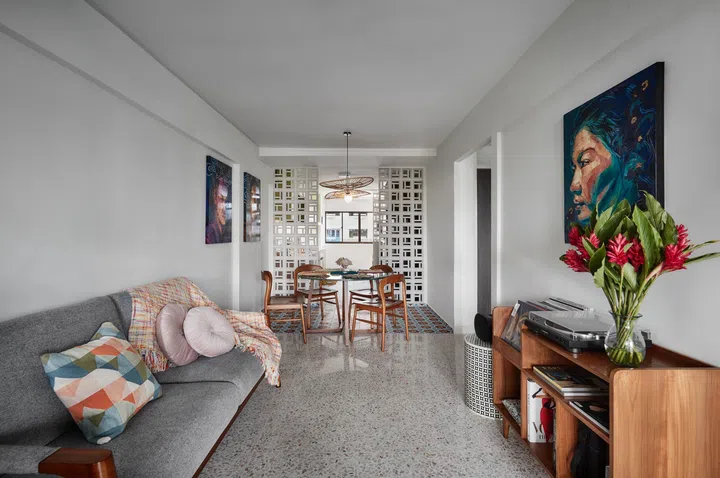
In this Bedok North home by Naim Design Studio, the dining area was pulled out from the kitchen and positioned as part of the main communal space, allowing conversation and movement to flow more naturally when guests are over.
#1. Stop designing around “designated hosting spots”
When homeowners think about hosting, the instinct is often to focus on a single “hosting zone”—usually the dining table. If there is enough seating around it, the assumption is that guests will naturally gather there and stay put.
In reality, people rarely behave so neatly.
“Even if it’s just one or two friends or family, they do walk around and not stay at the intended hosting spot,” says Verena, “So the idea of segregating a hosting spot may not work.”
Guests drift towards where food is being prepared, linger near the kitchen island, perch at the edge of the living room, or move between spaces mid-conversation. Hosting, in other words, is less about furnishing a single social zone and more about allowing movement and interaction to happen naturally throughout the home.
“The dining and living areas are where guests naturally tend to gather,” Verena notes. “I try to keep these two spaces intertwined where they are separate but, on the whole, one space. Something like when one can hop from one spot to the other like in the midst of a conversation and not feel awkward.”
That sometimes means rethinking the conventional roles assigned to different parts of the home. In her Bedok North project, Verena reworked the layout of a typical older three-room HDB flat, where the kitchen would traditionally have doubled as the main dining zone. Instead, part of the long kitchen footprint was carved away to create a dedicated dining area within the main communal space, allowing the dining and living zones to function more fluidly together.
A layout designed around fixed functions—dining here, sitting there, kitchen tucked away elsewhere—may work efficiently for daily routines, but prove far less accommodating when people begin circulating more freely. Instead of expecting guests to remain anchored to a single social zone, it often makes more sense to plan for the way they naturally move through a home.
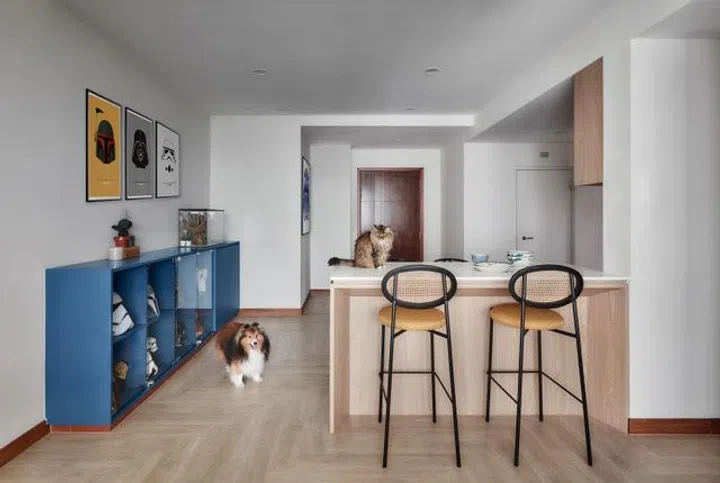
Good hosting is often less about square footage than circulation—how naturally people can move between zones without creating bottlenecks.
#2. Fix circulation first—this is where most homes struggle
A home does not have to be small to feel cramped. Often, the issue is not square footage, but how easily people can move through the space once it fills up.
One of the most common mistakes, says Verena, is trying to fit too many desirable features into a single layout without thinking through how they interact in real life.
“Getting everything—a foyer, an island, display cabinets, big sofa—can be detrimental,” she says. “They walk into the foyer, then have to ‘siam’ [avoid or dodge] to go past it and then the island is right there, ‘siam’ again to go into the kitchen or bedrooms.”
That constant sidestepping may seem like a minor inconvenience when the home is occupied by one or two people, but becomes far more obvious once guests arrive. A narrow foyer that works perfectly well for daily shoe-wearing routines can suddenly become congested when multiple people are entering, leaving, or setting their bags down. A kitchen that feels efficient for one cook may become a bottleneck the moment others gather nearby.
Even well-intentioned additions can create friction if they are not proportionate to the space. Oversized islands, bulky furniture, or decorative features that interrupt circulation may look appealing in isolation, but can make a home feel unnecessarily stressful to navigate.
Instead of focusing only on what can fit, homeowners may be better served by considering how comfortably two people can pass each other, or whether movement still feels intuitive once the home is occupied beyond its usual routine.
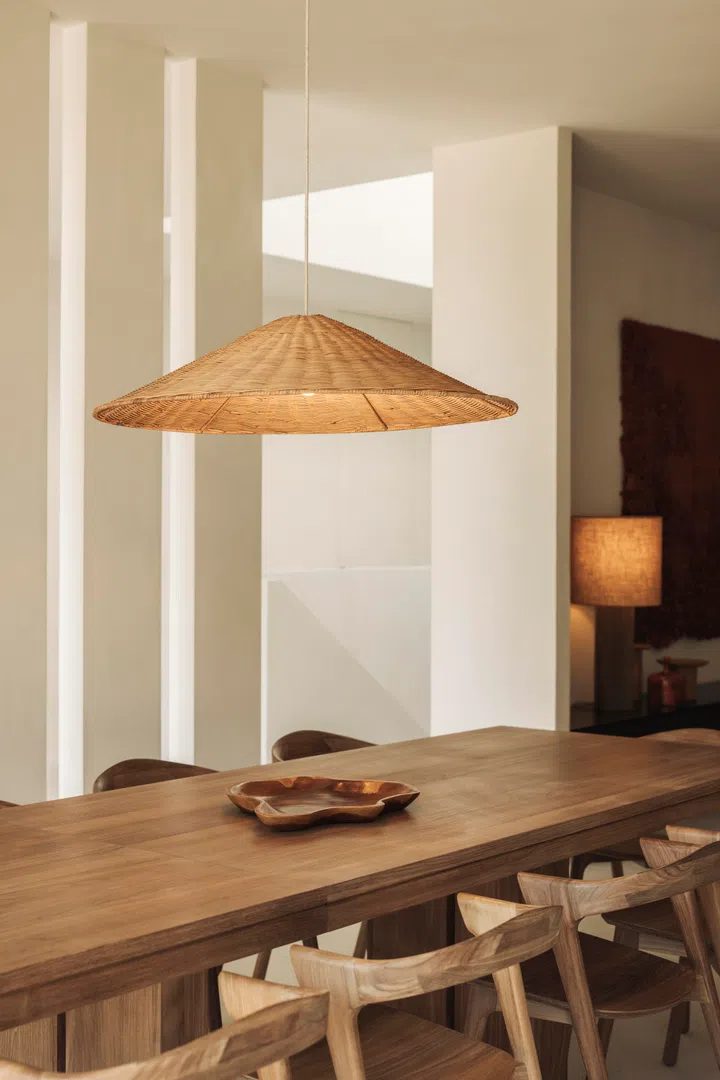
Seating capacity is about more than just how many chairs fit around a table—design details such as leg placement, chair size, and surrounding clearance all affect comfort.
#3. Your dining table is probably the wrong size
When hosting feels cramped, the dining table often gets blamed—or upgraded. But bigger is not always better.
In fact, oversizing is one of the most common mistakes Verena sees in Singapore homes, particularly when homeowners try to maximise seating without fully considering how the table will function in the room.
A table may technically fit within the dimensions of a space, but still make the room feel awkward once chairs are pulled up and people begin moving around it.
Jeremy Berghman, general manager of Soul & Tables, swears by what he calls the “60/90 Rule”. This means ensuring at least 60cm of width per diner as a practical minimum, with 70cm being more comfortable where space permits—“so they aren’t bumping elbows while eating”.
Just as important is the clearance around the table itself: ideally, at least 90cm should be left between the edge of the table and the nearest wall, cabinetry, or furniture, so guests can get in and out comfortably without disrupting anyone else.
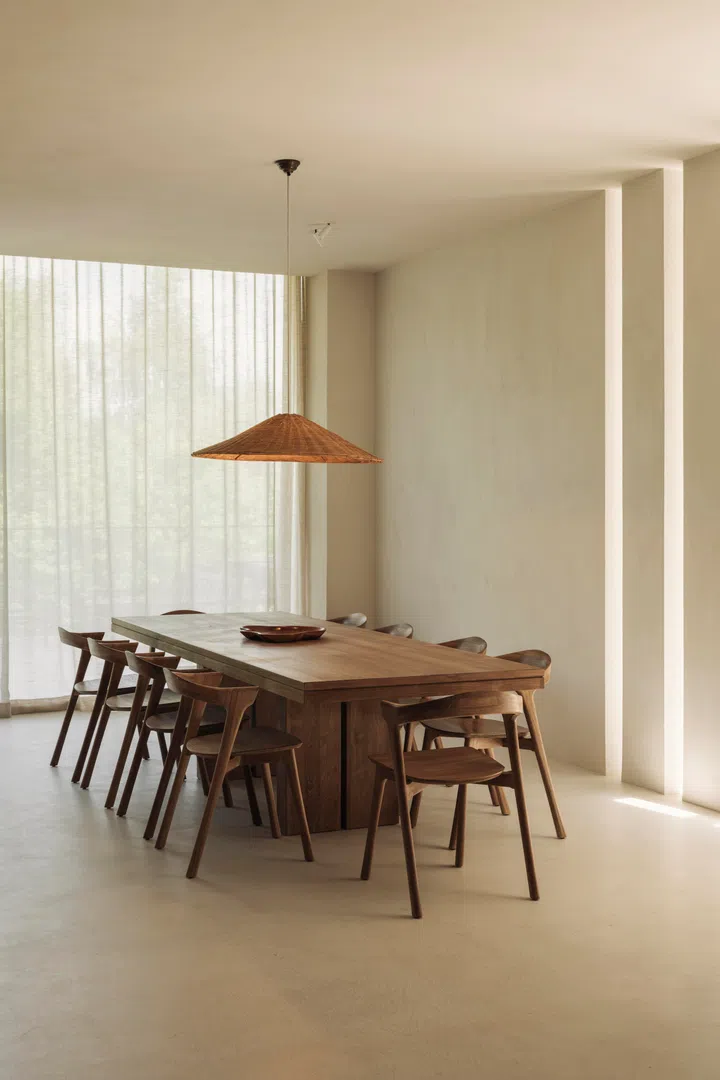
As a rule of thumb, allow sufficient width per diner and enough clearance around the table so chairs can be pulled out comfortably without obstructing movement.
One useful rule of thumb? Measure the room, then subtract 180cm from both the length and width. What remains is roughly the maximum dining table footprint that still preserves comfortable circulation.
Advertised seating capacities can also be misleading. An eight-seater may physically accommodate eight chairs, but table design can significantly affect how comfortable that arrangement feels in reality.
“Catalogue images often gloss over how a table’s architecture—such as the placement of trestle legs, thick pedestals, or inset corners—physically obstructs where chairs can tuck in and where human legs actually go,” says Jeremy.
That is why seating capacity is not simply about how many chairs fit around a table, but whether people can actually dine comfortably once everyone is seated.
“To find the true capacity, you need to pull up real-sized chairs and sit at the table yourself,” he adds, “to ensure the design doesn’t force guests to awkwardly straddle a leg or clash elbows, regardless of what the product label claims.”
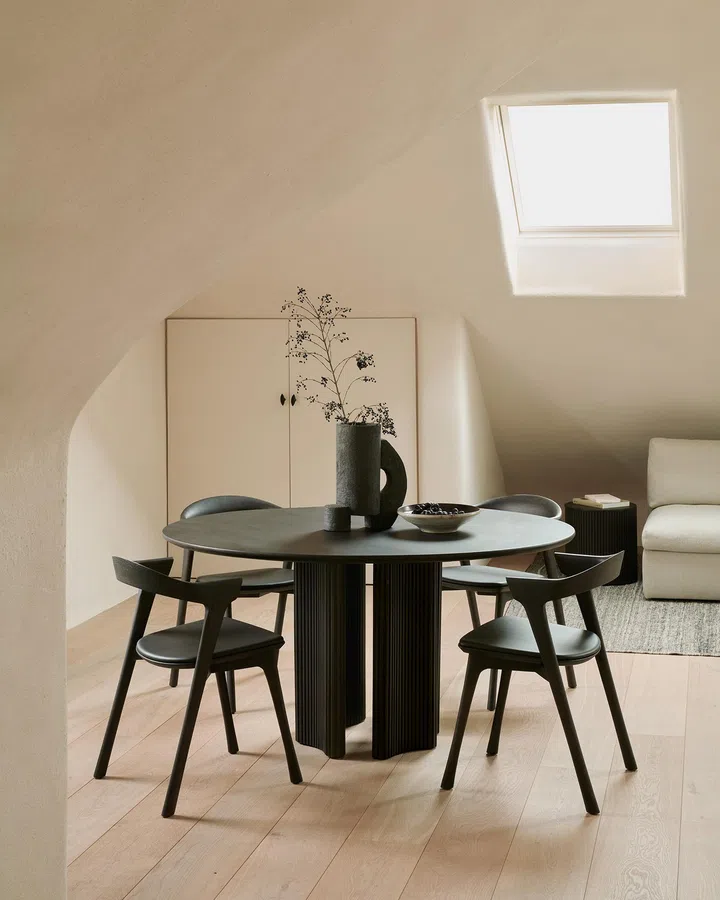
Round dining tables can improve circulation and conversation in the right layout, but the best shape ultimately depends on how the surrounding space is used.
#4. Round, rectangular, or extendable? Choose for your layout, not what’s trending
Once the size is right, shape becomes the next consideration—and there is no universal winner.
Round dining tables are often praised for encouraging conversation and softening circulation, particularly in more compact homes where sharp corners can make movement feel tighter. But that does not automatically make them the best choice for every layout.
For Verena, the right solution depends less on trend and more on how the surrounding spaces are intended to function. In her Bedok North project, for instance, the dining area was deliberately repositioned within the main communal zone, allowing the homeowners to move more naturally between dining and living areas rather than treating the table as a fixed, isolated destination.
Jeremy notes that round tables tend to work best in squarer spaces or layouts where movement happens around multiple sides, while rectangular tables can be more efficient in narrower rooms where linear planning makes better use of available floor area.
For households that host occasionally but do not want to permanently dedicate space to a larger dining footprint, flexibility may matter just as much as shape.
“Having an island that can double up as a high seating/bar counter helps,” says Verena. “The other typical way would be to have extendable tables.”
Jeremy also points out that table base design can make a significant difference to how usable a table actually feels. “The table base is arguably the most critical factor in determining a table’s true usability, with pedestal bases offering more seating flexibility than traditional four-legged designs,” he says. “By centring the support, a pedestal eliminates the ‘corner trap’ where guests are forced to awkwardly straddle table legs or fight for limited space between fixed posts.”
This can make a practical difference when extra guests need to be accommodated, particularly in tighter homes where every seat counts.
For larger round tables, accessories like Lazy Susans may improve usability, particularly when dishes need to be shared across a wider surface. But as with table shape itself, practicality should come before novelty.
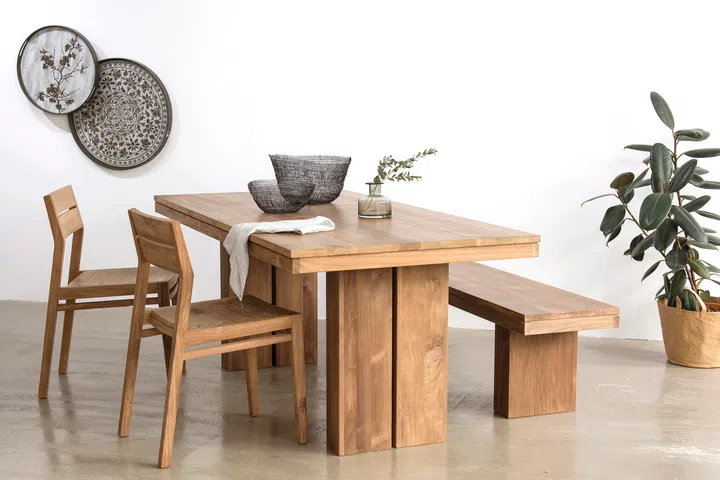
Flexible seating choices, such as benches that tuck neatly away, can help smaller dining areas feel more open and usable when guests are not around.
#5. Flexible seating beats permanent bulk
If hosting happens only occasionally, dedicating precious floor area to oversized furniture that sits half-empty most of the year may not be the smartest solution.
Instead of planning around peak guest numbers, a more practical approach is to build in flexibility without compromising everyday comfort.
“Although hosting is not done super often, catering allowance for that also comes in handy for daily living,” says Verena. “We can always do better with more space to flow and move around than squeezing ourselves in odd angles that stick out and excessive storage.”
That might mean resisting the temptation to install bulky built-ins or oversized furniture simply because the space technically allows for it. A home that feels generous and easy to move through every day will often host better than one packed with features intended for occasional use.
Jeremy points to seating choices as one example.
“Unlike chairs with high backs that create visual clutter, a bench can be tucked completely underneath the table, instantly opening up the walkway,” he says.
This kind of flexibility can make a noticeable difference in compact homes, where every centimetre of circulation matters. Seating that disappears when not in use, or furniture that can adapt to changing needs, often serves households better than permanently dedicating space to maximum guest capacity.
After all, the goal is not to recreate a restaurant at home—but to make everyday living, and the occasional gathering, feel equally comfortable.
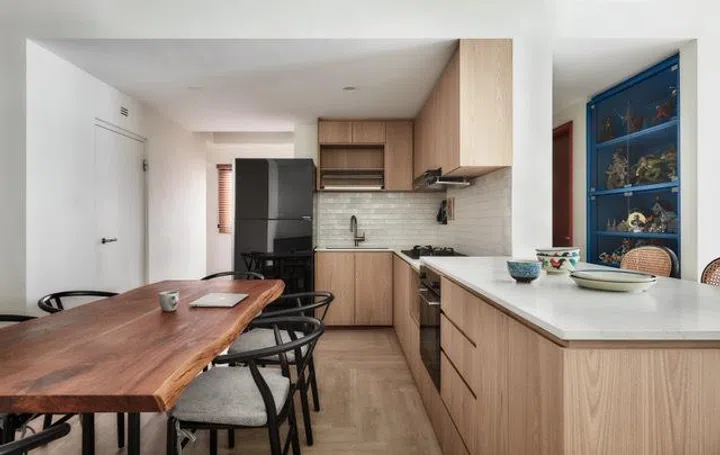
Open-plan layouts can make hosting feel more inclusive by allowing conversation and movement to flow more naturally between kitchen, dining, and living spaces.
#6. Open-plan layouts help—but only if they are planned properly
Open-plan living is often treated as the default answer to better hosting. Fewer walls, better sightlines, more space to mingle.
And in many cases, it does help.
“Everyone in the unit has accessibility and visuality to whoever else are in the kitchen prepping, so everyone is included,” says Verena. “The ecosystem is bigger, more inclusive and there is more allowance for interaction.”
That sense of connectedness is one reason open-plan homes tend to feel naturally friendlier when guests are over. Conversations can flow more easily between the kitchen, dining, and living areas, rather than breaking into isolated pockets.
But openness alone does not guarantee better hosting.
A poorly planned open layout can still feel cramped if furniture interrupts circulation, sightlines are cluttered, or oversized features compete for the same footprint. Removing walls does not automatically solve the problem if the remaining space is then overfilled.
What matters is whether the openness genuinely improves movement and interaction, rather than simply creating the illusion of space.
Done well, an open-plan home does not just feel bigger—it feels easier to use when more people are in it.
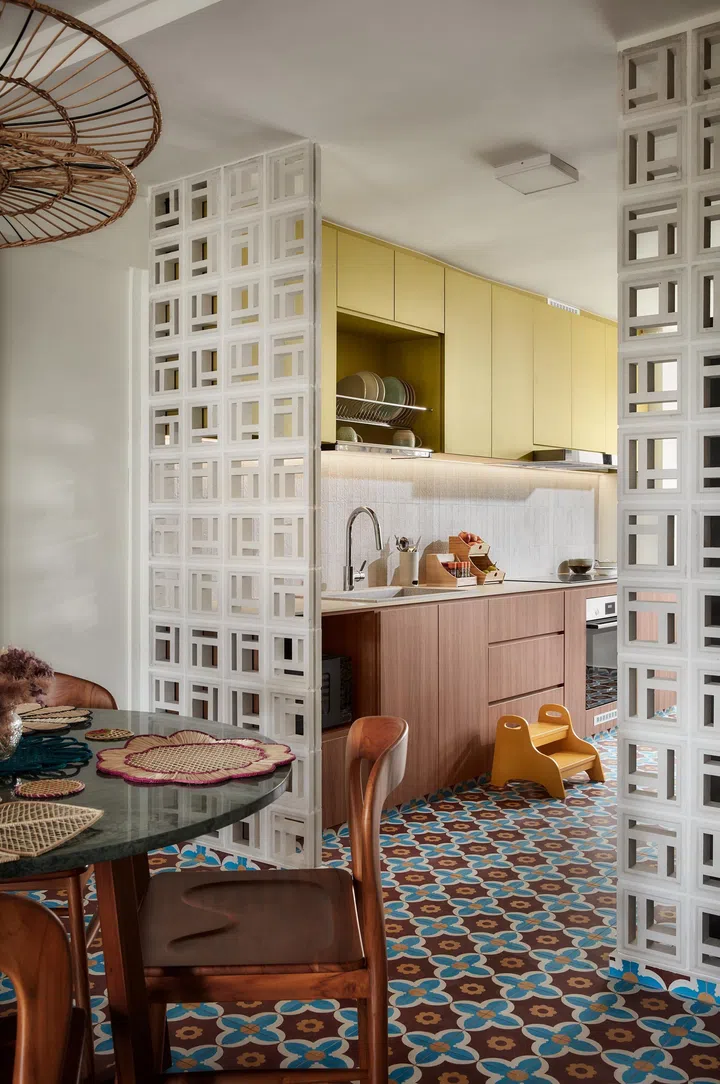
Rather than being fully enclosed, the kitchen in this Bedok North home remains visually connected to the dining area, allowing food preparation to feel part of the wider social flow when guests are over.
#7. Don’t overlook the forgotten hosting zones
When homeowners think about hosting, attention tends to go to the obvious communal areas: the dining table, the sofa, perhaps an island counter.
But some of the most useful hosting spaces are often the ones people overlook.
For Verena, that includes transitional zones such as the foyer and kitchen, which are sometimes treated too inflexibly as purely functional spaces instead of being incorporated into the wider hosting experience.
“They might be rigidly kept aside as a kitchen or foyer,” she says. “But those spaces can actually be a part of the sitting and hosting circle.”
Her Bedok North project offers a good example of this thinking. Rather than treating the kitchen as a fully separate back-of-house zone, the space was kept visually connected to the dining area through breezeblock partitions, allowing conversations and interaction to continue even while food is being prepared.
The foyer, too, was considered as more than just a place to remove shoes and pass through. In homes where guests are coming and going, these threshold spaces can quickly become part of the wider social choreography—where people pause, greet one another, set bags down, or linger between conversations.
In smaller homes especially, rigidly assigning each zone a single purpose can make the overall layout feel more constrained than it needs to be. Some of the most sociable homes are not necessarily the biggest—they are simply the ones that allow more parts of the home to participate.
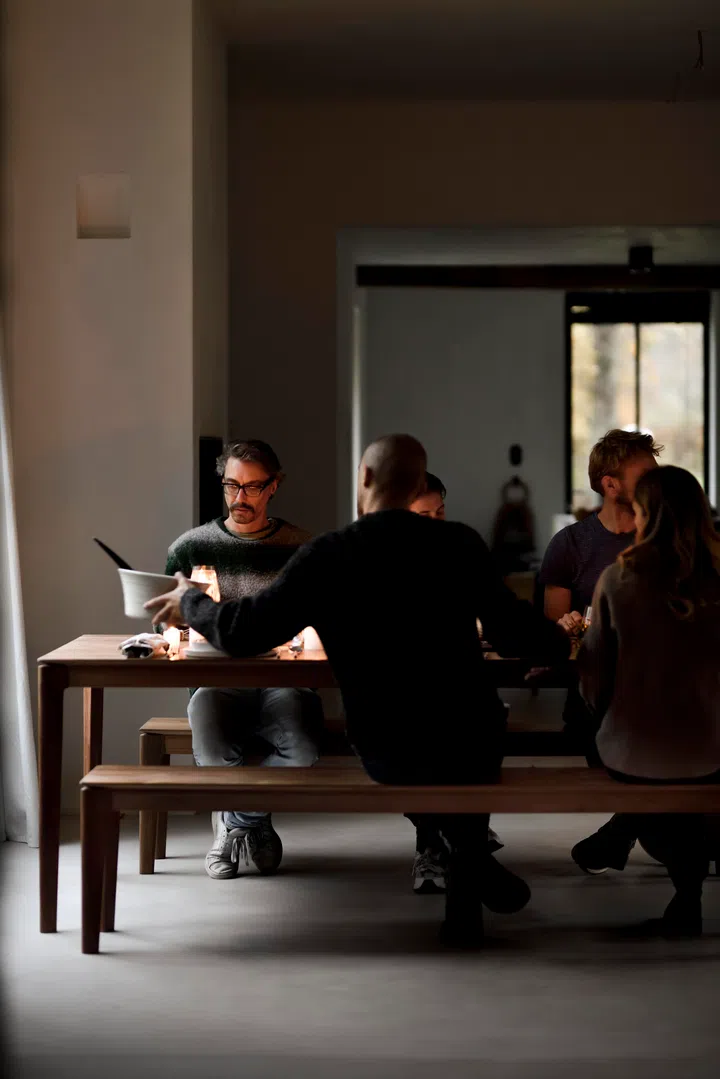
The real test of a hosting-friendly home is not how it looks empty, but how comfortably it functions once people are actually moving, sitting, and gathering within the space.
#8. The 6–10 guest test
Before committing to a layout or dining setup, try this simple thought exercise: imagine six to 10 people in your home at once.
Not sitting politely in the exact spots you envisioned but arriving, moving around, helping themselves to food, pulling out chairs, setting bags down, and drifting between conversations—basically being human.
As Verena points out, guests rarely stay confined to a single “designated” hosting zone and tend to naturally move between spaces. Jeremy’s advice is equally practical: do not assume a table’s stated capacity reflects how it will function in real life, especially once real chairs, real bodies, and circulation are factored in.
So ask yourself:
- Can two people pass each other comfortably without awkward sidestepping?
- Can someone get up from the dining table without disrupting everyone else?
- Is there enough room for chairs to be pulled out properly?
- Where do bags, gifts, or serving dishes naturally go?
- Can guests drift between spaces without creating bottlenecks?
- Does the kitchen become a choke point the moment more than one person enters?
- Does the space still feel comfortable when nobody is hosting?
A home that hosts well is rarely the one with the most seats or the largest dining table. More often, it is simply the one that has been planned around how people actually live, move, and gather.