
Dyson V10 Optic Review: Is a $699 Vacuum Still Relevant in 2026?
Can a $699 vacuum really find the dirt your robot misses? We explore whether the V10 Optic is a 2026 upgrade you need, with a sneak preview of the first auto-emptying dock by Dyson.
By Teo Jing Yuan -
Share this article
To be completely honest, the last time I picked up my good old stick vacuum to clean the floors manually was over 3 months ago. All credits to our very hardworking robot vacuum, relieving us of the labour-intensive floor vacuuming duties, an essential for working parents without any paid domestic help!
Our floors feel clean after the robot vacuum does its magic of vacuuming and mopping without us lifting a finger, but “feeling” clean and “being” clean are two different things. Not with the amount of dust buildup quietly accumulating around the furniture and in the darkest corners of our home, as revealed by the newly released Dyson V10 Optic cordless vacuum.
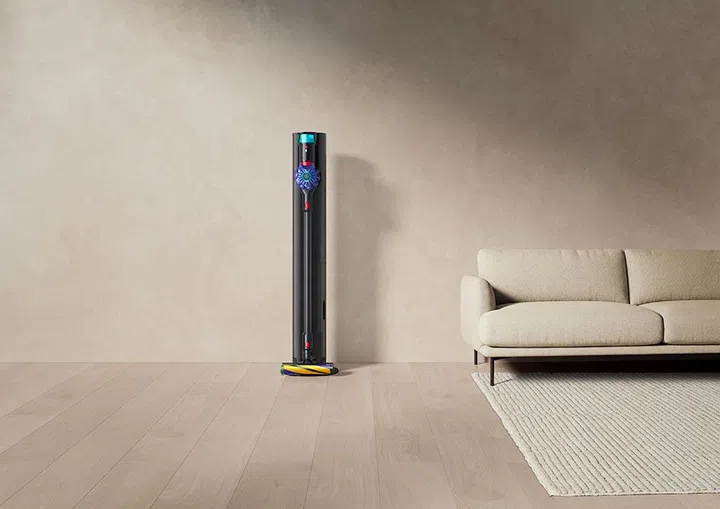
Preview of the Dyson V10 Optic Vacuum on the yet to be released Auto-empty Dock.
Dyson V10 Optic and Auto-Empty Dock
Released in April 2026, the Dyson V10 Optic is a “fresh out of the oven” addition to the lineup. Its biggest selling point? It is Dyson’s first-ever self-emptying cordless vacuum when paired with the Auto-empty Dock. Both the vacuum and the Auto-empty Dock feature fully-sealed HEPA filtration, ensuring that once the dust is sucked up, it stays trapped.
According to Asaph Ooi, Dyson’s Head of New Product Development for Floorcare, the Auto-empty Dock solves a massive pain point: the “dust cloud” created with allergens being released back into the air you breathe when manually emptying a bin.
This process is recognised by Dyson as inconvenient and almost counterintuitive. The new Auto-empty Dock automatically transfers debris from the vacuum into a 2.5-litre sealed bin liner, making maintenance almost hands-free.
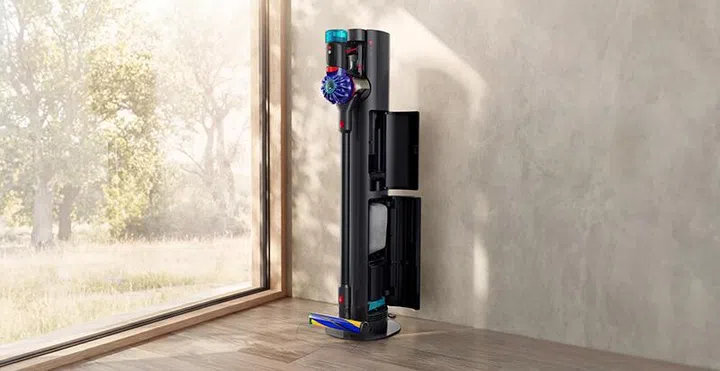
Preview of the Auto-Empty Dock with the 2.5-litre sealed bin liner.
Dyson Auto-Empty Dock Compatibility
The intelligent Auto-empty Dock is a long-awaited dream for the Dyson community. In a surprising move, Dyson made the Dock backward compatible with the Dyson V8. This allows existing users to upgrade their workflow without the massive price tag of an entirely new system.
Note: While I tested the V10 Optic for this review, the Auto-empty Dock is slated for a late May 2026 release. I look forward to seeing how they pair in the wild.
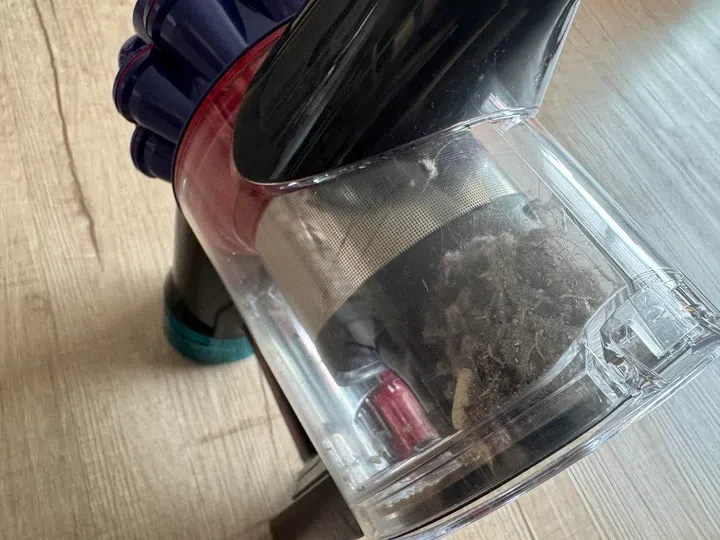
This is the amount of dirt collected from one deep cleaning session with the Dyson V10 Optic, bearing in mind how hardworking our robot vacuum is with alternate days of vacuuming and mopping.
The Fluffy Optic: Seeing is believing
The V10 Optic features the upgraded Fluffy Optic cleaner head (an evolution of the old Laser Slim Fluffy). It promises to reveal twice as much invisible dust as previous generations.
At $699, the V10 Optic is positioned as the “budget-friendly” alternative to the flagship Dyson V12 Detect Slim Absolute (currently $849 on promotion).
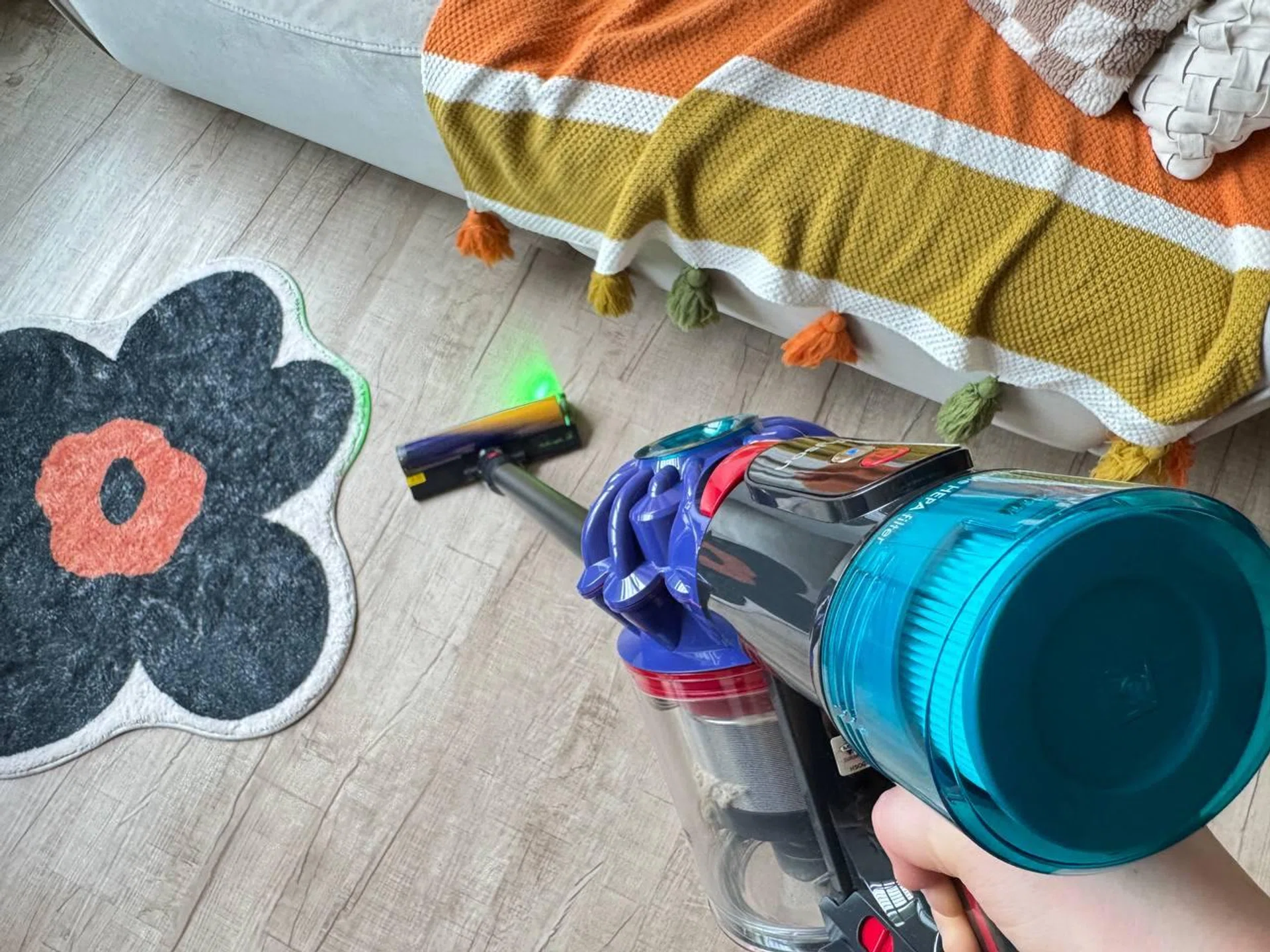
My experience cleaning with the Fluffy Optic cleaner head? I appreciate how it illuminates the floor in a more superior way than my previous stick vacuum, indicating where the particles are located. However, I would say that it is still a pretty much manual process with lots of “eye-power” required to spot the dirty area and toggle between the Eco, Medium, and Max modes each time. For a busy homeowner, the automated suction adjustment of the V12 remains a significant quality-of-life advantage.

Shocking amount of dust after deep cleaning the cushion and sofa with Dyson’s mini motorised tool on the V10.
Using Dyson V10 Optic for deep cleaning
I used to spend 30 minutes manually vacuuming the floors in our 4-room HDB home, which would not be a problem with Dyson V10 Optic’s 60 minutes battery run-time on Eco mode.
In my home, the V10 acted as a “cleaning supervisor.” I used the optic light to inspect areas the robot vacuum missed. With the help of our robot doing most of the general floor cleaning, I focused my efforts on deep cleaning the tight and forgotten areas, such as around the dining chairs and under the kitchen carpentry, using the crevice tool.
The mini motorised tool was a standout on our sofa and mattress. Comparing it to my usual dust mite vacuum, the intense suction power of the Dyson V10 Optic vacuum felt exceptional, thanks to the digitally controlled motor spinning up to 110,000rpm. Seeing the 0.5-litre bin fill up with “invisible” debris after just one session was both satisfying and slightly horrifying.

It takes a large rubbish bin to empty the big 0.5-litre bin in Dyson V10 Optic, if you know what I mean.
Charging and emptying the Dyson V10 Optic
Without the Auto-empty Dock in the picture, the manual experience felt a bit cumbersome. I opted not to drill my walls for the standard dock, using the loose charging cable instead. A minor gripe: you cannot use the vacuum while it’s plugged in—so no “corded mode” for long sofa cleaning sessions.
I have a love-hate relationship with the 0.5 litre bin compartment on Dyson V10 Optic. It’s spacious, meaning fewer trips to the rubbish bin, but it adds bulk and weight to the unit at 2.3 kg. While the emptying mechanism takes a moment to master, I appreciate that the entire bin can be detached for a thorough wash.
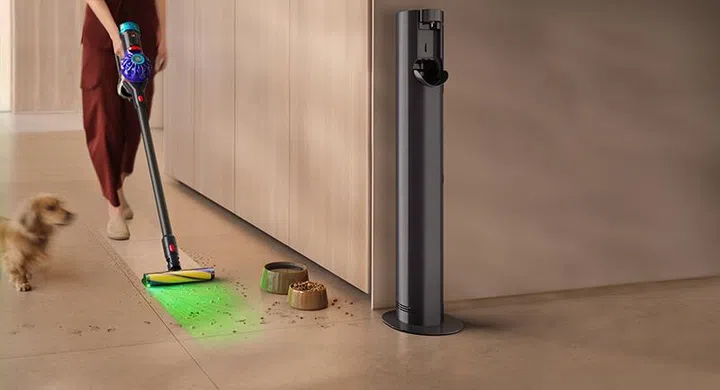
The Dyson V10 Optic with the illuminated Fluffy Optic brush head, and a sneak preview of the Auto-empty Dock.
Dyson V10 Optic $699: Is it worth it?
At $699, the Dyson V10 Optic serves as a powerful workhorse for those who want advanced dust-illumination features without the steep price tag of the flagship models. It is an ideal choice for larger households or pet owners who prioritise a high-capacity bin and straightforward controls over complex screens.
However, it is important to acknowledge that Dyson vacuums remain a significant investment, thanks to their remarkable after-sales care and service. While the brand is known for its engineering, there are many affordable alternatives on the market today that offer similar features, and some even come with all-in-one capabilities at a fraction of the cost.
If you are looking for the best overall user experience, you might prefer the lighter, smarter Dyson V12 Detect Slim, with automated suction and wet-dry options, making it a more versatile tool for the price.
For an accessible price point with the Dyson name and power, the V10 Optic is the most logical entry into the ecosystem. It might also be worth waiting for the Auto-empty Dock to launch next month, as the added convenience of self-emptying could be the deciding factor that makes the V10 Optic a truly essential purchase.