
$300,000 Renovation for a double-volume penthouse in Far Horizon Gardens, Lentor
A dramatic double-volume space is reworked through a sculpted axis, bringing coherence, circulation, and a sense of calm to everyday living.
By Gwyneth Goh -
Share this article
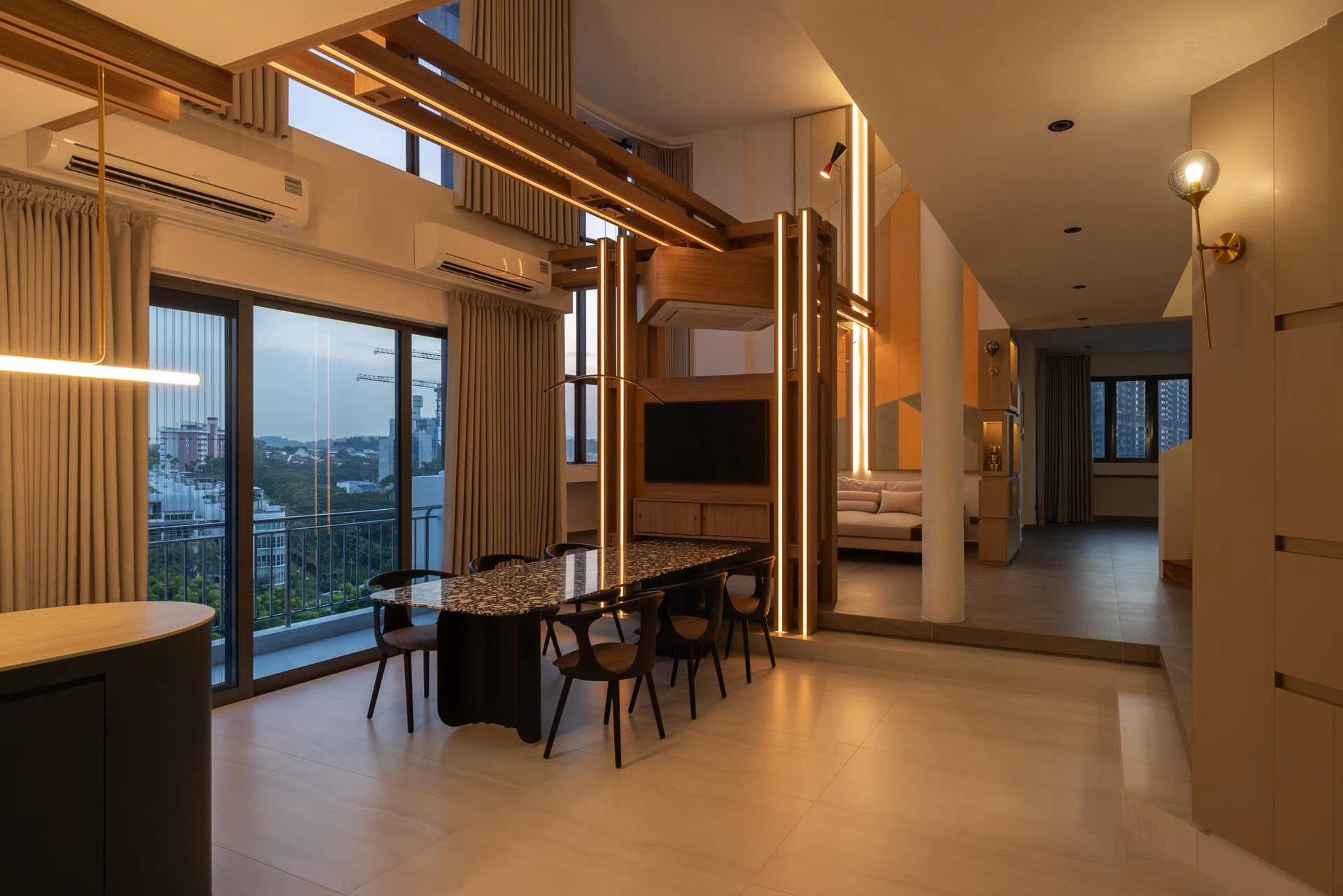
By dusk, the apartment settles into a quieter rhythm. Warm light traces the timber structure that runs through the centre of the home, casting a soft glow across the dining table and into the living space beyond. Suspended at mid-height, the sculpted axis reads less as a partition than a presence—ordering movement, framing views, and drawing the eye across the double-volume expanse.
For homeowner Michael, the home was always meant to be the opposite of his professional life. “The chaos is outside; at home you want to find a sea of calm, a place you can recentre yourself and reset for the next day,” he says. What unfolds here is not simply a dramatic volume, but a carefully considered sequence, where circulation, light, and structure are aligned to support everyday rituals.
Who Lives Here: Michael, in his 50s, who runs several fitness businesses, with his wife, 12-year-old daughter, helper, three very opinionated cats, and a rabbit
Home: Penthouse condominium at Far Horizon Gardens
Size: 3,500 sq ft
Interior Designer: Woon Chung Yen, Metre Architects
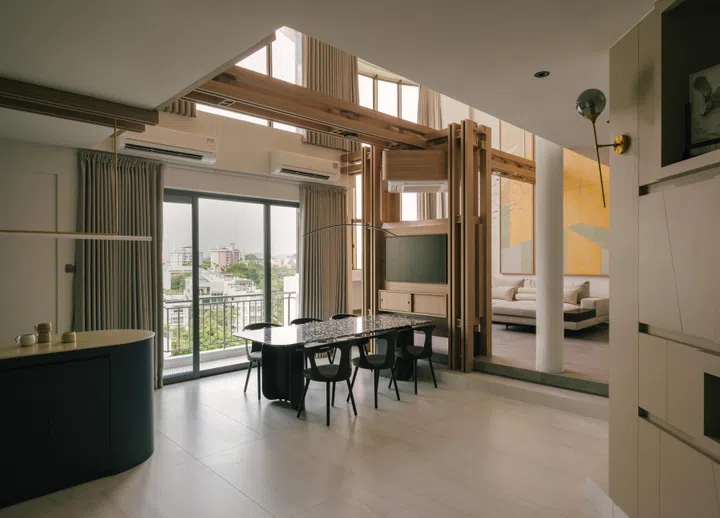
The timber axis defines the open-plan layout, framing the dining area while maintaining visual continuity across levels.
A spatial axis that connects flow
The first thing you notice isn’t the height, but the structure. Running through the centre of the home is a timber axis that gathers the dining, living and upper level into a single, continuous gesture. Designed by Woon Chung Yen of Metre Architects, it works as both threshold and connector, framing views while subtly directing movement across the split levels.
For Michael, who designs and runs fitness businesses, the way a space flows was a primary concern from the outset. “My growing up and profession give me great consciousness of how people move in the workflow of their lives,” he says. “I’m very particular about energy flow… concentration of vibes… concentration of energy.”
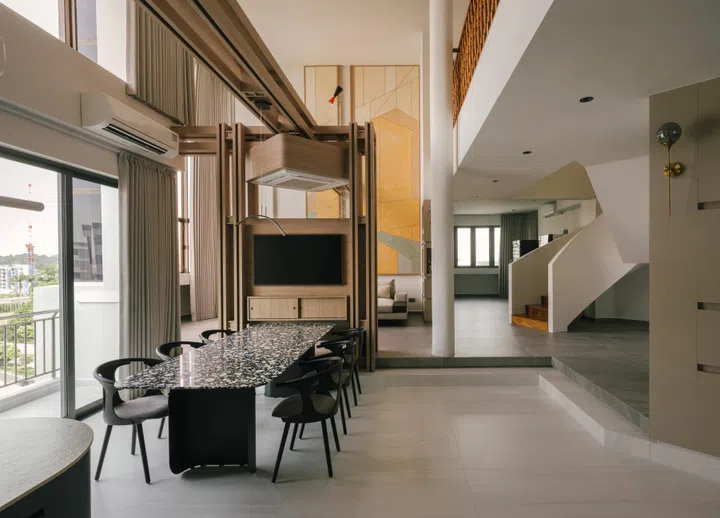
A shift in floor level subtly separates dining and living, creating distinction without interrupting flow.
At ground level, the dining area sits directly beneath the axis, while the living room is set slightly apart on a raised platform. The transition is subtle but deliberate, creating zones without interrupting movement. From certain angles, the entire sequence reads as one continuous volume; from others, each space reveals its own character.
“Things are naturally designed in a circulation and energy flow concept,” Michael adds. “User experiences are a lot smoother and better. So space has a lot to do not just with the feel of a space, but with flow, movement, circulation. We are very sensitive to openness, visual openness.”
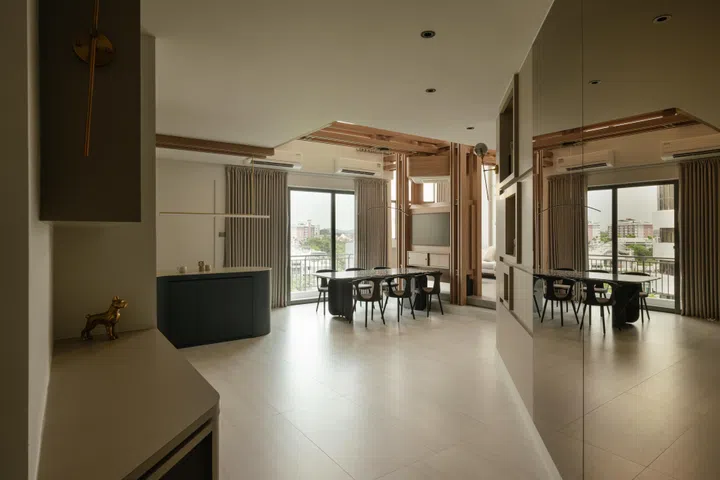
A wide entry view frames the dining area, while the living space remains partially concealed beyond the timber axis.
A gradual arrival into the living space
The transition from entry to living is not immediate. It unfolds in layers.
From the doorway, the home opens into a generous, light-filled volume, where the dining area sits in full view. Beyond it, the living room remains partially screened by the timber axis, only revealing itself as you move further in. It is along this approach, as you walk towards the dining area, that the large-scale murals also begin to emerge, rising along the double-height wall at the far end of the room.
“I’m very sensitive to circulation, openness, visual breathing space—the horizon within an apartment,” says Michael. “A space you should be able to move through, instead of confining.” That idea is most apparent here, where movement is guided without feeling directed.
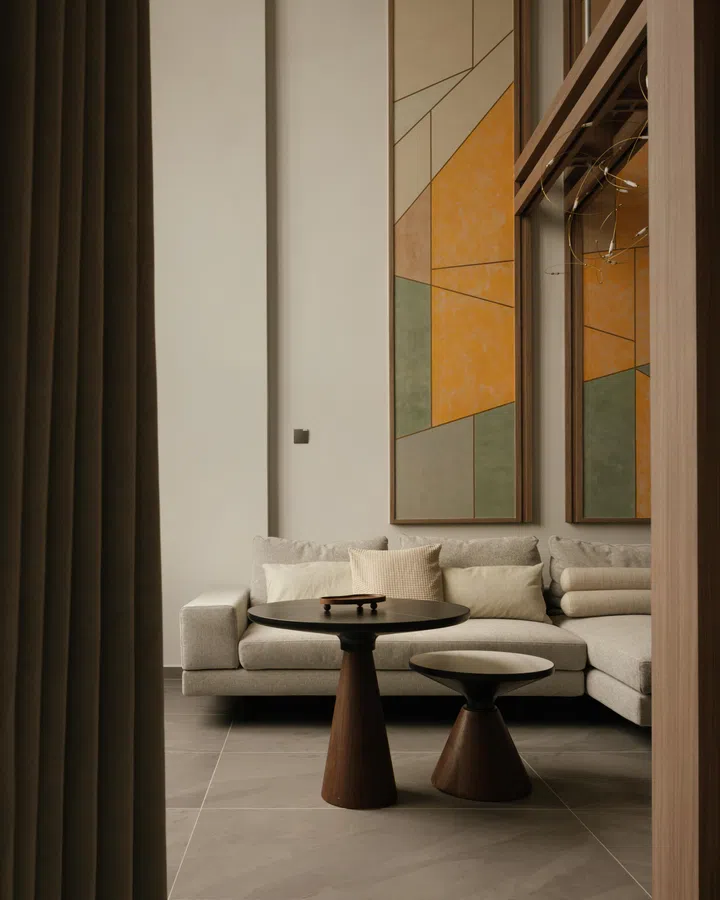
Abstracted from travel memories, the murals introduce colour and depth while anchoring the living space.
As you move deeper into the home, the living area comes into view—set slightly apart on a raised platform—and the murals become legible. “One of the murals is an abstract art piece of the mountain we used to ski a lot with our daughter in Japan, in Hirafu Niseko,” Michael shares. “This mural was done by the architect, designed by Woon, and wall-painted by a specialist.”
Rather than literal depictions, the compositions are intentionally abstract. Woon of Metre Architects explains: “While chatting with the owners, they shared very casually some of their favourite travel experiences, which left an impression on my mind. Subsequently, when we realised the need to properly articulate the two large walls on each end of the living and dining space, the abstracted depictions of the owners’ travel experiences became the most natural ingredient. These murals try to express visceral sensations of nature, rather than specific localities.”
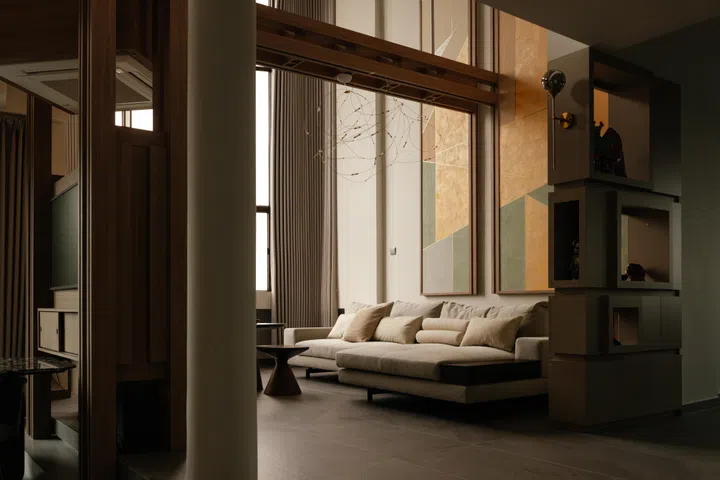
Set against the raised living platform, the murals and timber axis work together to frame the space and guide movement.
That sensibility extends beyond the walls. “This whole environment design is very much in Japan,” Michael adds. “If you look at the axis, they’re all temple-interlocking wood-framed structures… a lot of interlocking wood beams without nails and rivets.”
Together, the murals and the timber framework shape not just how the space looks, but how it is experienced—as a sequence of memories, references and movement.
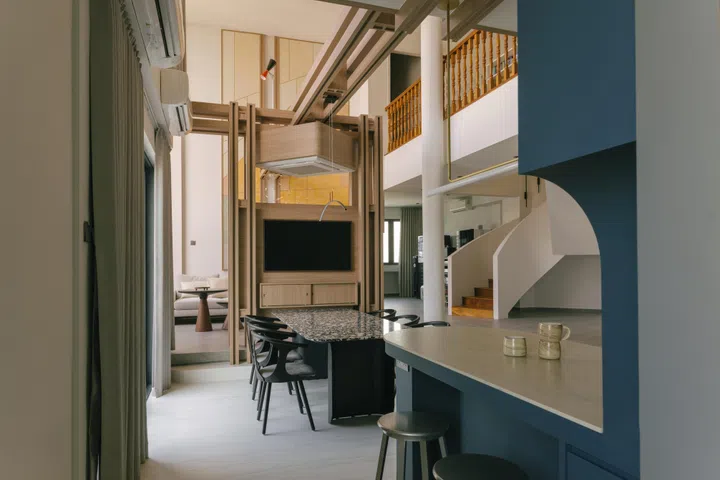
The dining area sits beneath the timber axis, where a suspended cassette air-conditioning unit anchors both airflow and gathering.
Dining under the axis
Positioned directly beneath the timber structure, the dining area sits along what Michael describes as the home’s “spine”.
“I said it’s good from a feng shui perspective to design an axis that acts as a spine,” he explains. “Along this axis, I like a more Modern movement, without too many walls and doors, to connect the living room, dining area and the kitchen… in a very joint manner, seamless flow.” It is here, at this central point, that the family naturally gathers. “We usually entertain in the dining area.”
Above the table, the suspended cassette air-conditioning unit becomes part of this spatial logic. Rather than being concealed, it is deliberately integrated into the axis, both visually and functionally.
“Where air-cons are being placed is also where the natural concentration of people will be,” Michael says. “We have a very interesting feature of a suspended cassette… for day-to-day use we use the wall-mounted units, but when there are group gatherings, this entire cassette is enough to power up the whole room.”
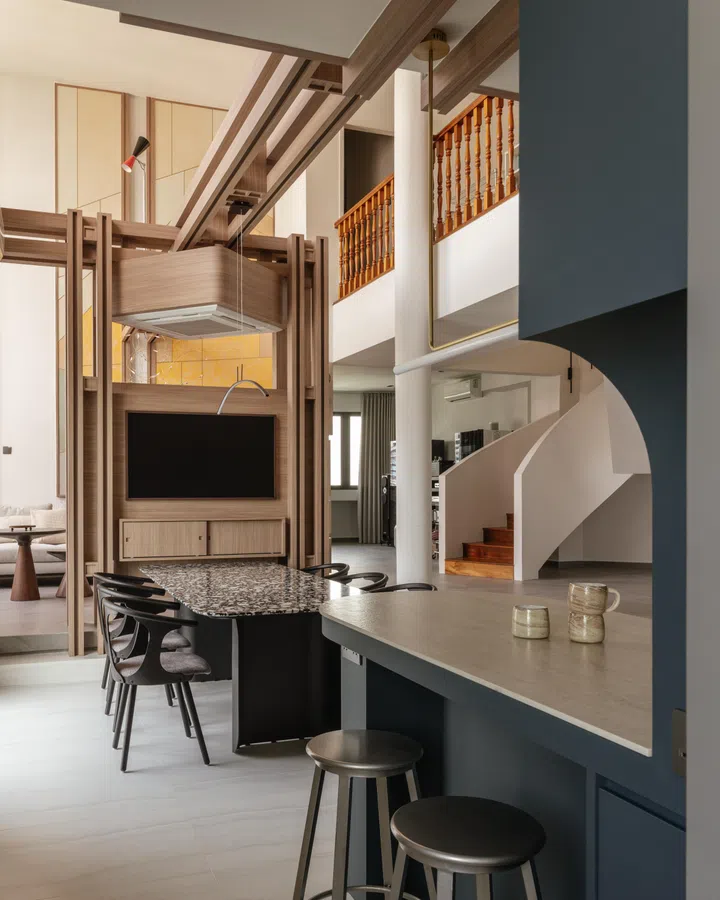
Integrated into the axis, the suspended cassette helps define two corridors, reinforcing circulation between dining and living.
For Woon of Metre Architects, this move was instinctive. “It started with a very practical suggestion from the owner to suspend the aircon cassette at mid-height to ease its subsequent maintenance,” he says. From there, it evolved into something more. “In design, we never do one thing to fulfil one function, but rather try to make a single gesture address multiple issues.”
That gesture is now the defining element of the space. The structure that holds the cassette also becomes a framework for lighting, a double-sided console, and a spatial divider. “Since we need a structure to suspend the aircon cassette, it just made a lot of sense to mould this structure into a separation between the living and dining areas,” Woon explains. “This in turn creates a double corridor… that enhances the circulation between the spaces that it delineates.”
Even the form carries meaning. “If you look at the axis, it’s actually a fu zi—the Chinese fu zi [meaning: prosperity],” Michael notes. At once symbolic and highly functional, the dining space captures the larger intent of the home: a place where movement, gathering and design are tightly interwoven.
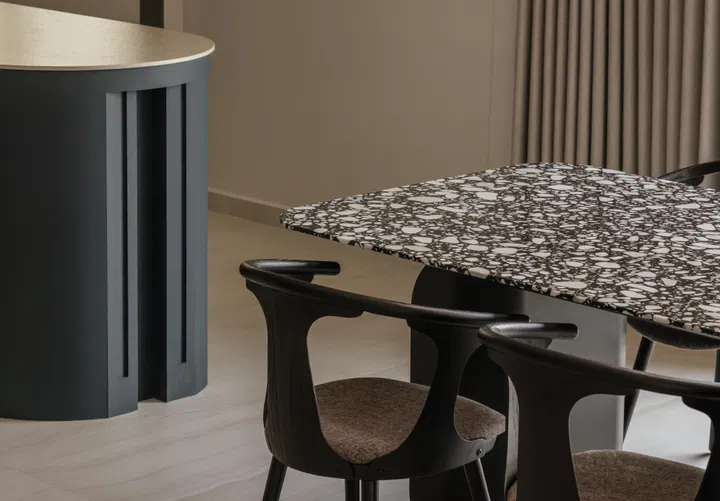
A closer look at the dining setting, where a dark textured tabletop and sculptural chairs ground the space.
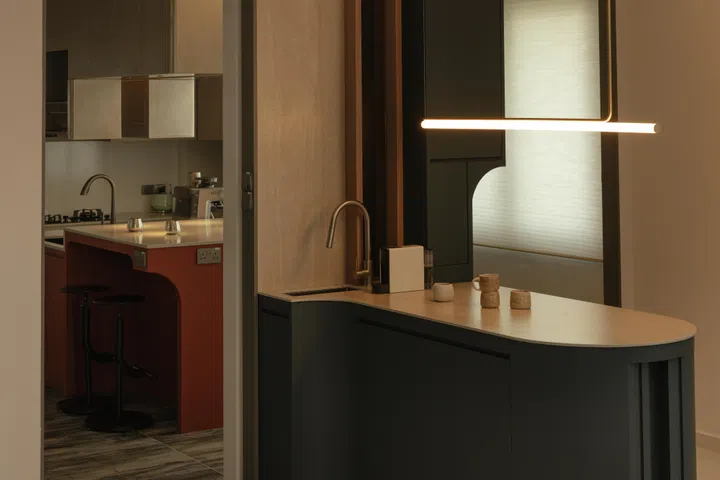
The blue-toned island marks the transition into the kitchen, introducing a softer, more informal counterpoint to the dining area.
A softer threshold into the kitchen
Off the main axis, the island shifts the spatial language without breaking it. Where the dining area is defined by darker tones and sharper lines, the island introduces a quieter, more rounded form. Its curved edges and muted blue finish soften the transition into the kitchen, easing the movement rather than marking a hard boundary.
This transition was deliberately calibrated by Woon as part of the home’s broader spatial sequencing. Rather than treating the kitchen as a separate room, it is allowed to recede slightly—both visually and materially—while still remaining connected to the rest of the home.
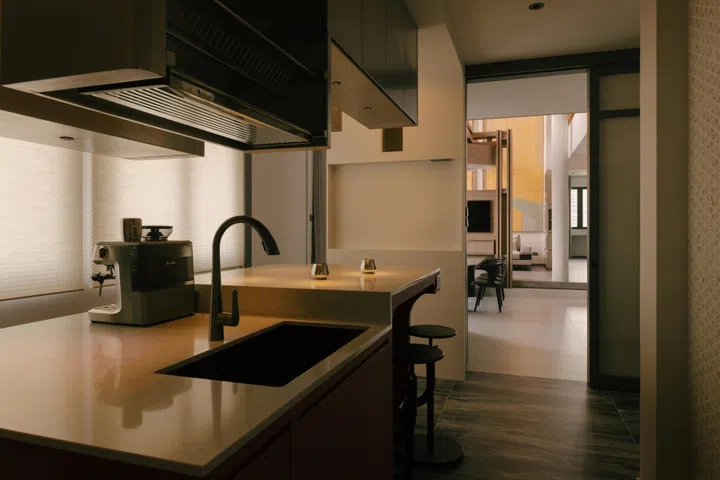
From the kitchen, the axis remains visible beyond, maintaining continuity with the dining and living areas.
A kitchen shaped by purpose
From within the kitchen, the axis remains visible beyond, a quiet reminder that this is not a separate room, but part of a continuous spatial sequence. The connection back to the dining and living areas is maintained, even as the palette deepens and the space becomes more task-focused.
At the centre, the island reveals the level of thought behind its making. More than a simple counter, it is built with integrated storage, electricals and layered detailing. As Michael puts it, “The kitchen is quite high-specs… the island is specially crafted with a lot of insets and electricals running through.”
These decisions reflect a broader mindset. “Less clutter and more purpose in the way I live… less decoration actually creates more meaning.”
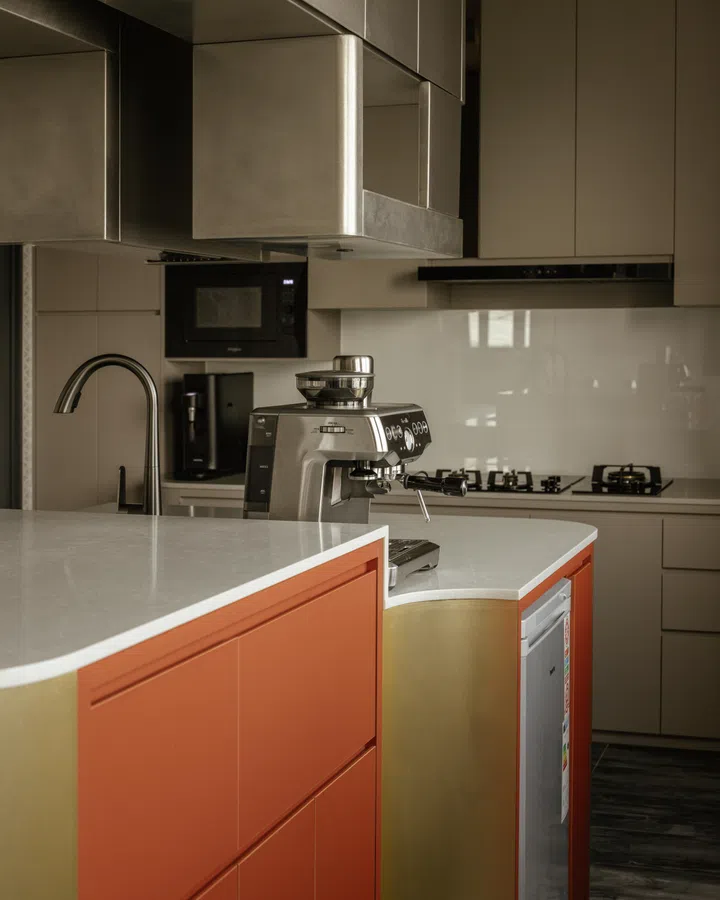
The island is custom-built with integrated services and storage, reflecting the home’s high-spec, purpose-driven approach.
That emphasis on purpose extends to how the kitchen is used day to day. “If my helper doesn’t feel right in the kitchen, the things she cooks will be…” he says. “I want her to take pride in the food she cooks.” It’s a practical consideration, but one that shapes the overall atmosphere of the space.
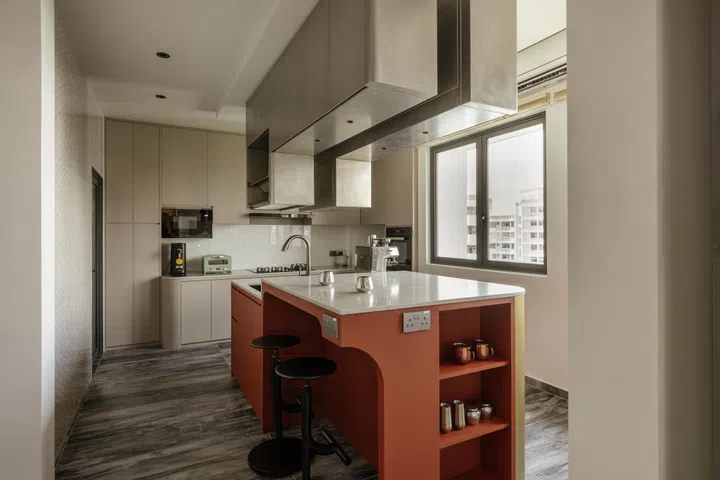
Double upper cabinets extend the axis into the kitchen, forming a softly lit spine that organises the space.
Overhead, the axis resolves into its final form. Reinterpreted as a series of double upper cabinets, it runs through the centre of the kitchen, not as a structural element but as utility and light.
“The need for ample storage in the kitchen gave the perfect reason to provide double upper cabinets above the island counter,” Woon explains. “This produced a glowing axis along the centre of the kitchen, subtly ordering the space with its soft glow.”
In this way, the kitchen completes the spatial narrative. What begins as a structural gesture in the living and dining areas resolves here into something quieter, but no less intentional—a space where function, craft and daily routines come into alignment.
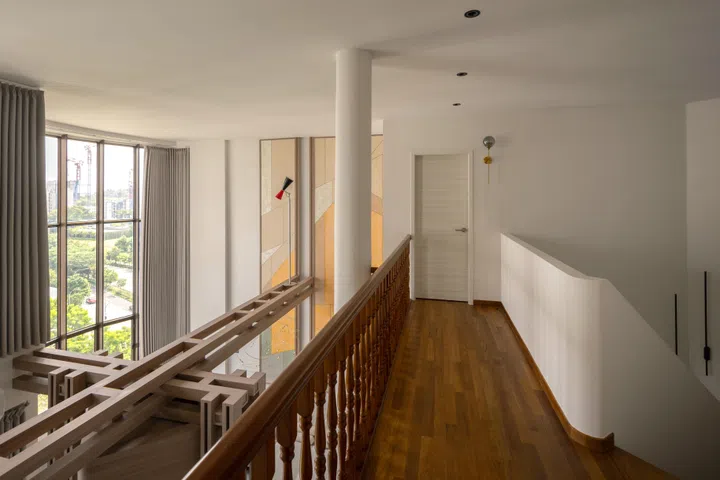
The preserved upper-level railing recalls a wooden bridge, introducing a quiet reference to the home’s Japanese influences.
A bridge above the space
On the upper level, a single element from the original home was preserved—this railing. “We demolished the whole house except we left one area, the railing on the second floor,” Michael says. Its presence introduces a different kind of continuity, not just within the new design, but with what came before.
For him, the reference is immediate and personal. “In Japan there are a lot of wooden bridges… this railing actually has that resemblance to the bridge. Imagine you’re in the mountain.” Set against the double-height volume, it reads less like a conventional balustrade and more like a passage suspended within the space.
It’s a small gesture, but one that reinforces the broader language of the home, where structure, memory and atmosphere are closely intertwined.
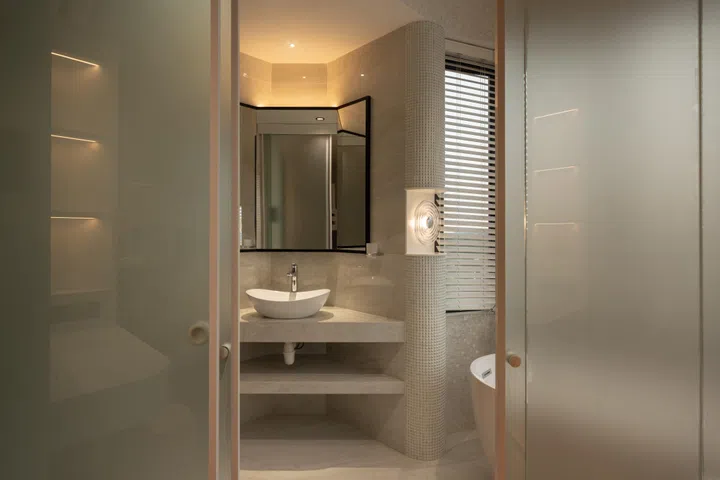
At first glance, the bathroom reads as a quiet extension off the main spine, its full shape only revealing itself as you move further in.
A bathroom to come home to
Tucked just off the circulation spine, Michael’s daughter’s bathroom unfolds in an unexpected way—not as a typical enclosed room, but as a space extended from what was once a balcony.
“This is my daughter’s bathroom,” he explains. “This is a creation by converting a balcony and joining it angularly… the bathtub used to be the balcony.” The result is an L-shaped plan that turns a constraint into a sequence: shower tucked behind a screen to one side, with the toilet and bathtub opening out along the other.
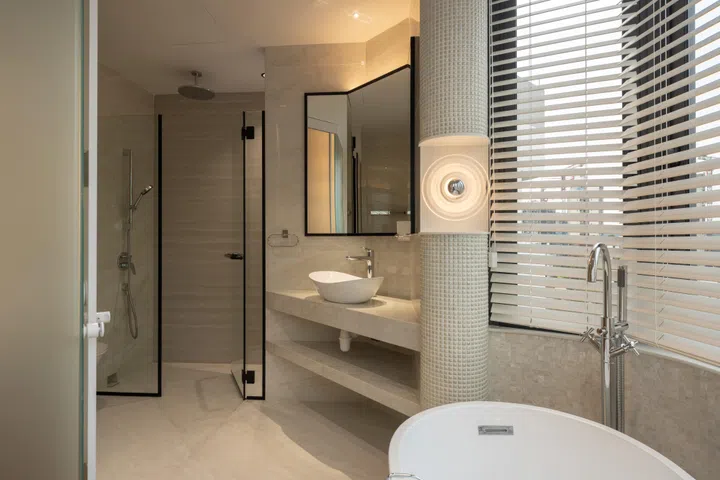
The daughter’s bathroom unfolds from a former balcony, reconfigured into an L-shaped plan organised around a 45-degree geometry.
For Woon, that geometry was not incidental but generative. The 45-degree angle becomes the organising logic of the space, allowing zones to separate naturally without feeling partitioned. It’s a subtle shift, but one that makes the room feel more fluid—less like a series of functions, and more like a continuous experience.
Materially, the bathroom is deliberately restrained. “We had this idea of a monolithic white space,” Woon says, “where only upon closer inspection would the various textures from mosaics and tiles be revealed.” What reads at first as calm and uniform gradually deepens, rewarding attention rather than demanding it.
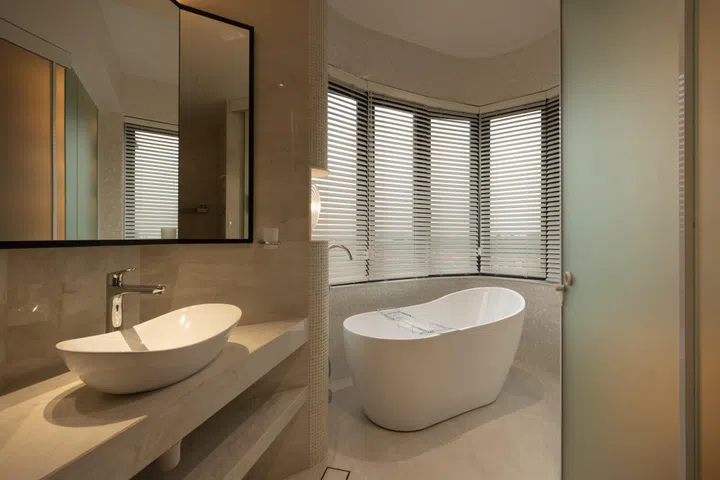
Once a balcony, the bathtub area is now part of a calm, monolithic white space designed as a place to unwind after school.
More importantly, it has become part of a daily ritual. “One of my daughter’s favourite activities after school,” Michael shares, “is to dip in the bathtub, look at her iPad or iPhone… it’s relaxing. I want the space to be a reset.”
In that sense, the bathroom is less about utility and more about decompression, scaled to a young girl’s rhythms but designed with the same care as the rest of the home.
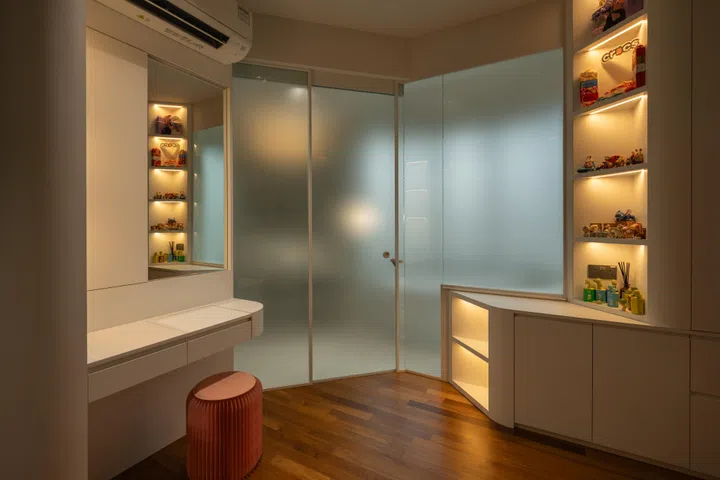
A concealed vanity with lift-up storage and sliding mirror keeps daily routines discreet, revealing a painting when slid.
Just outside, that experience continues in quieter ways. Storage is embedded rather than expressed: a lift-up vanity concealed within a table, shelving for personal items, and a sliding mirror that reveals a painting when shifted aside.
“She’s very exposed to art,” Michael says, “so we have a few paintings in the house.” Even here, the boundary between functional and personal remains deliberately blurred.
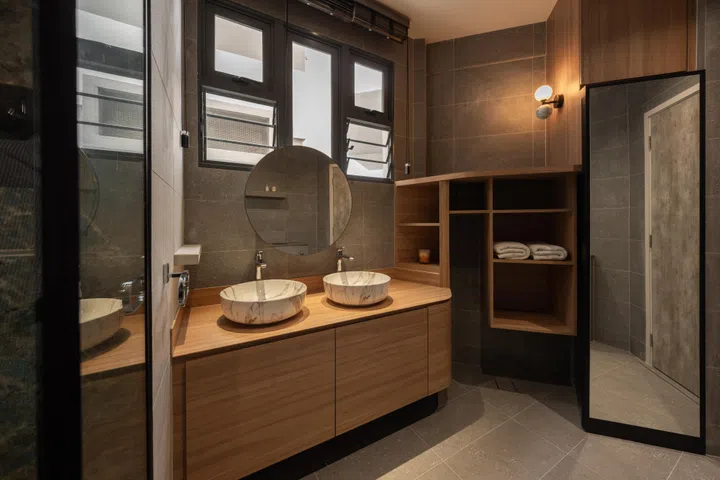
The master bathroom blends Japanese onsen references with retro window details, creating a more introspective, grounded space.
A small shift in mood
If the rest of the home leans distinctly Japanese in its spatial language, the master bathroom introduces a slightly different register—one that blends those references with something more personal and nostalgic.
“This is the master bathroom,” Michael says. “It is also a bit of a Jap design… but I wanted, even the windows, to feel a bit retro.” The detailing is deliberate. One window recalls older pane configurations from his childhood, while another vertical pane sits at the middle, bringing in light while maintaining privacy.
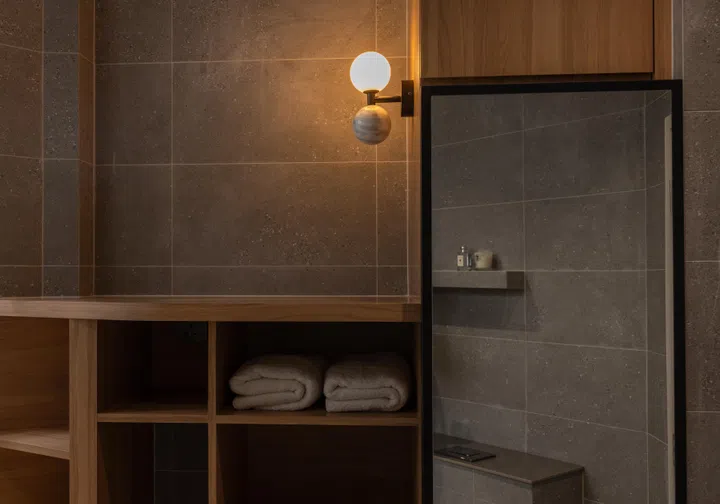
Integrated carpentry conceals storage behind mirrors and walls, keeping the washbasin area clean and deliberately composed.
Storage and function are folded quietly into the architecture. Carpentry rises seamlessly from the ground into a series of integrated shelves, while more practical elements are tucked away: a concealed zone behind the mirror for hanging clothes, “like at a ski resort, where you hang your clothes in a locker.”
The laundry basket is also hidden behind the mirror. “I like a very neat washbasin area,” Michael adds—a preference that shapes the entire elevation, where the shelf ledge is reserved for a flower arrangement.
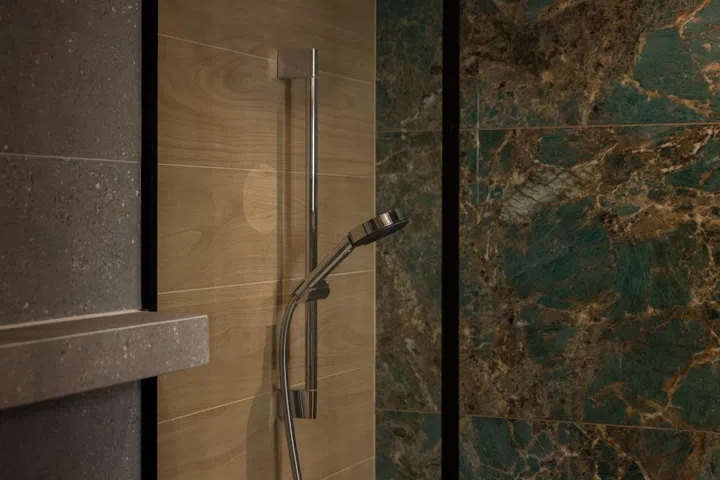
The master bathroom references an onsen bath where granite, wood, and even moss inspired its material choreography.
For Woon, the material language anchors the space more clearly. The bathroom draws from the idea of an onsen, with granite, wood and even moss informing its composition. The result is less literal than atmospheric—a quiet, grounded environment that contrasts with the openness of the main living spaces.
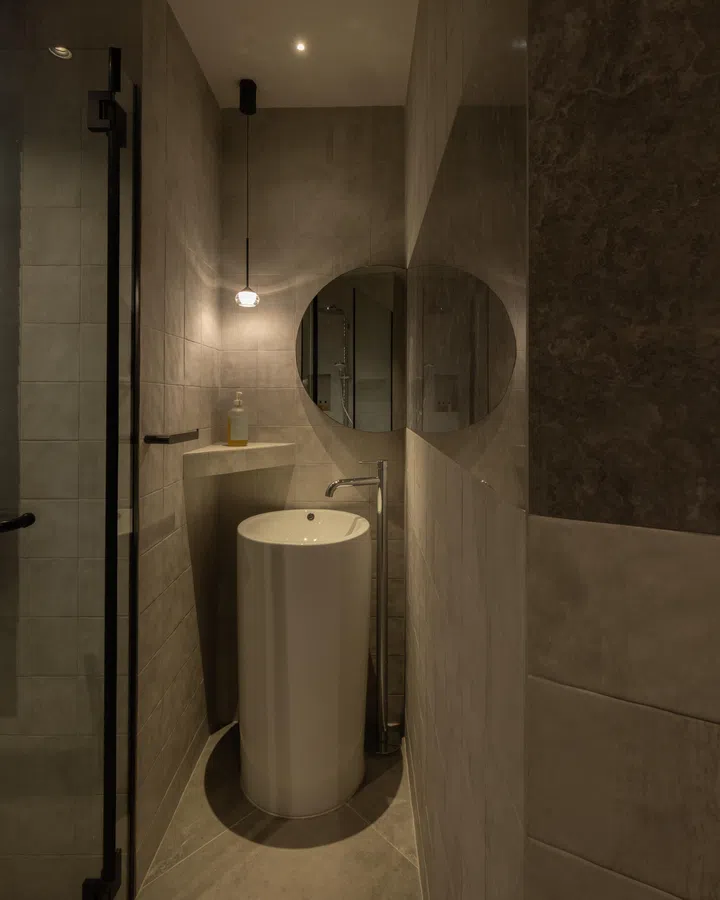
A narrow, angular footprint is reworked into a comfortable passage, with a mirrored strip extending the sense of depth.
Working within the constraint
At the lower level, the common bathroom begins with a constraint—a tight, angular footprint that could easily have felt compressed.
“This is the common bathroom. Odd space, shaped in angular,” Michael says. “We had to create, in a very narrow alley, a comfortable space… just nice for one person standing, and inviting.” The challenge was not just fitting in the essentials, but making the experience feel intentional rather than compromised.
That sense of depth is achieved through a carefully placed visual line. A mirrored strip draws the eye through the space, extending what is physically narrow into something more open and legible. It’s a small intervention, but one that shifts how the room is read and used.
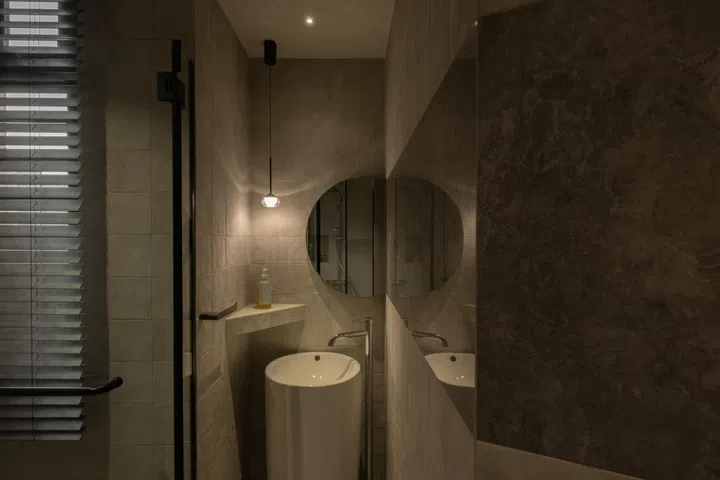
A horizontal band of reflective tiles meets an angled mirror at the basin, layering light and reflection across the compact space.
For Woon, the geometry becomes an opportunity rather than a limitation. The 45-degree entry introduces a layered threshold, which then informs the material expression—a horizontal band of reflective, marble-like tiles set against matte white surfaces. As it wraps the space and meets the pedestal basin, the angled mirror catches and extends this band, creating a subtle loop of reflections.
The effect is quiet but deliberate. What begins as a constrained corridor resolves into a more composed sequence, one where light, angle and material work together to lend the space a sense of calm, almost ritual-like focus.
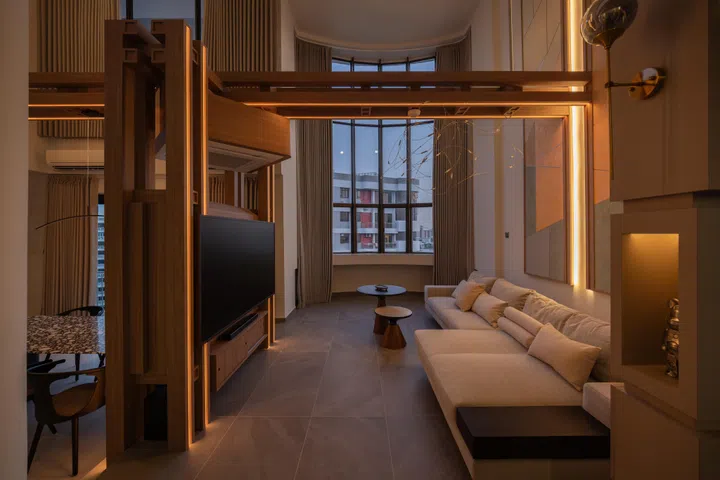
At dusk, the illuminated axial structure defines the double-volume space, bringing warmth, clarity, and calm to the home.
$300,000 renovation cost
The renovation began in December 2024, and the family moved in by July 2025. “We took about eight months… it’s a very long renovation, because of the architectural work,” Michael says. Several months on, the impact is felt in quieter ways.
“We’re very settled in, very comfortable. Our new habits of living have evolved to be less of a clutter, add more meaning to our workflow.” Looking ahead, he sees it as a long-term anchor: “If I do stay here for eight to ten years, it’s going to be my safe abode, my safe space.”
For Woon, the project comes back to a single organising idea—the axis. “We always find the axis a very endearing principle… we were very intrigued and humbled that the architectural axis of the Forbidden Palace or the boulevards of Paris could be manifested at an interior scale here.”
That intent was tested after completion, when the homeowners invited the team back for dinner. “Michael gave us a quick tour of the kitchen to illustrate the workflow that was an important part of the owners’ brief to us, and then we got to enjoy his restaurant-standard cooking.”
Moving from kitchen to living and dining, the axis proved both generous and intimate when experienced, just as it was intended.