
Home Tour: A designer’s own home, designed to grow with time
Designer Mak Ai Ling shapes her 1,450 sq ft condominium at Le Crescendo into a calm, adaptable home for herself and her growing family.
By Gwyneth Goh -
Share this article
Mak Ai Ling’s family home at Le Crescendo is markedly different from the projects she designs for others. As the director of her own design studio, Studio Makal, and an architect by training, she is accustomed to responding to briefs, budgets, and external expectations. Designing her own home, however, proved to be a far more personal and introspective exercise.
“Designing my own home was actually very challenging,” she reflects. “Because there’s no one to say this is good or this is perfect. I know there are so many permutations...” Without a client to anchor decisions, the design evolved intuitively. “The whole design became very personal,” Ai Ling says. “It kept evolving as I was designing it—and now that we live in it, it continues to evolve.”
Moved into three to four years ago, when her children were still very young, the 1,450-sq-ft home was shaped around a specific moment in family life. “When we moved in, my daughter was one,” Ai Ling recalls, “So the house was designed very much for children and safety.”
Home to Ai Ling, her husband, their three children aged five, ten, and twelve, and a helper, the apartment needed to support not just everyday routines, but frequent hosting and flexible use. Rather than chasing permanence, the designer-homeowner approached this project as a living framework—one designed to grow with her family, even as it quietly anticipates being outgrown.
Who lives here: Mak Ai Ling, in her 40s, design studio owner, her husband, their three children, and a helper
Home: A 4-bedroom condominium at Le Crescendo, Paya Lebar Road
Size: 1,450 sq ft
Interior Designer: Studio Makal
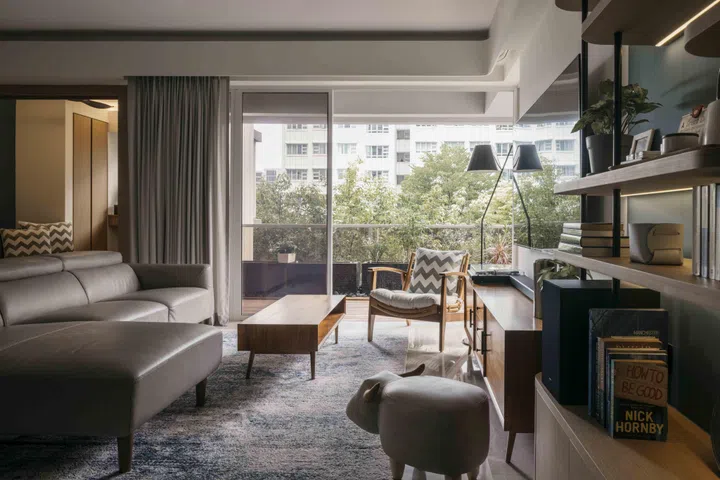
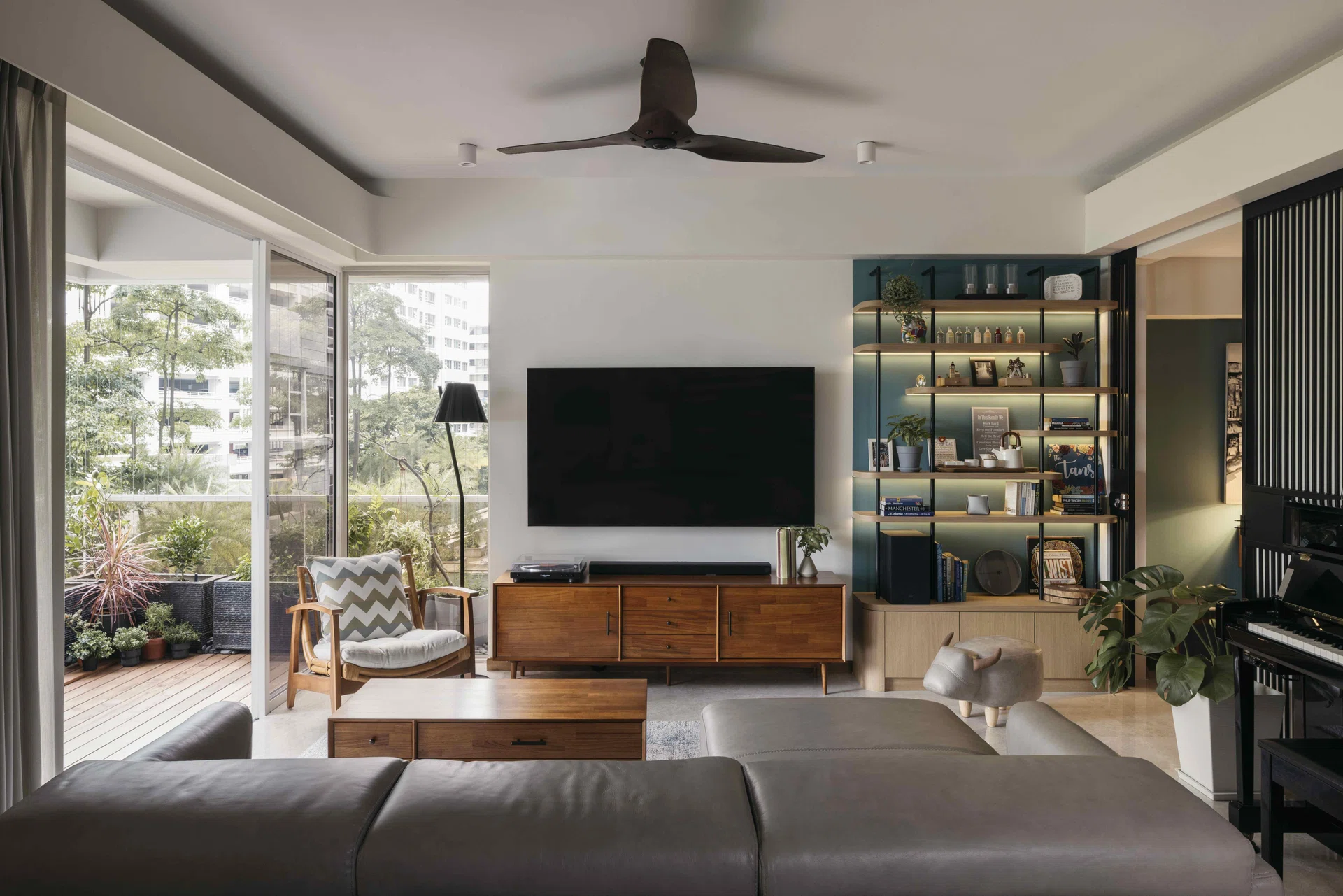
Set within the tree canopy, the living area draws in light and greenery, grounding the home in a sense of space and calm.
Choosing the home: Space, light, and convenience
Before Le Crescendo, the family lived in a penthouse, but it quickly became too tight. “The liveable space was too small,” Ai Ling says. “When my daughter was born, there was really not enough space.” What they needed was not height or novelty, but room to live—and to grow.
The older condominium appealed precisely because of its age. “It’s very old, but very spacious,” she explains. “Because it’s old, it gave me the freedom to redesign and gut out the space.” As a designer accustomed to working within constraints for clients, the ability to start afresh—and to do so for her own family—was a rare and happy opportunity.
Light and greenery were equally important. “It has many windows, so it’s very bright,” she says. Positioned at the level of the surrounding trees, the apartment enjoys an outlook that feels quietly removed from the city. “It’s on the same level as the tree canopy, so I see a lot of leaves—it’s very nice.”
Practicality, however, was what ultimately sealed their decision. The apartment sits between her children’s schools, within walking distance of her office, and close to her husband’s workplace, church, and her mother-in-law’s home. “We didn’t want to spend so much of our lives travelling on the road,” Ai Ling says. “At this point in time, it is everything we need.”
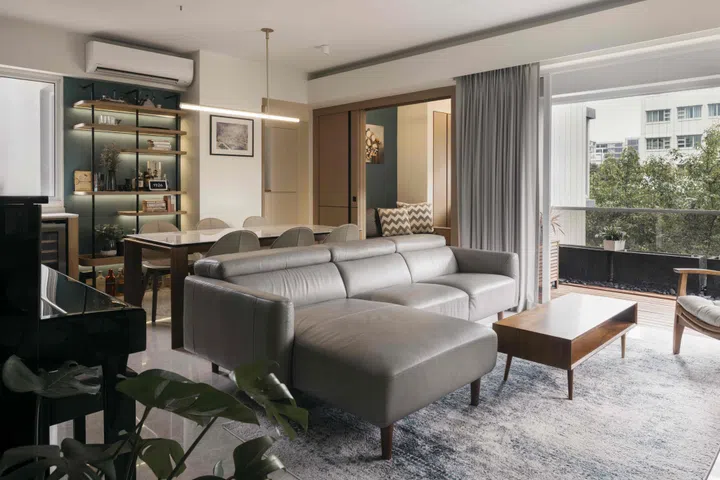
Planned as a single, generous volume, the living and dining areas are organised through clean lines and careful alignment rather than visual clutter.
Living and dining: Clean lines for a full house
The living and dining areas are designed as a generous, uncluttered core that can accommodate both daily family life and large gatherings. Rather than zoning with walls or visual noise, Ai Ling relied on proportion, alignment, and clarity to organise the space.
“For me, alignment is very important,” she says, “Everything has to be clean.” She attributes this precision to her architectural training in the UK. “I’m trained as an architect,” Ai Ling explains. “I used to do a lot of replanning.”
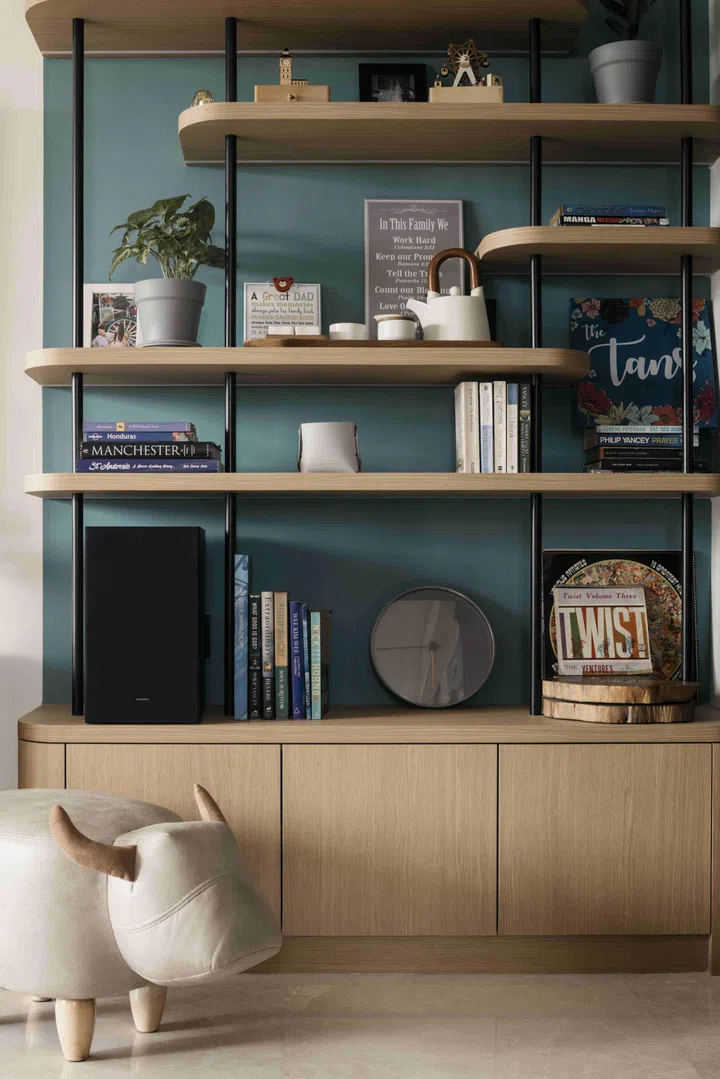
Open shelving introduces warmth and everyday function, reinforcing a space that is orderly without feeling over-styled.
Despite the precision, the atmosphere remains intentionally restrained. “I don’t like a space to be very loud and noisy,” she says. “I need it to be calm and coherent.” Warm timber finishes, soft furnishings, and a muted palette soften the clean lines, ensuring the space remains comfortable even when the house is full.
Splashes of turquoise bring warmth and calm to the living area and private lift lobby—a colour Ai Ling chose because she and her husband are drawn to blue and green hues. It reappears subtly throughout the home, establishing a quiet emotional thread that runs across shared and private spaces.
Art adds a more personal layer. “Another thing I like is the paintings,” Ai Ling shares. In the study hangs a work by one of her favourite artists, while another piece is thoughtfully placed at the private lift lobby.
“When I was travelling in Hanoi with my husband, we saw this painting of the streets of Vietnam,” she says. “It’s a very beautiful oil painting.” Positioned where guests first enter—and where the family returns each day—it becomes a familiar presence. “This is what greets our guests when they enter, or when we come home in our private lift.”
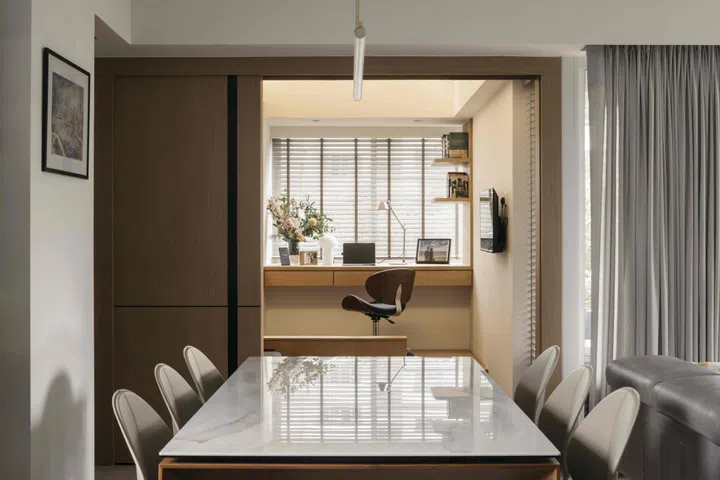
Designed to evolve over time, the study was planned as a flexible room that could shift from tuition space to playroom and guest room without structural change.
Shapeshifting study: One room, many lives
If there is one space that encapsulates the home’s philosophy, it is the study. Compact in size, it was designed to be deliberately flexible, serving as play space, home office, guest room and even storage unit.
Rather than resisting these shifts, Ai Ling designed for them. Built-in platforms, concealed compartments, and stepped levels allow the room to take on different configurations without feeling temporary or compromised.
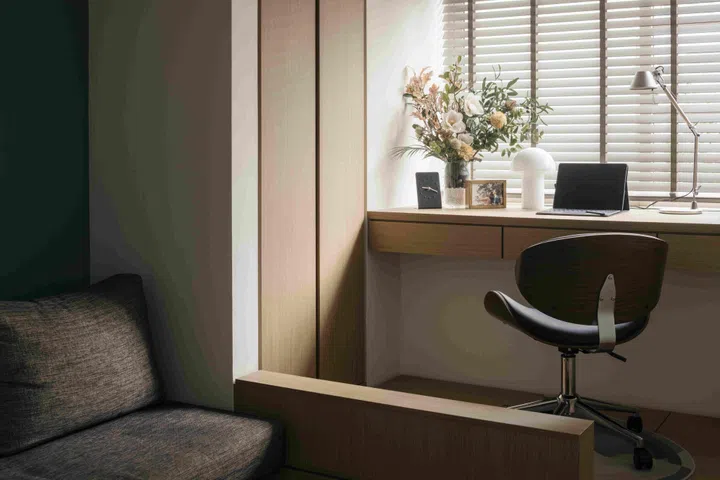
Platforms, concealed storage, and stepped levels allow the room to adapt quietly, reflecting Ai Ling’s approach to designing for her children and for their evolving needs.
“I designed my study room as a flexible space,” Ai Ling shares. “The children are fully utilising it now as a tuition room. It also doubles up as a guest room, because my parents and friends do come over and stay.”
Hidden storage is layered everywhere: beneath platforms, within steps, behind seating. “Everything is utilised,” she smiles. “Nothing is wasted.”
Even small decisions were carefully calibrated. “I built the platform to a height so that the chair won’t roll back,” she explains. “Someone can sit on the ledge. The sofa bed opens up. The steps going up are also storage.”
More than any other room, the study embodies the project’s central idea: a home that grows not by expanding, but by making space—physically and mentally—for change.
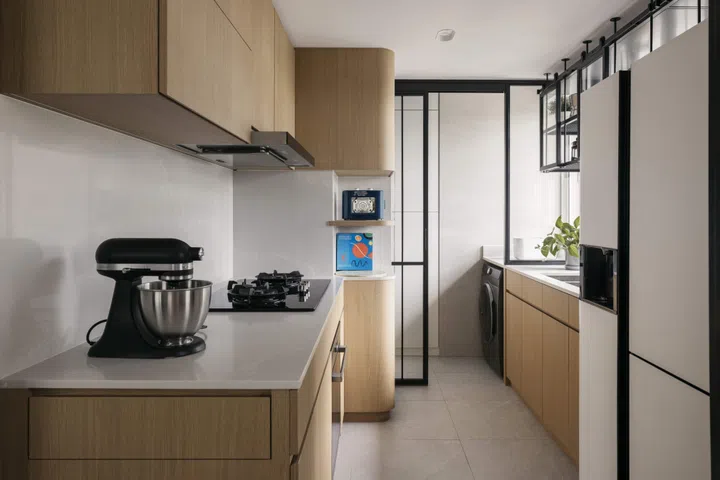
Light-toned cabinetry and glass-backed shelving keep the kitchen open and visually connected, while a pull-out counter supports family activities.
Kitchen: Designed for togetherness
In the kitchen, functionality is paired with participation. Rather than treating it as a back-of-house zone, Ai Ling designed it as an extension of family life—open, legible, and easy to gather around. “I designed it so there’s a pull-out counter,” Ai Ling shares, “So I can bake with my children.”
The pull-out counter allows her children to work alongside her, transforming the kitchen into a place of learning rather than production alone. Transparency plays a key role here: glass-backed shelving above the sink allows light to pass through while keeping frequently used items visible and accessible. Glass sliding doors maintain visual continuity while containing cooking smells when needed.
Throughout the home, material discipline is strict. “The whole house has three materials,” Mak explains. “Oak laminate, quartz wherever it’s wet, and black metal.” The same restrained palette and careful alignment seen in the living and dining areas carry through, ensuring the kitchen feels connected rather than contained.
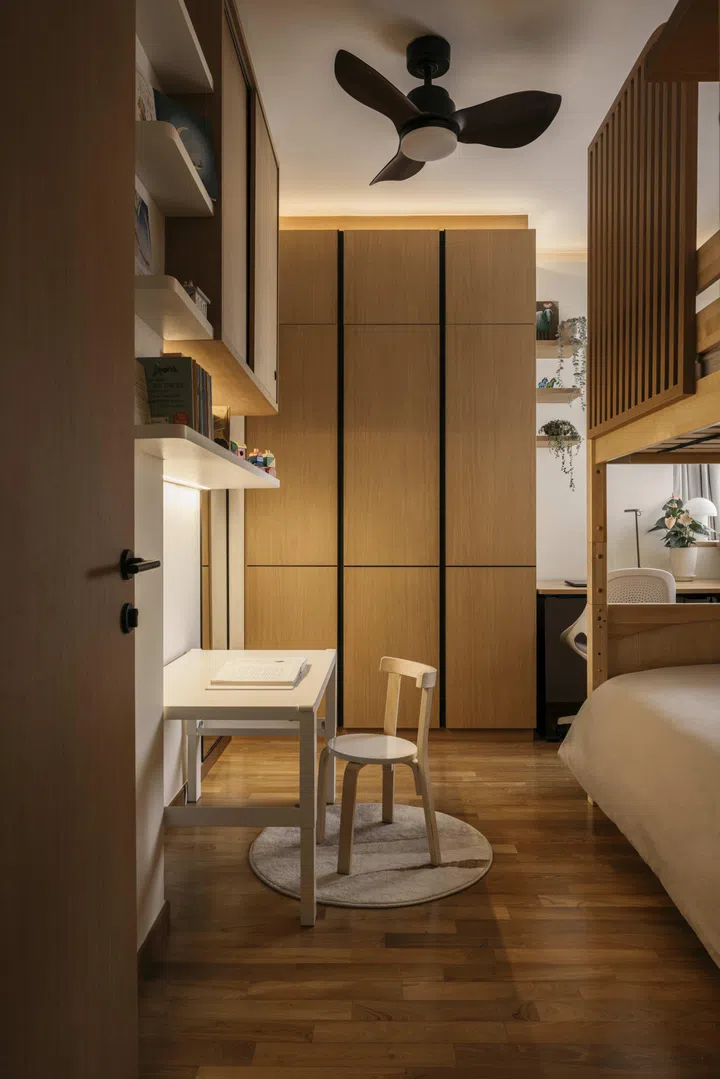
Designed to adapt as her children grow, their bedrooms combine modular bunk beds with integrated storage and soft, rounded details.
Children’s Bedrooms: Growth made visible
Viewed together, the children’s bedrooms form a cohesive chapter about growth—designed to evolve over time without constant reinvention. Modular bunk beds anchor the rooms, allowing sleeping configurations to shift as the children grow older and their needs change.
Designing for children meant turning constraints into opportunities—particularly the unusually tall bay windows. “The bay window is very high, about one metre,” Ai Ling says. “Rather than treating it as a limitation, we integrated it into storage and raised platforms.”
Transformed into a perch where her children can sit to read or observe the world outside, Ai Ling shares that the bay window area is one of her son’s favourites spots—where he perches to observe passing buses, one of his favourite things.
Custom moveable steps also allow her children to ascend safely and independently. “I wanted them to be able to climb up safely,” she explains. “They use the steps to climb up to the bay window and also to their bunk beds.” Designed with multifunctionality in mind, the steps also double as storage—small interventions that quietly support everyday use.
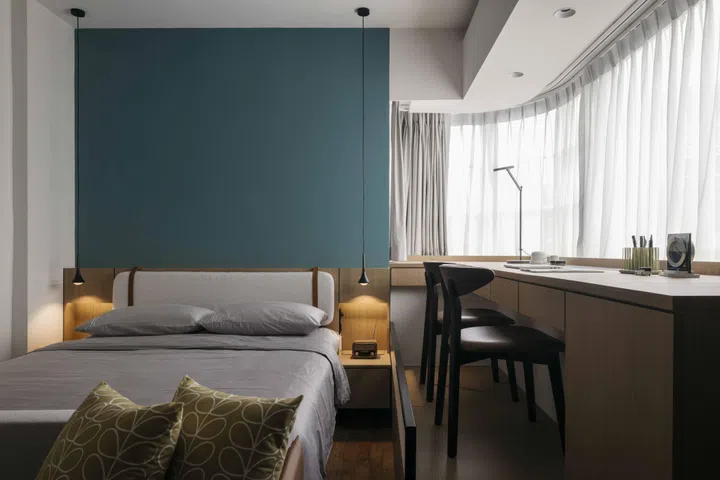
Designed as a suite, the master bedroom integrates a sleeping area with a window-side desk and seating, allowing work and rest to coexist without intrusion.
Master bedroom: A suite-like retreat
Moving beyond the shared rhythms of family life, the master bedroom unfolds as a quieter, more reflective space. Conceived as a suite rather than a conventional bedroom, this space is designed as a private sanctuary for rest, conversation, and small daily rituals.
“I used to do a lot of hotels,” Ai Ling shares. “I always wanted to have a loveseat in my room.” The loveseat has become a favourite spot. “At night we unwind and talk here,” she says. “It’s my husband’s favourite place.”
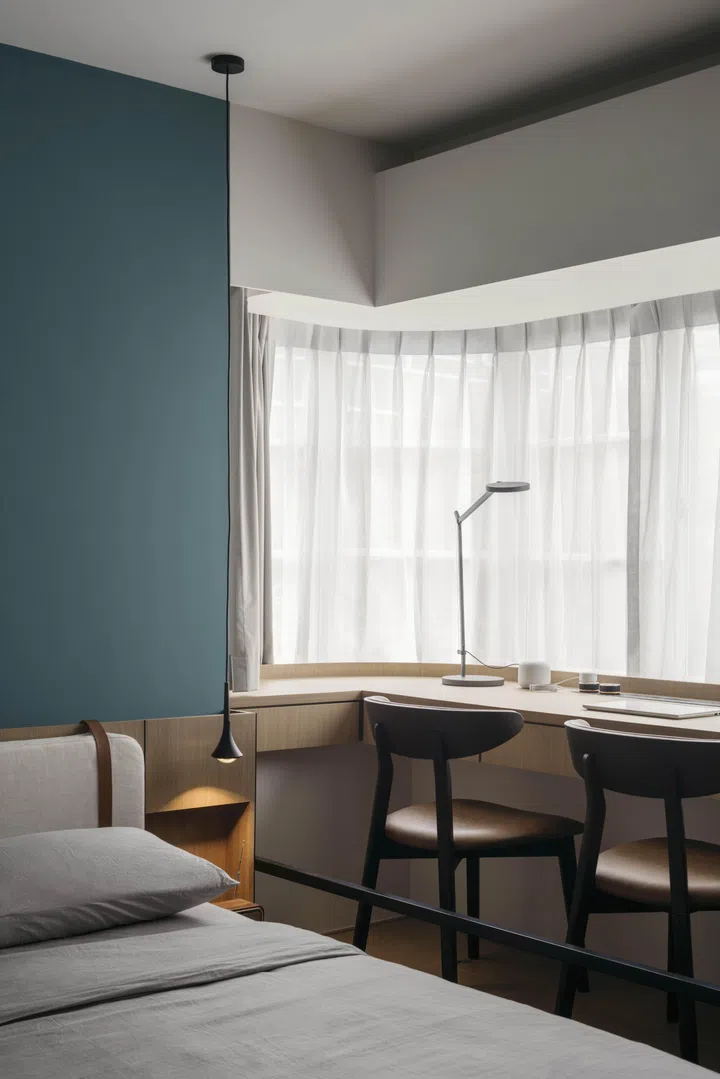
A long writing desk by the window creates a quiet workspace within the master bedroom.
The bedroom also houses a long writing desk, television, fridge and coffee machine, allowing the couple to begin and end the day without leaving the room—a Covid-era legacy that continues to shape how they live. “My husband can use this desk while I use the one in the study,” Ai Ling explains. “So we each have our own study area.”
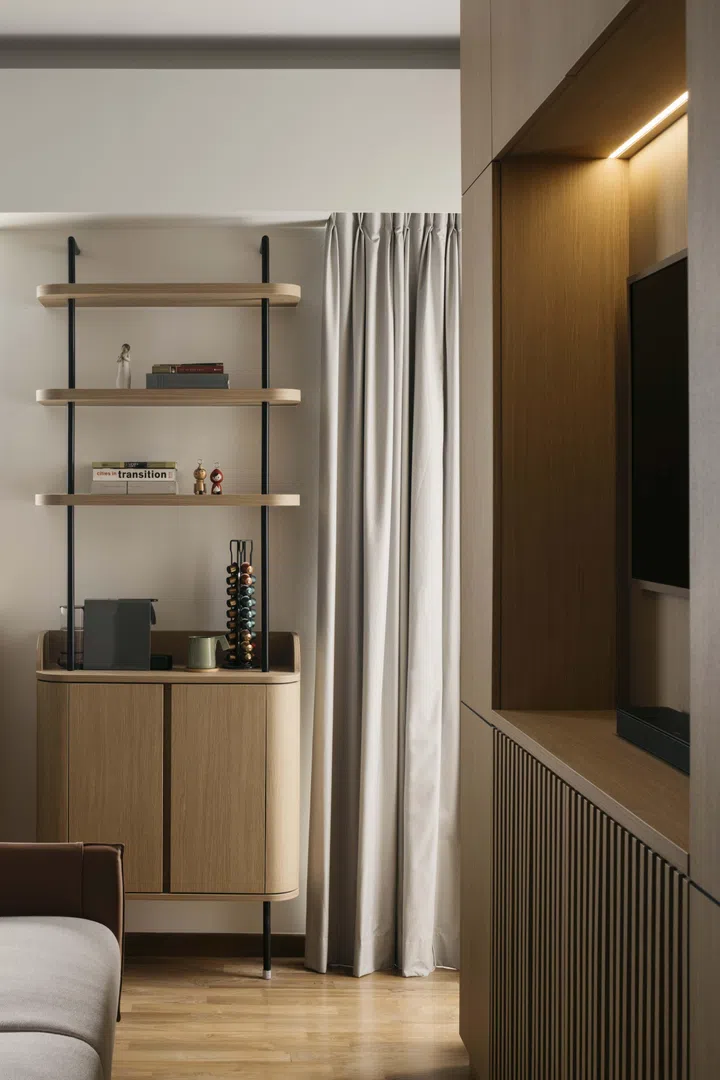
Open shelving allows books and objects to remain visible, turning storage into a form of memory-keeping.
Open shelving plays a more personal role here. “I like to display memories,” she says. “When I see a book, it reminds me who I was at that point in my life... and what I learnt from it.” In this way, the bedroom becomes less about retreating from the world, and more about quiet reflection within it.
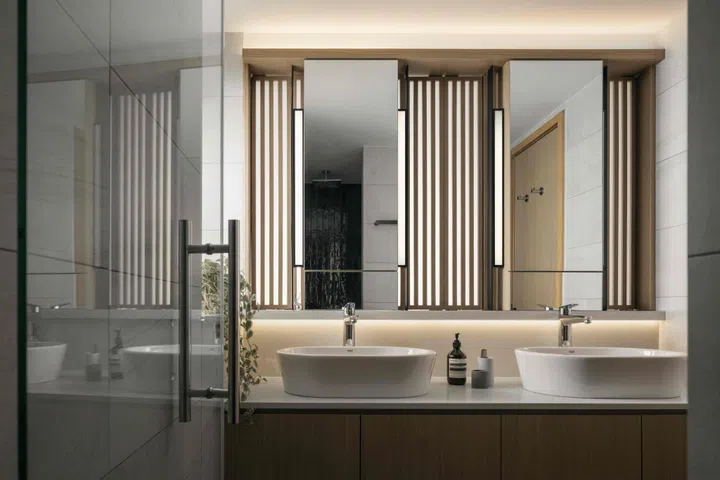
A reworked window and louvres bring light and greenery into the bathroom, extending the home’s connection to its surrounding canopy.
Master Bathroom: Light, connection, and calm
If the master bedroom is a place for slowing down, the bathroom extends that sense of retreat through light, alignment, and careful editing. One of Ai Ling’s proudest interventions was connecting the master bathroom to the bedroom visually. “My bedroom overlooks the tree canopy,” she says. “I thought, I want to see this when I’m in my bathroom.”
A window was hence carved out above the sink and fitted with frosted louvres for privacy. “I can open it and look out while putting on my makeup, and talk to my husband also,” she laughs. “At night, when the lights are on, it adds a glow and a special quality to the space.”
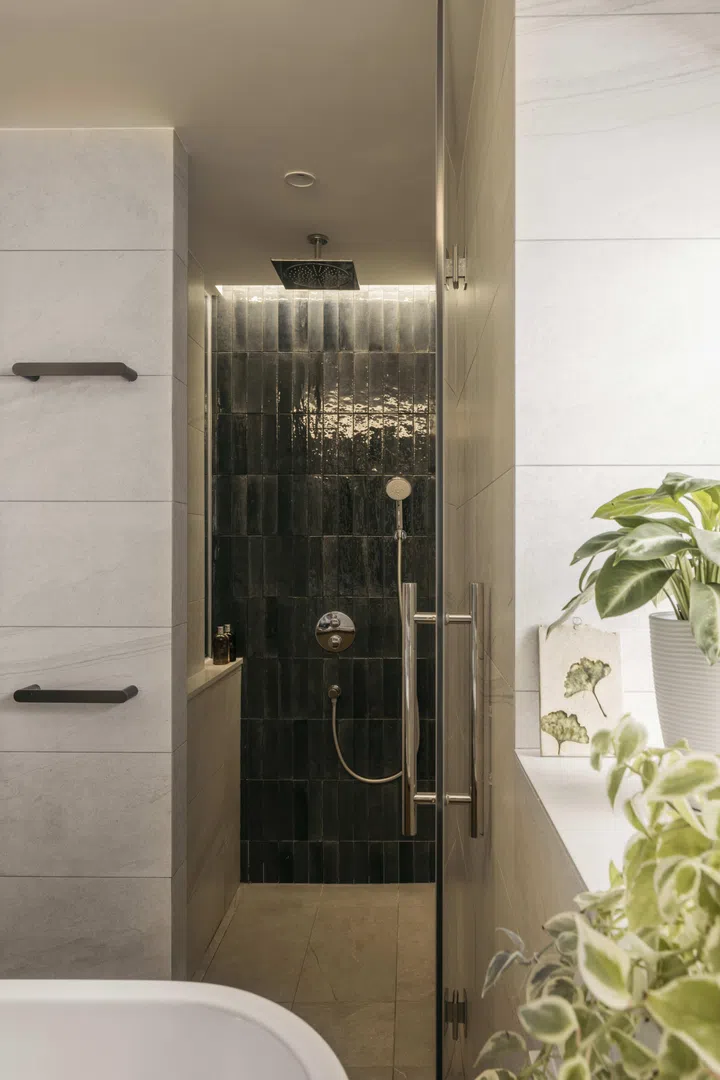
Finished in jade green tiles, the shower becomes a small but deliberate feature—one of her favourite colours.
In the shower, darker tiles introduce depth and contrast, grounding the space while maintaining a calm, intimate feel. Nothing here is decorative for its own sake. The bathroom reflects Ai Ling’s instinct to design with clarity and restraint—where comfort comes from proportion, light, and how the space feels when experienced daily.
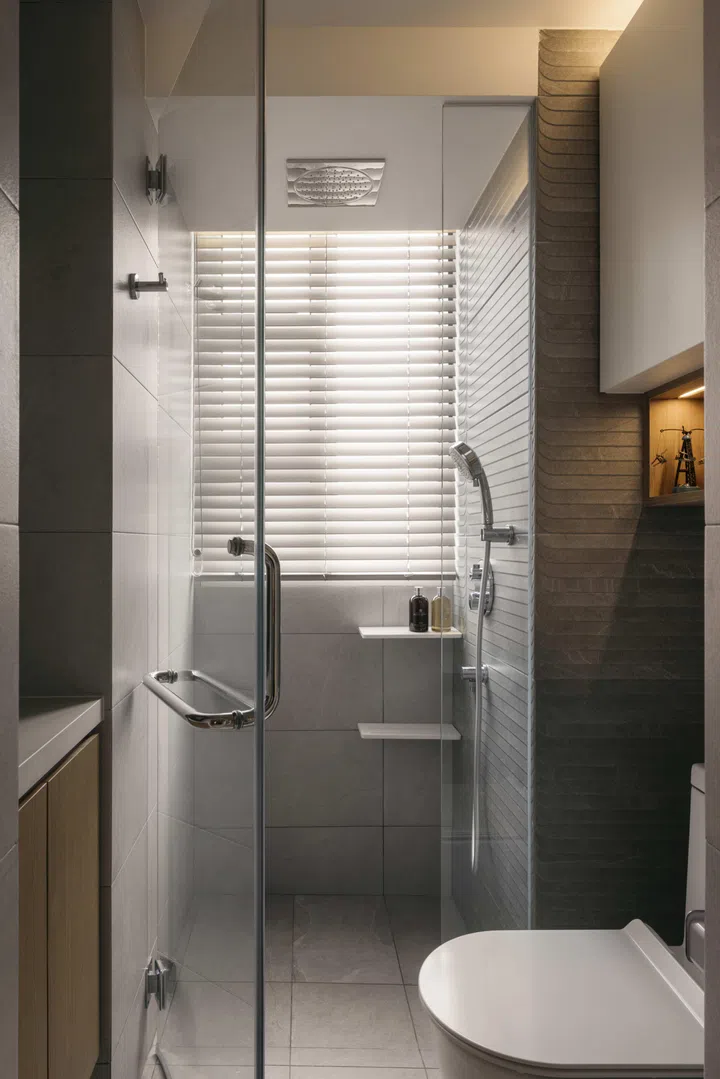
The common bathroom is kept compact and efficient, with a glass-enclosed shower and light-toned finishes that prioritise everyday use.
Common Bathroom
Smaller and more utilitarian, the common bathroom and corridor are where Ai Ling’s approach to editing becomes most evident. During planning, the bathroom was deliberately resized to allow the adjacent study to grow—a trade-off she was comfortable making, prioritising how the family actually lives and uses the home. “It’s sufficient for my kids but they’re growing bigger so it might be time to change to a bigger home again,” Ai Ling comments.
Despite its compact footprint, the bathroom is carefully considered. Light-toned surfaces, clear lines, and a glass-enclosed shower keep the space feeling open and functional, while integrated storage ensures daily essentials are kept close at hand but out of sight. Nothing here competes for attention; the focus is on ease and longevity.
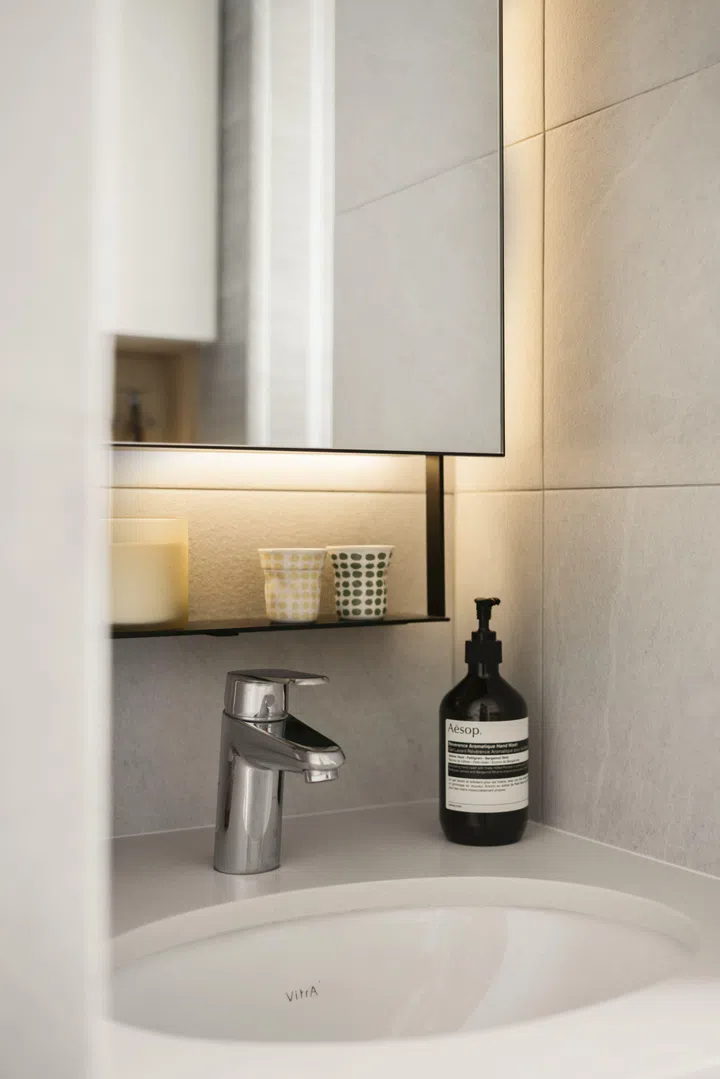
Simple fittings and integrated lighting keep the common bathroom functional and uncluttered, allowing it to age gracefully over time.
A home that grows with time
Ai Ling is pragmatic about the future. As her children grow, the family will likely need to move again—and this home was never designed to resist that possibility. “My children are growing bigger,” she says. “My girls will want their own rooms in a few more years, so we will have to look for a bigger place again.”
For now, the home fulfils everything they need. It supports daily life, holds meaningful memories as they form, and adapts easily as the family grows. When the time comes to move on, it will have served its purpose well—marking this season of life with grace, and making room for the next.