
$100,000 Colourful renovation for a HDB Executive Apartment in Sembawang
A 131 sqm HDB EA flat is transformed into a layered, personality-filled family home through bold colour, classical detailing, and thoughtful everyday planning.
By Gwyneth Goh -
Share this article
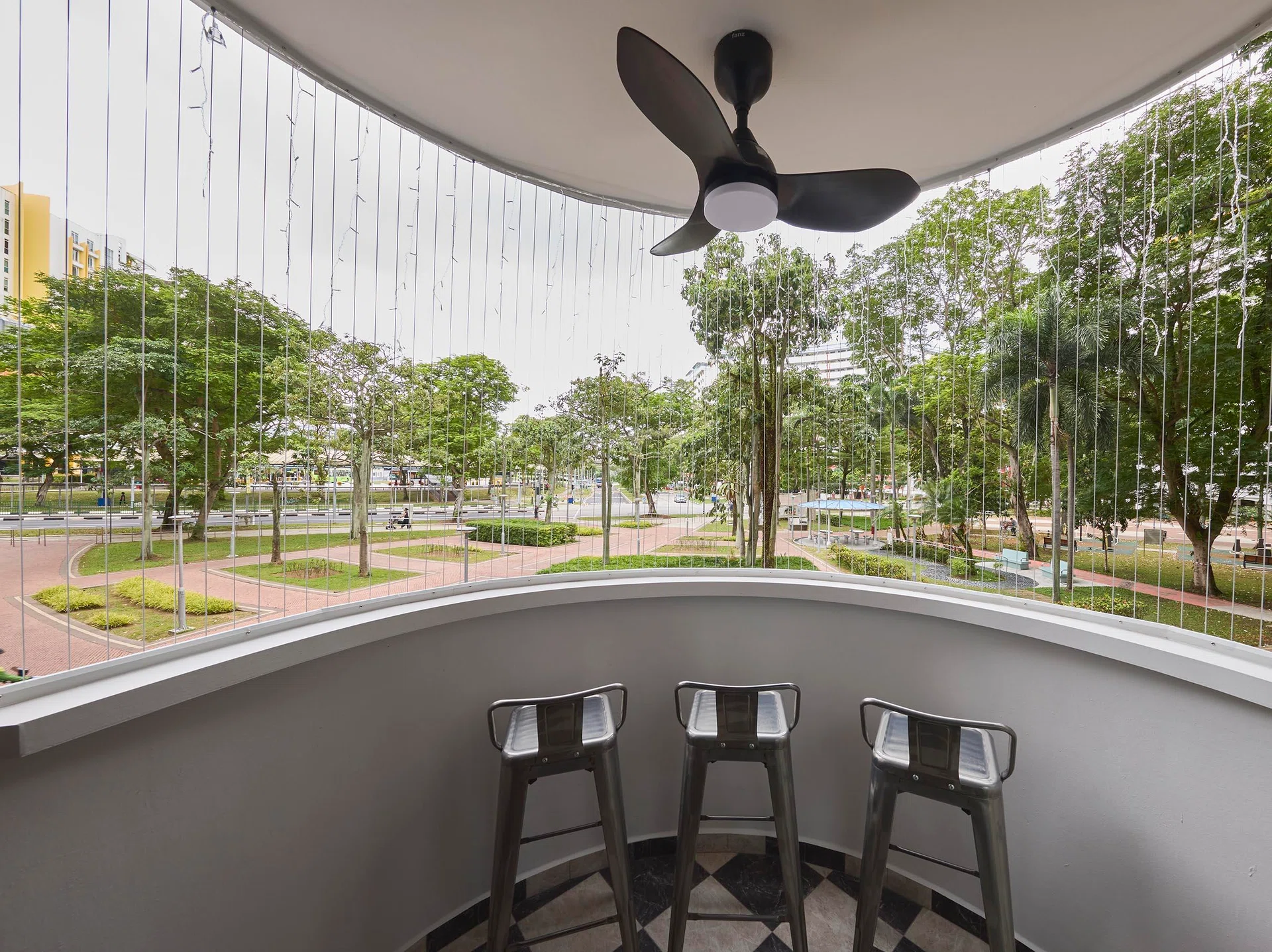
The day often begins at the balcony. Three stools line the curved ledge, set just high enough to overlook the small park below. A steady rhythm plays out through the day—neighbours exercising, commuters heading to work, and children at play.
“In the morning, before going to work, we drink coffee on the balcony,” says Hafiz. “We look outside. Our balcony is facing the small park so we can see people exercising and rushing to work.”
“When the kids play downstairs, we also stand there,” adds Mayang.
At certain times of the year, the visual offerings change. “During festive seasons, the town council hangs lights, so we can see everything from here,” Hafiz says. “It’s also a good distance away from the road, not too loud and not too quiet.”
Who Lives Here: Mayang and Hafiz, their two children (aged six and three), a helper, and two cats
Home: HDB Executive Apartment in Sembawang
Size: Approx. 1,410 sq ft
Interior Designer: Modern Nest Interior
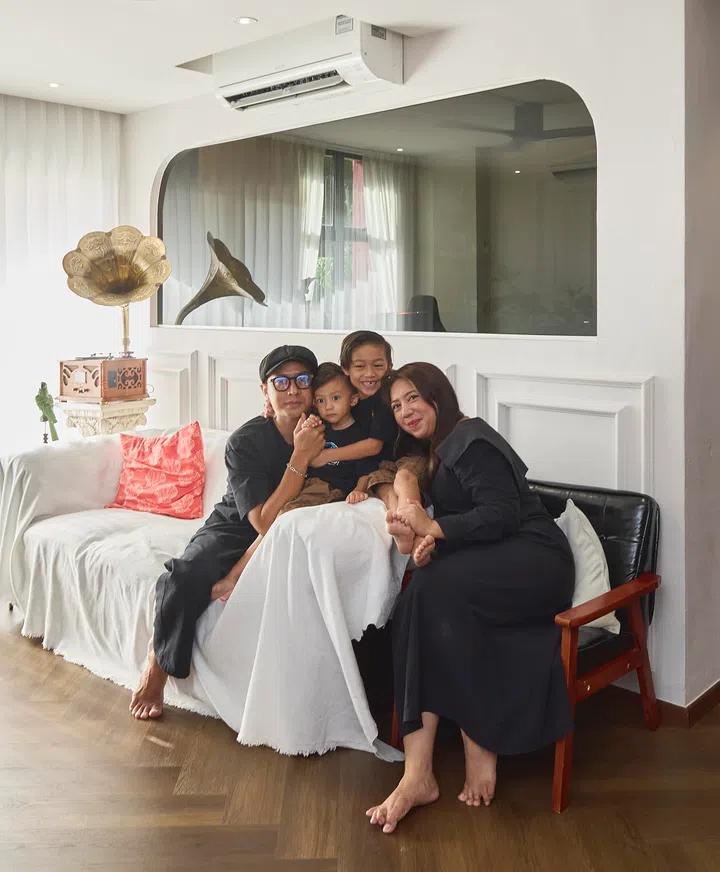
The homeowners with their two children in the living area, where wainscoting and arched openings introduce the home’s layered mix of classical detail and everyday family life.
Lessons from a first home
Set against a backdrop of wainscoted walls and an arched opening into the adjacent room, the family gathers in the living area—a space that already hints at the layered character of the home beyond. Mayang and Hafiz live here with their two young children, aged six and three, their helper, and two cats, in what is now their second home together.
Their first flat, a BTO they moved into shortly after getting married, served them well at the time but came with its limitations. “We were still young, we didn’t have our children back then,” the couple share. “BTO is on the smaller side, and almost all BTO layouts are the same. For renovation and decoration, we couldn’t do much as we didn’t have a good budget to start from.”
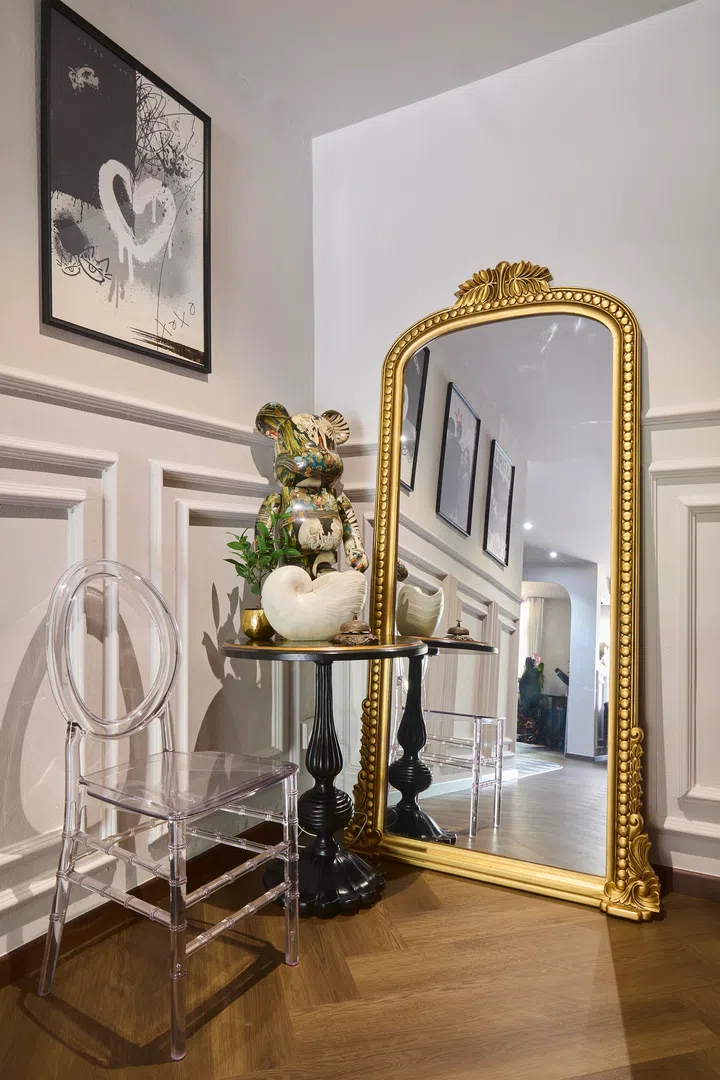
A vignette near the entry layers vintage finds with classical wall mouldings, offering an early glimpse of the homeowners’ evolving, collected approach to the space.
HDB Executive Apartment
Over time, as their family grew, so did their expectations of what a home could offer. Space became a practical need with two children, pets, and a helper, and design became something more considered, shaped by lived experience rather than aspiration alone.
“Everything we learnt from the old place, we rectified it here,” Mayang adds. “Previously I didn’t think about where to put the dishes, where to put the plates… this time I made sure we had a proper place for everything.”
The move to this HDB executive apartment in Sembawang was guided as much by these lessons as by a few non-negotiables. “One of the things we really wanted in the first home, which we didn’t have, was a balcony,” Mayang says. That requirement, combined with proximity to transport, schools, and amenities, made this unit an easy decision.
For Hafiz, the expanded footprint sealed it: “Our family is growing… so we needed a bigger space. This place has the fourth bedroom.”
That additional room is already being reimagined as something more than just another bedroom. “We have the intention to create it into a studio,” Mayang shares. “A space where we can run our brand and create… it’s still a work in progress.”
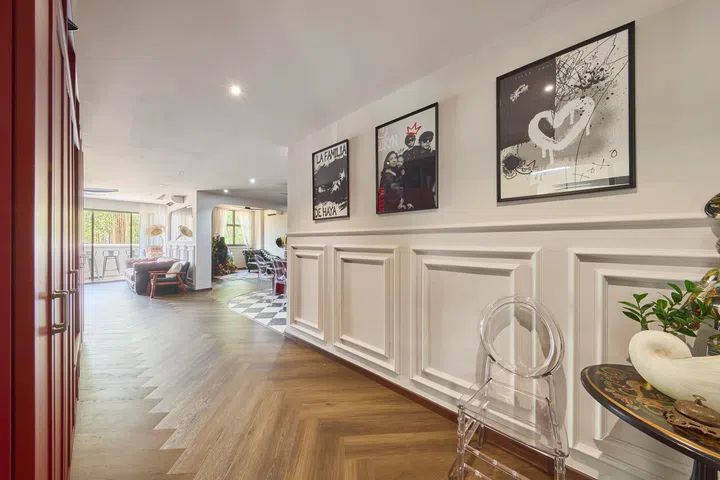
Classical wall mouldings line the entry corridor, layered with artworks created by the homeowners, offering an immediate glimpse into the home’s personal and artistic direction.
A personalised arrival
Stepping in from the entrance, the tone of the home becomes immediately clear. Classical wall mouldings line the corridor, but instead of leaning fully into a traditional look, the surfaces are layered with artworks that feel distinctly personal—many of them created by the homeowners themselves.
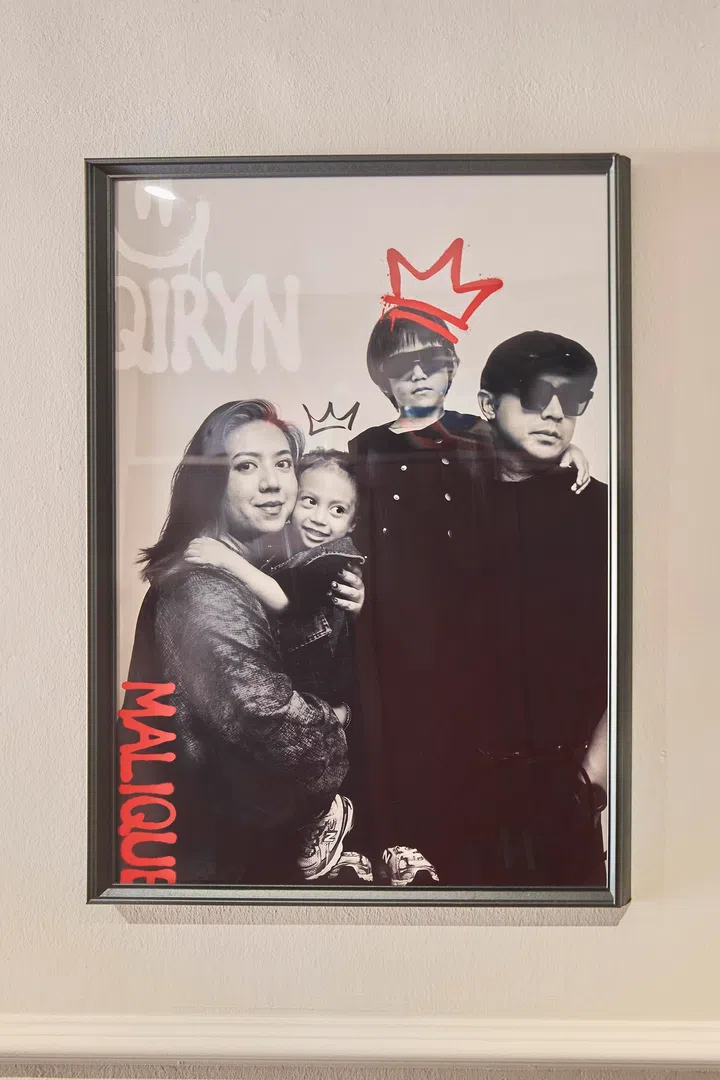
A series of framed works, including pieces by Mayang and Hafiz, introduces the home’s emphasis on self-created art and individual expression.
On one wall, a series of framed pieces sets the visual rhythm for the space. Among them are digital artworks created by Mayang and Hafiz, as well as a family portrait that reinterprets familiar imagery through their own lens.
The couple first met while studying at LASALLE College of the Arts, and that shared foundation continues to shape how they approach their home today. Set against the clean, off-white backdrop, the works establish a visual language that is personal rather than prescriptive, not defined by a single theme but by a layering of influences rooted in their mutual love of art.
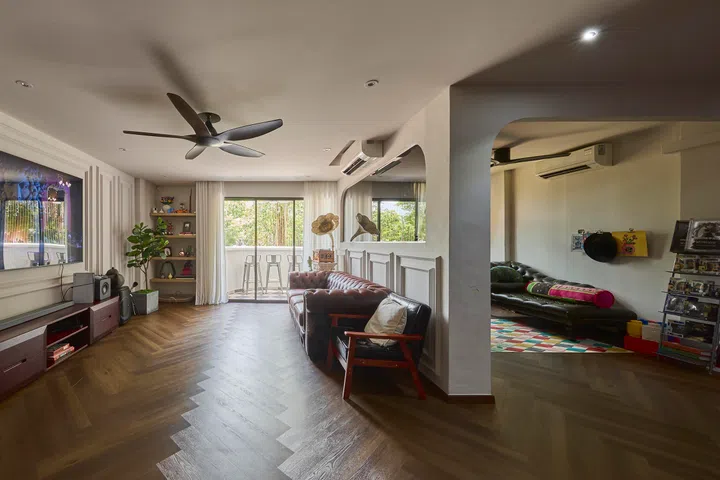
Natural light draws the eye through the living area towards the balcony, where classical wall mouldings meet an eclectic mix of furniture, art, and everyday objects.
A layered living space
From the corridor, the home opens into a generous living area where the classical envelope gives way to a more expressive mix of styles. Wainscoting continues along the walls, but the furnishings and objects introduce a different energy—one shaped by the couple’s varied interests in art, vintage pieces, and subcultural references.
“We have a lot of mix of interests which includes art stylings, gothic, a bit of rock n roll and punk and also vintage décor,” Hafiz shares. “So there’s a mix of modern, classic, vintage, punk… here and there.”
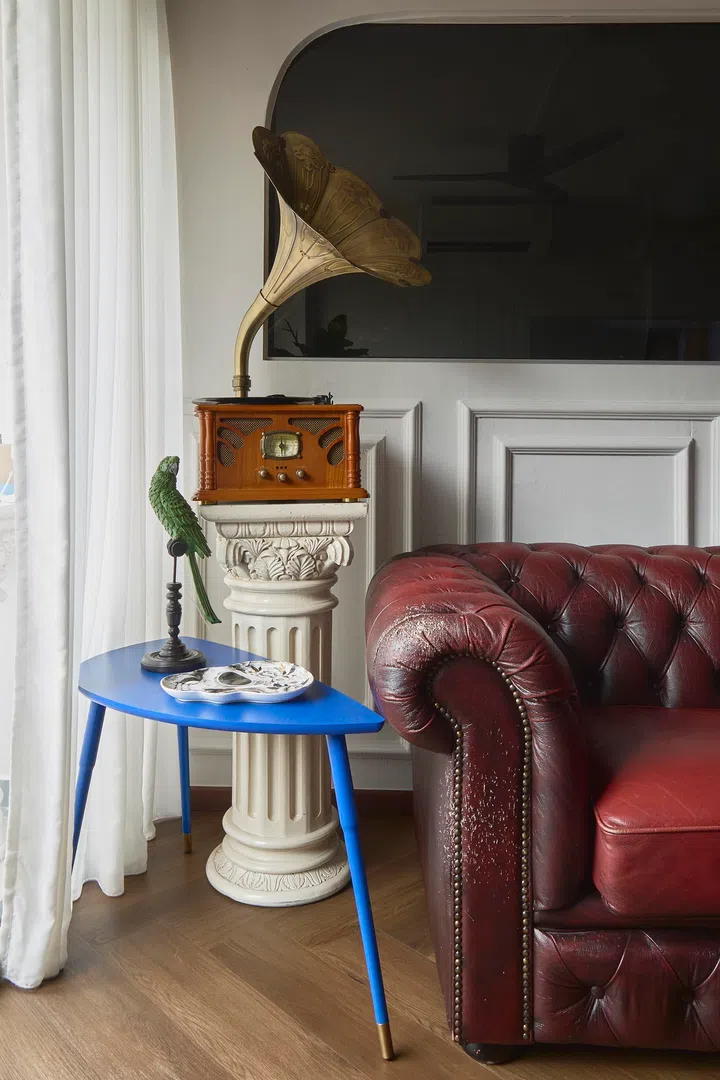
A gramophone displayed on a pedestal sourced from Carousell sits beside a Chesterfield sofa chosen for how it ages over time.
At the centre of the space, a deep-toned Chesterfield sofa anchors the room, chosen as much for its ageing quality as for its form. “Those English homes, they love this Chesterfield sofa,” he adds. “We feel that it ages well. Even if it starts to wear out, it contributes to the aesthetics.”
Around it, objects are placed with a sense of play rather than strict styling. A gramophone sits atop a pedestal sourced on Carousell, while nearby surfaces carry an evolving mix of decorative pieces.
“Our home is constantly changing,” Mayang says. “Whenever we want to put floral arrangements, or display something new, we move things around.”
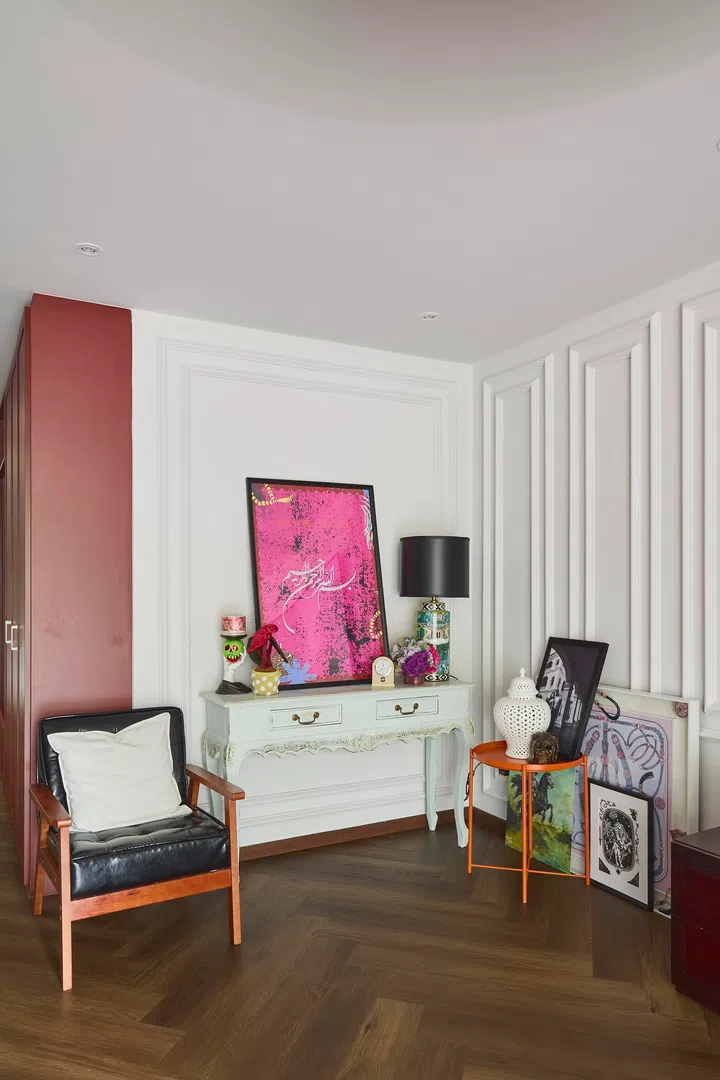
A collaborative artwork by Mayang and Hafiz introduces a bold pop of colour, reflecting their desire to create pieces that align with their own aesthetic.
That sense of personal authorship is most evident in the artworks. A vivid pink piece displayed against the wall is a collaboration between the couple, created in response to a gap they felt in what was available.
“We wanted to have Islamic art in the home, but none of the ones outside matched our vibe or personality,” Mayang explains. “We wanted something different, so we did that.”
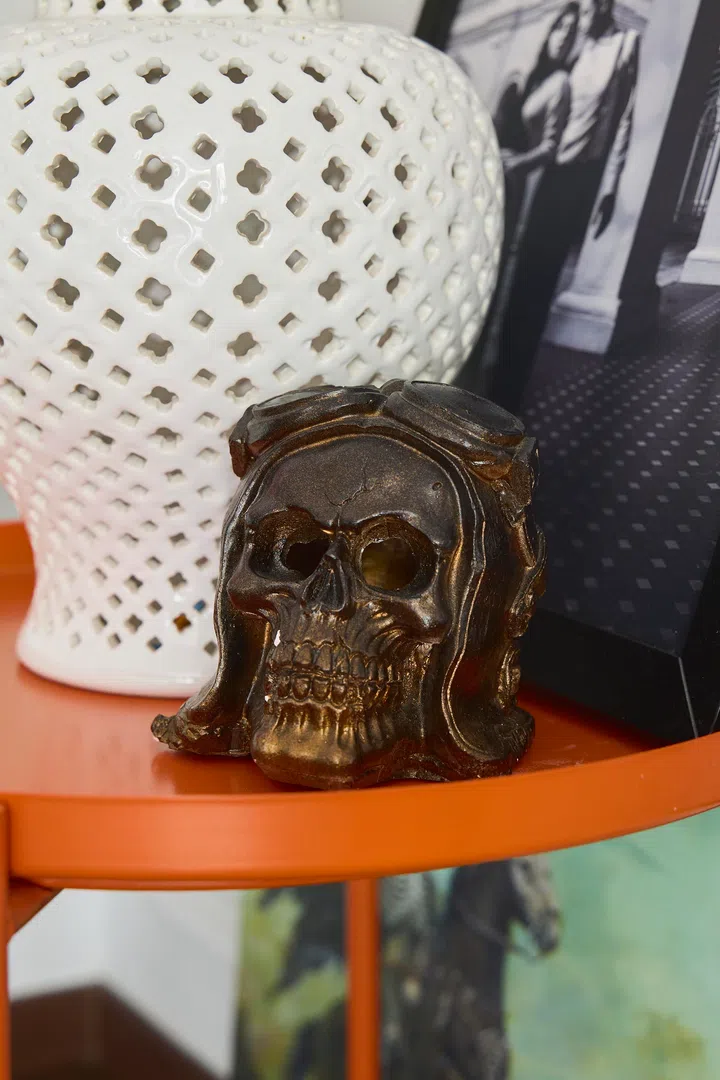
Skull motifs appear subtly throughout the home, a nod to the couple’s interest in gothic and punk influences.
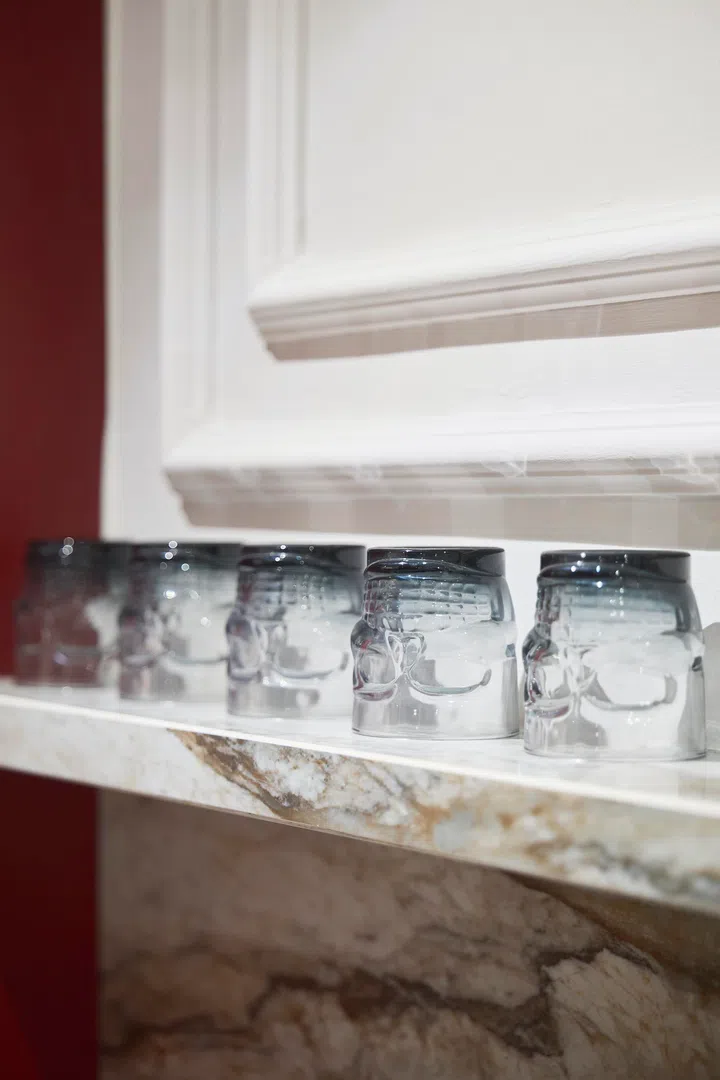
Skull-shaped glassware continues the recurring motif, integrated into everyday use rather than treated as purely decorative.
Running quietly through the space is another recurring motif: skulls. They appear in small, unexpected ways—on shelves, in objects, even in glassware—forming a subtle thread that ties back to their shared interest in gothic and punk influences.
“We both like skulls,” Mayang says simply. “We put skull elements here and there.”
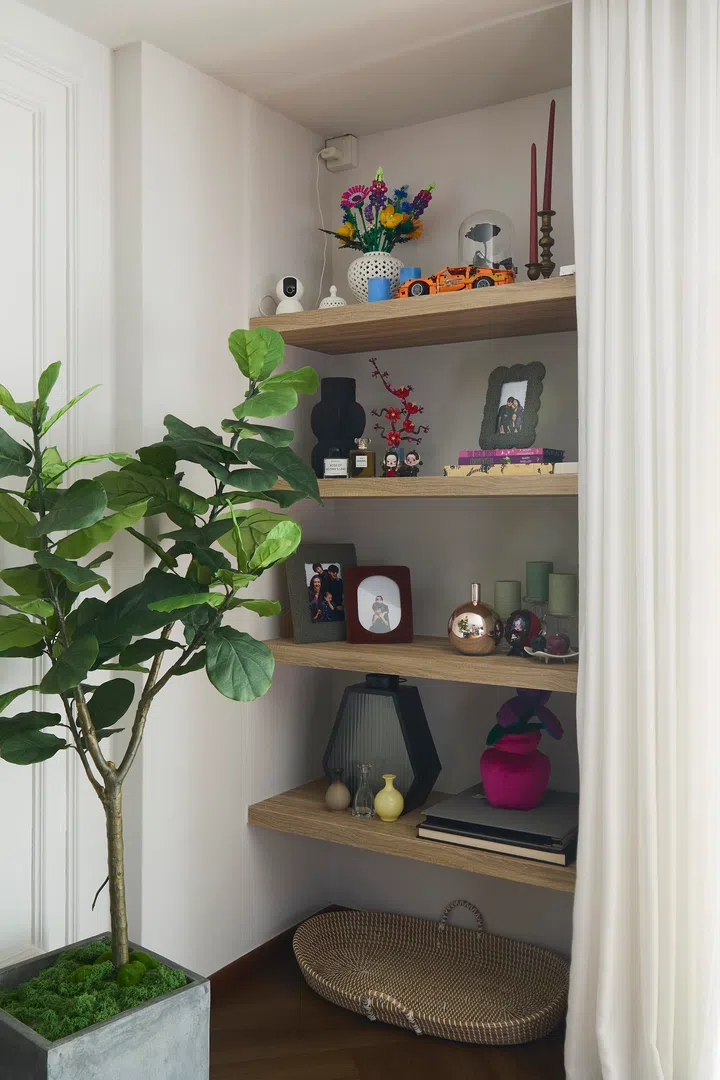
Open shelves display a rotating mix of personal objects, photographs, and collected items, reinforcing the home’s constantly evolving nature.
Together, these layers of classical detailing, vintage forms, and highly personal objects give the living room its character. It is not a space defined by a single style, but one that reflects the homeowners’ evolving tastes and the things they choose to live with.
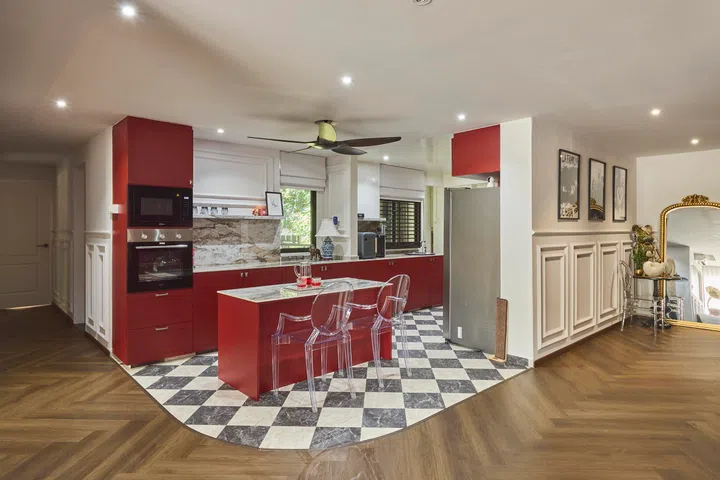
The kitchen introduces a bold burgundy palette, with a central island that doubles as the family’s everyday dining area.
Where it all comes together
Moving past the living area, the palette shifts decisively. The off-white shell gives way to a rich burgundy kitchen, where colour, material, and layout come together in a way that is both deliberate and highly lived-in.
At the centre of the space, the island doubles as a dining area. Slightly lowered to accommodate standard dining chairs, it becomes the family’s primary spot for meals. “We have breakfast here, and dinner here,” Mayang says.
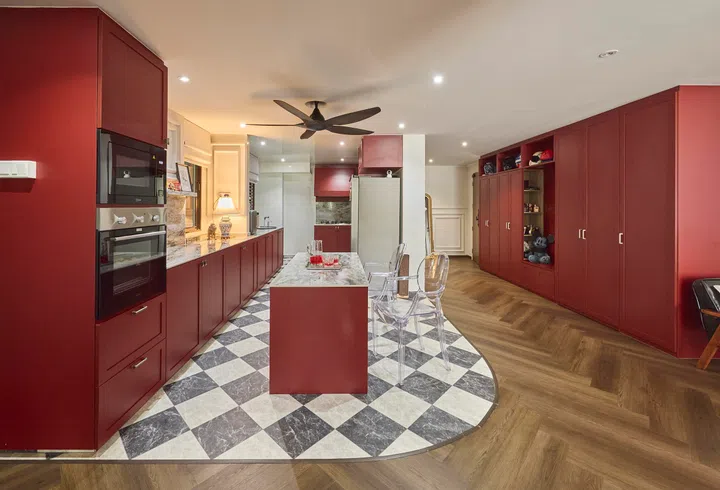
A curved transition marks the shift from herringbone vinyl flooring to checkerboard tiles, defining the kitchen without enclosing it.
“We didn’t want to be afraid of colour,” she smiles. “If we’re going to do colour, we’re going to do all of it.” That commitment plays out fully here, from the cabinetry to the enveloping tone of the space, set against a checkerboard floor that immediately distinguishes the kitchen from the rest of the home.
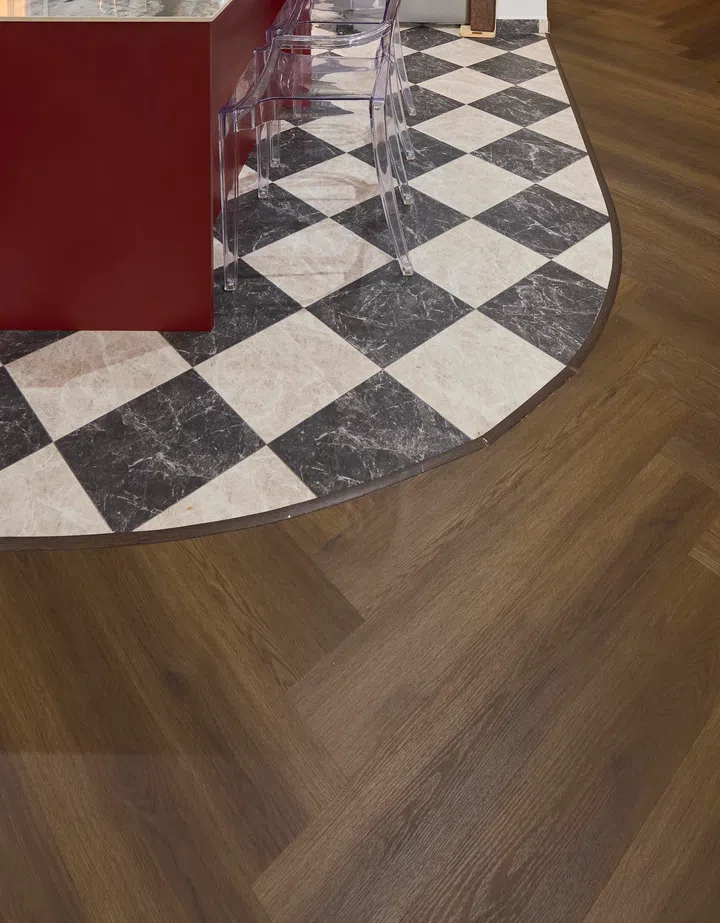
The junction between herringbone vinyl and checkerboard tiles is executed in a soft curve, requiring close coordination between trades.
What makes the transition particularly striking is how the flooring changes. The herringbone vinyl of the living area does not meet the tiles in a straight line, but in a soft curve that wraps around the kitchen zone. It is a small move, but one that required careful coordination.
“It’s tricky,” Shariff, founder of Modern Nest Interior, explains. “The vinyl is herringbone, so we had to work with the tilers to make sure they cut nicely, and with the vinyl vendors to make sure they place it right—how to join the two materials in a curved manner.”
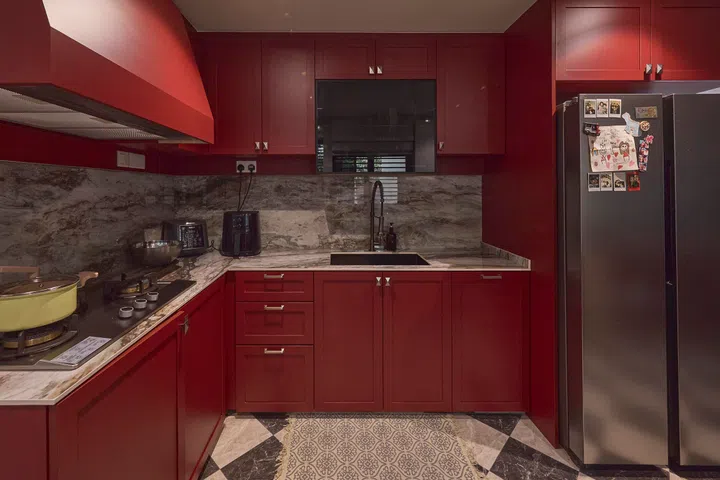
Full-height cabinetry maximises storage, shaped by the homeowners’ experience from their previous home.
Beyond the visual impact, the kitchen also reflects the couple’s attention to function—much of it informed by what didn’t work in their previous home.
Storage is more considered, surfaces are more usable, and everyday needs are integrated into the design. Even the cat litterbox is concealed within the carpentry, tucked behind a small arched opening. “We worked with Shariff to make a hidden litterbox for the cat,” Hafiz says.
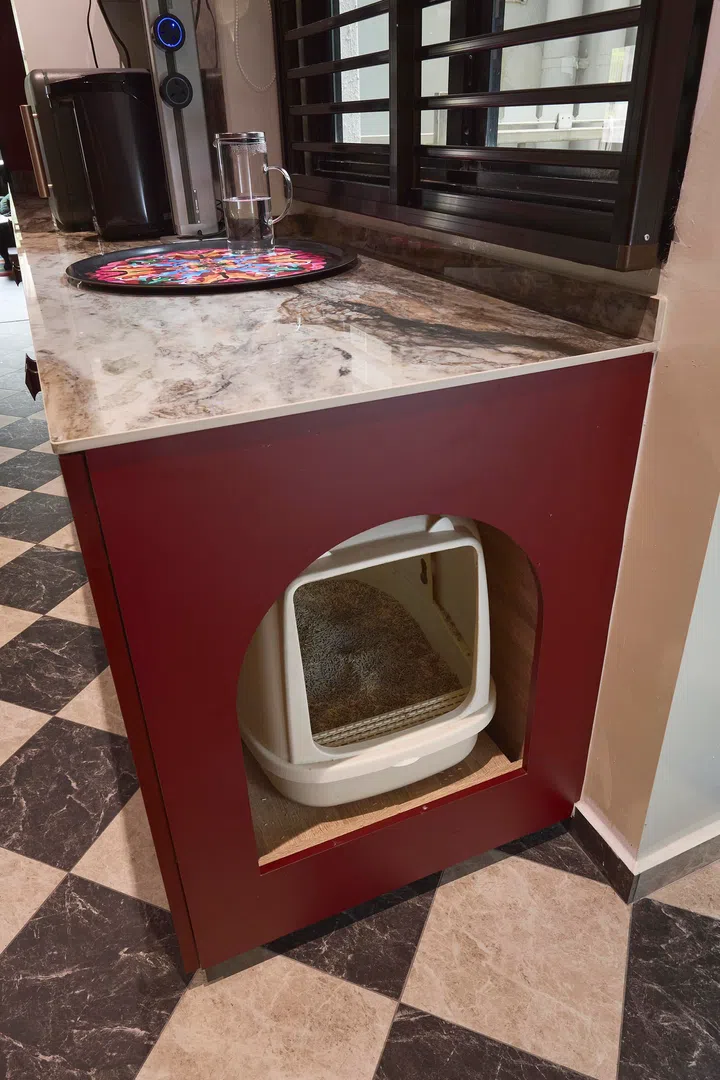
A concealed litterbox is integrated into the kitchen carpentry, accessed through a small arched opening.
Some elements emerged through the process rather than being pre-planned. The sintered stone used for the countertop and backsplash, for instance, was introduced on Shariff’s recommendation to balance the intensity of the burgundy.
“I advised them to go with white or off-white so that everything else pops,” he notes.
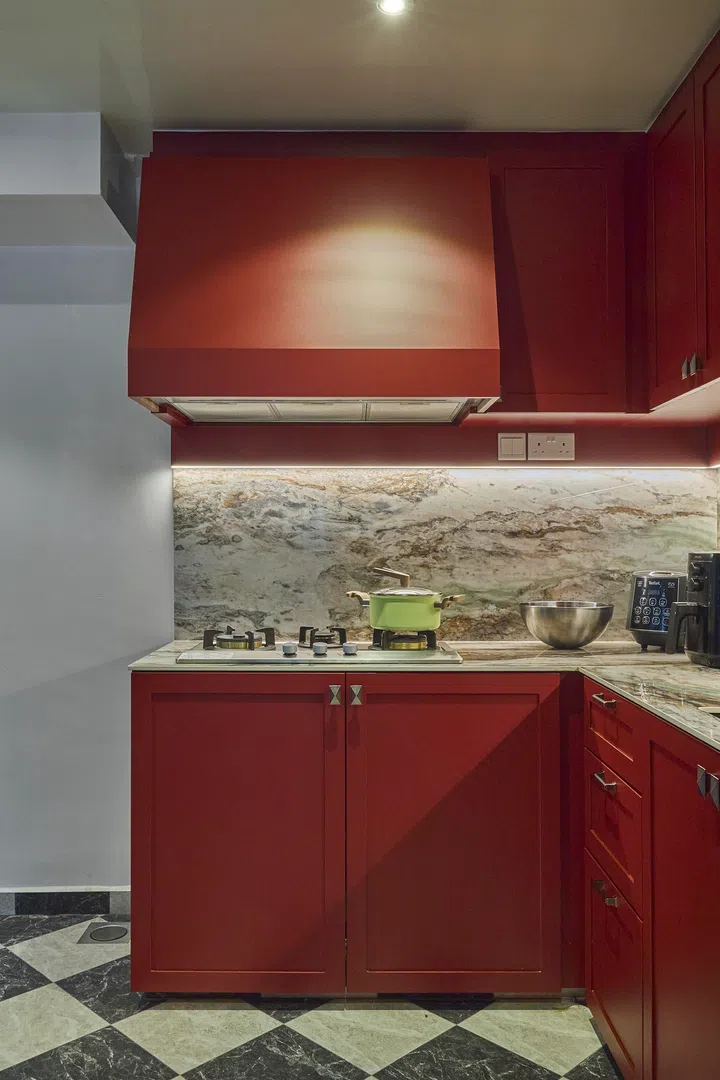
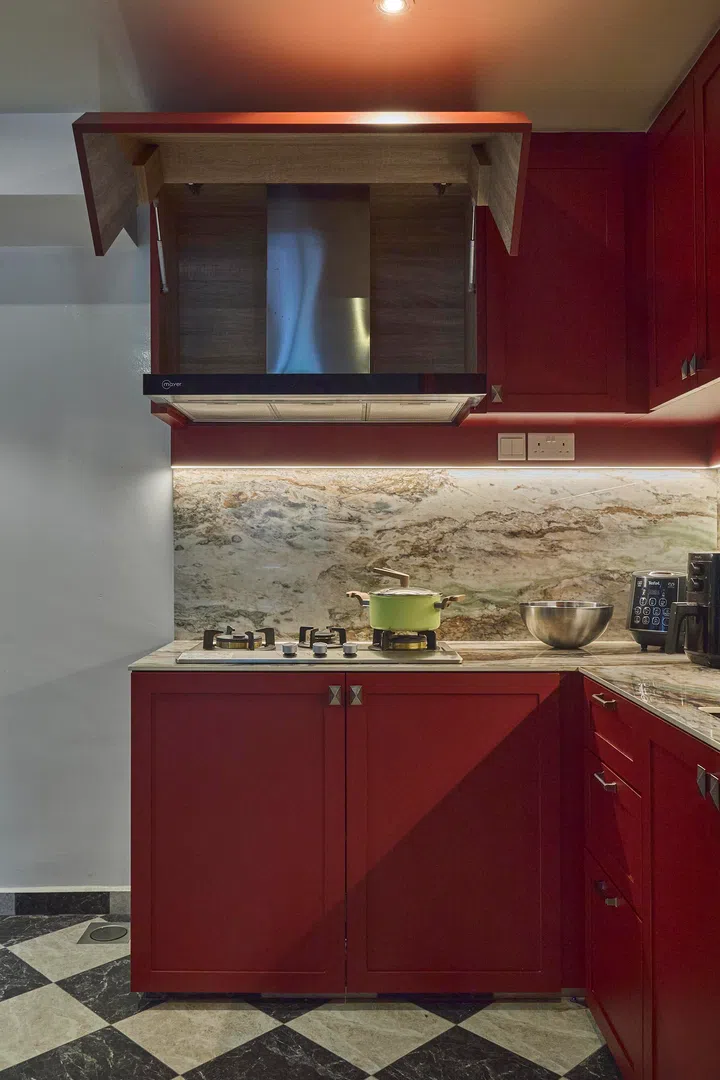
A hidden hood reveals itself when in use, combining function with a seamless exterior.
Other details reflect the homeowners’ preferences more directly. The chimney hood, for example, is concealed within custom carpentry—a request Shariff had not executed before. “It was a challenge and a good opportunity,” he says. “The first time we did this.”
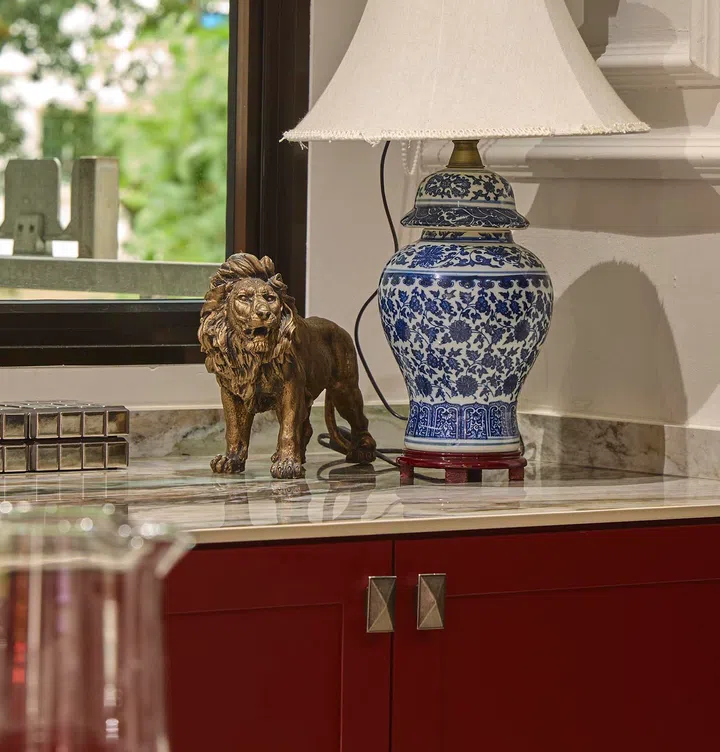
Everyday objects, such as a lion figurine placed on the countertop, contribute to the home’s layered and lived-in character.
Small objects continue to carry meaning here as they do elsewhere in the home. A brass lion figurine sits on the counter, one of the pieces the couple brought back from their honeymoon.
“It’s brass and very heavy,” Mayang says. “I really love it. The piece I will never let go of, I love it so much.” Placed within everyday reach rather than set apart, it becomes part of the kitchen’s daily rhythm—less a display, more a constant presence within the space.
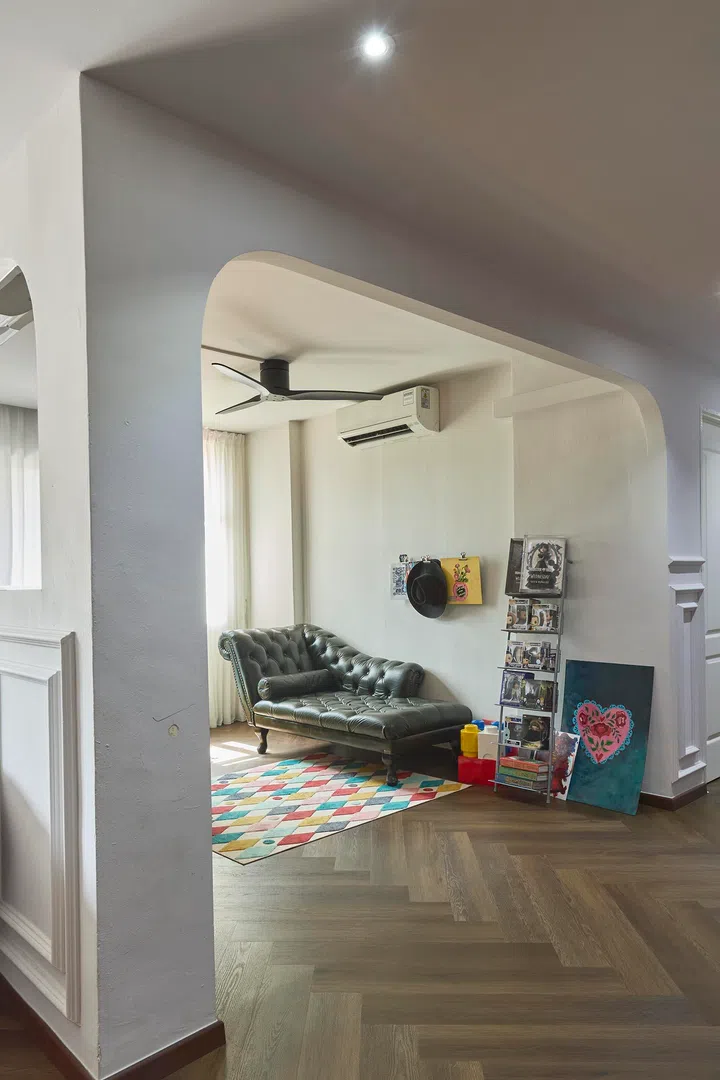
An arched opening defines the fourth bedroom, keeping it visually connected to the living area while setting it apart as a workspace.
A room that will keep evolving
Framed by a soft arch, the fourth bedroom sits just off the main living area—visually connected, yet clearly defined as its own zone. From the outset, Mayang and Hafiz intended for this room to function as more than a spare space.
“For the fourth bedroom, we had the intention to create it into a studio,” Mayang shares. “We are working to change it into a creative space that we can run the brand and whatever we create and decide to put out there for people. Right now it’s kind of like a home office, it’s a work in progress. I take photos and TikTok videos out of this studio also.”
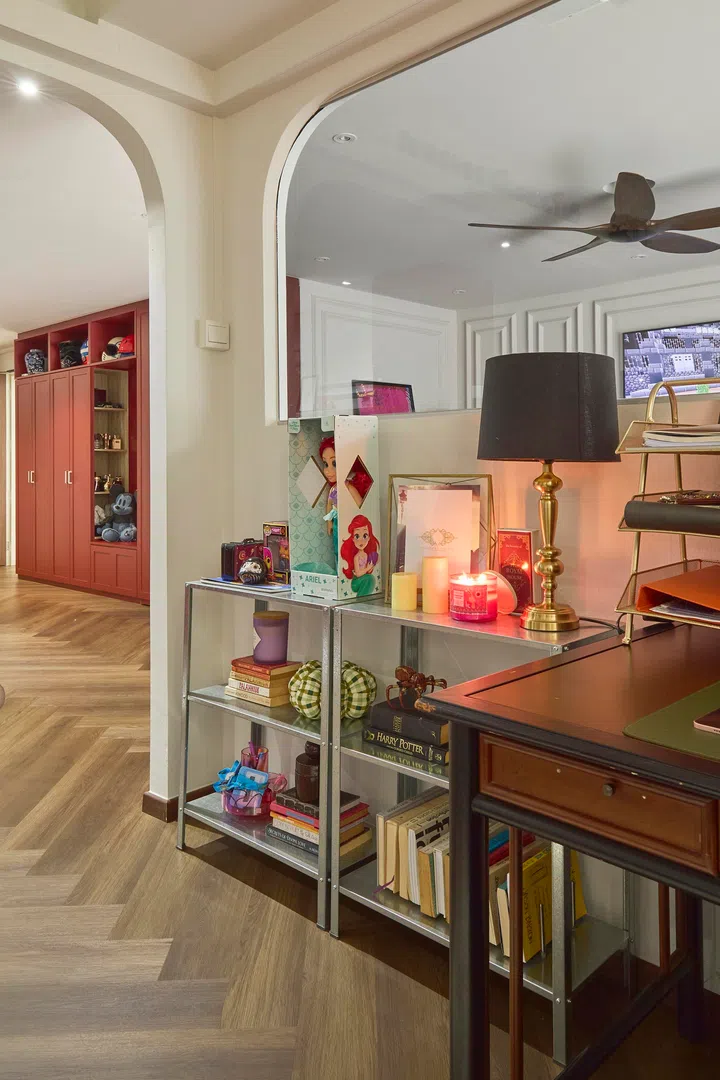
Used as both home office and studio, the room supports the couple’s business, content creation, and everyday creative work.
Inside, the room is arranged as a hybrid of workspace and display. A writing desk anchors one side, while open shelving holds books, objects, and small personal items. Artworks—some finished, some still in progress—lean casually against the wall, reinforcing the sense that the space is still evolving alongside the couple’s practice rather than being fixed in place.
A tinted glass opening maintains a line of sight back into the living room. “If we are working inside and the kids are outside, we can still see them,” Mayang explains. The move reflects a broader approach across the home, where spaces are defined without being fully enclosed.
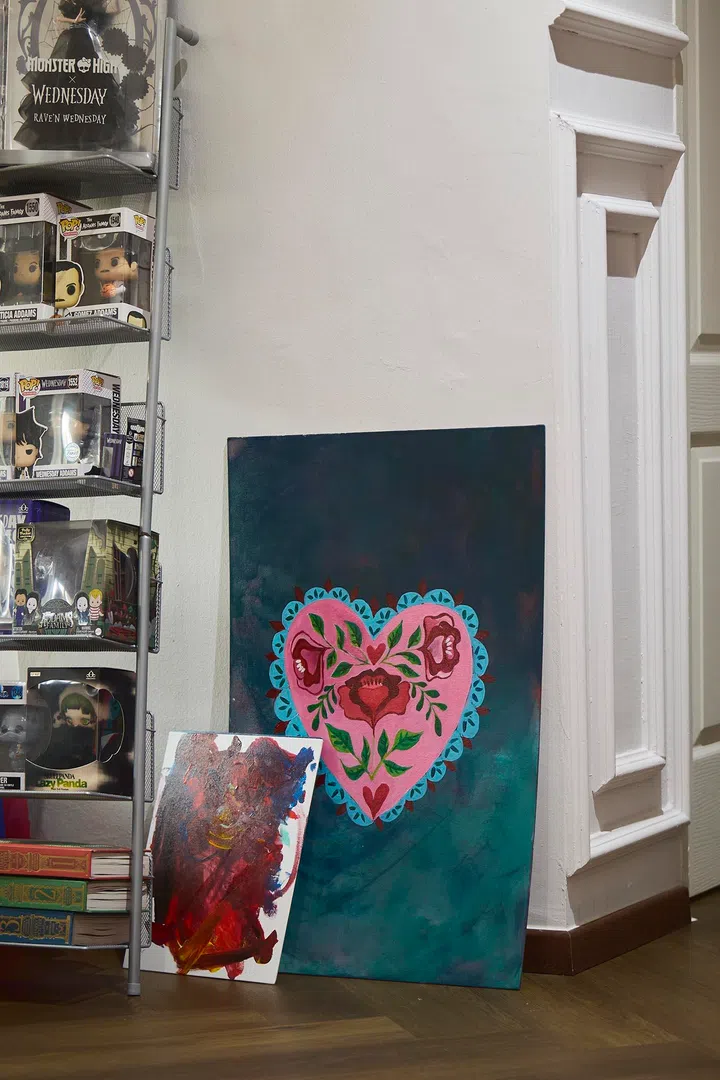
Artworks—some completed, others still in progress—are layered into the space, reflecting an active and evolving creative practice.
From a planning standpoint, this openness required adjustments during the renovation.
“The study is an open concept, so we had to reposition the aircon to make the ceiling work,” says Shariff. “Once we aligned on that, everything went smoothly.” Completed within five weeks, the project relied on quick, coordinated decisions to keep the build on track.
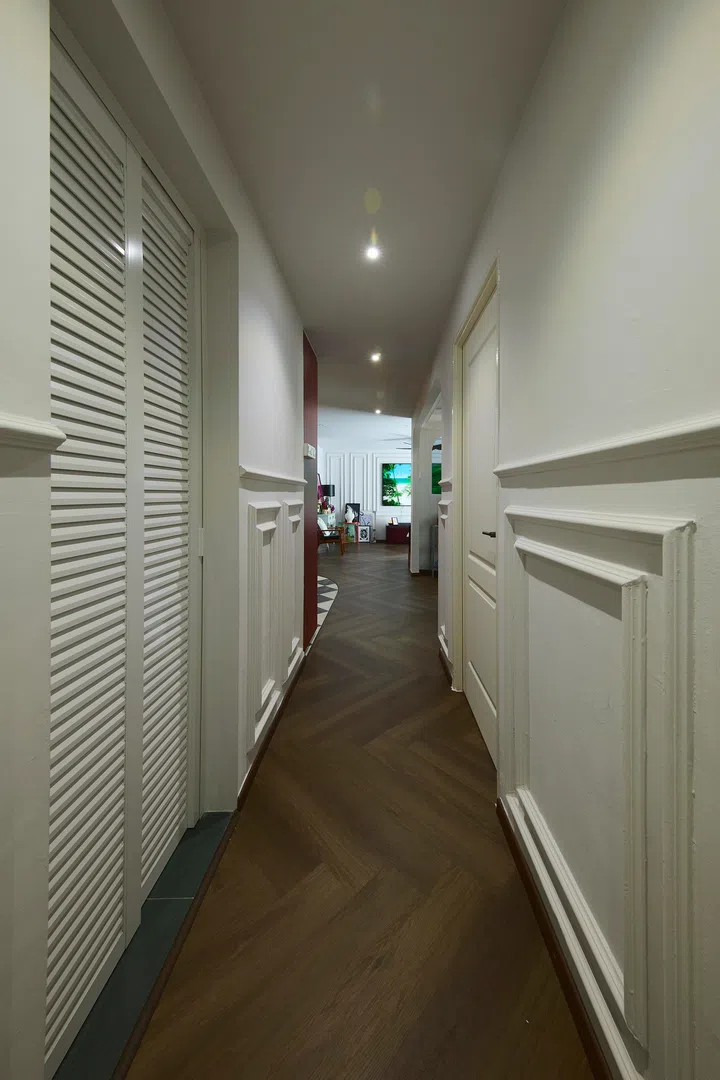
Beyond the studio, the corridor continues the home’s classical detailing, leading towards the more private areas of the house.
Stepping back out, the corridor continues the same language of wall mouldings and herringbone flooring, drawing the eye further into the home. From here, the spaces transition towards the more private rooms beyond.
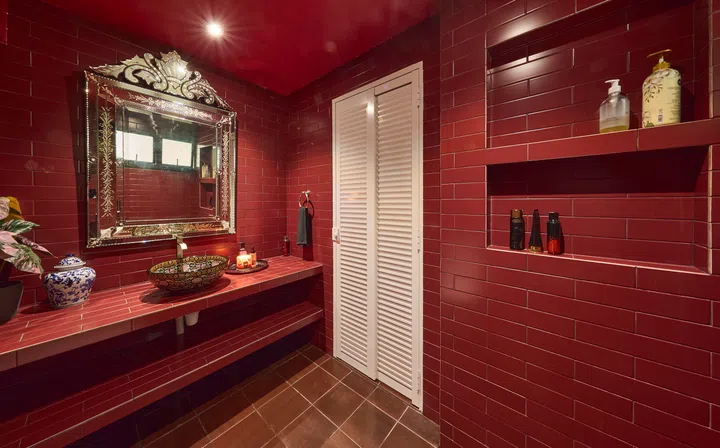
The master bathroom is fully drenched in deep red, with tiles extending across walls and ceiling to create a cocoon-like space.
Full colour commitment
The bathrooms depart most clearly from the home’s otherwise restrained base, each conceived as a fully immersive space. Rather than using colour as an accent, both rooms are entirely drenched—walls, floors, and ceilings treated as a continuous surface.
In the master bathroom, deep red tiles wrap the room from end to end, extending up onto the ceiling to create an enveloping, almost cocoon-like atmosphere.
“If the walls and floors are green, but the ceiling is white, the mood is not going to come out,” Mayang explains of their approach, which was applied consistently across both bathrooms. Here, the same logic results in a space that feels intentionally dark and contained, rather than fragmented.
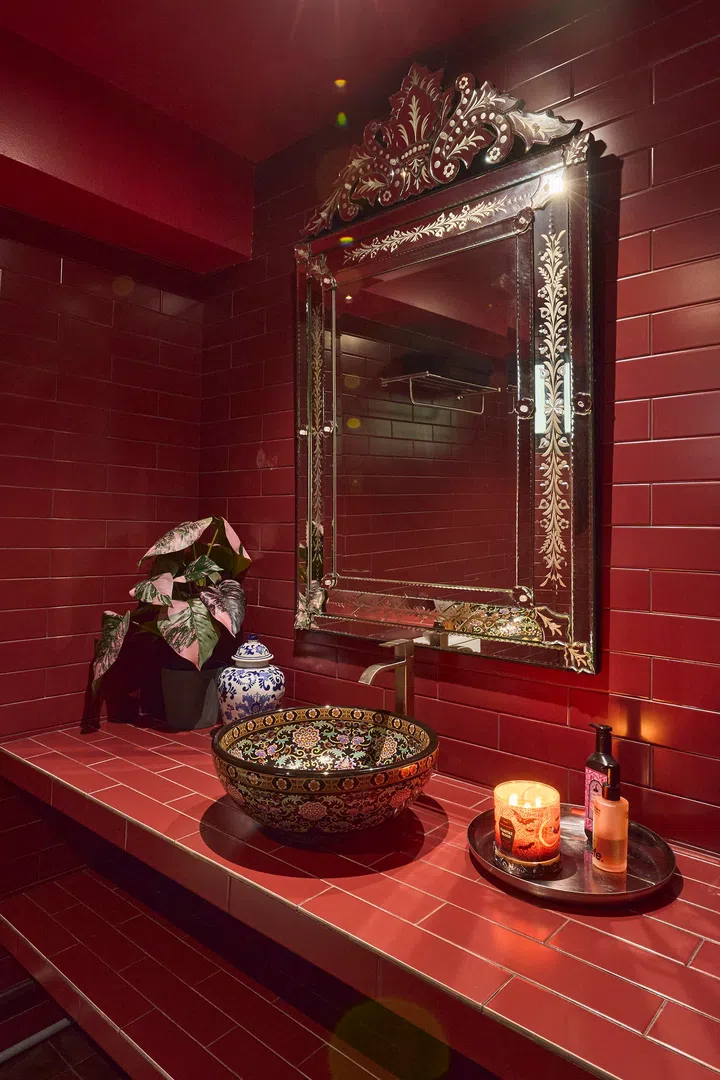
A porcelain vessel sink and ornate mirror introduce contrast against the richly tiled backdrop.
For Shariff, the execution was as challenging as it was unfamiliar. “It was the first time we used small tiles for the toilet,” he says. “I was quite worried that it would turn out too dark.”
The process itself required precision, with the smaller tile format taking more time to lay evenly across multiple surfaces. But the result exceeded expectations. “When the tilers finished, I was like—wow. It turned out so nice.”
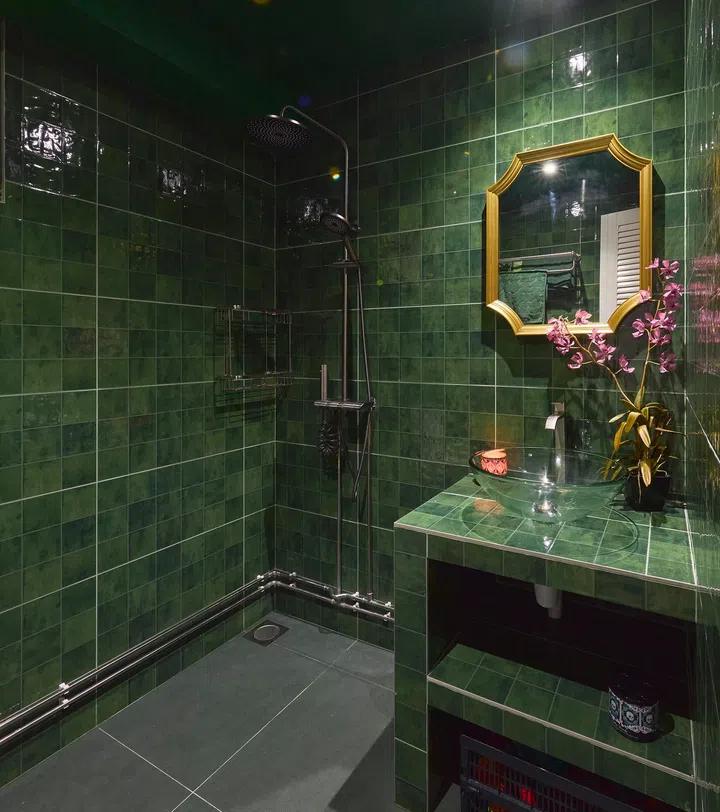
The second bathroom shifts to deep green tiles, creating a distinct mood while maintaining the same immersive approach.
Second Bathroom
The second bathroom shifts the palette entirely, moving into deep green tiles that evoke a different kind of mood. When first shown the reference, Shariff recalls his initial reaction: “I asked them, are you a fan of Harry Potter? Because one looks like Slytherin and the other like Gryffindor. And they were like ‘yup’. They wanted to achieve that concept.”
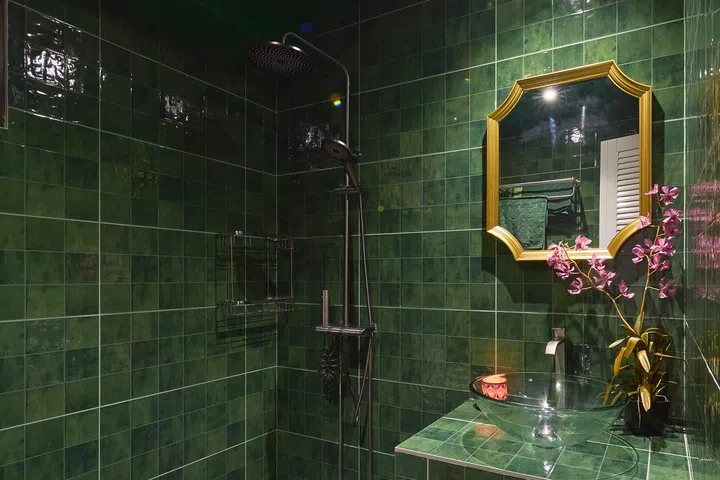
Tiles wrap every surface, allowing tonal variation and simple fittings to define the space.
Despite the intensity of colour, the detailing remains carefully considered. In the red bathroom, a porcelain vessel sink sits against a tiled ledge, paired with an ornate mirror sourced separately. In the green bathroom, a softer contrast emerges through the use of a framed mirror and simple fittings, allowing the tonal variation of the tiles to take focus.
Across both spaces, the decision to extend colour across every surface transforms what could have been standard bathrooms into highly specific, atmospheric rooms—each one distinct yet aligned in intent.
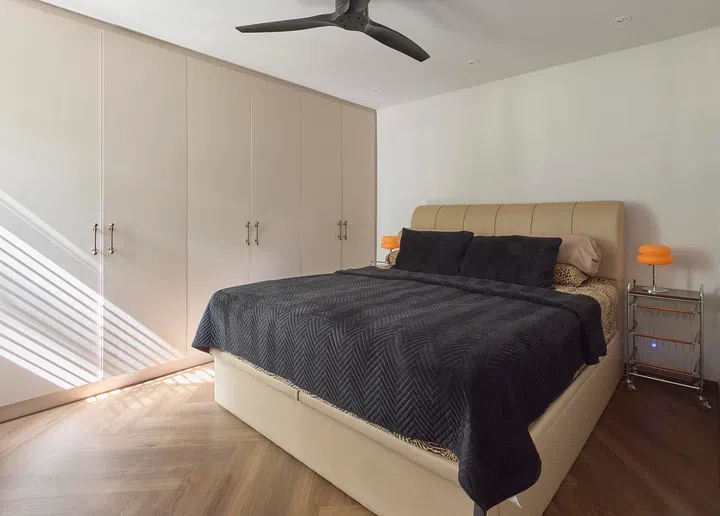
The master bedroom is kept simple and uncluttered, with built-in storage and a neutral palette for rest.
A quieter retreat
In contrast to the more expressive communal areas, the bedroom is kept pared back and functional. Built-in wardrobes line one wall, while the same herringbone flooring continues through the space, maintaining visual continuity with the rest of the home. The palette is restrained, with soft neutrals and simple furnishings allowing it to function primarily as a place of rest.
For Mayang, the sense of retreat extends beyond the bedroom itself. “I like our toilet. Master toilet. The reason why I love it is because I get to escape from the kids,” she laughs. “It’s big enough, doesn’t feel suffocating even though it’s dark red. It’s just my escape.”
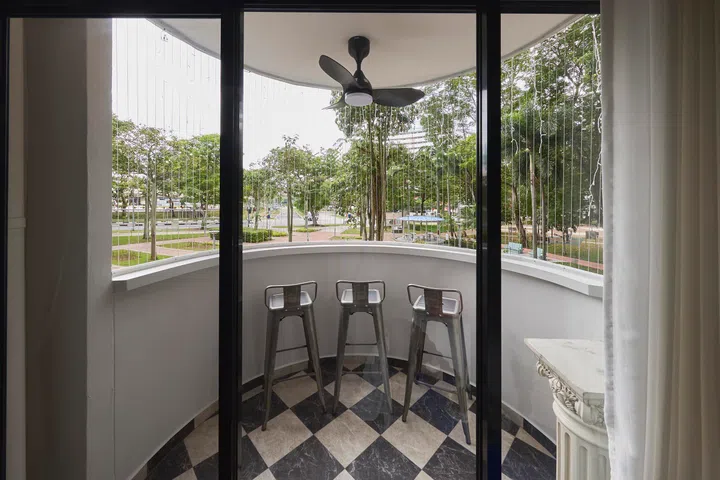
Framed by the living room, the curved balcony remains a daily touchpoint used for morning coffee, quiet observation, and time watching their children play below.
Over $100,000 Renovation Cost
Completed in just five weeks, the renovation was delivered at a pace that is unusually tight for an executive apartment’s full overhaul. The scope included full hacking, new flooring throughout, custom carpentry, two fully tiled bathrooms, and a house-wide false ceiling with downlights—requiring close coordination from start to finish.
For Shariff, the speed came down to clarity. “I told them I can do it, as long as we finalise everything from the start,” he says. “It’s not the rushing that causes problems—it’s the decision-making.” Working with a team he has collaborated with for years, the project was completed on schedule, even as details were resolved along the way.
The homeowners describe the process as intense but smooth. “Honestly, the biggest issue was time,” Mayang says. “The pressure was there but everything went well,” Hafiz adds, “No renovation will be perfect, but for us so far it was smooth. Most important is everything was completed within that five weeks.”
More than the speed, what remains is how closely the home reflects their lives. “What really makes it our home is every small thing that we and our kids put into the home—the Lego, the lion on the kitchen,” Mayang says. Hafiz agrees: “The renovation look is maybe 30 to 40 per cent. The rest is the styling, which shows the personality of whoever lives in the house.”