
A 30s lady’s $90,000 renovation for her 3-room HDB in Bedok
Original terrazzo, handcrafted tiles, and considered colour choices come together in a home designed to evolve with its owner over time.
By Gwyneth Goh -
Share this article
The first thing you’d notice is not the furniture, but the floor. At the threshold, patterned tiles meet the home’s original terrazzo in a deliberate, almost quiet gesture, one that signals how this flat would be approached. Rather than erase what was there, the renovation builds on it, allowing material and memory to coexist from the very first step inside.
“I was particularly taken by the original terrazzo flooring,” says homeowner Jerusha Tan. “I liked that it had a timeless quality, and I wanted to keep as much of it as possible.”
It was this instinct to preserve rather than replace that set the direction for the renovation. Working with interior designer Verena Lim of NAIM Design Studio, Jerusha approached the flat not as a blank canvas, but as something to be built upon—where new elements would sit alongside what was already there, creating a home shaped as much by continuity as it is by change.
“Being a first-time homeowner, I knew mistakes were bound to happen—it was more a matter of whether I could live with them,” she muses. “With Verena, it really came down to trust—in her taste, her expertise, and her ability to deliver. From the very first meeting, she embraced the terrazzo wholeheartedly, and it felt like we shared a similar sensibility.
Who Lives Here: Jerusha Tan, a cultural worker in her 30s
Home: A 3-room HDB flat in Bedok
Size: 721 sq ft
Interior Designer: Verena Lim, NAIM Design Studio
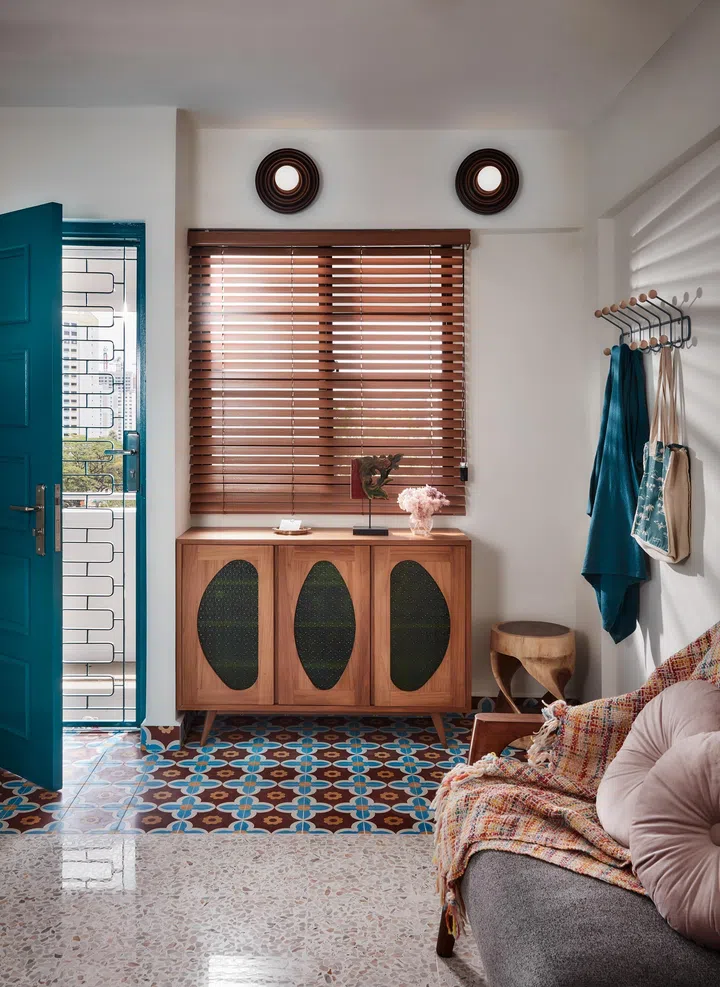
The entry opens directly into the living area, setting a tone of openness from the moment you step inside.
At the threshold
At the entry, the shift is marked underfoot. Patterned floor tiles are introduced at the threshold before giving way to the home’s original terrazzo, a deliberate pairing that signals arrival without enclosing the space. Rather than creating a hard boundary, the two materials are allowed to sit side by side, setting up a language that continues through the rest of the flat.
“Her brief was to keep the aged terrazzo with the original flat. She wanted to mould it with the future design concept without making it look odd,” interior designer Verena Lim recalls. “Instead of making the foyer a small area or in the longish sense, I made it horizontal so it will also pull the senses to feel the house isn’t as narrow as it is.”
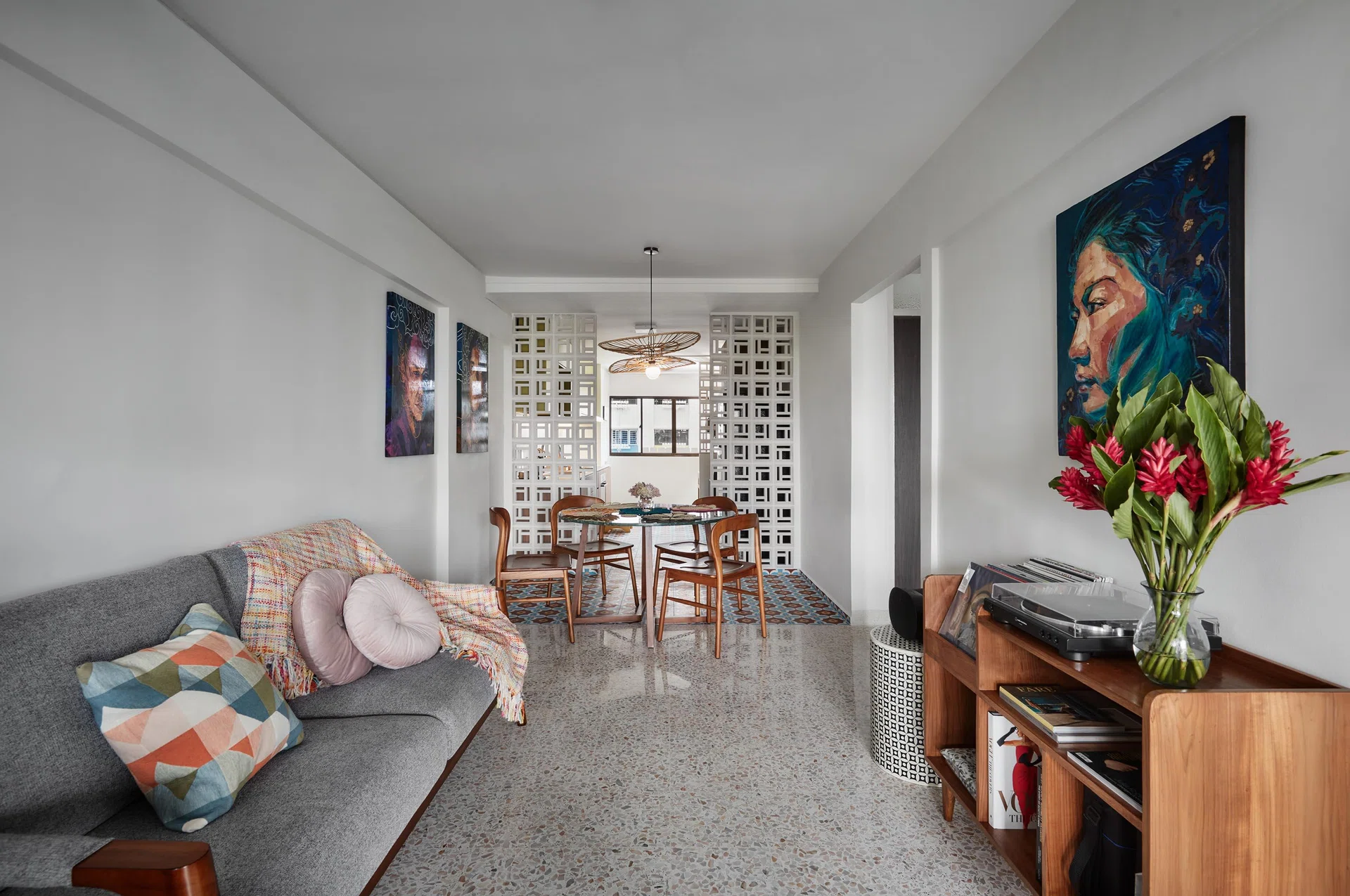
The length of the flat is expressed through a continuous living–dining axis, with spaces unfolding one after another.
A long flat given rhythm
From the living area, the length of the flat becomes more apparent. Rather than breaking it up, the plan leans into this linearity, allowing spaces to unfold one after another with minimal interruption. This sense of openness was part of what drew Jerusha to the unit in the first place. “The flat was completely empty, with white walls and a stunning terrazzo floor, offering a blank canvas full of possibilities,” she says.
That original terrazzo became the foundation for how the space would be organised and experienced. “The terrazzo was a definite non-negotiable—it was just a matter of how much to keep,” she explains. Instead of replacing it, the design works with it, allowing the material to carry through the length of the home and establish a sense of continuity.
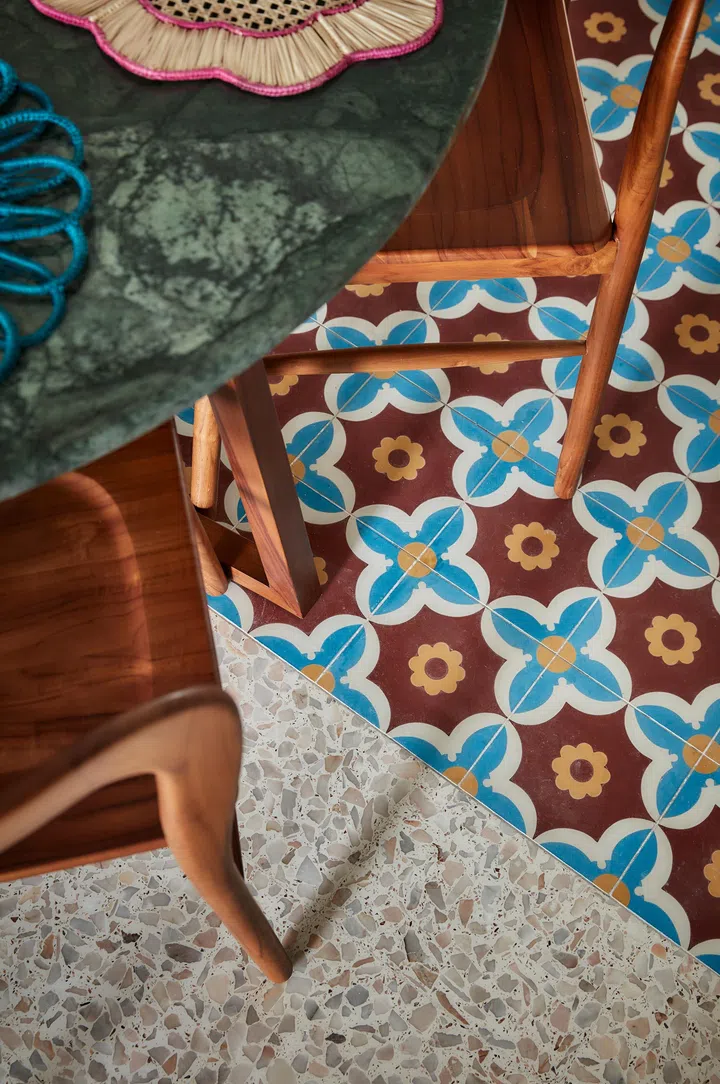
Terrazzo meets patterned tiles at the dining area, where the transition defines the space without enclosing it.
The dining area sits along this axis, where the shift in flooring gathers the space without enclosing it. “Where I wanted to split the tiles was right below the dining table,” says Verena. “When I hacked the floor, it’s quite impossible to replace and patch with terrazzo, so we transitioned to the Peranakan tiles… to create some linkage between the foyer and the inner part of the house.”
For Jerusha, the decision felt instinctive. “The patterned tiles were a bold choice, but I felt confident about the personality and flair they could bring without overwhelming the space,” she shared. “Verena played a big part in that decision—her guidance gave me reassurance about introducing contrast while maintaining balance.”
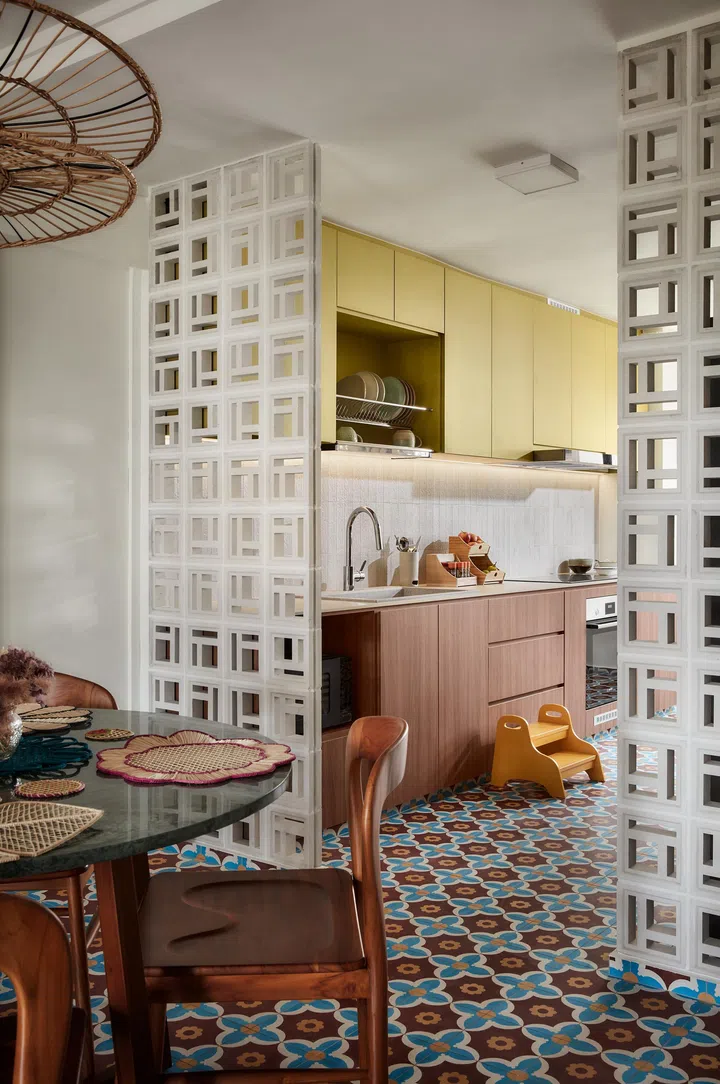
Breeze block screens frame the kitchen beyond, allowing light and views to pass through while maintaining separation.
Breeze blocks and a language of continuity
The transition into the kitchen is marked not by a solid wall, but by a pair of breeze block screens that frame the space without fully enclosing it. They hold the line between rooms lightly, allowing air, light, and views to pass through while maintaining a sense of separation.
“These elements feel familiar in the local design language and reflect a way of living that’s specific to this region,” Jerusha says. “I chose them for their practicality and how they connect to the environment. Much like how five-footways were created to provide shade from the heat, breeze blocks offer privacy while allowing air to flow through the room.”
Verena saw this as part of a broader sensibility that shaped the home. “It’s not about nostalgia,” she says. “It’s about how these elements were part of her life, how they still are, and how they will be.”
That thinking extends to the way materials and colours are used throughout the flat, not as a passing expression but as something intended to hold its place over time. “They had to be items with quality to it—quite sturdy and durable—and also able to hold its weight now and in the future.”
Within the compact footprint of a 3-room flat, the result is a space that feels open but not undefined, where each transition is gently marked rather than enforced.
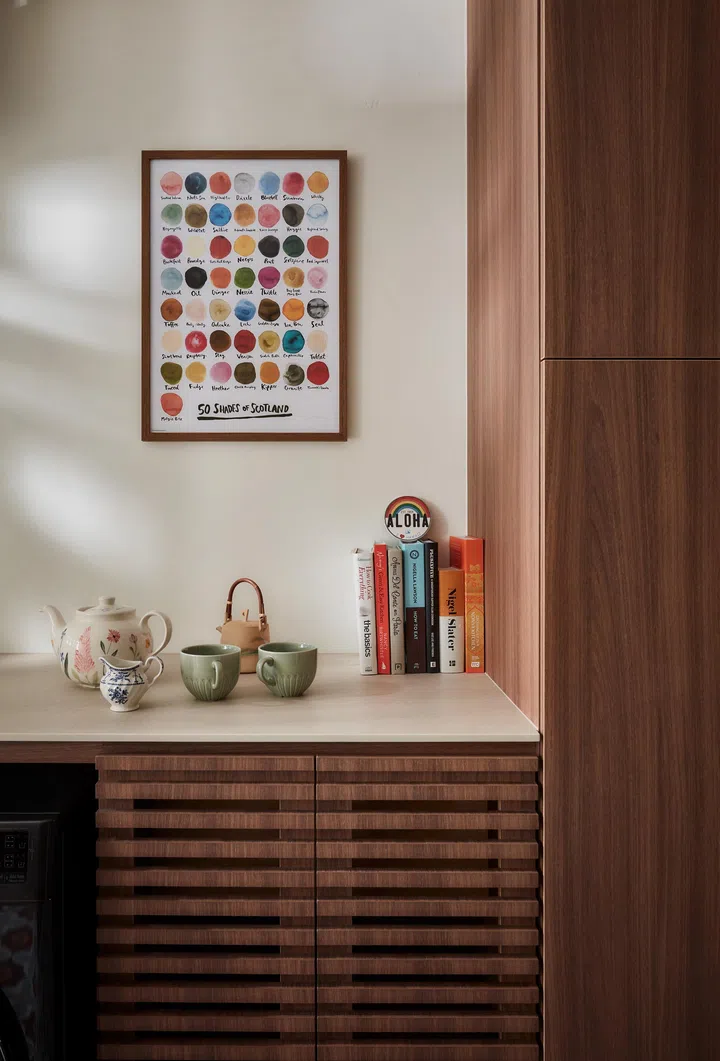
Everyday objects are treated with the same care as materials, chosen for form, function, and how they sit together.
Material, detail, and the everyday
Up close, the material language of the home reveals itself in quieter ways. Surfaces are layered rather than matched—terrazzo set against patterned tiles, timber against stone—each element chosen for how it holds its own while still sitting comfortably alongside the others.
“It’s about choosing elements that complement each other, with a clear sense of intention behind the design,” says Jerusha. “I’m drawn to pieces with form, purpose, and craftsmanship.”
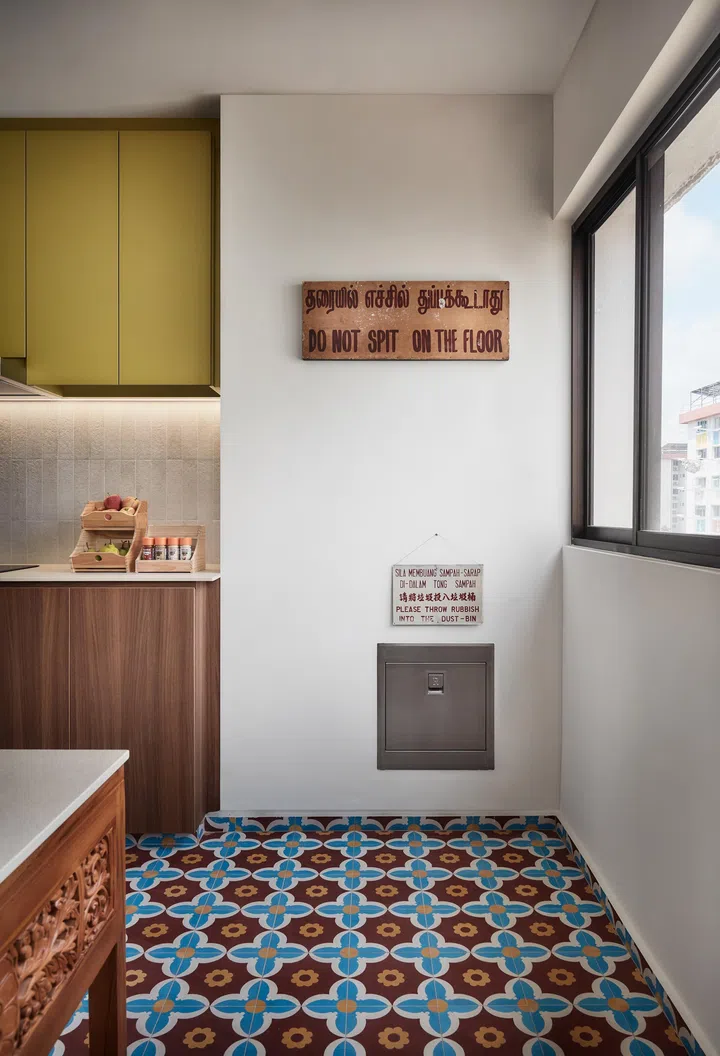
Patterned tiles and timber meet in close detail, reflecting a layered but intentional material palette.
That thinking extends beyond the fixed finishes. Objects and furnishings are approached in much the same way—not as decoration, but as things to be lived with over time. “I sought to bring that sensibility to life by selecting furniture and soft furnishings that could evolve with the space over time,” she adds. “The goal was to create a home that felt grounded and thoughtful, without being tied to trends.”
In the kitchen, this comes through in the pairing of warm wood cabinetry with patterned tiles underfoot, and a softer, muted palette above. The materials do not compete; instead, they build on one another, reinforcing a sense of continuity that runs through the home.
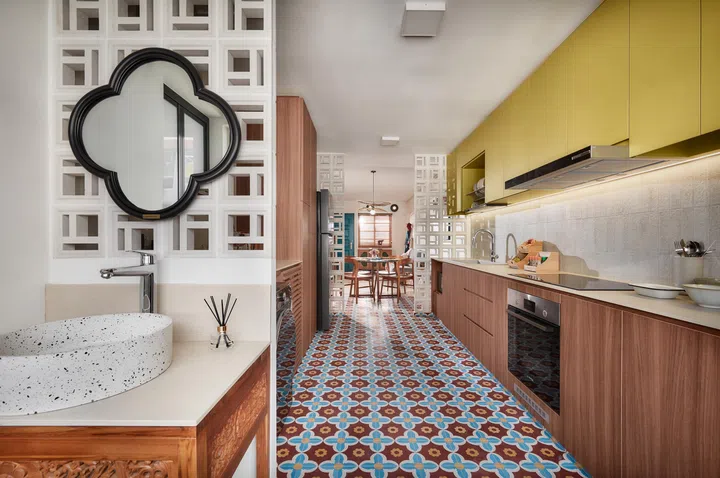
Patterned tiles extend into the kitchen, echoing the geometric rhythm of the breeze blocks and curved forms throughout the space.
Made with craft and care
A custom basin stand, hand-carved in teak by a local furniture maker, sits alongside the more utilitarian elements of the space, its floral motifs adding a quieter layer of craft and character. The piece took time to complete, part of a longer renovation process that stretched to accommodate these made-to-order elements.
“When we are in this space, we can all take a moment to truly appreciate every moment that happens in this space, in this home,” says Verena. “Older things, when they are built, they are built with more consideration and more time spent. I also wanted to exhibit that in the design and feel of this home. Inside here, there’s a quality, a pace, where we take our time to do everything well.”
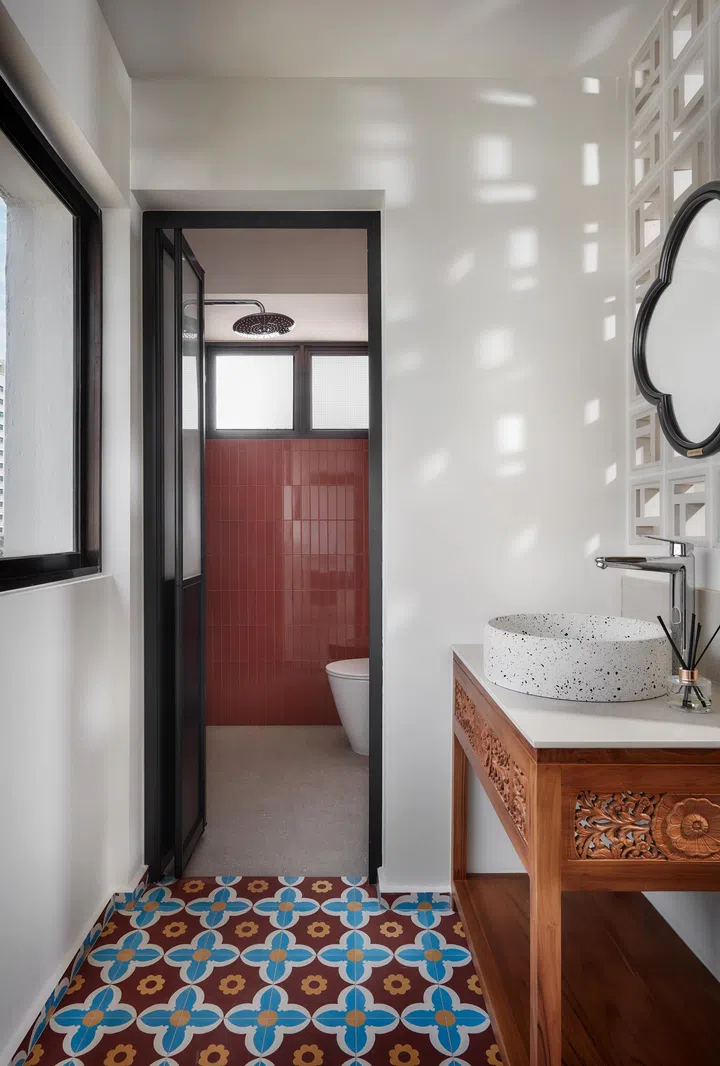
A hand-carved teak basin stand sits outside the common bathroom, while glossy terracotta tiles inside continue the home’s warm, grounded palette.
That emphasis on craft is something Jerusha was drawn to as well. “Handcraftsmanship adds a distinct touch, where the imperfections themselves add character,” she says. “While it may be a bit more of an investment, you’re paying for the time artisans spend honing their craft to create something truly unique.”
Inside the bathroom, the palette shifts but remains connected. Terracotta wall tiles bring in an earthy depth, finished in a gloss for ease of maintenance.
“The traditional ones are absorbent, so they won’t be very long lasting in terms of carrying the look,” Verena explains. “We also wanted to carry on that earthen, natural colour, but also something bold.” The tiles are laid to stop short of the ceiling, a more restrained treatment that keeps the space feeling balanced. Underfoot, a light grey-beige floor grounds the room, chosen for durability and ease—a quieter counterpoint to the richness of the walls.
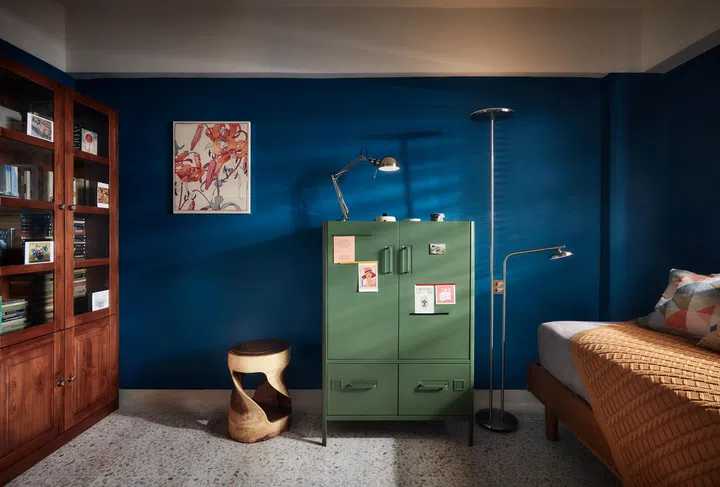
A deep blue envelope defines the workroom, where free-standing pieces allow the space to shift and evolve over time.
A room to evolve
This room is conceived less as a fixed bedroom and more as a space that can shift with time—currently Jerusha’s workroom, but open to change as her needs evolve. Free-standing furniture allows pieces to be moved, replaced, or reconfigured without disrupting the overall language of the home.
“Staying long-term was always the plan from the start, which is why I wanted the space to be flexible and timeless,” says Jerusha. “I chose free-standing pieces built for longevity and materials that deepen in character over time, without being tied to a single style. The idea is that, as I grow, the home can evolve with me—whether through shifting the layout, adding new elements, or adapting to my changing needs.”
The deep blue walls anchor the room, adding a sense of calm without overwhelming the space. Rather than carrying the colour all the way up, it stops just short of the ceiling, another subtle move that keeps the proportions feeling lighter.
“I wanted the blue to stop short of the ceiling,” says Verena. “Not electric, a solid blue—like a darker royal blue.” The resulting room feels grounded yet adaptable, shaped as much by what it holds now as by what it can become.
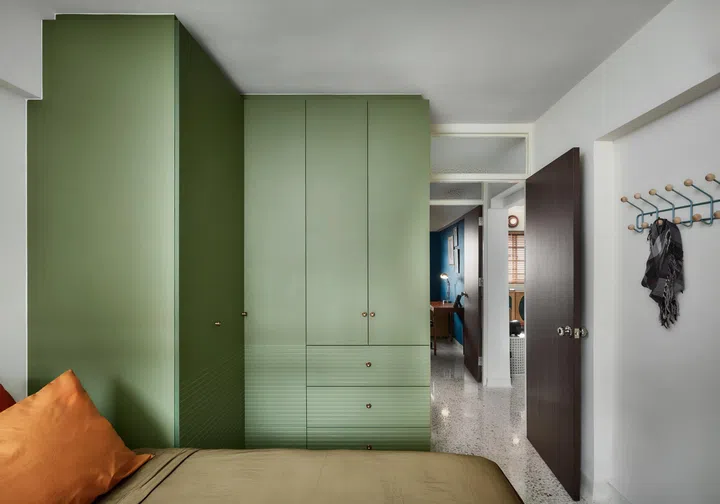
Green-toned wardrobes with subtle groove detailing anchor the bedroom, where small crafted touches soften the built-in elements.
A room shaped by personal choices
In the master bedroom, the approach shifts again to become quieter, more contained, while still rooted in the same material and design logic. The palette softens into green, with built-in wardrobes forming the main backdrop to the space.
Here, even the more utilitarian elements are treated with care. The wardrobe fronts are detailed with subtle groove lines along the lower half. “This is to break the flow of a solid block,” says Verena. “Also to show some kind of handcrafted craftsmanship… I didn’t want to leave out the wardrobe.” Small touches—from the choice of handles to the proportions of the panels—lend the joinery a sense of depth and tactility, steering it away from something overly sleek or anonymous.
Above the doorway, a strip of shell glass introduces a softer transition between rooms, allowing light to pass through while maintaining privacy. It was a move initiated by Jerusha. “She suggested, how about we do glass here, instead of sealing it up,” Verena recalls. The result is a threshold that feels lighter and more permeable, in keeping with the rest of the home.
At its core, the home is less about any single design gesture than it is about what it holds. “Simply put, this place reflects my taste and personality,” says Jerusha. “It’s filled with things that are personally meaningful to me, and that’s not something anyone else could easily replicate—nor should they. Everyone ought to pick what speaks to them.”
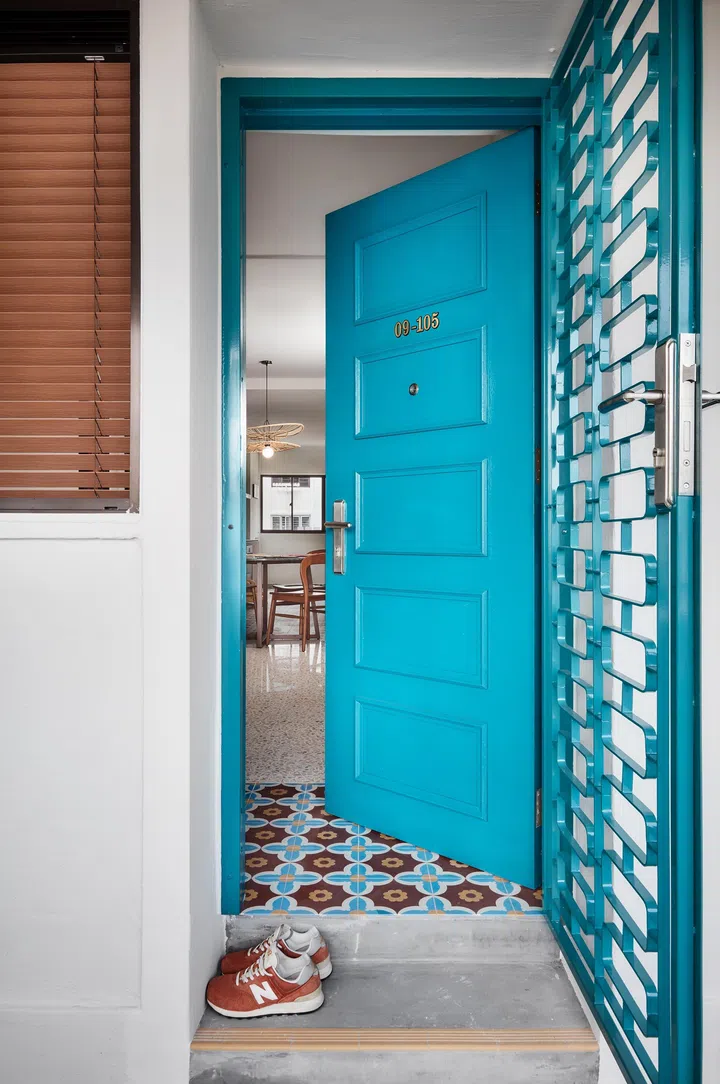
The entrance sets the tone with hand-painted details and a custom gate, reflecting the home’s emphasis on craft and personal expression.
$90,000 renovation cost
At the entrance, the home returns to where it began—with small, deliberate gestures that speak to how it was put together. The gate, with its geometric patterning, and the painted detailing at the threshold are not just decorative, but part of a considered sequence leading into the flat. Even the unit number is hand-painted by someone Jerusha knows, a detail that quietly reinforces the value placed on craft and personal connection.
“This also subtly yet strongly shows that personal touches and actual workmanship here matters,” says Verena.
That attention to detail extends beyond what is immediately visible. The renovation, which took about four months from July to October, was shaped in part by the time needed for custom pieces—from carved vanity cabinets to made-to-order fittings. “The carvings took time but I think they were worth it,” Jerusha reflects. With no urgency to move in, the process was allowed to unfold at its own pace.
Today, the result is a home that feels distinctly hers. “Guests often say the space feels very ‘me,’ which is a lovely compliment,” she says. “While the bold choices might not be something some would choose for themselves, they all appreciate the balance and harmony of the space.” It is a place she intends to grow into rather than out of. “I hope to stay for many years to come.”