
Home Tour: $98,000 Sculptural renovation for a piano teacher’s 5-room BTO in Tengah Plantation Crescent
Curved ceilings, light wood tones and a baby grand piano turn this 113 sqm flat into a calm, harmonious sanctuary designed for family life and teaching.
By Gwyneth Goh -
Share this article
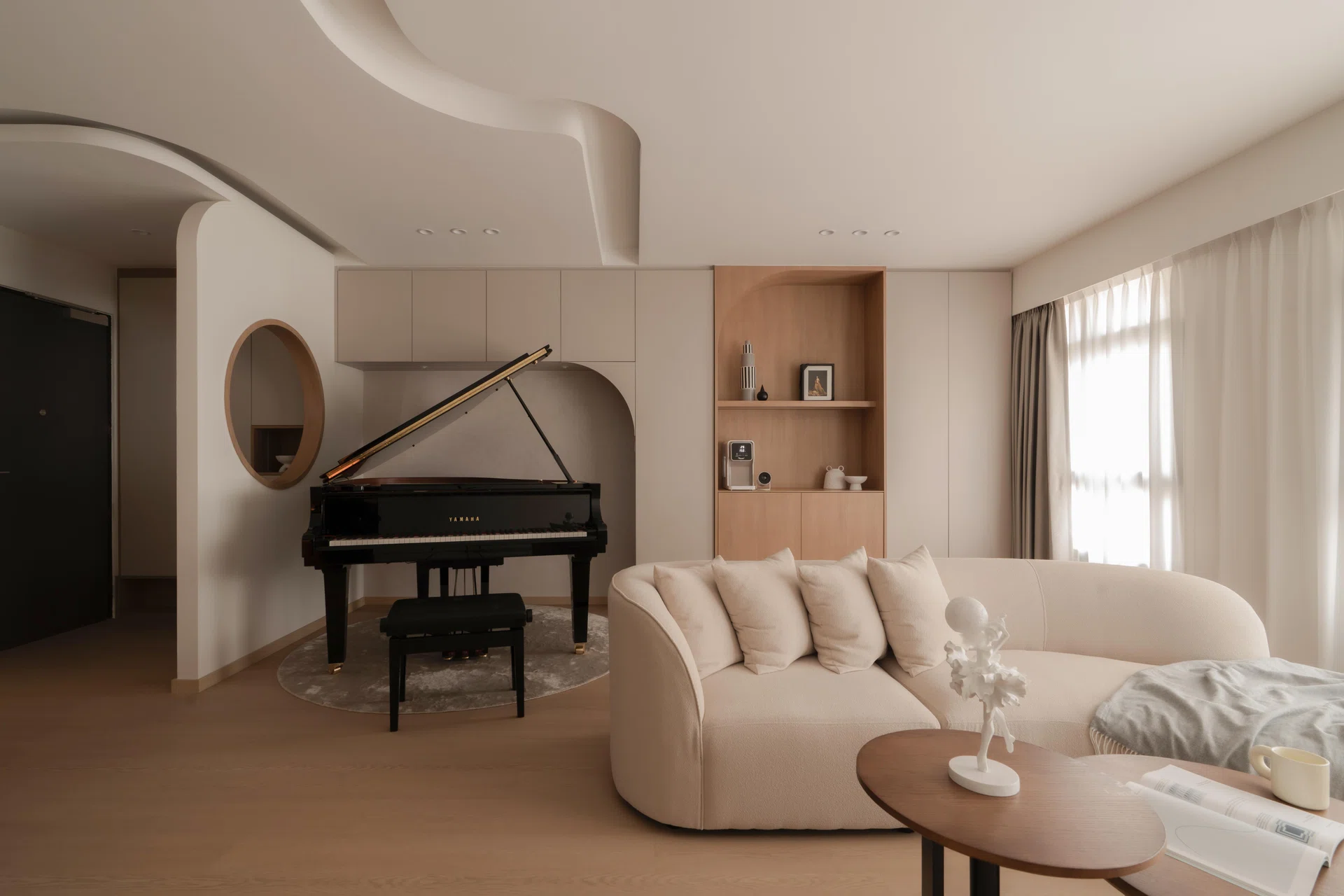
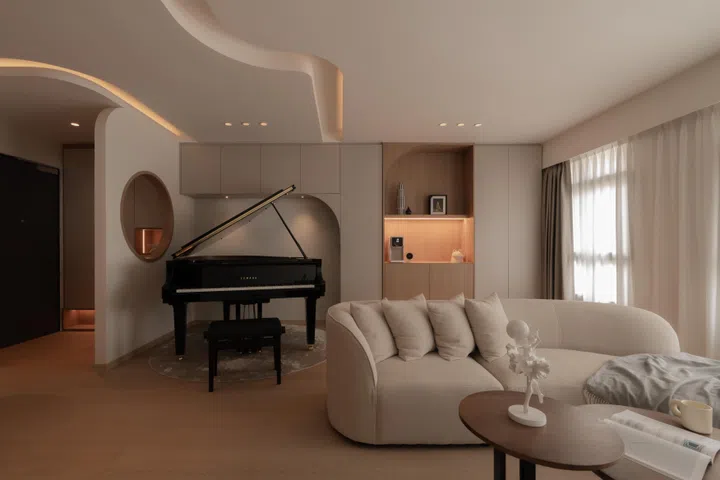
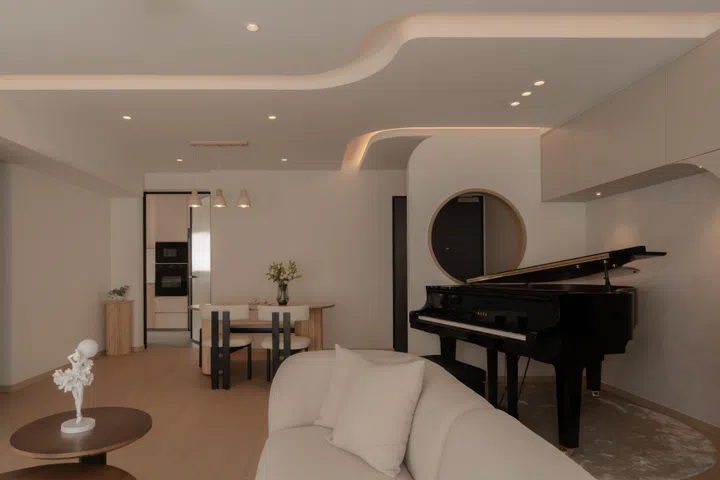
Awash in daylight, this 5-room BTO flat at Tengah’s Plantation Crescent unfolds with a quiet, almost musical rhythm. Soft curves trace the ceiling, cabinetry and walls, guiding the eye towards a baby grand piano that anchors the living space.
For its homeowners—a young family in their mid-thirties with a two-year-old toddler—the home was always meant to be more than a place to live. It had to function as a calm family sanctuary, a teaching studio, and a space where everyday rituals could unfold with ease.
Music is central to daily life here. As a piano teacher who records performance videos and teaches students at home, the homeowner needed the piano to be both a functional workspace and a visual focal point.
Rather than treating it as a bulky object to be tucked away, the renovation places the instrument front and centre, wrapped in a sculpted alcove and framed by flowing ceiling lines that echo the softness of musical notes. The result is a living area that feels intentional, serene, and deeply personal.
Who Lives Here: A young family in their mid-thirties—a piano teacher, her husband, and their two-year-old toddler
Home: A 5-room BTO flat at Plantation Crescent
Size: Approx. 113 sqm
Interior Designer: Ray Seah, Ovon Design
Designing for now and future ease
As first-time homeowners, the couple approached the renovation with a clear set of priorities. “Our initial brief focused on achieving a clean and neat aesthetic throughout the home,” the homeowner shares. Integrated storage was therefore a key requirement, ensuring clutter could be kept out of sight as their family grows.
Beyond aesthetics, the brief was shaped closely around lifestyle needs: a dedicated piano area that could double as a professional backdrop, a guest pantry for hosting, and a walk-in wardrobe with space to display handbags.
Location also played a decisive role in their decision. The couple chose Plantation Crescent for its proximity to one set of parents, offering easy familial support, as well as its immediate access to the MRT station and neighbourhood mall.
“We were particularly drawn to the spacious layout of the living area on the floor plan, which is essential for a family with a young toddler,” she explains. With a baby grand piano to accommodate as well, generous circulation space was a practical necessity.
To bring their vision to life, they engaged Ray Seah of Ovon Design. Introduced through a professional matching service, Ray stood out early in the process.
“While I had a specific vision for the house, Ray demonstrated his creativity by providing two distinct proposals—one aligning with my preferences, and a second reflecting his own unique conceptual design. Comparing these two proposals side-by-side convinced me of his strong design acumen.”
Designing around the piano
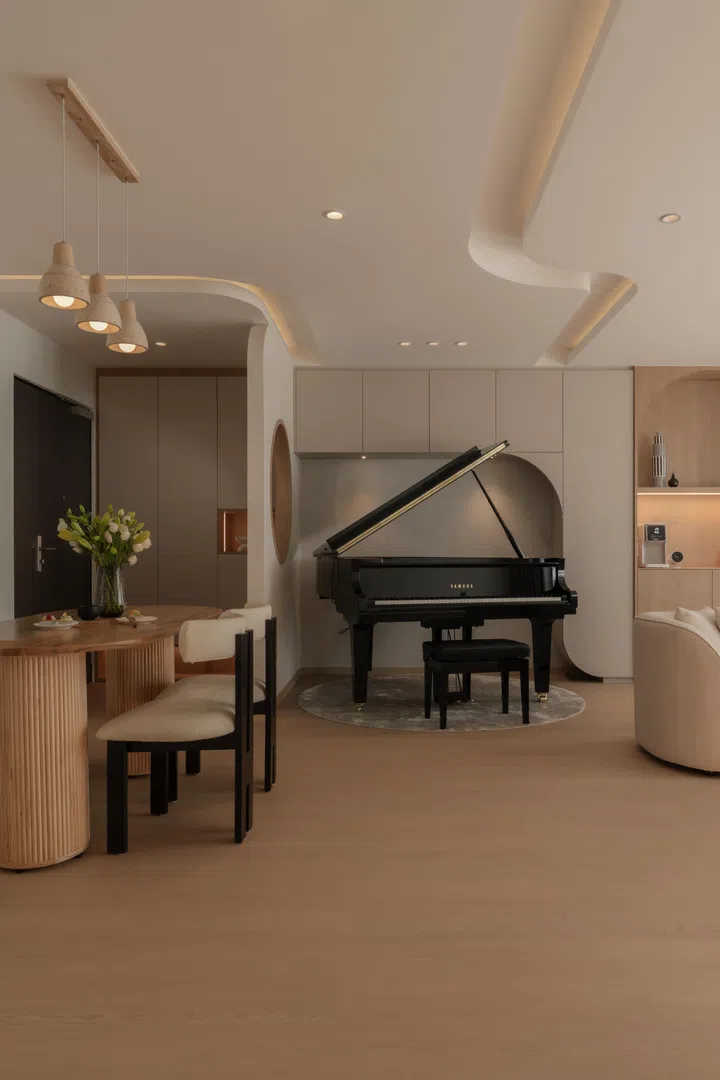
From the outset, the piano was the emotional and spatial anchor of the home. “Music is truly the heartbeat of our home, and the living area was intentionally designed to feature the piano as its central focal point,” the homeowner shares. Rather than treating the instrument as an obstacle to work around, the layout was shaped deliberately to accommodate it—both as a professional tool and a defining presence within family life.
For Ray Seah of Ovon Design, the challenge lay in scale and proportion. “The requirements she had were the typical essentials needed for a newborn family—the only thing is, she challenged me to put in a grand piano,” he explains.
“From the start, I was thinking about how to make everything come together without making the space feel cluttered. BTOs are generally quite small, even though hers is a 5-room flat.” With structural changes limited, the living and dining area became the primary zone where design intervention could make the most impact.
The piano’s placement was considered carefully from multiple angles. “Spatially, the layout was tailored to accommodate my five-foot-eight baby grand, which fits perfectly within the custom-designed alcove,” the piano teacher explains.
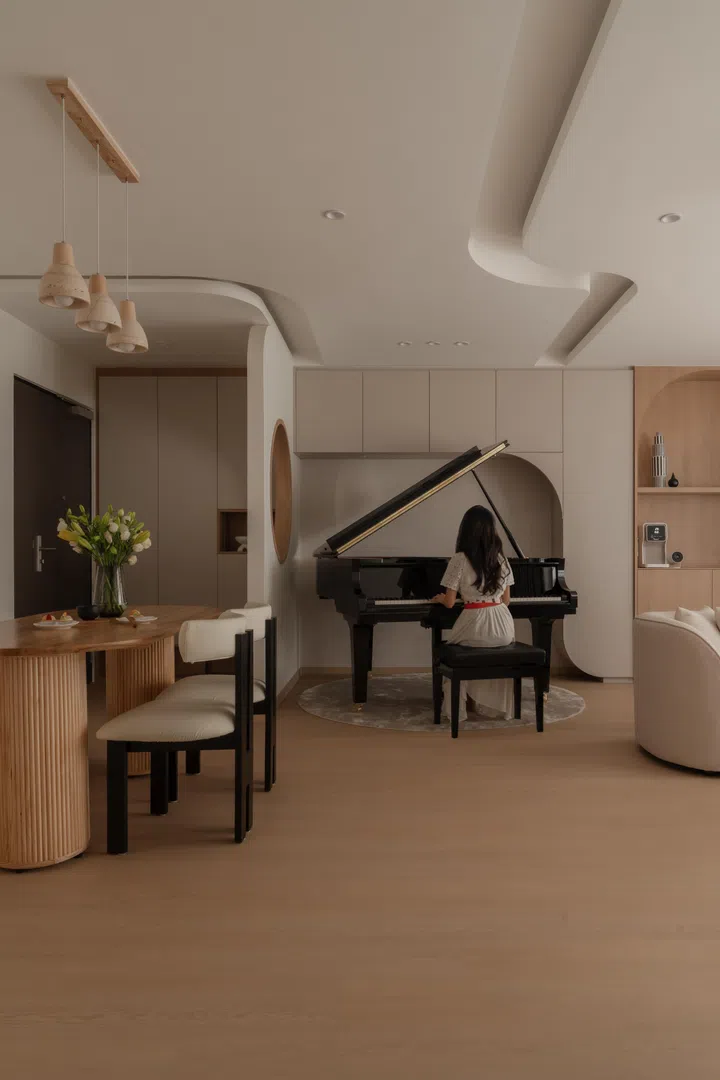
“This dedicated corner serves a dual purpose: it is my personal sanctuary for hours of practice and a premium study environment for my students.” Its position allows the space to remain open and fluid, while still clearly defining the piano as a focal point.
HDB Acoustics for Piano
Acoustics were equally important. “By positioning the piano with the keys facing outward, we’ve ensured optimal sound projection throughout the room,” she adds. “This allows the instrument to produce a rich, full resonance that fills the home, rather than being muffled by the walls.” Beyond sound, the arrangement also supports the way she teaches, with nearby surfaces offering space to pause, discuss, or take notes during lessons.
Visually, the architecture reinforces this intent. interior designer Ray drew inspiration from both the form of the piano and the language of music itself. “When I was thinking about how to integrate the grand piano, the piano itself has a very structural look,” he says.
“But when I think about musical notes, like treble notes, they have a curve to them, so I wanted to incorporate that into the false ceiling design and the cabinet design in the living room.” The resulting curves act as subtle guides, leading the eye—and movement—towards the piano.
This sense of direction is intentional. “I use a lot of this principle called leading lines,” Ray explains. “The ceiling curves I used act as a leading line along the walkway towards the grand piano. The curves also add fluidity.” The curved false ceiling, full-height cabinetry, and piano alcove work in concert, allowing the instrument to feel integrated rather than imposed.
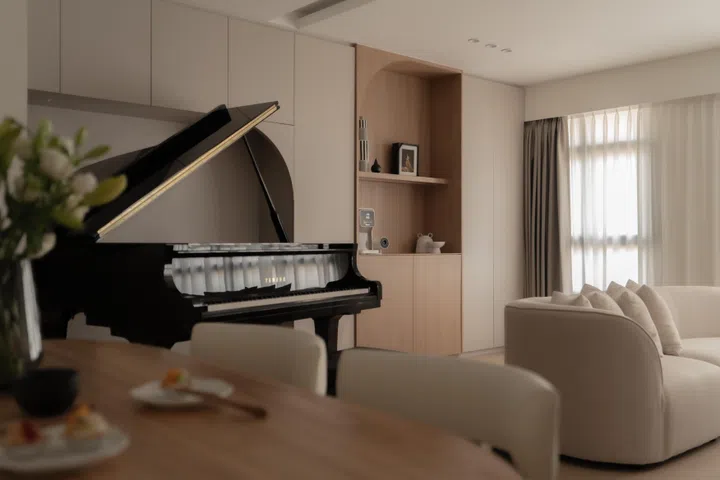
Piano in HDB Living Room
“My absolute favourite corner and design detail in the home is the piano alcove, seamlessly integrated with the sculpted false ceiling,” the homeowner says. “I feel this specific area truly gives the house its unique character and represents the core of our aesthetic vision.”
She adds, “The way the gentle curves of the ceiling blend with the dedicated piano space is particularly appealing, almost resembling the flowiness and harmony of a musical melody.”
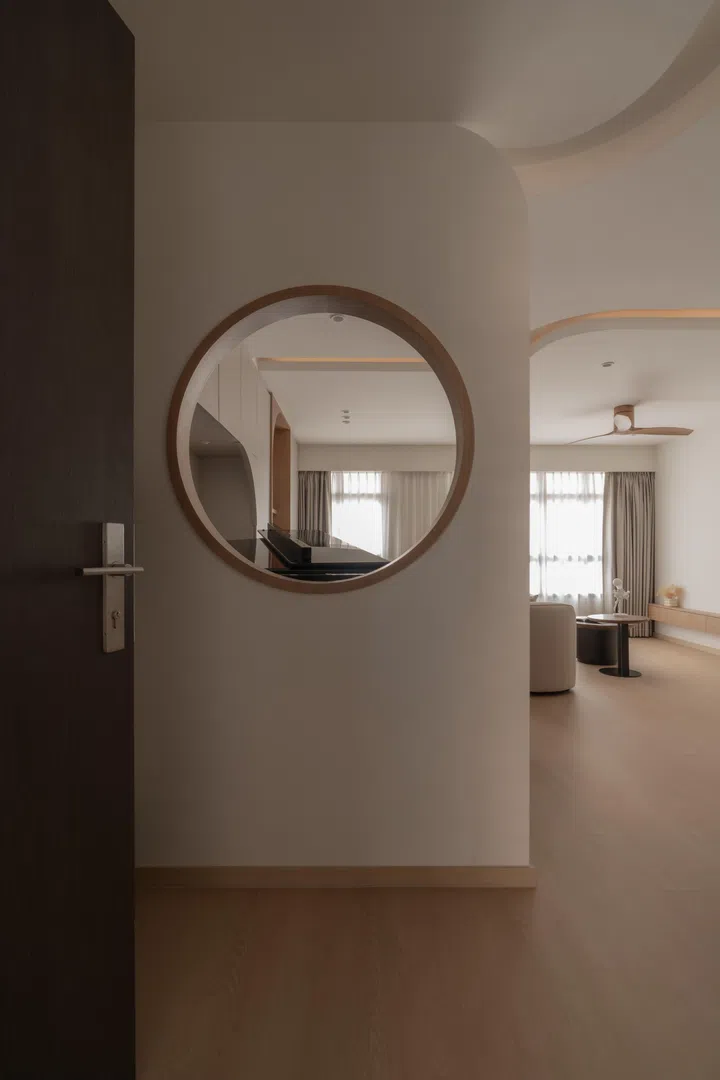
Curves as a quiet way of zoning
Rather than relying on walls or hard partitions, this home uses curves as a subtle but powerful way to organise space. This approach is first felt at the foyer, where a softly rounded partition with a circular opening marks the transition from entrance to living area. Instead of closing the space off, the curved wall allows glimpses through, offering a gentle sense of arrival while maintaining openness.
The effect is both functional and atmospheric. From the doorway, the round aperture frames a partial view of the living area beyond — a composed moment that hints at the home’s sculpted language without revealing everything at once. It is here that interior designer Ray’s earlier idea of leading lines begins to take shape, guiding movement forward through form rather than signage or barriers.
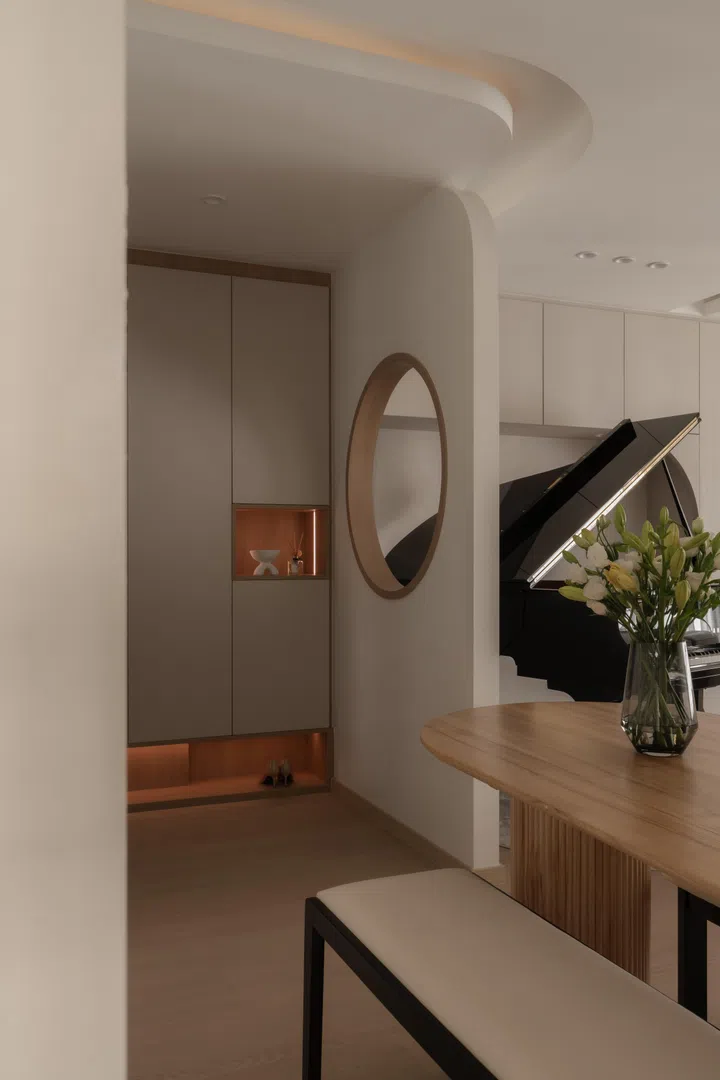
Curved False Ceiling
This curved gesture continues overhead, where the false ceiling traces a fluid path through the living and dining spaces, reinforcing zones without fragmenting them. Rather than signalling transitions through walls or thresholds, the ceiling becomes the primary guide, subtly directing movement and attention towards the home’s key moments.
iThe same language is echoed in the surrounding cabinetry, where rounded edges and recessed niches soften full-height storage and prevent it from feeling imposing. Together, the ceiling and built-ins work quietly in tandem, shaping the layout in a way that feels instinctive — a home where zoning is sensed rather than stated, and movement unfolds naturally from one space to the next.
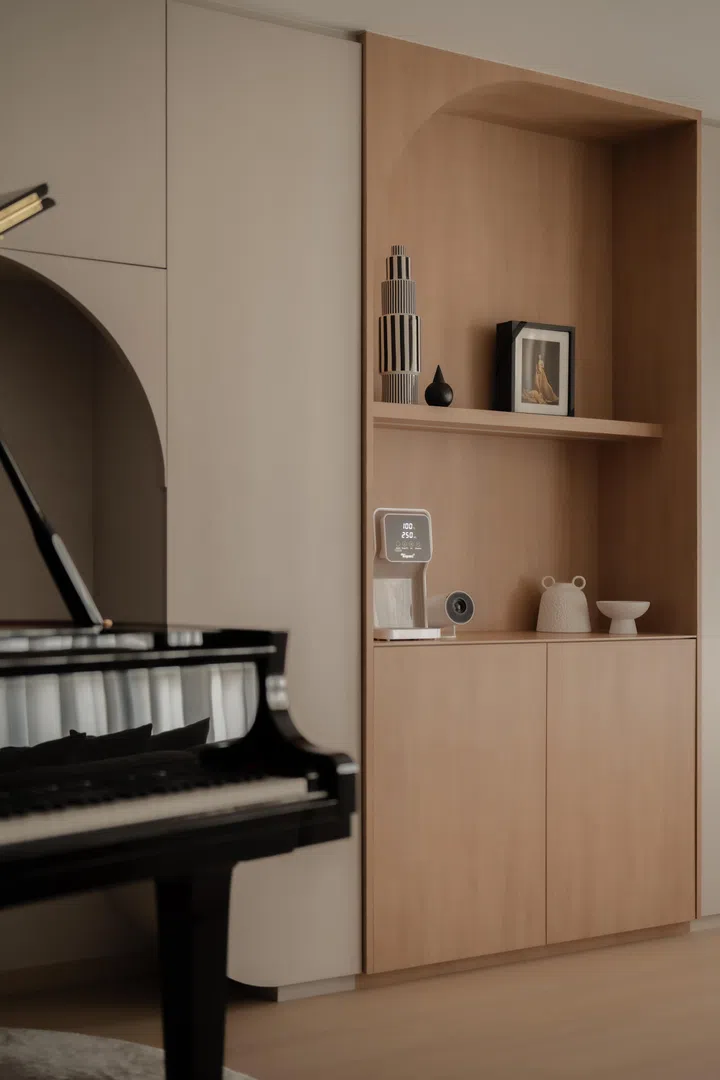
Storage and pantry wall
The built-in piano feature wall and pantry echo this same language, running along one side of the living space, its curved edges aligning precisely with the ceiling above.
“The full-height cabinet in the living room is the length of the entire room,” interior designer Ray shares. “So it doubles up as a dry pantry and a storage area for her music notes.”
Rather than being concealed, the pantry is deliberately positioned within the living zone, allowing it to serve both hosting and daily routines. “When she takes down notes while teaching her students, she uses the dry pantry area as a small desk,” he adds.
The result is a built-in that supports multiple functions without introducing visual clutter, its warm wood finish helping it read as part of the architecture rather than a separate element.
Furniture
Loose furniture continues this quiet zoning strategy. The curved sofa softens the living area, while the oblong dining table continues the rounded language at a more intimate scale.
For the homeowners, this choice was deliberate. “We felt the oblong silhouette was a natural extension of the curved language found throughout the home, creating a sense of visual harmony,” she explains. “The straight, fluted legs introduce a striking textural contrast to the soft edges of the tabletop, which we believe gives the dining area an elevated and sophisticated feel.”
Together, these elements—ceiling, carpentry, and furniture—create subtle zones that feel instinctive rather than imposed. Each area has a clear purpose, yet nothing feels boxed in.
A study shaped by restraint
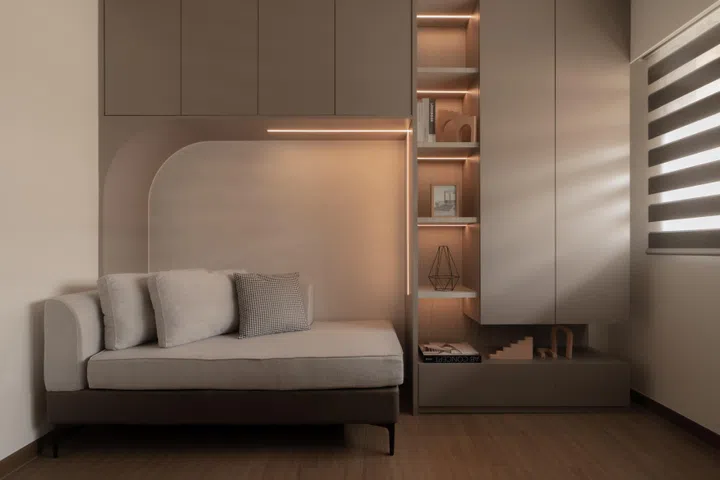
As the home transitions away from its social core, the curves begin to soften. In the study, the design language shifts to support focus and rest, with curvature used more selectively and deliberately.
“With the curves in mind, I also try not to overdo it,” interior designer Ray notes. “Curves are in trend nowadays. Everyone is doing curves. When I did up this house, I thought intentionally which area I can curve on purpose instead of just curving for the sake of curving.”
Here, the expressiveness of the living space gives way to a calmer composition. A gently arched backdrop frames a built-in daybed nook, while surrounding cabinetry adopts cleaner, more structured lines. The result is a space that feels visually settled—one that encourages pause without feeling disconnected from the rest of the home.
Back to
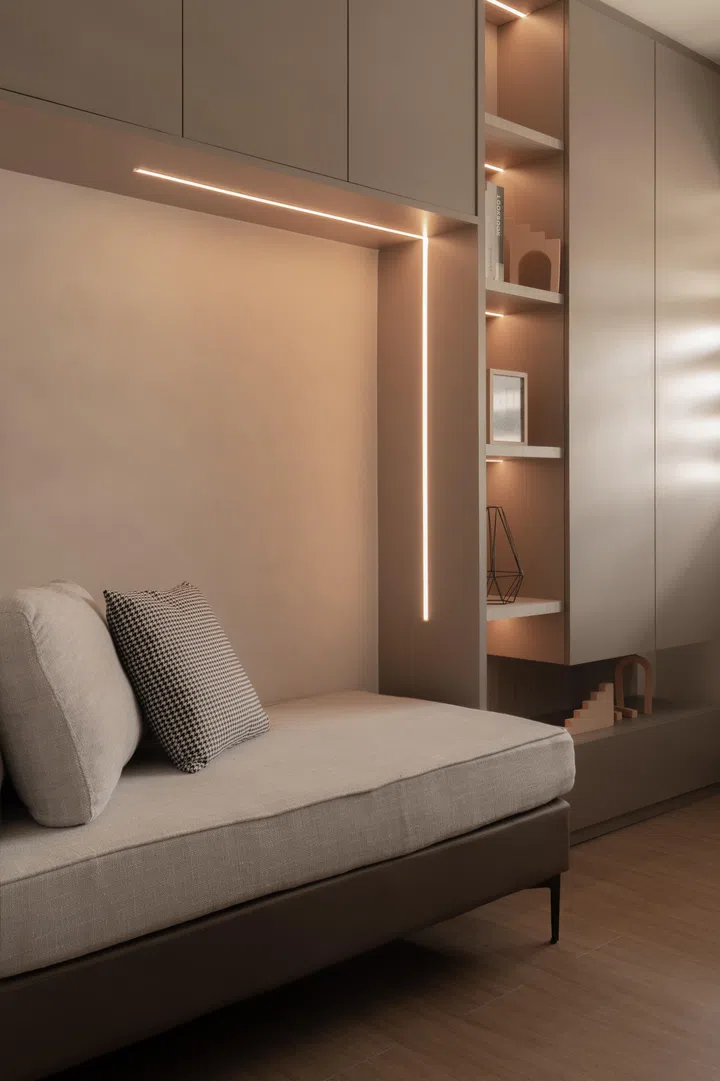
The study is quietly versatile. The daybed doubles as a resting spot, reading corner, or guest perch, while integrated shelving and concealed storage keep the room uncluttered.
Warm, linear lighting traces the edges of the built-ins, adding depth without distraction, while allowing the architectural details to remain understated. In contrast to the flowing movement of the main living areas, this room demonstrates how the same design language can be moderated—proving that continuity does not require repetition.
A softer rhythm in the master
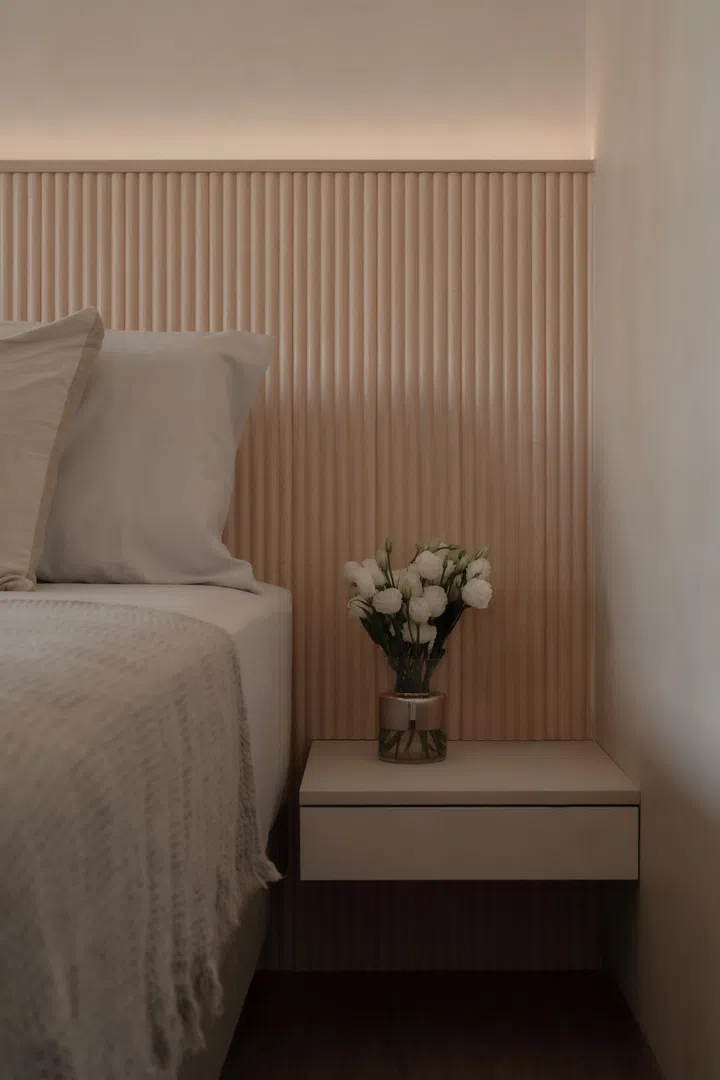
In the master bedroom, the home’s curvilinear language takes on a gentler, more tactile quality. The palette lightens, textures soften, and the emphasis shifts from movement to rest. A fluted timber headboard stretches across the bed wall, its vertical rhythm grounding the space while adding warmth and quiet texture.
Concealed lighting tucked above casts a soft, even glow, eliminating harsh contrasts and reinforcing the room’s restful mood.
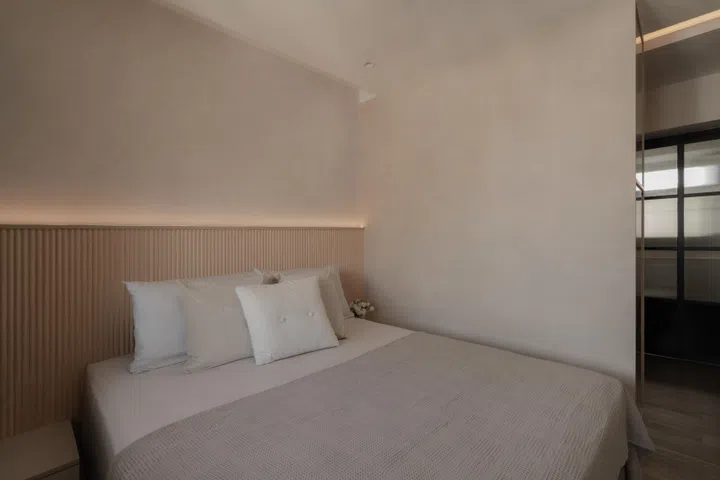
Master Bedroom
Here, curves are no longer directional but enveloping. Rounded edges appear in the bedside detailing and built-in forms, offering visual comfort without drawing attention to themselves.
The bed sits low and centred, flanked by pared-back nightstands that prioritise calm over ornamentation. Everything feels deliberately held back, allowing the room to function as a true retreat from the more expressive social spaces beyond.
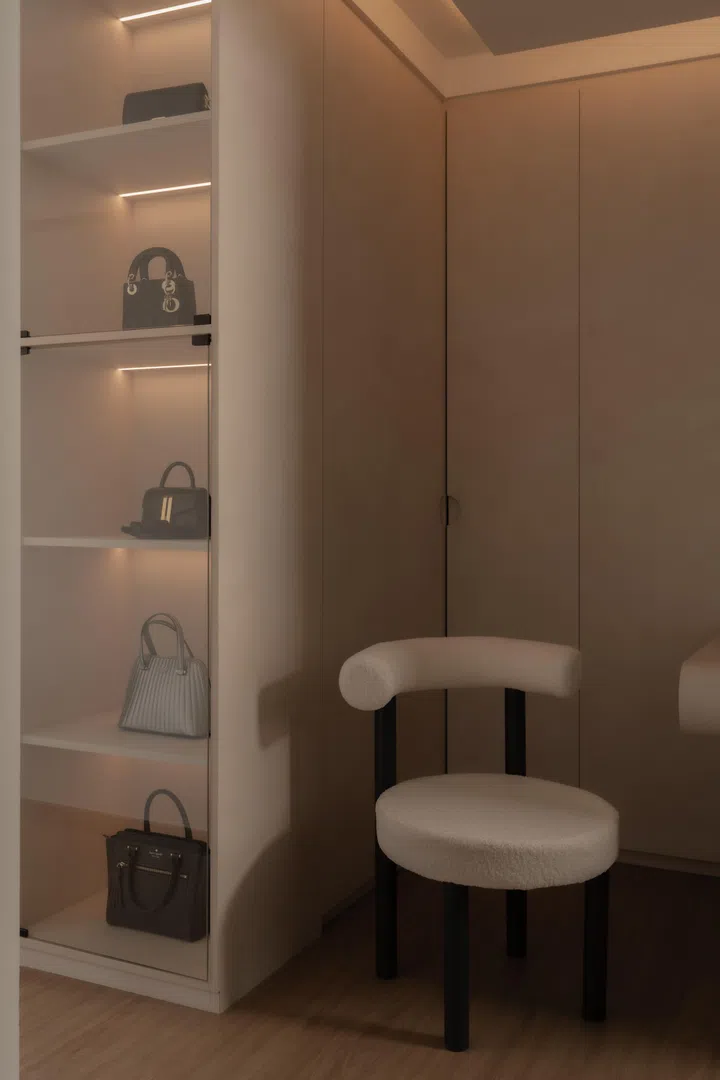
A display wardrobe that doubles as dressing zone
Moving deeper into the private suite, the L-shaped corner wardrobe is conceived not just as storage, but as a daily ritual space.
Glass-fronted display shelves line one side, softly lit to showcase handbags, while full-height cabinetry keeps larger storage concealed. The contrast between transparency and solidity introduces visual depth without clutter.
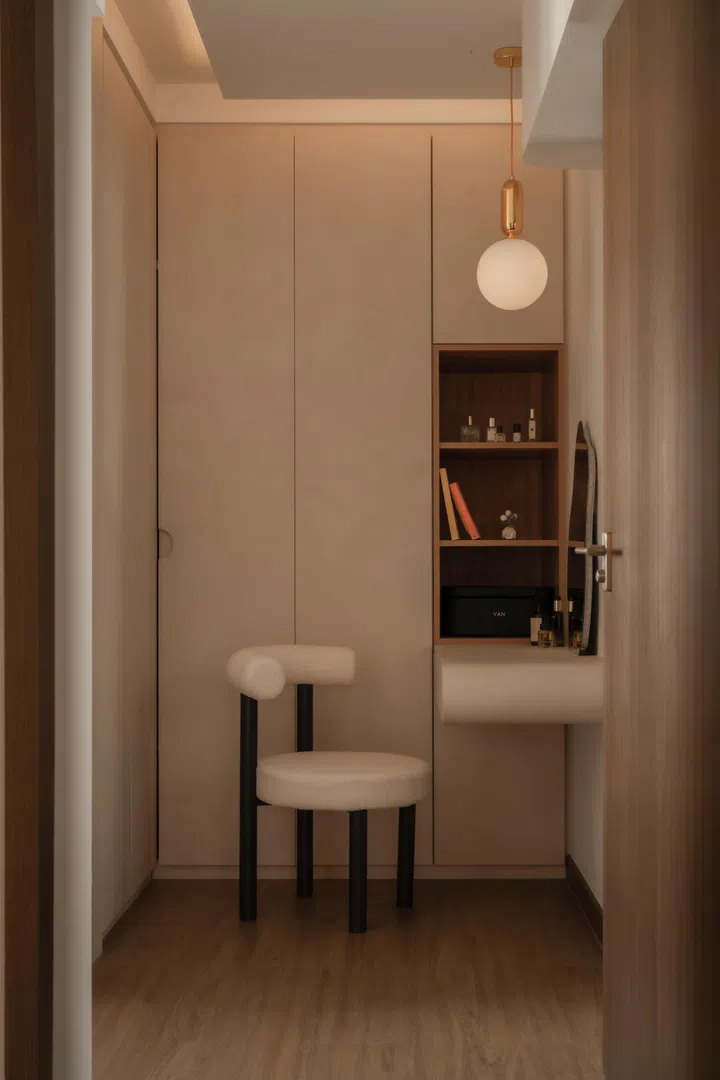
Vanity Table
At the heart of this zone sits a compact vanity nook, its rounded counter edge echoing the curves seen throughout the home. Paired with a sculptural upholstered stool, the vanity feels intentionally carved out rather than added on—a moment of pause between bedroom and bath.
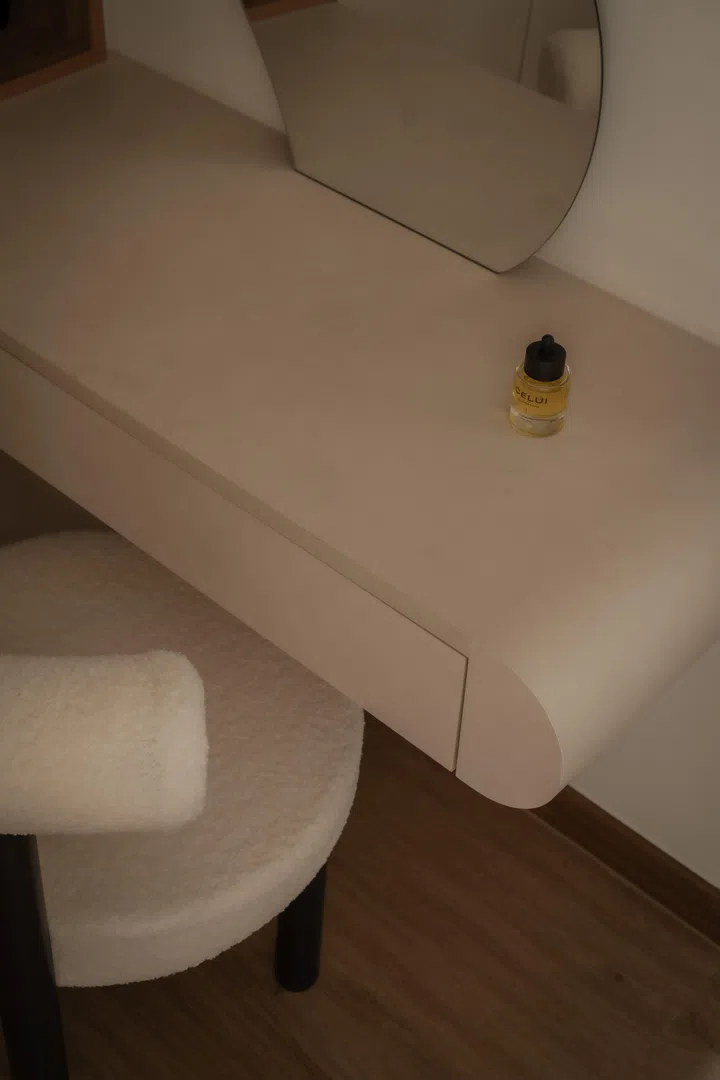
“It might not be the largest piece in the room, but my vanity mirror is easily the most used item in my daily life,” the homeowner shares.
“It’s where I spend those first quiet moments of the morning, preparing myself before the day truly kicks into gear. It’s a small ritual, but having a well-lit, beautiful mirror makes that routine feel like a bit of daily self-care.”
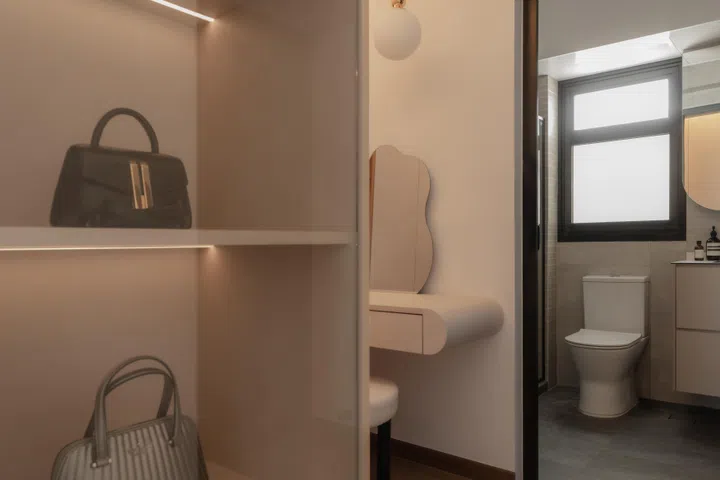
Handbag Display
“The design for this zone was born out of a specific need for both privacy and preservation,” she continues. “The L-shaped configuration was a strategic choice; it acts as a natural partition, providing immediate privacy for the sleeping area from the corridor.”
The dedicated handbag display transforms storage into a personal gallery, carefully positioned away from humidity-prone areas to protect prized items.
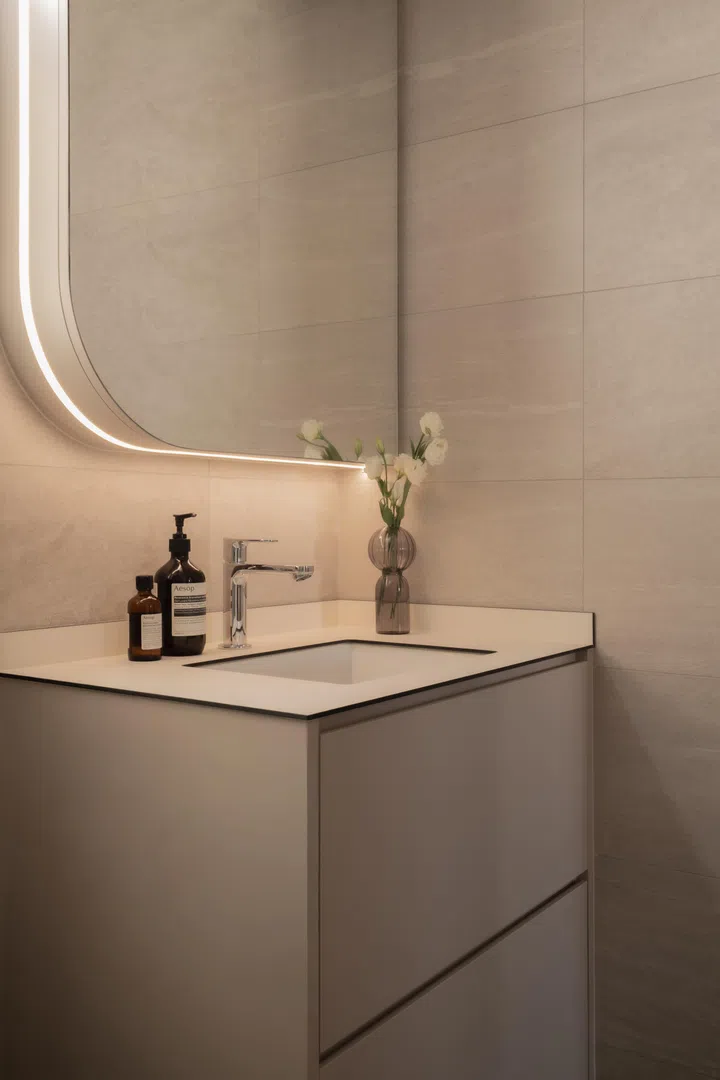
A calm, grounded bathroom
The bathroom continues this sense of quiet restraint. Materials shift subtly—from timber and upholstery to stone-textured surfaces and porcelain—but the overall palette remains warm and cohesive. Clean lines dominate, with storage neatly integrated to keep surfaces clear.
Natural light from the window brightens the space during the day, while soft artificial lighting takes over in the evening, maintaining a consistent atmosphere.
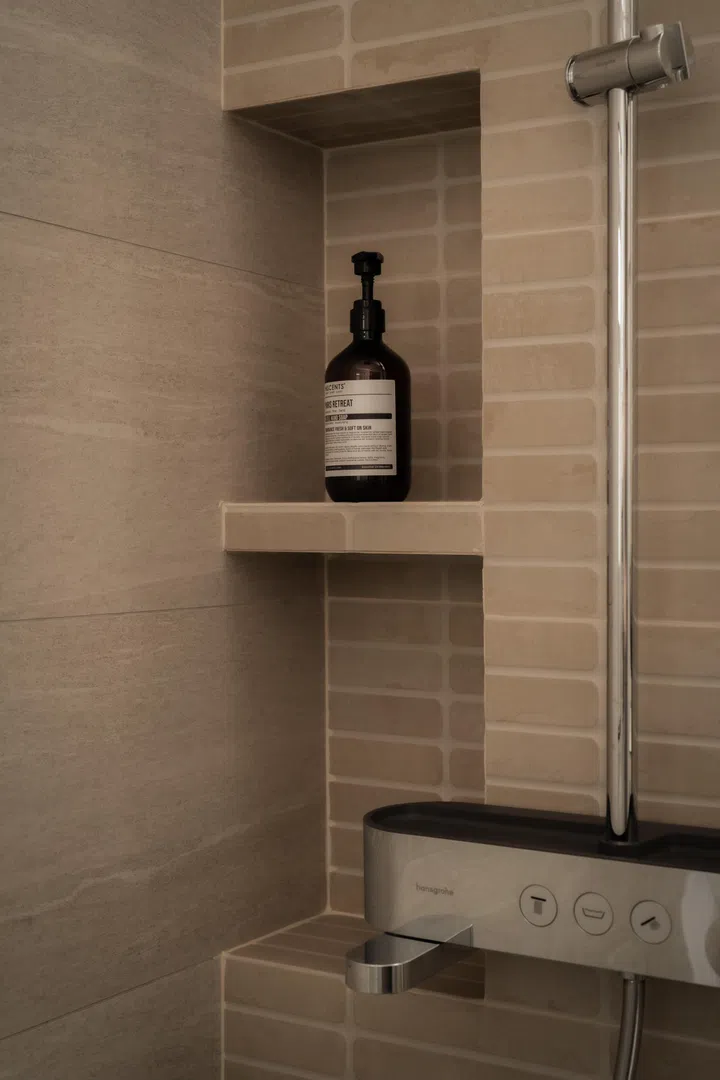
Despite its functional nature, the bathroom does not feel clinical. The palette deepens, but the sense of cohesion remains. Textured surfaces and controlled lighting create a more grounded mood, offering contrast without breaking away from the home’s overall calm.
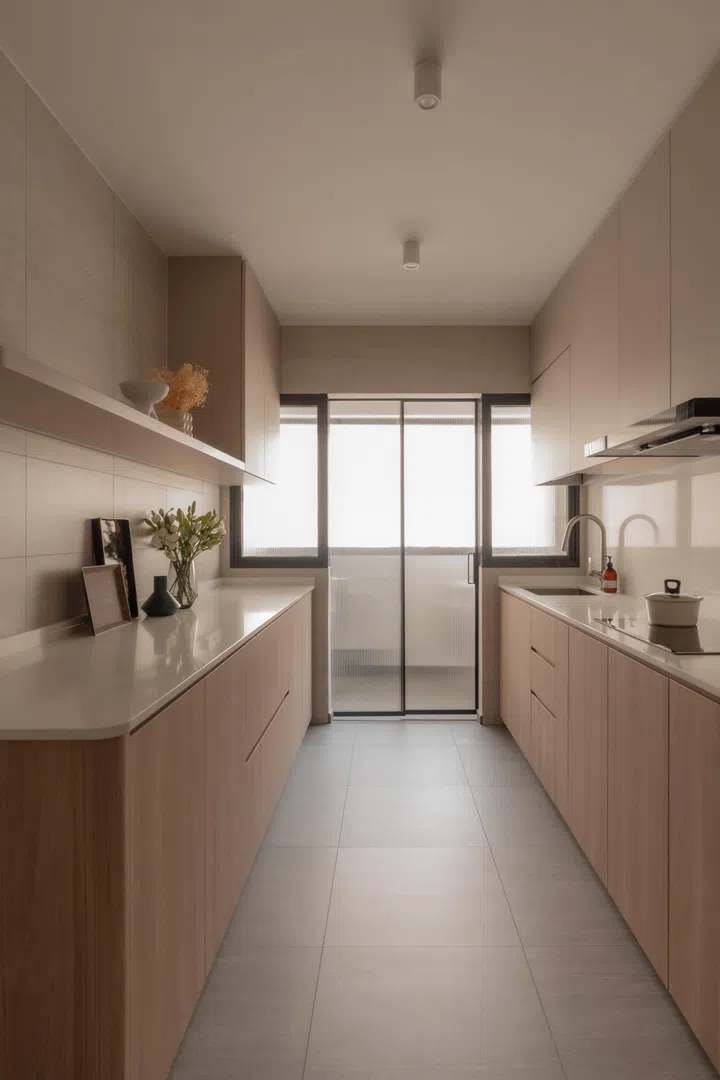
The Kitchen
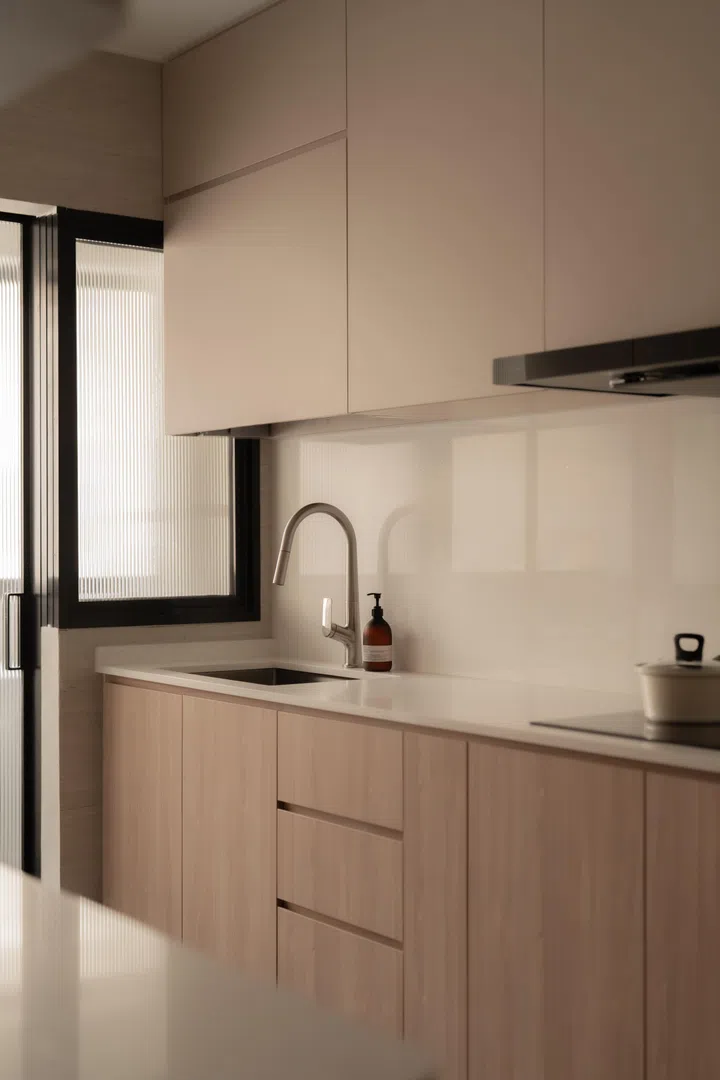
In the kitchen, the language shifts once more—still warm and cohesive but pared back to support daily routines. The curved gestures soften, giving way to cleaner lines and quiet symmetry, allowing function to take precedence without feeling austere. Pale wood cabinetry and light-toned surfaces reflect natural light deep into the galley layout, creating a sense of openness despite the kitchen’s linear form.
Details are restrained but thoughtful. Handleless cabinets keep the elevations visually calm, while a subtle wood grain introduces texture without distraction. A frosted glass sliding door filters daylight from the service yard, maintaining privacy while preserving brightness.
Here, the design feels intentionally understated—a space that supports cooking, cleaning, and everyday rhythms with ease, while still belonging clearly to the home’s broader visual story.
$98,000 Renovation Cost
The $98,000 renovation took around three and a half months to complete. Each decision was guided by daily use, with an emphasis on openness, balance, and ease of movement. For the young family, the home now supports their rhythms of everyday life while remaining calm and uncluttered—from teaching piano to raising a young child and hosting family.
For interior designer Ray Seah, the project was an exercise in restraint within the constraints of a BTO flat. By prioritising proportion and circulation, and using curves and built-ins as subtle spatial tools, the resulting design is a well-considered space that allows music, family life, and rest to coexist naturally.