
7 Exquisite Furniture Pieces You Must See at the Peranakan Museum’s New Exhibition
A lounge chair & table set from the Kay Hian family, prayer altar cloths from the Hong Lim family, and kamchengs from Perak’s last Chinese captain family.
By Guanlin Tan -
Share this article
The Peranakan Museum unveils its latest showcase, Exceptional/Everyday: New Acquisitions, New Perspectives, examining the rich ambiguity of Peranakan material culture.
Presenting over 150 objects across 14 groups - ranging from bespoke jewellery to mass-produced kitchenware - the exhibition moves away from rigid definitions to explore the lived realities of port-city communities.
Rather than presenting Peranakan material culture as static or insular, the showcase demonstrates how domestic life was actively shaped by migration, colonial commerce, and cross-cultural dialogue.
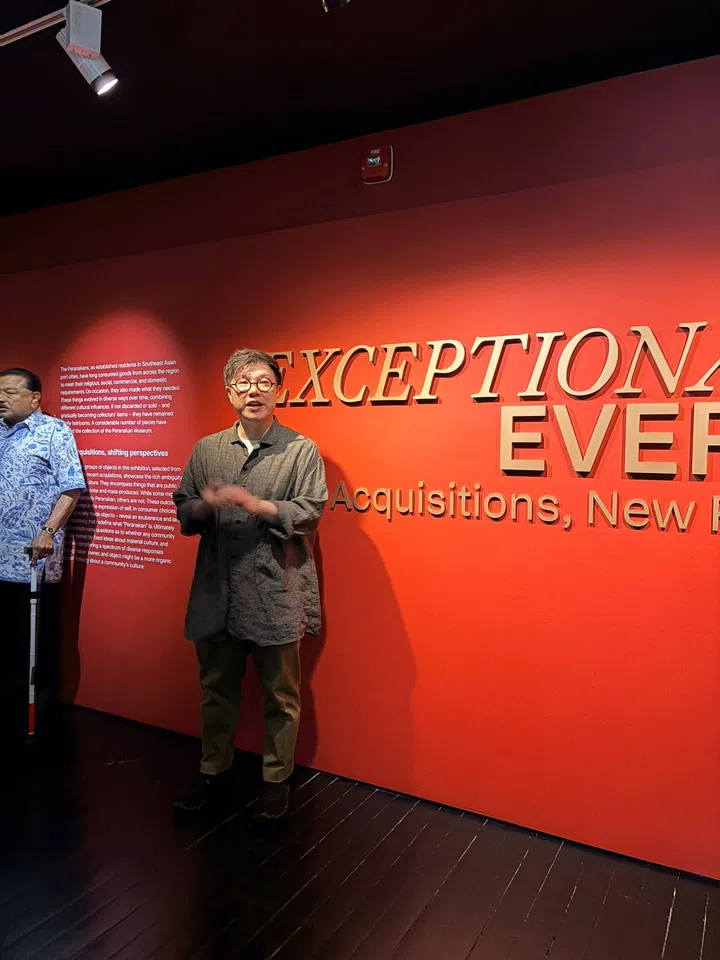
A curator at the Peranakan Museum speaking at the 27th October 2026 media opening of, Exceptional/Everyday: New Acquisitions, New Perspectives, a special exhibition examining the rich ambiguity of Peranakan material culture.
What makes an object ‘Peranakan’?
Curated around three core themes - “Identity”, “Buying”, and “Creating” - the exhibition asks a deceptively simple question: what truly makes an object Peranakan?
Through items acquired, adapted, or specially commissioned across centuries, it traces how goods moved fluidly between communities, demonstrating that an object’s cultural resonance often lay in how it was adopted into daily and ceremonial life rather than its origin alone.
- Exhibition: Exceptional/Everyday: New Acquisitions, New Perspectives
- Exhibition Dates: 30 October 2026 to 29 August 2027
- Exhibition Entry Fee: $6 for adults, free for children (6 and below), students, and seniors. Foreigners and tourists - $18 for adults; $8 for concessions; Free for children (6 and below)
- Opening Hours: Daily from 10am to 7pm (open late until 9pm on Fridays)
- General Entry Fee: Free for Singaporean citizens and Permanent Residents. Foreigners and tourists - $12 for adults; $8 for concessions; Free for children (6 and below)
- English Guided Tours: Mondays - Fridays at 11am & 2:30pm, Saturdays - Sundays at 11am & 2pm
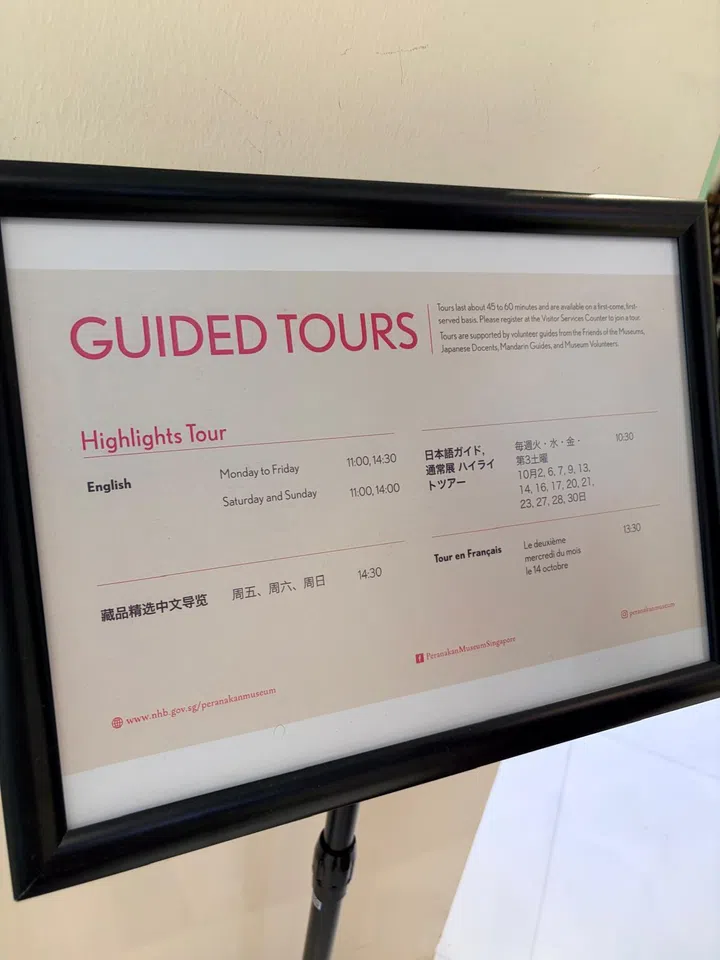
Peranakan Museum's English guided tours run from Mondays - Fridays at 11am & 2:30pm, Saturdays - Sundays at 11am & 2pm.
As part of the exhibition highlights selected by Naomi Wang, Senior Curator (Southeast Asia) and Tun Tan Cheng Lock Curator of Peranakan Art at ACM and the Peranakan Museum, several prominent furniture and ancestral altar furnishings reveal this dialogue between cosmopolitan trade and intimate domestic life:
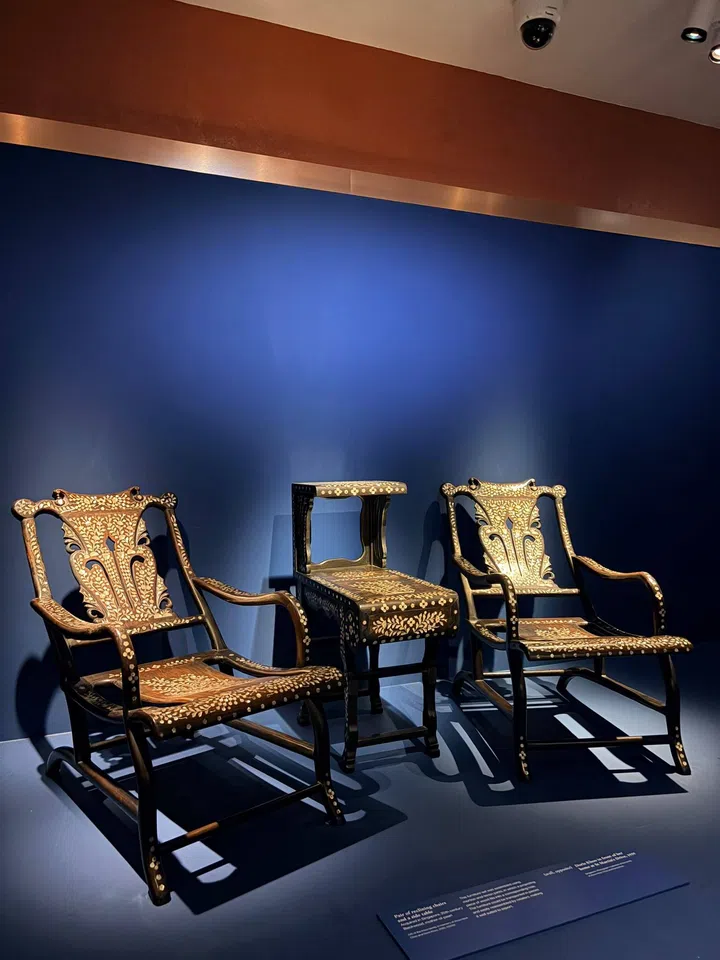
Mother-of-pearl blackwood (or rosewood) set of lounge chairs and a Qing-dynasty style two-tiered table (designed to fit a telephone) from the brokerage firm Kay Hian & Co. family. The family wasn't Peranakan, but were closely related to Peranakans by marriage.
Moon-Gazing Chairs and Side Table (from Kay Hian & Co. Family)
Assembled using traditional mortise-and-tenon joinery without nails, this 酸枝 (suan zhi, means blackwood or rosewood) suite features intricate mother-of-pearl inlay. The suite was designed to be flat-packed, transported in modular pieces, and easily reassembled by retailers across regional port cities.
The chairs seamlessly fuse the structure of traditional Chinese “moon-gazing chairs” with Anglo-Indian deck and planter’s chairs, while the two-tiered side table incorporates an extended lower tier tailored specifically to hold a modern domestic telephone.
Blackwood furniture inlaid with mother-of-pearl was a luxury commodity exported out of Guangzhou to affluent Southeast Asian homes.
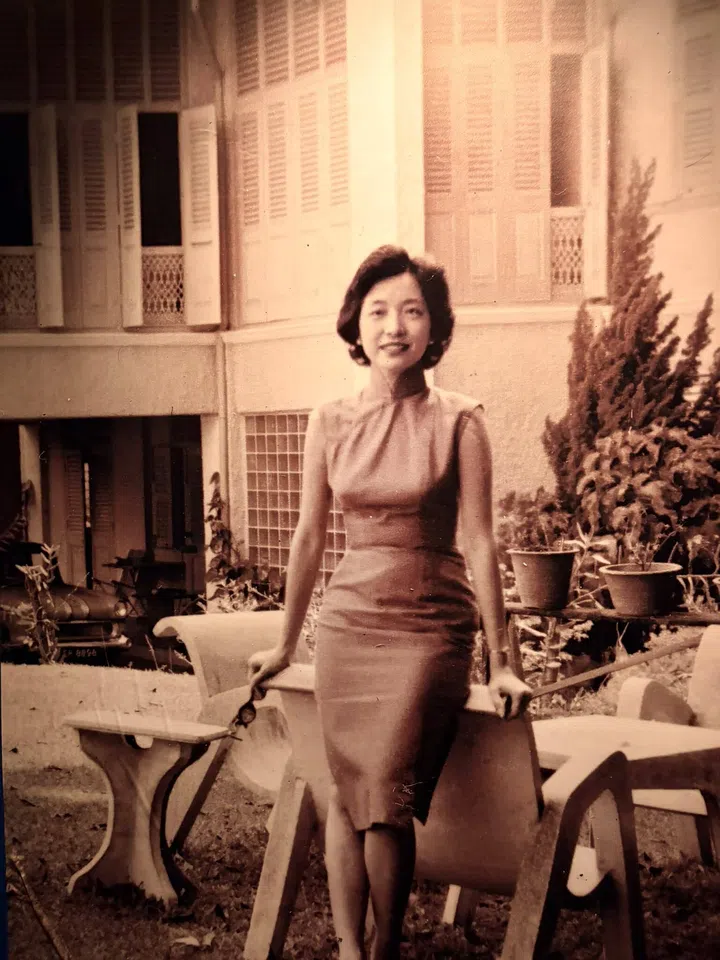
The late Doris Khoo Nyuk Tze nee Liew passed away on 15 October 2021. Her obituary was published in The Straits Times on 16 October 2021.
This set belonged to Doris Liew Nyuk Tze (1927 - 2021) and Khoo Hock Choo (1921 - 2016) and were a mainstay in their St. Martin’s home in the Tanglin area.
The couple were figures tied to the brokerage firm Kay Hian & Co. Although the Khoo family was not Peranakan, they were closely allied with prominent Peranakan families by marriage.
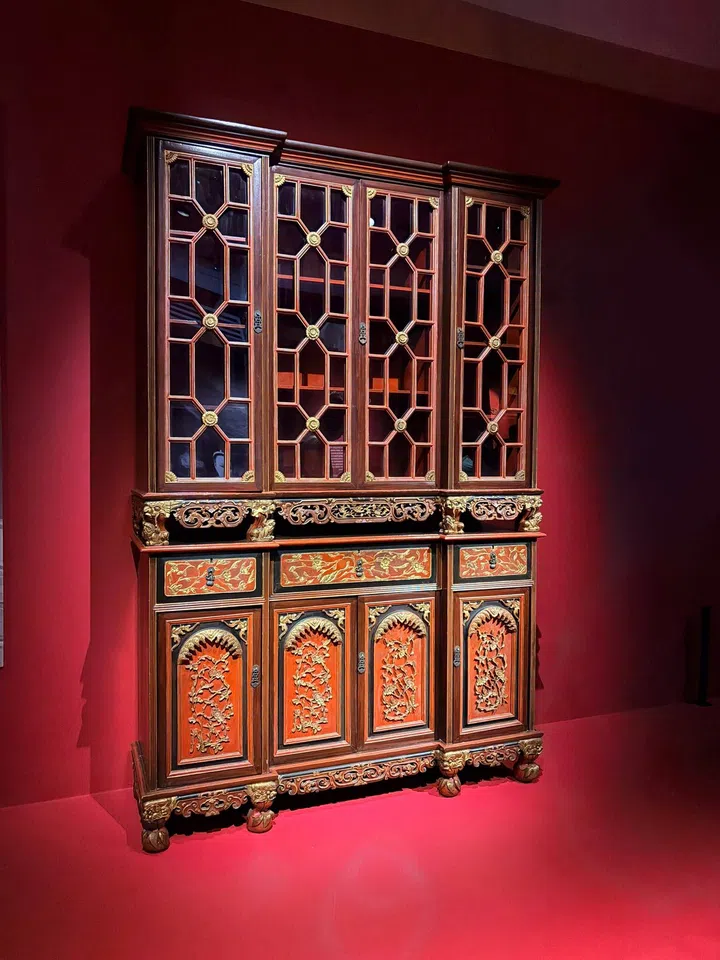
A "red and gold" gilded (means: covered with a thin layer of gold) cabinet made from namwood (means: highly prized Chinese Imperial wood) and red lacquer.
1916 Peranakan Bridal Gift: “Red-and-Gold” Wardrobe Cabinet
Built from namwood finished in rich black and red cinnabar lacquer, the cabinet’s intricate gilded detailing was achieved by applying delicate gold leaf over an adhesive base of tung oil.
The architectural form draws directly on 18th-century European cabinetry - complete with glazed display doors, latticework panels, and curvaceous legs - while remaining encrusted with classical Chinese auspicious emblems, including bats, lions, and dragons.
The brass locks are stamped by Birmingham and Singapore makers: OSAM / SINGAPORE and A. MURCOTT & Co. / BMINGHAM.
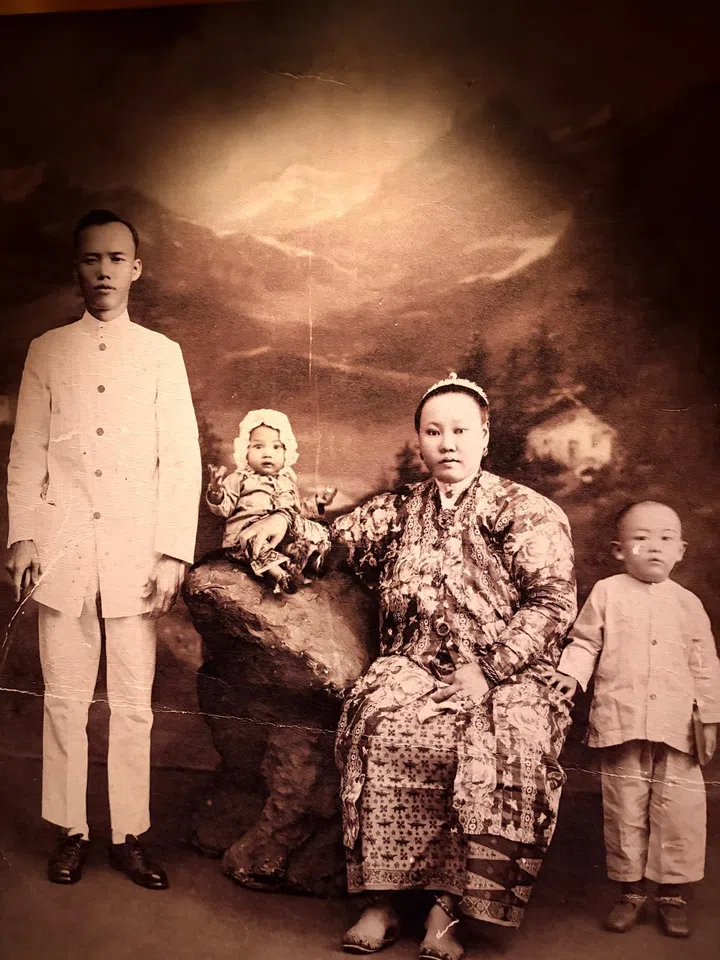
This specific wardrobe was presented to Malacca nyonya Chia Siew Chwee (1893 - 1973) by her groom, Lim Yan Keong (1890 - 1948), on their wedding day in 1916, eventually anchoring their family residence along Blair Road in Singapore.
“Red-and-gold” lacquer furniture was an indispensable centrepiece of Peranakan bridal chambers. While originally shipped from southeastern China, escalating local demand led itinerant Chinese artisans to construct bespoke pieces directly within Southeast Asia.
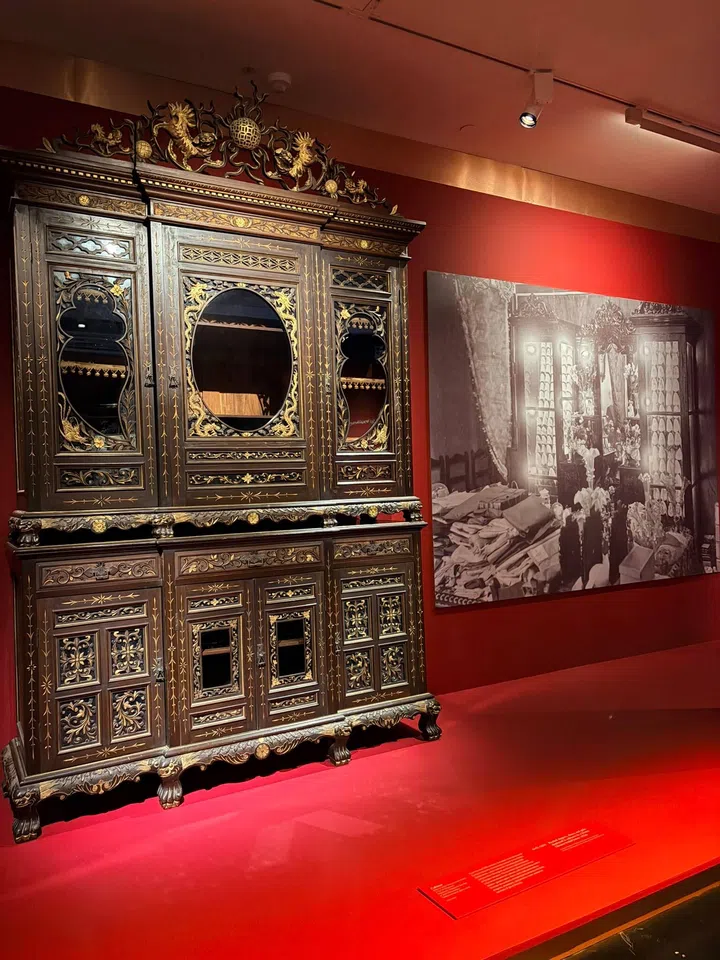
A European-style Teakwood Cabinet on the left. On the right hand side is an image of a Straits Chinese's bridal home with beaded slippers, shoes, and gifts displayed in a similar cabinet in the 1920s - courtesy of The Peranakan Association Collection, National Archives of Singapore.
1920s European-Style Teakwood Cabinet
Fashioned from solid teak, this imposing “brown-and-gold” piece replicates the formal silhouette of an English breakfront bookcase, highlighted by a projecting central compartment, glazed upper display sections, and lower enclosed cupboards.
Regional woodcarvers, including itinerant craftsmen from Shanghai, layered auspicious Chinese carvings - phoenixes, peonies, and playful lions romping with brocade balls - across a thoroughly British colonial form.
The lock hardware bears the local stamp Secure Lever / R.M.S. & Co / 46 Singapore.
A status symbol
From the mid-19th century onwards, European-style teak furniture became a major status symbol across the Straits Settlements. Unlike imported temperate woods, regional teak withstood the tropical climate and wood-boring insects. These cabinets stood proudly in public reception and dining halls, where Peranakan households used them to show off fine porcelain and familial wealth to visiting guests.
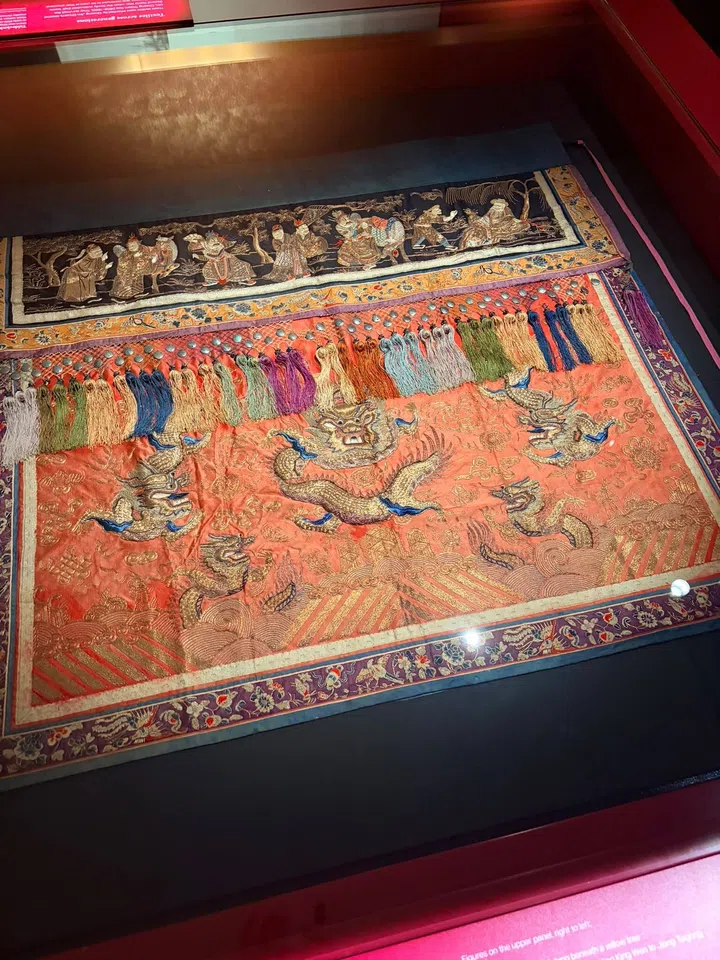
Descendants of the Hong Lim family wrote into the generic museum email wanting to donate their ancestral 桌帏 (or 'Tok Wi' in Hokkien, meaning table curtain). The top altar scene depicts a Chinese literature story of Jiang Taigong (姜太公 or 姜子牙), a retired scholar fishing without a bait and hook - alluding to the Daoist idea of non-intervention and awaiting opportunities in life. The popular Chinese idiom that follows this story is, "姜太公钓鱼, 愿者上钩". King Wen Zhou saw Jiang's act, and named him prime minister for his genius.
‘Hong Lim’ Family’s Ancestral Altar Cloth
Measuring as a monumental hanging panel of cotton, silk, and dense metallic couching, this tok wi bears the workshop stamp 李光記廠繡 (Li Guang Ji Chang Xiu, means Li Guan Ji’s embroidery workshop).
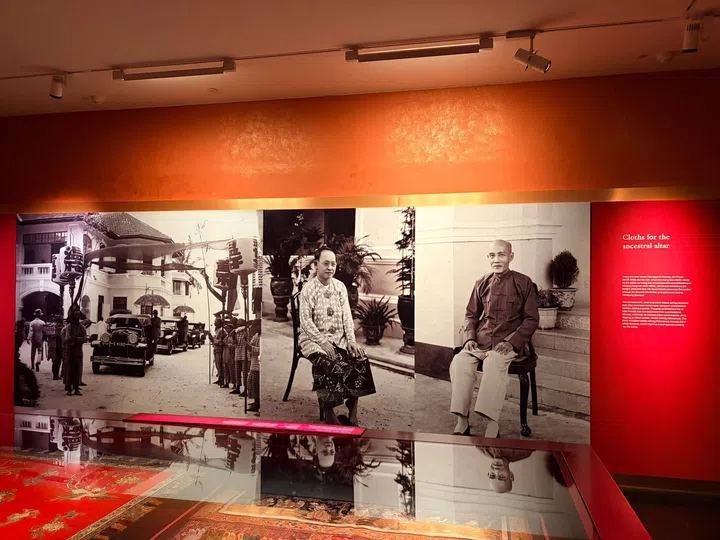
Left - wedding procession of Cheang Seok Cheng Neo (Cheang Jim Chuan's daughter) and Woon Chow Tat on 26 September 1930 outside their seafront villa in Pasir Panjang. Middle - Chan Kim Hong Neo pictured in 1929. Right - Cheang Jim Chuan pictured on 23 May 1937. Both their graves were documented to be found in Bukit Brown (hyperlinked). Photos collection of Professor Walter Woon.
Descendants of the ‘Hong Lim’ family
Furnishing the domestic ancestral altar table, the tok wi belonged to Cheang Jim Chuan (c. 1873 - 1940) - the eldest surviving son of pioneer philanthropist Cheang Hong Lim (1841 - 1893) - and his wife, Chan Kim Hong Neo (c. 1875- 1934).
Chinese literature stories like Jiang Taigong were translated to Baba Malay and widely popularised among the Peranakans.
During WWII, as the family fled their seafront Pasir Panjang villa home, they clearly took this (and the below cloth) along with them, preserving them for ancestral prayer rites (or semayang) until 1969 before they reached out via email and donated both to the National Collection.
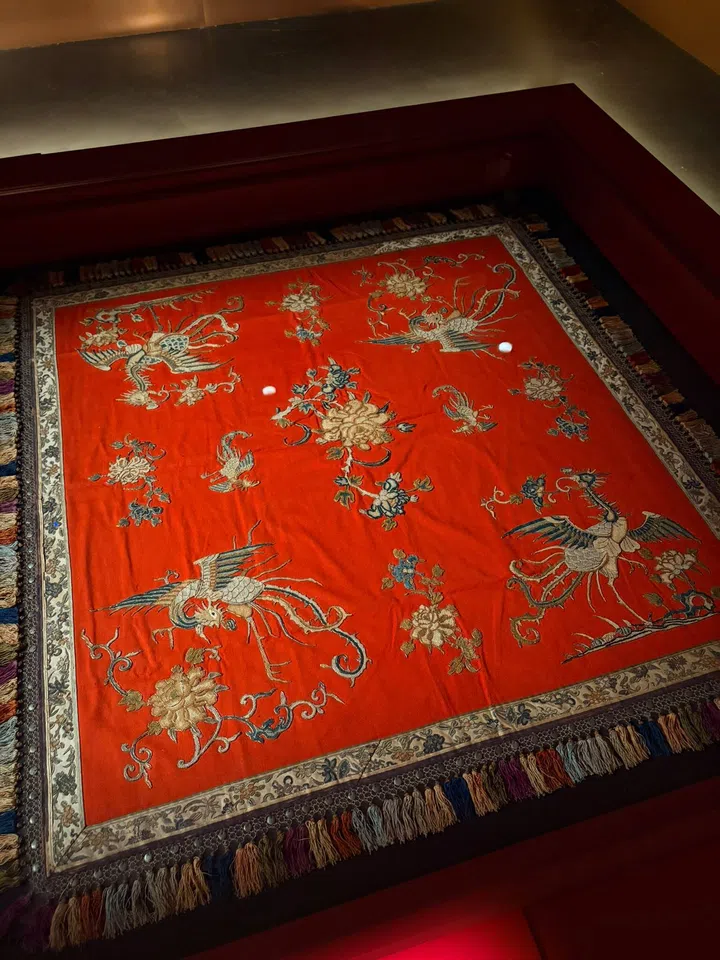
An imported European wool cloth with pre-made patterns handsewn likely by Nonyas at home. This prayer tablecloth was likely used to present food offerings for prayers.
‘Hong Lim’ Family Ancestral Prayer Tablecloth
Designed to drape over the flat altar surface for food offerings during commemorative ancestral rites, this vibrant red textile is made on an imported European wool ground.
It is embellished with prefabricated embroidered appliqué panels from China depicting symmetrical phoenixes and peonies, finished with multi-coloured fringing.
East Meets West
Demonstrating pragmatic domestic ingenuity, Peranakan women (nyonyas) frequently combined imported commercial fabrics with pre-embroidered Chinese appliqués, stitching them together locally to assemble high-status textiles efficiently.
Also preserved through wartime flight from the Cheang family’s Pasir Panjang residence, it was used continuously for sacrificial food rites and Lunar New Year celebrations into the late 20th century.
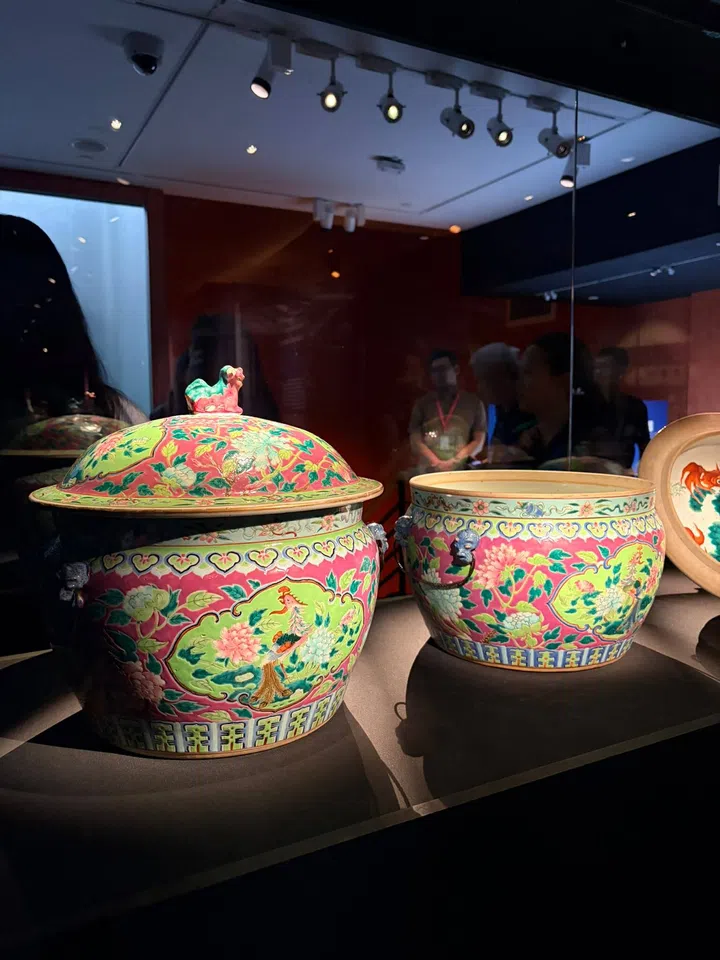
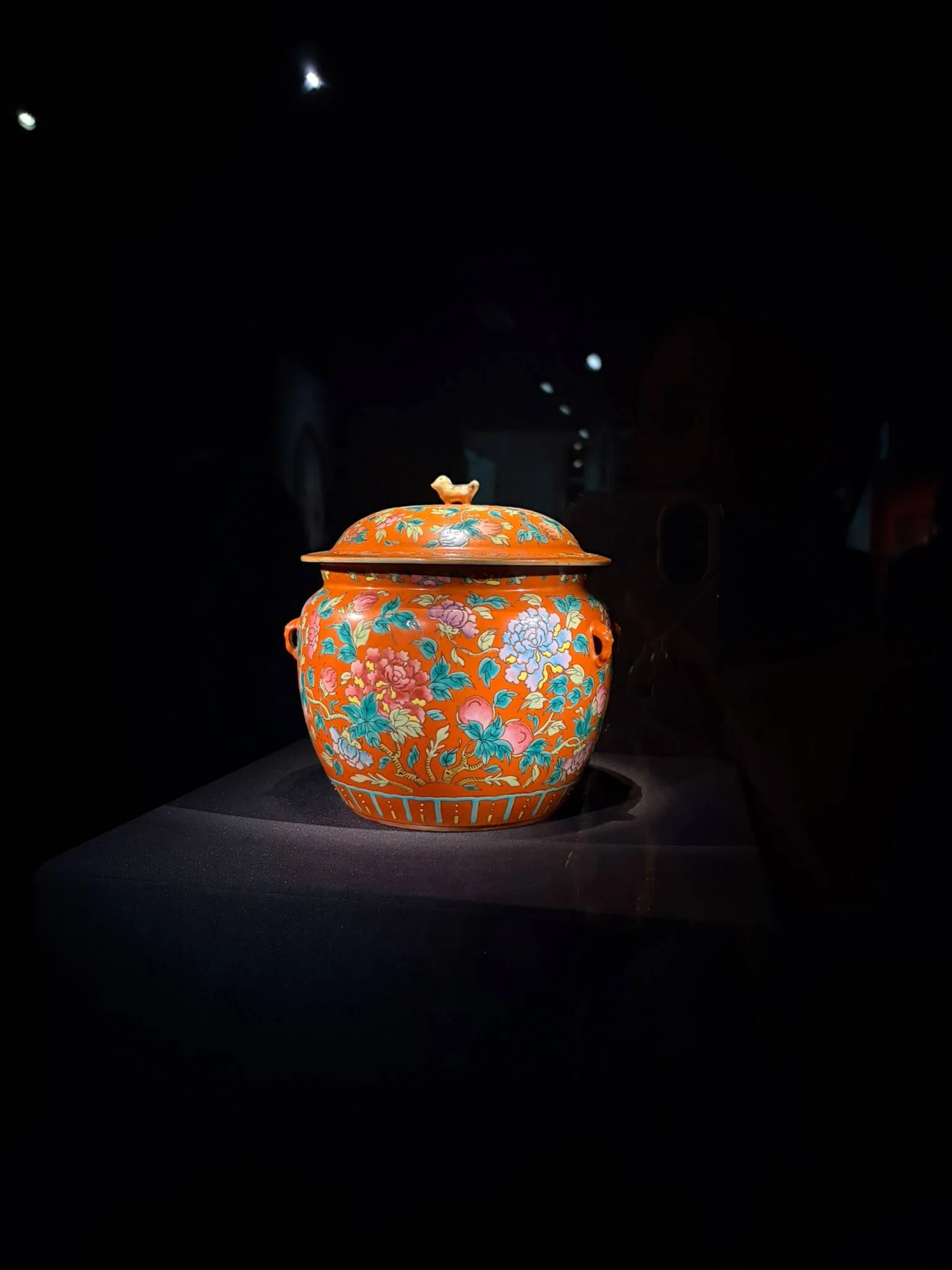
Kamchengs - Hokkien for 盖盅 (or covered vessel) - have grown to be known as quintessential Peranakan home decor. However, Naomi Wang, Senior Curator (Southeast Asia) at Peranakan Museum, clarifies that these items were likely ready-made specifically for Peranakan consumers. Throughout the years, the Museum observed more and more of the same types of kamchengs in the homes of various donors.
Perak Kapitan Cina Family’s Pair of Kamchengs (1890s)
These porcelain covered jars are decorated with vibrant phoenix and peony motifs set against striking lilac and green grounds, with depictions of goldfish swimming along the interior base.
The distinctive lilac hue was achieved using pink overglaze enamel - an artisanal technique introduced to China by Jesuit missionaries and perfected by Jing De Zhen potters around 1730
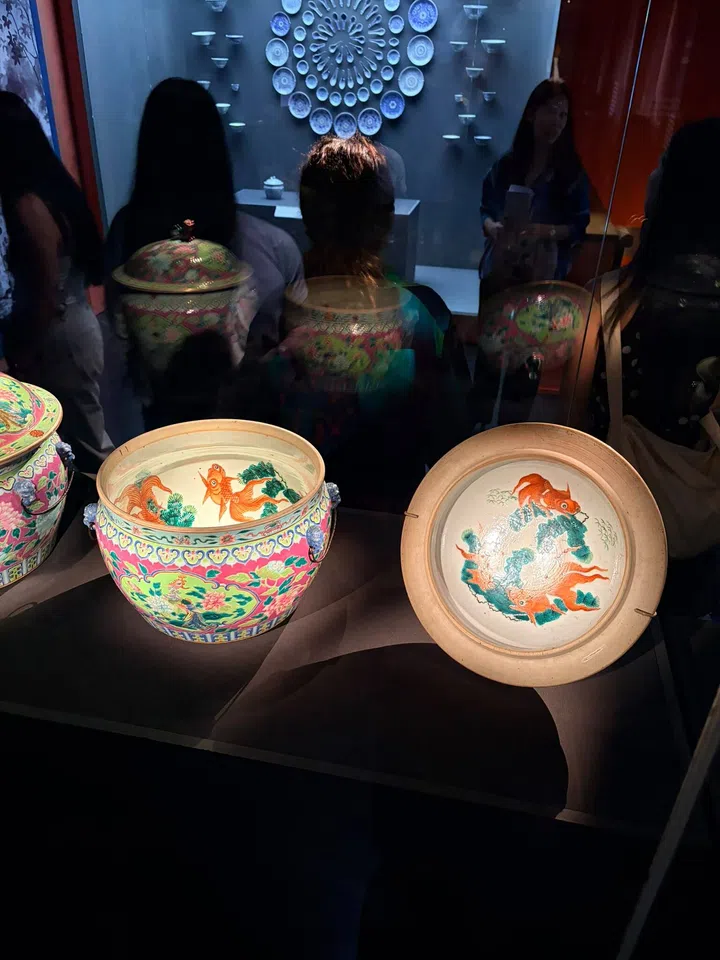
The goldfish painted inside were likely adapted from earlier Chinese export fish bowls originally destined for European markets. The lid handles feature sculpted lion dogs (石狮, or Chinese guardian lions).
Ayer Kamcheng
In Baba Malay, potable drinking water is referred to as ayer kamcheng (or ”kamcheng water”), indicating one of the primary domestic uses for these lidded containers.
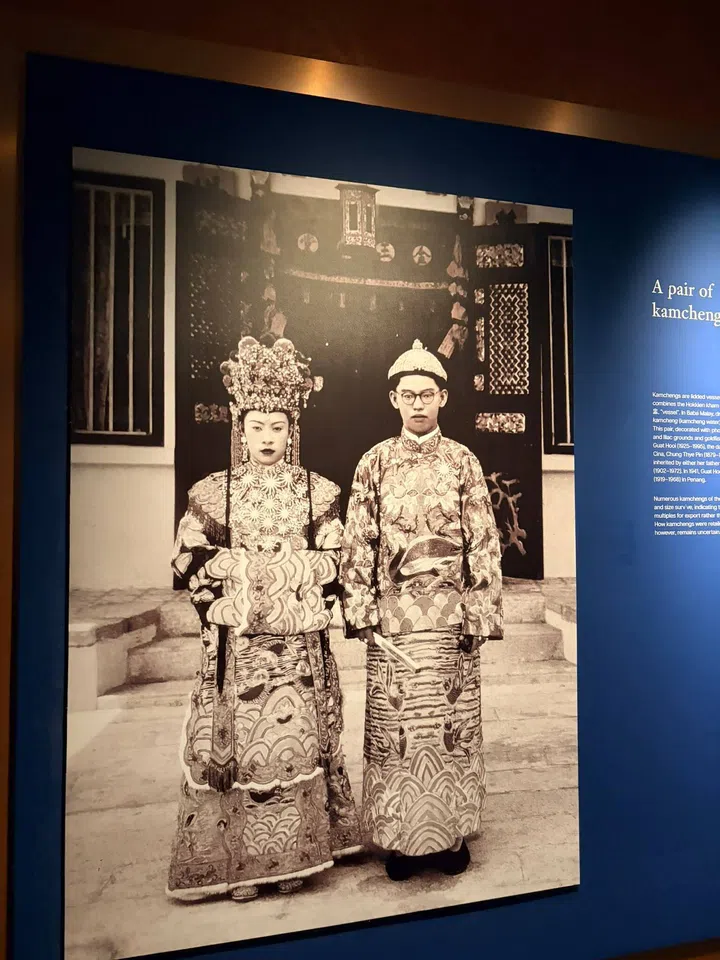
This particular pair of kamchengs belonged to Chung Guat Hooi (1925–1995), daughter of Perak’s last Kapitan Cina, Chung Thye Pin (1879–1935), and his wife Tan Sim Hiang (1902–1972). In 1941, Guat Hooi brought them into her marriage with Khoo Soo Beow (1919–1968) in Penang.
Family of Perak’s last Chinese Captain
Long considered quintessentially “Nonya ware,” vessels of this exact size, colour scheme, and design exist in multiple collections across Southeast Asia.
Their survival in matching multiples indicates that they were not individually commissioned heirloom pieces, but rather high-end export wares mass-manufactured in China specifically for the Southeast Asian market, illustrating the blurred line between commercial trade goods and cherished family heirlooms.
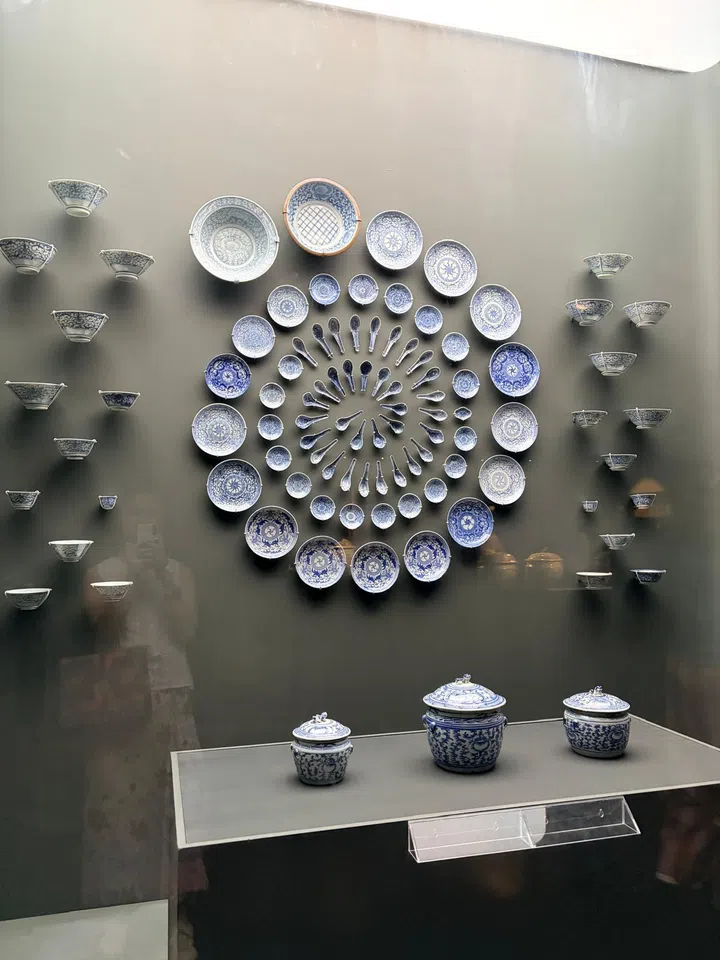
In Baba Malay, Chinese blue-and-white porcelain featuring continuous scrolling floral patterns was referred to as pinggan mangkok batek (literally "batik ware" or "batik plates and bowls"). Peranakans adopted this colloquial name because the flowing, organic vines and floral decorations appeared strikingly similar to the sinuous patterns found on regional batik fabrics
Batik Ware: Blue-and-White Porcelain
While popular culture frequently associates the Peranakan dining table exclusively with bright, polychromatic enamel porcelain, blue-and-white batek ware was in fact ubiquitous across Straits Chinese residences throughout the 19th and 20th centuries.
The three kamchengs displayed in the foregrounf belonged to Tan Quee Kee (1913–1992), who received them from her mother. The family used them for ancestral worship and to store condiments in the kitchen.
During the 19th century, these wares were exported hand-painted from kilns in China.
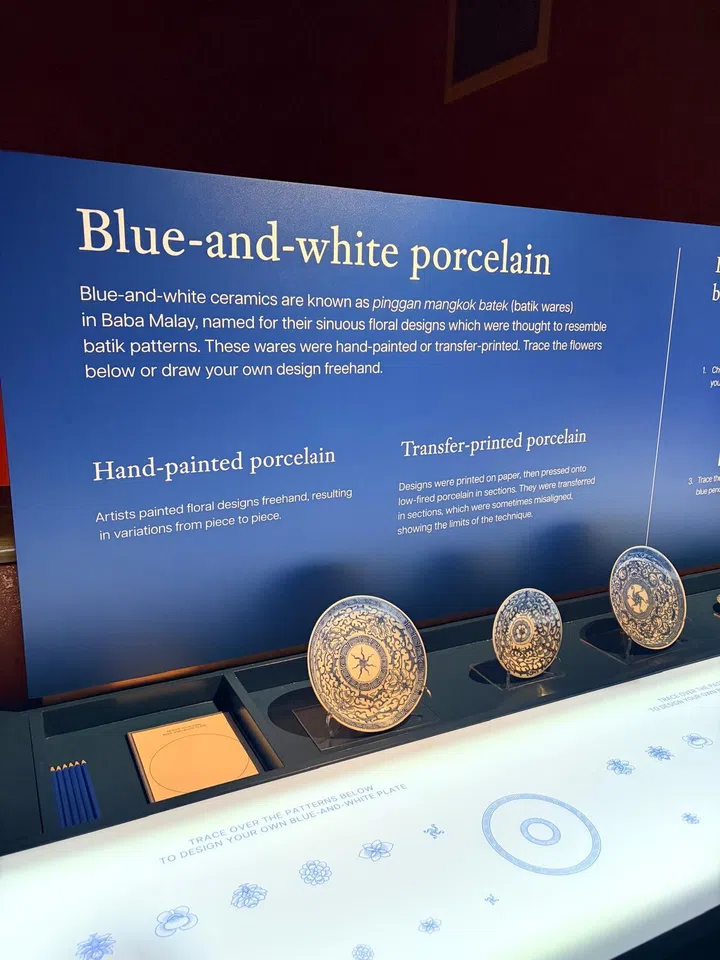
Visitors get to investigate the mechanical transfer process that often left distinctive visual traces, such as noticeable misalignments where different printed decals overlapped or met at seams.
By the early 20th century, manufacturers integrated industrial transfer printing techniques. This decorative method allowed factories to produce batek utensils much more quickly and at a fraction of the cost, making them affordable to a broader spectrum of society.
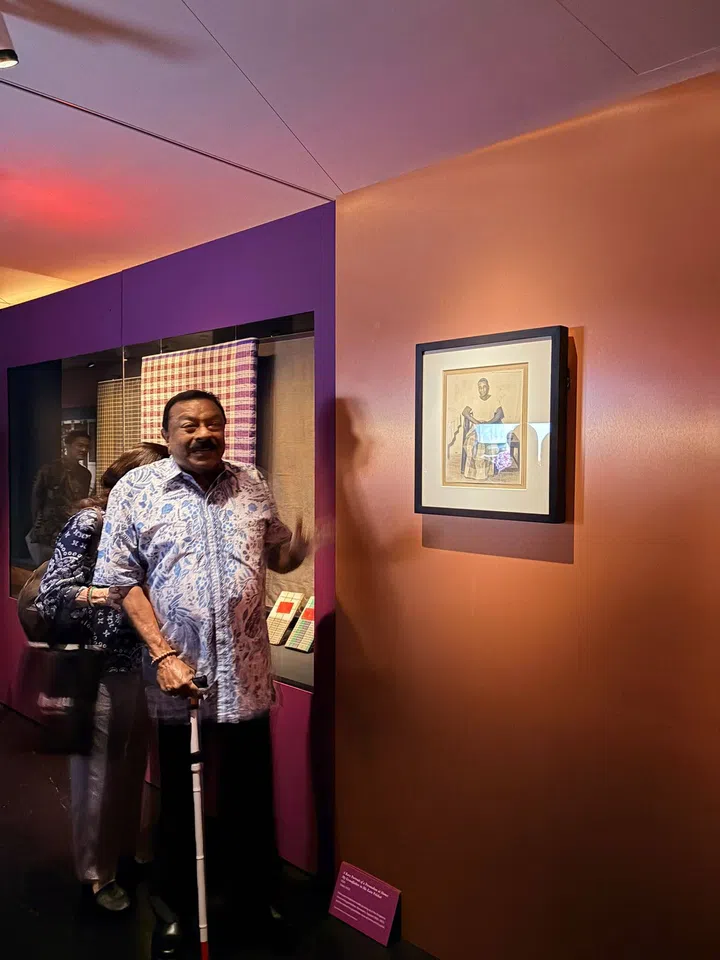
Ponnusamy Kalastree (or Baba Ponno Kalastree) is the President of the Peranakan Indian (Chitty Melaka) Association in Singapore. He talked us through his grandfather, Ramasamy Suppiah Naidu (1893 - 1967)'s portrait and Kain Pelekat that's exhibited in the Peranakan Museum.
Who is ‘Peranakan’?
The word “Peranakan” is derived from the Malay and Indonesian root word anak (”child”), broadly translating to “locally born” or “native of.”
Historically, it refers to descendants of foreign traders - primarily Chinese, but also South Asians, Arabs, and Europeans - who settled in maritime Southeast Asian ports such as Malacca, Penang, Singapore, and coastal Java, intermarrying with local women.
This sustained cultural synthesis produced distinct creolised communities, notably the Peranakan Chinese (Baba-Nyonya), Chitty Melaka (Peranakan Indians), Jawi Peranakans (Indian-Muslim descendants), and Kristang Eurasians.
Rather than denoting an exclusive bloodline, Peranakan identity is culturally defined through syncretic languages (such as Baba Malay), hybrid material culture, layered culinary traditions, and customs that blend indigenous Southeast Asian heritage with ancestral and colonial influences.
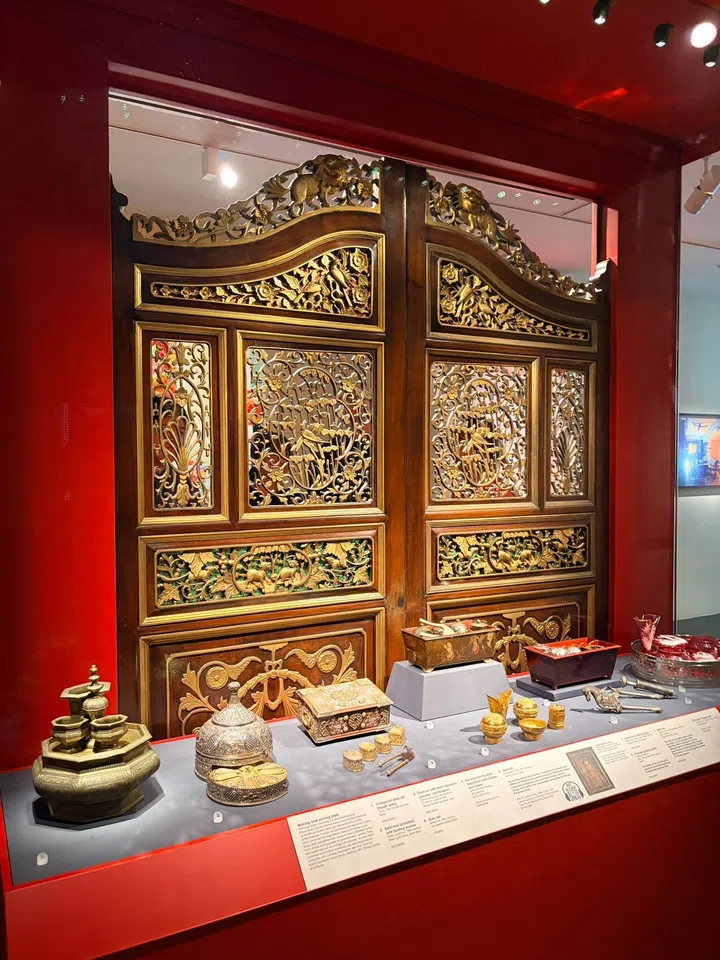
There are more Peranakan home fixtures and furniture in the permanent collections at the Peranakan Museum.
Peranakan Museum was formerly ‘Tao Nan School’ in 1912
Housed along Armenian Street in the stately 1912 neoclassical edifice of the former Tao Nan School, the Peranakan Museum houses one of the finest public collections of Peranakan ethnography in the world.
Singapore maintains dedicated community heritage institutions managed or supported alongside the National Heritage Board. Here are other cultural centres you can explore, too:
- Chinese Heritage: Sun Yat Sen Nanyang Memorial Hall in Balestier (a colonial villa tracing Singapore’s connection to regional Chinese revolutionary history and early overseas Chinese communities) and the Singapore Chinese Cultural Centre in the Central Business District.
- Malay Heritage: Malay Heritage Centre, situated in Kampong Gelam within the former 19th-century Istana Kampong Gelam (the historical seat of Malay royalty in Singapore).
- Indian Heritage: Indian Heritage Centre, located in Little India, exploring the multifaceted history, culture, and diasporic connections of South Asians in Southeast Asia.
- Eurasian Heritage: Eurasian Heritage Gallery, housed at the Eurasian Community House along Ceylon Road in Katong, documenting the roots, lifestyle, and wartime sacrifices of Singapore’s Eurasian community.