
Rising Demand for Circular Furniture in Southeast Asia: QORE Founder, Jatanat Suppipat, Weighs In
By Guanlin Tan -
Share this article
For a long time, choosing sustainable furniture meant making compromises - trading refined textures and sleek finishes for rough, heavy-handed pieces that screamed “recycled plastic.” But a major shift is happening in contemporary interior design, where eco-conscious materials are stepping up to replace traditional stone, timber, and laminates without sacrificing an ounce of luxury.
At the forefront of this movement is QORE, a design-led circular-material platform bridging industrial recycling with fine woodworking craftsmanship. Operating out of Samut Sakhon, Thailand, QORE transforms unconventional waste streams (like coffee chaff, post-consumer food packaging, rPET, and eggshells) into highly durable, architectural-grade surfaces and ready-to-place furniture.
We reached out to Jatanat Suppipat (Jade), Founder & Director of QORE, to discuss how the brand is elevating circular design, expanding its footprint into Singapore, and proving that sustainability can serve as a home’s most sophisticated feature.
What’s your background before QORE?
Jatanat Suppipat (Jade), Founder & Director of QORE: My transition into circular materials began directly on the manufacturing floor. Before QORE, I founded a design-led furniture studio supplying high-traffic hospitality and commercial spaces across Southeast Asia. Working closely with interior architects and the F&B sector exposed me to the immense volume of post-consumer waste generated daily, and sparked an obsession with transforming those discarded materials into high-end architectural surfaces.
The central challenge was clear: Could waste be re-engineered into sophisticated, highly durable materials that homeowners and designers actively covet rather than merely settle for? Alongside my co-founder, we initiated rigorous material R&D, combining industrial recycling processes with bespoke craftsmanship to birth QORE.
Traditional recycling often results in downcycled, heavy-handed items that still scream “recycled plastic.” The material changes form, but lacks tactile refinement or aesthetic sophistication.
At QORE, we elevate waste into luxury-grade finishes. We engineer architectural panels and furniture pieces with such precision that their origins feel like a hidden luxury detail rather than a compromise, whether it is a custom kitchen island, a feature wall panel, or a sculptural dining seat.
What is in the name “QORE”?
Jatanat Suppipat (Jade), Founder & Director of QORE: “QORE” represents the essential spirit of our ethos: circularity at our core. We believe eco-conscious living should never require a compromise on aesthetic elegance or structural integrity. Every surface we develop is crafted to serve as a stunning design element first, backed by a compelling story of circular innovation.
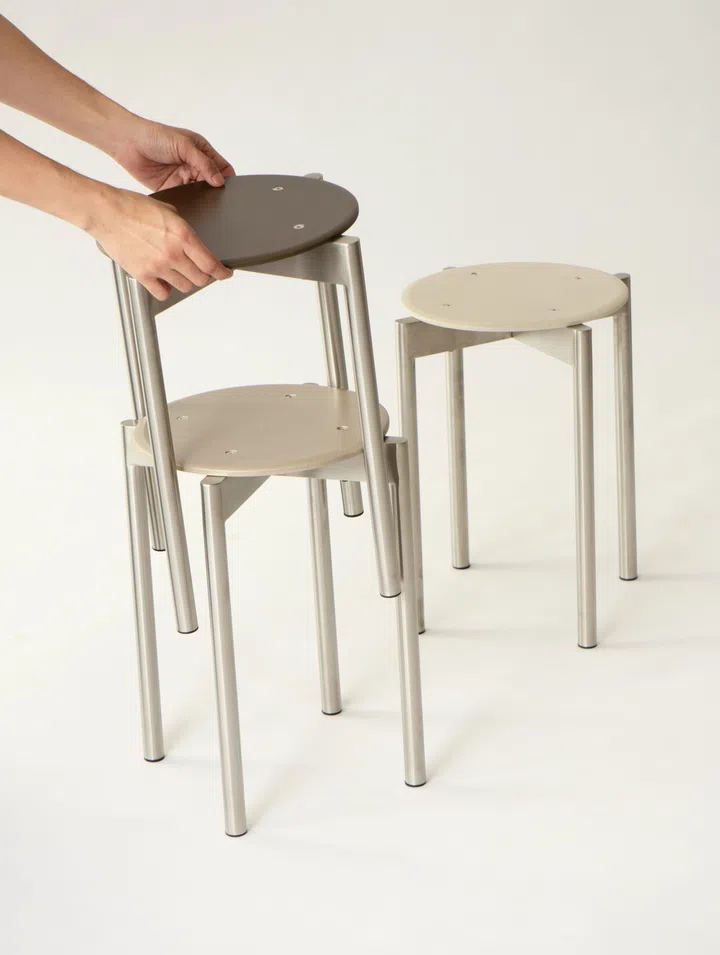
QORE 2026 Betterism Stool by QORE x Alchemist comes in a flat pack and is priced at $128 apiece.
How was the process of setting up QORE?
Jatanat Suppipat (Jade), Founder & Director of QORE: Perfecting our proprietary circular formulations required nearly a year of intensive research. We repurposed specialized woodworking machinery, precision hot presses, high-grade sanders, and custom finishing line equipment, to work seamlessly with waste-based composite matrices.
Our core strength lies in bridging material engineering with high design. Having established one of the first in-house product design teams in Thailand’s furniture sector, we approach every surface from an architectural standpoint, focusing on depth of texture, tactile warmth, and long-term functionality in modern living spaces.
We control the full creative lifecycle, from designing the raw material matrix, such as our stone-inspired Terrazzo series, to hand-curating the final interior application.
Tell us more about your QORE Facility in Thailand
Jatanat Suppipat (Jade), Founder & Director of QORE: Located in Samut Sakhon, Thailand, our facility leverages decades of advanced woodworking and precision manufacturing infrastructure. Rather than starting as a pilot lab, QORE immediately integrated recycled polymers and bio-aggregates directly into scalable manufacturing processes.
As our understanding of composite science deepened, we evolved from utilizing recycled components to formulating bespoke material surfaces, mastering color tone, grain density, and surface tactile feedback tailored for high-end interior architecture.
Our vision is to replace resource-intensive traditional stone, timber, and laminates with circular alternatives that outperform in durability while offering unmatched tactile storytelling. Expanding to mass production allows us to meet the commercial and residential demands of global interior projects effortlessly.
Your choice of waste - why these materials?
Jatanat Suppipat (Jade), Founder & Director of QORE: Our material palette reflects a curated narrative deeply tied to modern lifestyle rituals. By sourcing organic and industrial waste streams, like coffee chaff, post-consumer food packaging, and eggshells, we create materials with intrinsic organic depth, subtle flecks, and natural tonal variations that appeal to contemporary interior aesthetics.
Coffee chaff provides warm, earthy textures reminiscent of fine timber grains; upcycled eggshells produce a soft, honed stone appearance; and rPET plastic adds jewel-like flecks in modern terrazzo surfaces. Utilizing our own factory’s wood shavings closes our internal loop, ensuring every material line tells a story of refined renewal.
Could you explain the process of turning waste into 5mm–20mm architectural panels?
Jatanat Suppipat (Jade), Founder & Director of QORE: Transforming raw aggregates into refined, architectural-grade panels involves five meticulous stages:
- Material Collection & Sorting: Standardizing upcycled waste for consistent quality, color, and purity.
- Precision Compounding: Homogenizing polymers and natural fibers into uniform material matrices.
- Thermo-Compression Molding: Applying exact heat and pressure to form dense, structural-grade slabs (5mm–20mm).
- Surface Calibration & Sanding: Achieving ultra-flat tolerances and revealing rich internal textures.
- Protective Sealing & Coating: Applying protective, low-VOC surface treatments that enrich color while providing scratch, stain, and water resistance.
How do you ensure they are safe and durable (water resistance, fire-resistant, load-bearing)?
Jatanat Suppipat (Jade), Founder & Director of QORE: Rigorous engineering ensures our surfaces meet strict structural and environmental demands. Naturally waterproof, stain-resistant, and non-porous due to high-density polymer matrices, our panels excel in demanding residential spaces like kitchen backsplashes, bathroom vanities, cabinetry cladding, and custom tabletops.
By fine-tuning density and structural reinforcement during thermal compression, we tailor panels for high load-bearing needs, seamless joinery, or intricate CNC router work.
Composed of over 80% recycled content, blended with non-toxic stabilizers and UV-resistant pigments, QORE materials offer long-lasting durability against fading, moisture, and daily wear.
This allows architects and homeowners to specify QORE with absolute confidence, replacing conventional wood veneers, stone slabs, and laminates with eco-luxurious alternatives.
How has the Thai recyclables industry changed in recent years?
Jatanat Suppipat (Jade), Founder & Director of QORE: We are witnessing a major cultural shift across Southeast Asia. Discerning clients and interior architects now demand full material transparency and sustainability without sacrificing luxury aesthetics. Eco-conscious design has shifted from a niche preference to a key indicator of quality and refined living.
Recycled furniture has been trending globally. What have you observed about this trend?
Jatanat Suppipat (Jade), Founder & Director of QORE: The global circular design movement has evolved into an era of material honesty. Rather than imitating conventional marble or timber, contemporary materials proudly celebrate their origins through elegant textures, rich depth, and unique visual stories that elevate modern spaces.
Our Plain collection illustrates this beautifully: crafted using upcycled coffee chaff, its light, medium, and dark roast colorways celebrate coffee culture while delivering a warm, tactile finish ideal for residential joinery and focal walls.
To support complete design freedom, our panels come in Solid, Composite, and Core configurations, offered in finishes ranging from honed Plain to refined Terrazzo, empowering designers to seamlessly integrate sustainable elegance from built-in furniture to full interior fit-outs.
How can Singaporeans use your recycled panels?
Designers and homeowners can explore our curated range and request custom sample kits directly [from the QORE website].
In residential interiors, QORE panels shine as statement kitchen islands, bathroom vanity fronts, custom wall paneling, and bespoke shelving. Supplied as high-precision slabs, they are fabricated and installed by interior contractors just like premium stone or timber. Meanwhile, our off-the-shelf furniture pieces arrive ready to elevate living and work environments instantly.