
Share this article
The idea for local furniture brand Cellini was sparked in Italy when a young Singaporean scholar, too poor to fly home for the summer, wandered around Florence.
Tan Cheng Whatt, then studying at the Duisburg Metallurgical University in West Germany, marvelled at the engineering alchemy behind the fluid, frozen bronze of a beheaded woman with serpentine tresses.
Exploring Europe on a shoestring in the late 1960s, Tan, who was studying metallurgy on a Public Service Commission scholarship, stood transfixed by Renaissance goldsmith and sculptor Benvenuto Cellini’s Perseus With The Head Of Medusa.
“It was so fascinating – all those centuries back, they could produce scaffold sculptures,” Tan, 79, tells The Straits Times, alluding to the hidden internal scaffolding Cellini fashioned to support the massive Medusa masterpiece.
On his travels, he would also encounter British sculptor Henry Moore’s modernist, flowing silhouettes.
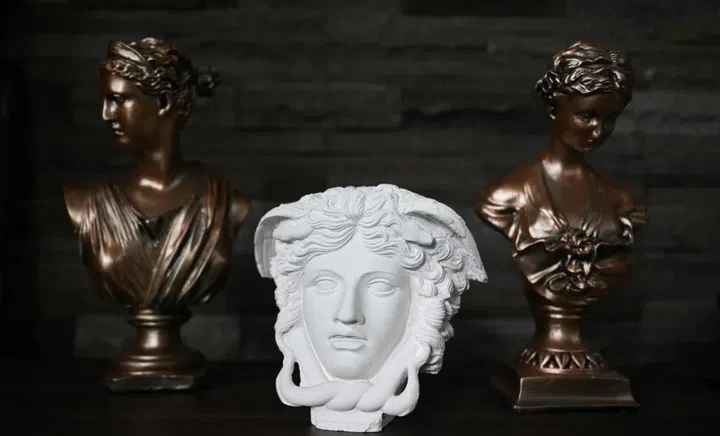
As a metallurgy student, Cellini’s founder Tan Cheng Whatt was fascinated by the engineering alchemy of the Medusa sculpture in Florence. Today, in his home workshop, he creates figurines of Medusa and other classics (above), learning from YouTube.
“I also felt I could use his organic forms to make furniture more interesting.”
Galvanised, Tan returned home with an emergent blueprint that anchored his technical roots in a love of art: Shaping heavy metals into sculptural lines for furniture.
Launched Cellini in 1986 with $180,000
In 1986, after completing his five-year bond at industrial enterprise National Engineering Services as a foundry manager and then doing a private-sector stint, he launched Singapore-built, Italian-inspired Cellini with a start-up fund of $180,000.
In October 2026, the company celebrates its 40th year, having survived recessions and ridden regional real-estate booms. Today, it operates 50 showrooms across Singapore, Malaysia, Indonesia and Taiwan.
It has six Singapore branches, including at The Centrepoint and Tan Boon Liat Building, though not everyone realises this is a home-grown brand. At Changi South Street 2, Cellini has installed its headquarters and experience centre.
Casinos and heroes
Cellini’s high-end commercial projects stretch from the casinos of Marina Bay Sands to the private island villas of Huvafen Fushi in the Maldives. Its design footprints are also traced in luxury hotels within capitals from London to Jakarta.
Behind these cross-border journeys is a “zero-to-hero” Singapore story of grit and inventive modernity that spans three generations.
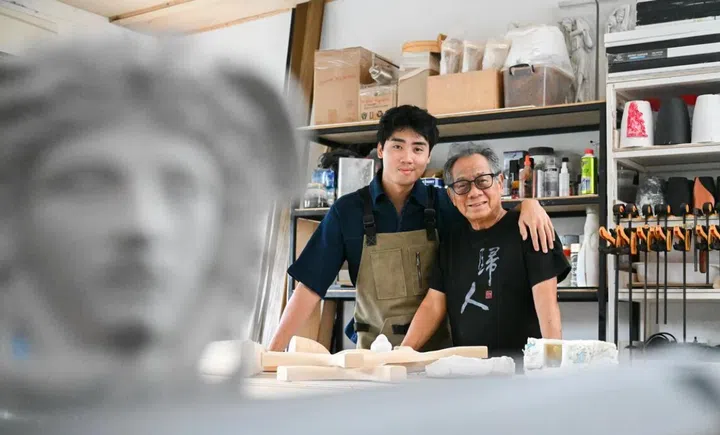
Tan Cheng Whatt and his grandson Tyrus Hong inspire each other when they work in Tan’s home carpentry workshop. A Medusa figurine, fashioned by Tan, is a mini-monument to his grit and inventiveness with furniture-making.
Tan, semi-retired for a decade, plays an active strategic role as founder, chairman and shareholder.
Daily executive operations have been passed down to his son Janssen Tan, 52, the group finance director. The founder’s daughter Janice, 51, is the group marketing director while her husband Jason Hong, 52, is the group managing director. The couple are also designers.
Their son, Tyrus Hong, 25, who trained in Lasalle College of the Arts, joined Cellini as a product designer in June.
This generation-crossing longevity springs from Tan Cheng Whatt’s tenacity. After his government and corporate jobs, he became his own boss and self-designed a furnace. It cast specialised components for industrial marine pioneers like Jurong Shipyard.
Peers questioned why a highly trained metallurgist was driving a pickup truck to deliver heavy machinery components, but he flourished.
Shipyards, then homes
Then came the watershed 1985 economic recession that wiped out shipyard orders and bruised every sector from banks to airlines. Tan reoriented from shipyards to homes the next year, tapping into another design epiphany: On a London trip, he had admired a sleek desk that used cast aluminum legs to suspend a glass top.
He recalls: “I figured out that maybe I could use my engineering components to make a coffee table.”
The coffee table, accented with curvaceous brass, intrigued the traditional timber-led marketplace. It won a bronze at the International Furniture Fair Singapore in the same year he established Cellini, and he continued to sweep awards.

Cellini casts sculptural shapes in furniture.
During the HDB boom years of the 1980s, a rotating TV console with a cassette cabinet was a bestseller for new home owners. The TV could be swivelled and the speakers angled for optimal sound.
“Everyone was talking about it,” he says of the game changer. His daughter adds: “People used to have to pre-order it. The design was futuristic because people were still buying rattan.”
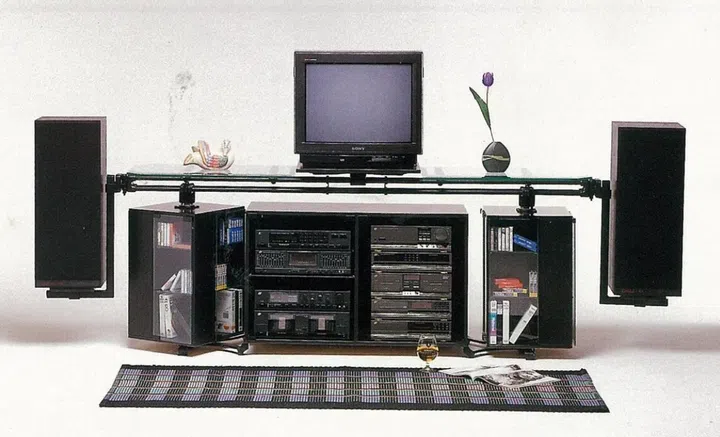
Cellini’s futuristic rotating TV Console was a top seller when it launched about 40 years ago, amid the HDB boom.
Also novel is Cellini’s business model that controls everything “from furnace to foam”.
Where furniture companies routinely outsource production, Cellini owns virtually every plant and process. Its vertical integration is exhaustive: Entire departments are devoted to foundries, chemical pre-treatment, carpentry, welding, polishing, leather-sewing, automated spring-making and more.
Rivals have been surprised by the sheer scale of the set-up in its Indonesian and Malaysian factories, according to the family.
But this infrastructure ensures pricing power and logistical flexibility. “We manufacture in-house, so we can control the timing, the quality and the pricing,” the elder Tan points out.
Among many examples are Cellini’s motorised Italian leather recliners such as the Homer, which currently starts at a discounted $1,498 for a one-seater and $2,798 for a three-seater.
A comparable European luxury import with the same materials and specifications can cost “40 to 50 per cent higher”, Janice Tan estimates. A significant cost advantage is that Cellini’s goods move directly “from factory to consumer”.
She adds: “We work directly with Italian tanneries for high quality at affordable prices, and this is the value our customers see in us.”
Owning your factories, however, can be a pricey and asset-heavy burden. During the 1997 stock market crash triggered by the Asian financial crisis, Cellini faced 11 gruelling months of unpaid rental to its landlord, the Housing Board, for its light industrial factory in Defu Lane.
There was also the Covid-19 pandemic, though it turned out to be both a low and high. Dinner conversations in the Tan family have always revolved around design and business, and this intensified during the global lockdown. They queried one another: What should we do?
Janice Tan recounts: “What do you do when you have 50 stores and zero revenue? All the stores were closed at the same time. We had salaries and rents to pay.”
She adds: “We went on a pay cut for the entire region. No one complained. They believed in us.”
‘The market is waiting’
When Singapore entered the circuit breaker during the pandemic, and showrooms darkened, the family kept up their workflow, continuously piling up inventory and saving their workers’ livelihoods.
Janice Tan says: “We had the best sales during the Covid period of 2021 to 2022. Because when everybody else was struggling with stock import uncertainties, we were building our stocks. We did not sit and wait.”
Cellini built stocks during the second and third quarters of 2020, she elaborates, and this paved the way for sales revenue to spike significantly in the next two years, with Singapore sales increasing by 40 per cent in 2021.
It was a masterstroke. When global supply chains convulsed, Cellini was still able to deliver. People had to push on with delayed renovation plans and needed furniture. Meanwhile, global supplier China was still closed, so its pipeline of furniture was choked.
Survive, and better times will arrive, her father says. “The market is waiting for you.”
It is also true of today’s uncertain times, and he points to the lingering Middle East conflict and China’s property crash. The collapse of China’s housing market has hollowed out home consumerism, forcing the overcapacity into international markets. This includes furniture dumping.
In good and bad times, his priority is unyielding: Care for the staff. A number have been with Cellini for 30 to 40 years.
He still employs a 76-year-old carpenter, who needs an assistant as he can no longer haul heavy things.
Tan reasons: “This guy supported you for so many years. So you just have to bear it for another couple of years until his children finish school.” The worker married late, so Tan will wait till his last child graduates from university.
Two of Tan’s younger brothers have also worked with Tan, who is the second of 12 siblings, since Cellini’s inception. Jimmy Tan, 73, is the vice-deputy chairman while Tan Cheng Liang, 69, is a director.
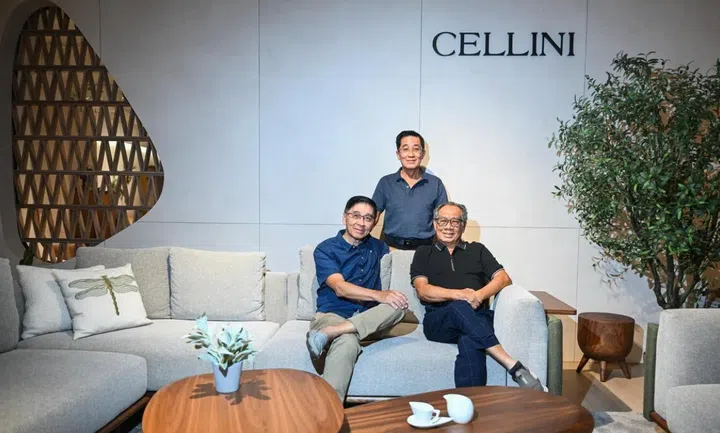
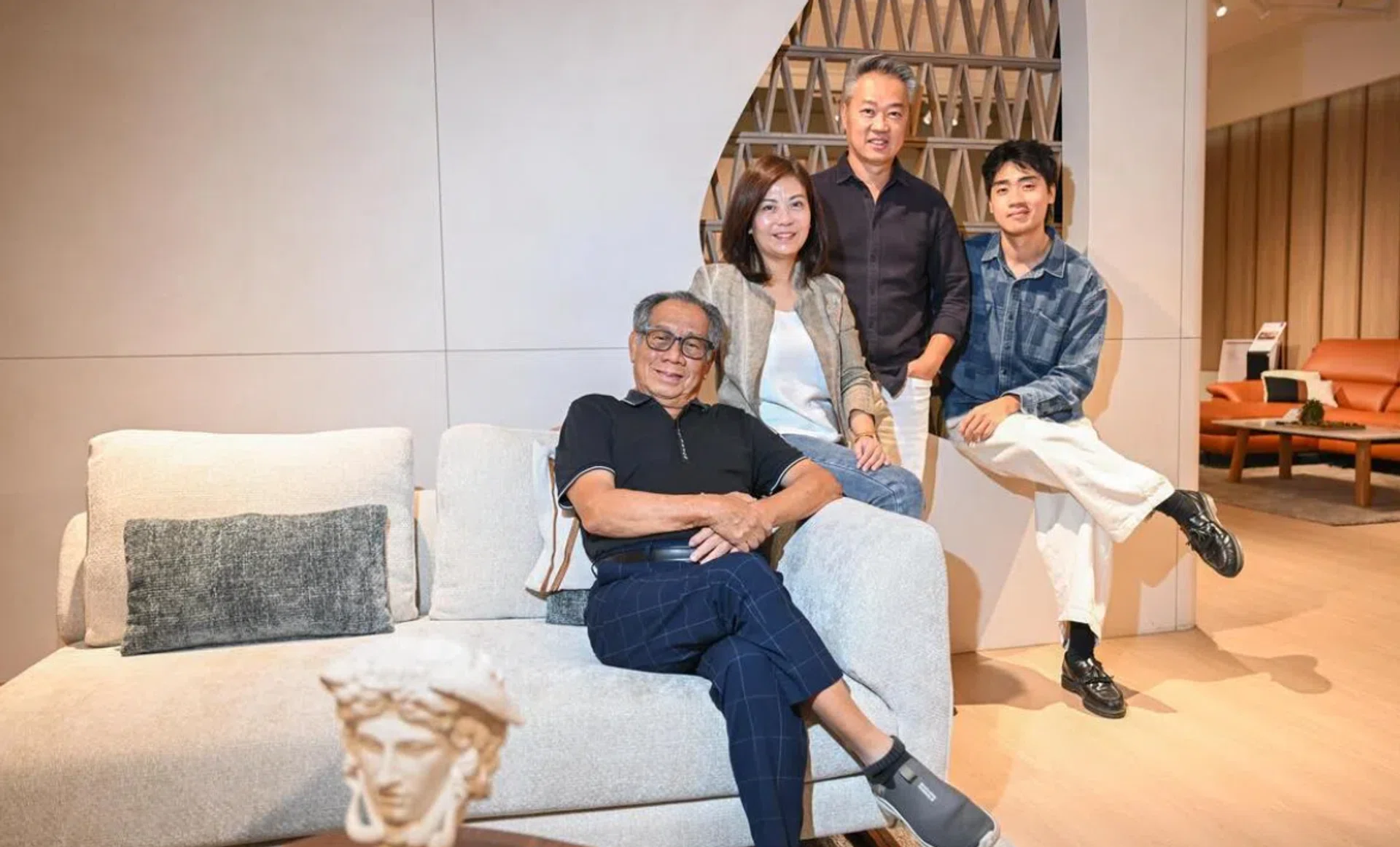
Cellini founder Tan Cheng Whatt (seated, right) with his younger brothers Jimmy Tan (seated, left) and Tan Cheng Liang (standing), who have worked alongside him since the brand’s inception 40 years ago. They are grouped around Cellini’s Celadon modular fabric sofa.
Shrinking spaces, staying relevant
Cellini and its teams, blessed with longevity, are not standing still. But while they innovate, they will not chase trends.
Instead, the brand targets modern pain points. It continuously collects floor plans, scaling the furniture collections proportionally so buyers can afford premium quality without crowding their compact living spaces.
It has retooled its catalogues with savvy, space-saving storage bed-lifts designed for tight apartment floor plans, for example, and launched premium modular wardrobe ranges starting from $640.
Pet lovers choose from a selection of high-performance scratch-resistant fabrics for their sofas.
The company also planned cross-selling collaborations with brands like Dyson and Oak & Sand.
In his sunset years, Tan is never inactive.
Learning from YouTube, he crafts figurines and leather handbags in two workshops at home. His Changi bungalow is a gallery for his acrylic-pour paintings. Pastel, calligraphic and photographic art line his walls, all his work.
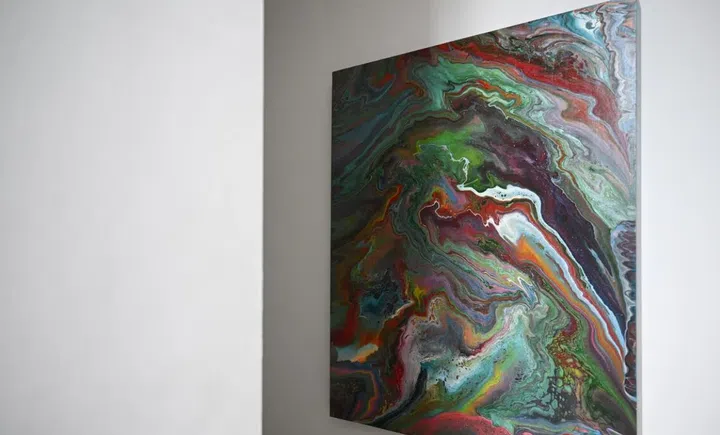
Cellini founder Tan Cheng Whatt’s home is filled with his artworks, such as this acrylic pour painting.
His grandson Tyrus joins the patriarch in the home carpentry space, where they inspire each other.
When the young man worked on a school project that combined recycled plastic with wood, his grandfather taught him about wood joinery. Tyrus says: “I took the idea and hybridised it with a welding method.”
Tyrus remarks: “I consider him quite a sculptor. He may not work like conventional designers – it’s more like ‘let me see and figure it out’.”
Designers can overthink and take too long to “plan, plan, plan”, he observes, but not his grandfather.
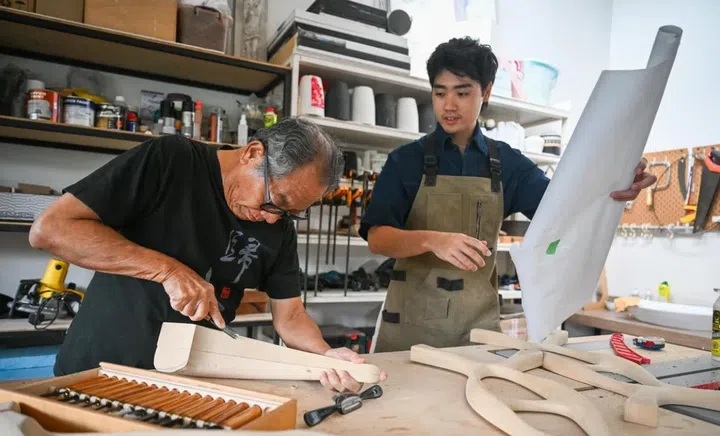
Tyrus Hong and his grandfather Tan Cheng Whatt inspire each other when they work in Tan’s home carpentry workshop. A Medusa figurine, fashioned by Tan, is a mini-monument to his grit and inventiveness with furniture-making.
And so four decades after Medusa captivated Tan, the circle has closed, with Tyrus’ arrival on the scene. Little replica sculptures of Medusa, made by Tan, are displayed in Cellini’s showrooms.
For the once-broke student, Medusa’s serpentine crown is no longer a symbol of distant European mastery. It is Tan’s mini-monument to 40 years of mettle, and a reminder that Cellini is forged in the fire of his own foundry.
This article was first published in The Straits Times.