
The Breeze Block House: When his father refused to move in with him, this son rebuilt his childhood family home instead
Returning to the terrace house where he grew up, this homeowner worked with YWA Studio to transform an ageing family home into a calm, carefully planned space for three generations.
By Gwyneth Goh -
Share this article
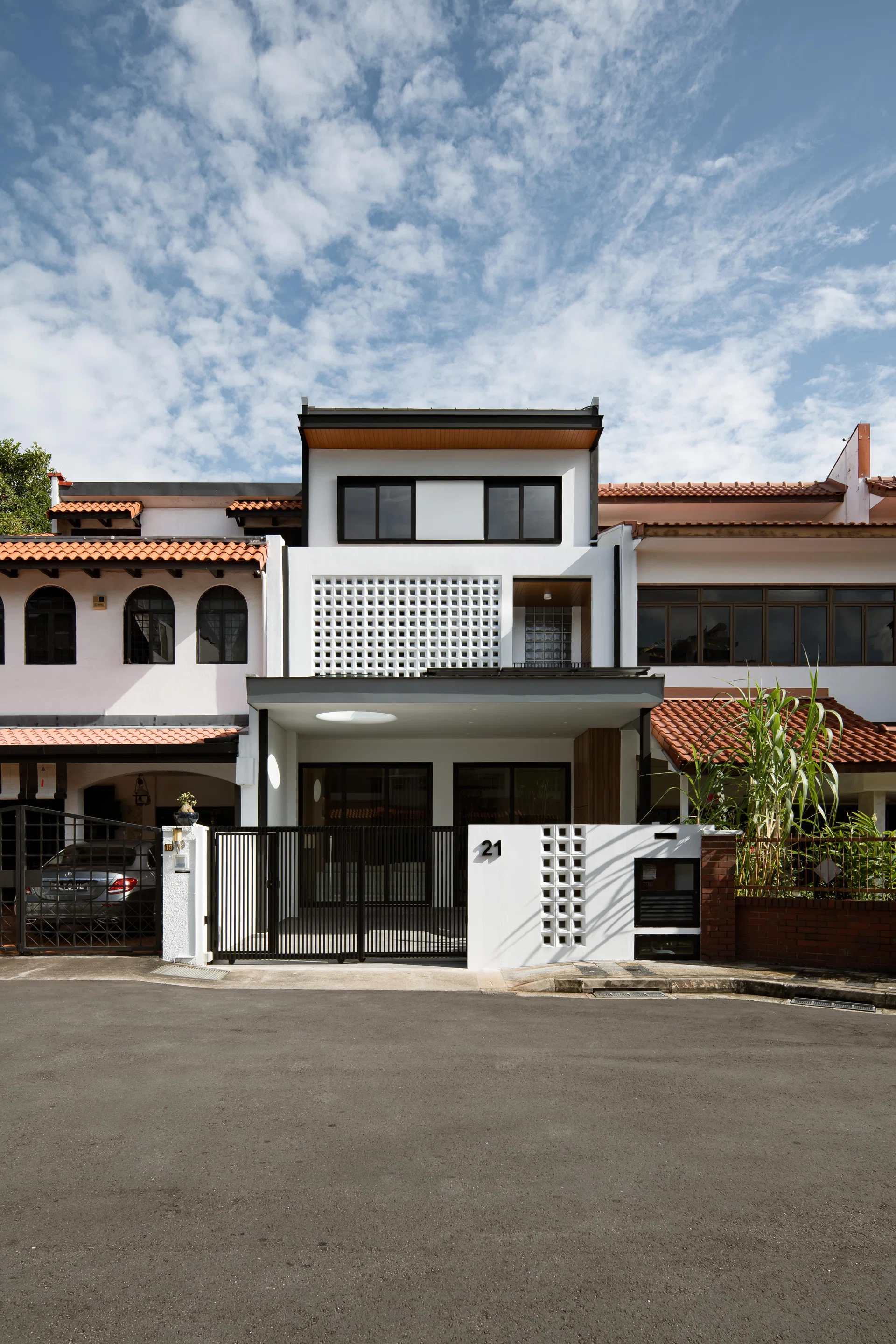
Fondly dubbed the Breeze Block House by YWA Studio, this Lorong Kembangan terrace house stands apart from its older neighbours with its crisp white façade, geometric screen, and clean contemporary lines. But behind the architectural transformation lies a far more personal story.
Returning to the home where he grew up, the homeowner and his wife engaged YWA Studio for a full addition and alteration (A&A) project—with the architecture firm reworking both the building envelope and interiors to create a calm, carefully planned home for three generations.
“This is actually my family home growing up,” says the homeowner. “This was my mum and dad’s place.”
The couple’s first marital home was, as they put it, “the typical HDB, the first BTO people buy when they first get married.” But as their family’s needs evolved, so did the idea of what home should look like. The move back was prompted not only by the practicalities of raising children, but by the reality that his father was living alone after his mother’s passing.
“The shift really was to deal with the kids and the fact that my dad was all by himself,” he says. “My mum had already passed. He had no helper and he would not come and join us.”
So instead, they returned to him.
For YWA Studio principal architect Tan Yue Wei, the brief was never simply about modernising an ageing house. The challenge was to create a home that could accommodate very different routines and needs across generations, balancing privacy with connection while working within clear spatial and budget constraints.
“The key planning strategy for the house was to address their lifestyle needs,” Yue Wei says. “We understand the importance of strategically planning for private spaces and also places for interaction. This is key for harmonious living.”
Who Lives Here: A couple working in legal and engineering, their two children, and the homeowner’s father
Home: Terrace house in Lorong Kembangan
Size: Approx. 3,445 sq ft
Interior Designer: Tan Yue Wei, YWA Studio
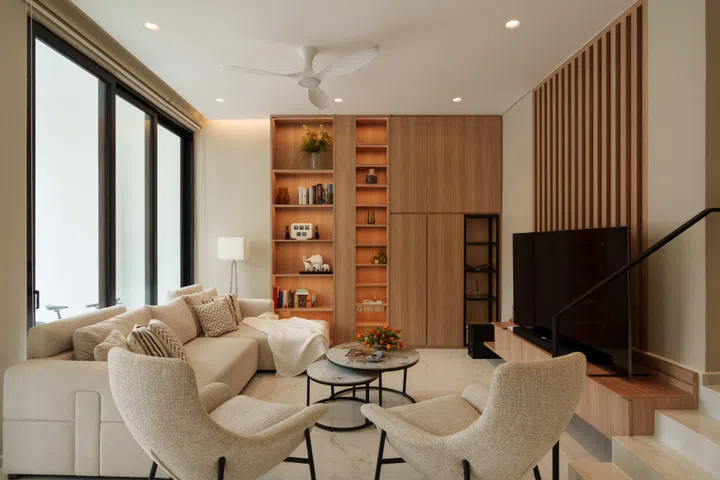
The rebuilt home balances openness with carefully defined zones, allowing three generations to live together while maintaining a sense of privacy and calm.
Planned for real family life
For all its calm restraint, the home was shaped by a highly practical brief.
The homeowners needed enough room for an elderly parent, themselves, their two children, and a helper—without the house feeling over-compartmentalised or crowded. That meant careful spatial planning and strategic decision-making about what to change, and what to work with.
One such decision was the split-level configuration between the communal spaces. While some homeowners choose to level older terrace houses entirely for accessibility reasons, Yue Wei explains that doing so here would have required significant structural intervention.
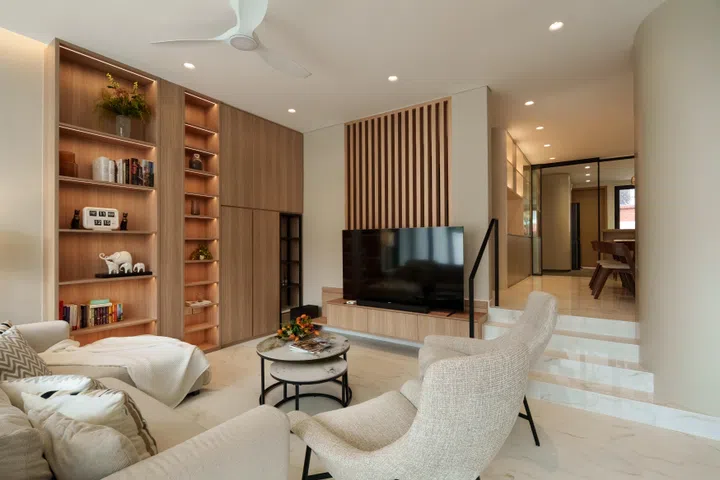
Rather than flatten the original split-level layout at significant cost, YWA Studio worked with the home’s existing structure, using the change in level to gently separate the living and dining areas.
“A lot of homeowners now realise it’s an issue of safety also for the elderly,” he says. “Most of the requests are for the rear to be hacked down, but this is not possible because they already have the structural beam underground which is integrated into the whole house.”
“It’s not impossible to change, but the amount of cost makes it something people would not want to consider, especially when it comes to an A&A renovation instead of a tear down and rebuild.”
The alternative was no more practical. “The only way to level it would be to raise the front portion, which would make the headroom extremely low, so that was thrown into the bin.” Instead, YWA Studio embraced the level changes as part of the spatial planning, allowing the shared zones to feel distinct without closing them off.
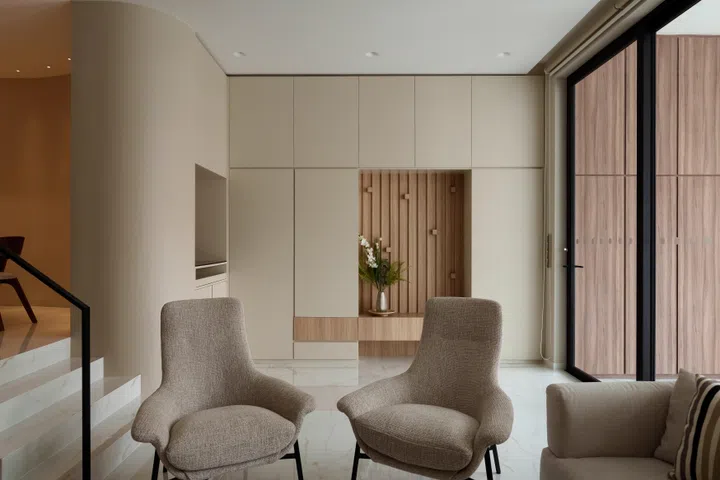
Full-height built-ins and carefully integrated storage keep the shared family spaces calm and uncluttered, despite the demands of multigenerational living.
Beyond the structural constraints, YWA Studio also worked through the practical demands of daily multigenerational living with a highly storage-conscious plan. “Upon entry we introduced a lot of space for shoes and also a shoe cabinet on the outside,” says Yue Wei. “We introduced storage spaces to the right of the living room after you enter—a full run of cabinets.”
Good planning rarely calls attention to itself. Here, it simply creates a home that feels calm, intuitive, and easy to live in. “It’s not very fussy, the space,” the homeowners say. “The place is very relaxing to come home to.”
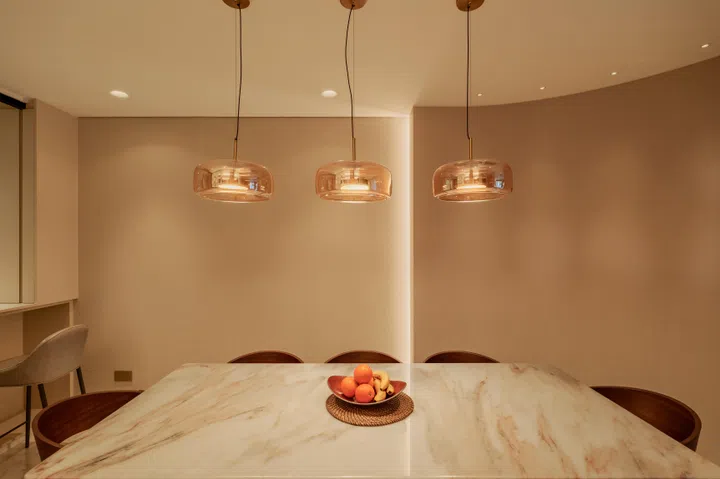
Positioned between the living room and kitchen, flanked by a curved wall, the dining area was conceived as a more intimate enclave.
An intimate dining enclave
“We introduced an L-turnaround which was for the altar they wanted” Yue Wei explains, “At the same time, we used the altar to screen off the dining space to give it a little bit of privacy and have an enclave setting where they were embraced by a curve in the carpentry.”
That sense of enclosure was entirely intentional. “I always see introducing curves into a space as an embrace,” he says. “Understanding humans still have a certain level of raw instincts, sometimes backing away into a cave gives you a sense of safety, so with introduction of curves like these, you feel protected.”
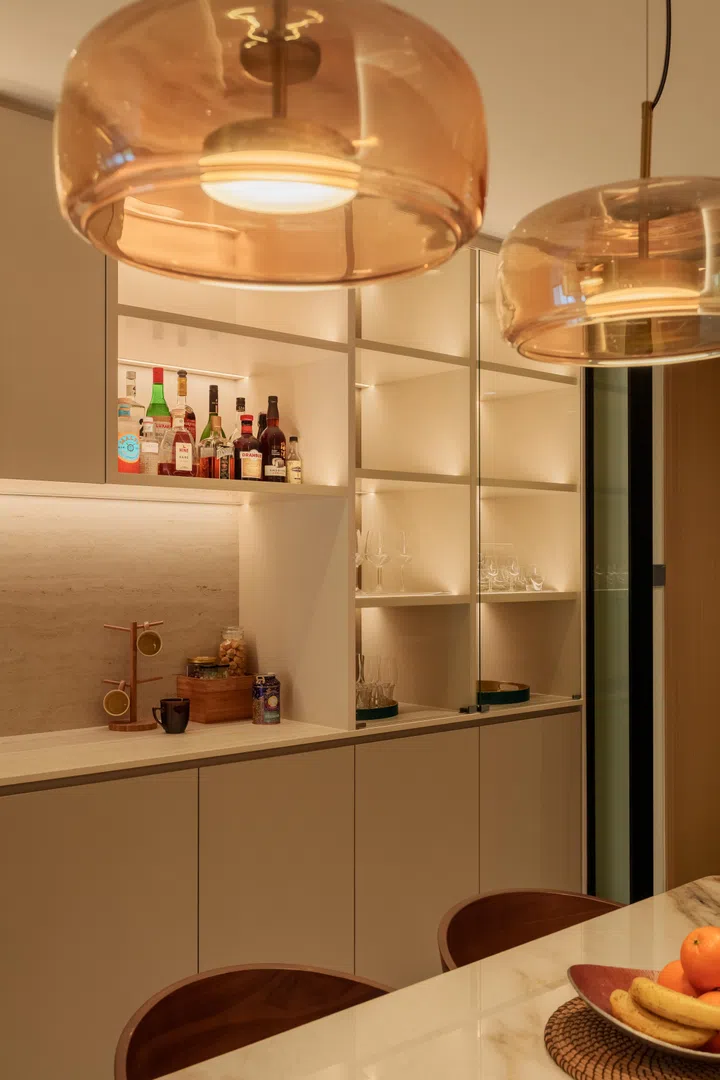
Amber-toned pendant lights and softly backlit cabinetry lend the dining space a warmer, more hospitality-inspired atmosphere.
Entertaining is an important part of the family’s lifestyle, and this is where guests naturally gravitate. “We like hosting,” say the homeowners. “Fairly frequently, friends and colleagues come over. Once every couple of months, we’ll have a big group.”
“My friends just come over to drink,” adds the homeowner with a laugh.
“People just congregate around the dining table,” they say. “That’s a central space that they will come to.”
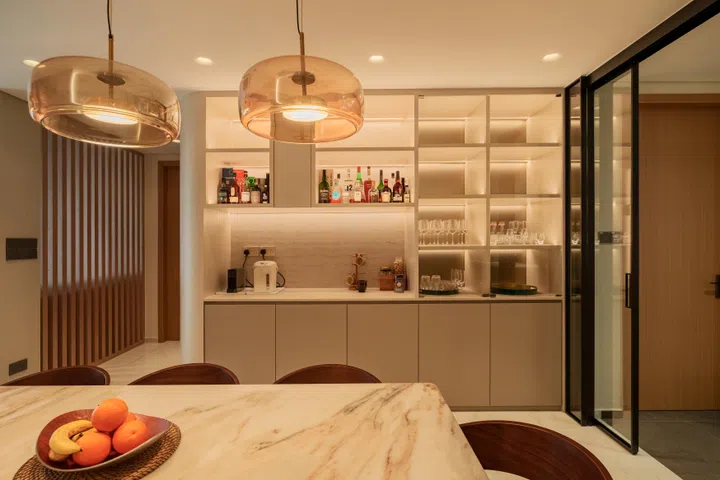
Integrated storage, softly lit shelving, and a drinks station make the dining enclave a natural gathering point for both everyday family meals and regular hosting.
Rather than leaving the dining area fully exposed within the open-plan layout, the curved wall intervention gives it a quieter sense of intimacy and privacy—somewhere everyday meals can feel slightly set apart from the busier rhythms of family life.
Beside it, integrated cabinetry functions as pantry and entertaining station, making the dining area a natural gathering point when friends come over.
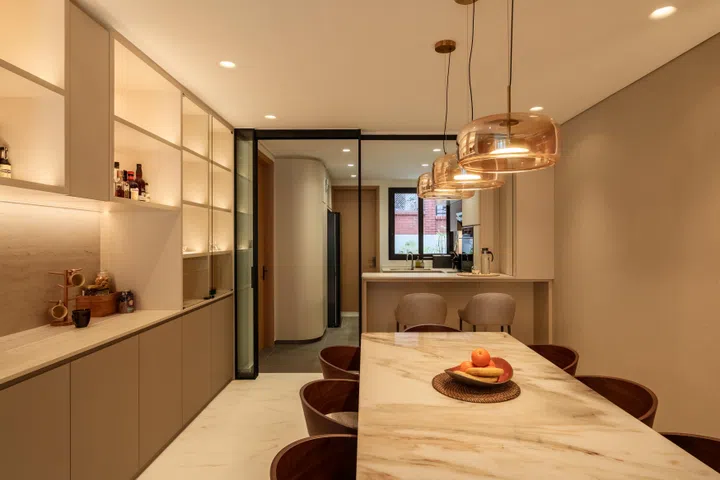
A breakfast counter and concealed glass partition improve connectivity between the kitchen and dining area, allowing conversation to continue while cooking.
A kitchen made for daily use and easy company
Unlike many contemporary homes where the kitchen functions more as a visual showpiece, this was always going to be a hardworking space. “With this family, I understand they cook almost every day so this is a very important space for them,” says Yue Wei.
The original kitchen, however, worked against the way they lived. “The kitchen was very small and it lacked connectivity with the dining spaces,” he explains. “The homeowner enjoyed cooking, but appreciated not being isolated from the family while cooking—he wanted to be present with the family even while cooking. They also like to have guests over sometimes, so being able to chat with them and entertain them while cooking was important as well.”
That became a key design driver. The kitchen was enlarged, but more significantly, carefully customised around how the homeowners actually cook and host. “What really changed was the customisation and bespoke approach to his cooking requirements,” Yue Wei says.
One of the most practical additions is the movable island. “The island is actually built on rollers so you can move it around, but most of the time it’s locked,” the homeowner shares. “It’s very tiny but we can put all our sauces on it. I think it’s only maybe 20–25cm wide, 90cm long. It doesn’t feel like a lot but when you’re working in the kitchen, you can put your chopping board, your stuff. It just makes things a lot easier because it’s a very small kitchen.”
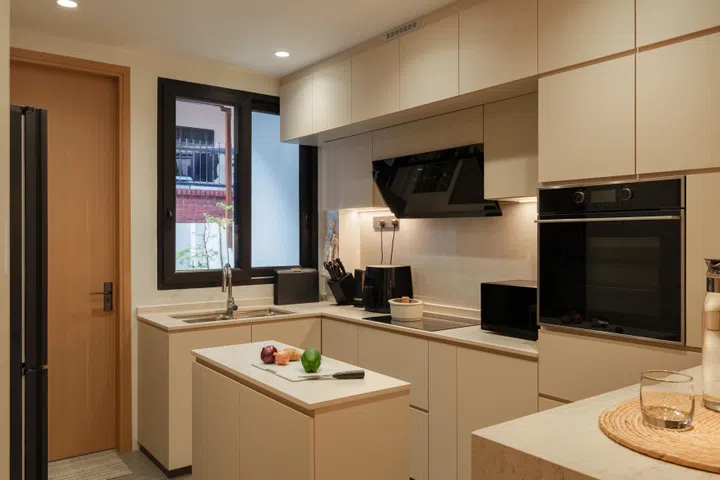
Customised around the family’s cooking habits, the compact kitchen includes a movable island that adds valuable prep space without permanently taking up floor area.
He admits he had initial doubts about fitting everything in. “Initially I looked at Yue Wei and said, ‘No way you can fit in a bar counter.’ He actually managed to squeeze in a bar counter and an island as well, so we have a lot of counter space.”
That breakfast bar has quickly become one of the most used spots in the house. “My daughter loves the bar, and has her breakfast there every day—favourite spot. Weekends, she will have breakfast there by herself, take her time.”
Just as important was balancing openness with practicality. A concealed bifold glass panel above the breakfast counter and a sliding glass partition allow the kitchen to connect visually with the dining area while still containing smoke and odours when needed. “If I’m cooking in the kitchen, I can still hear what’s happening, it’s very cosy,” the homeowner says.
The setup has already been well tested. “We hosted quite a few rounds over CNY, steamboat. We’ve also catered—that also is easy to deal with.”
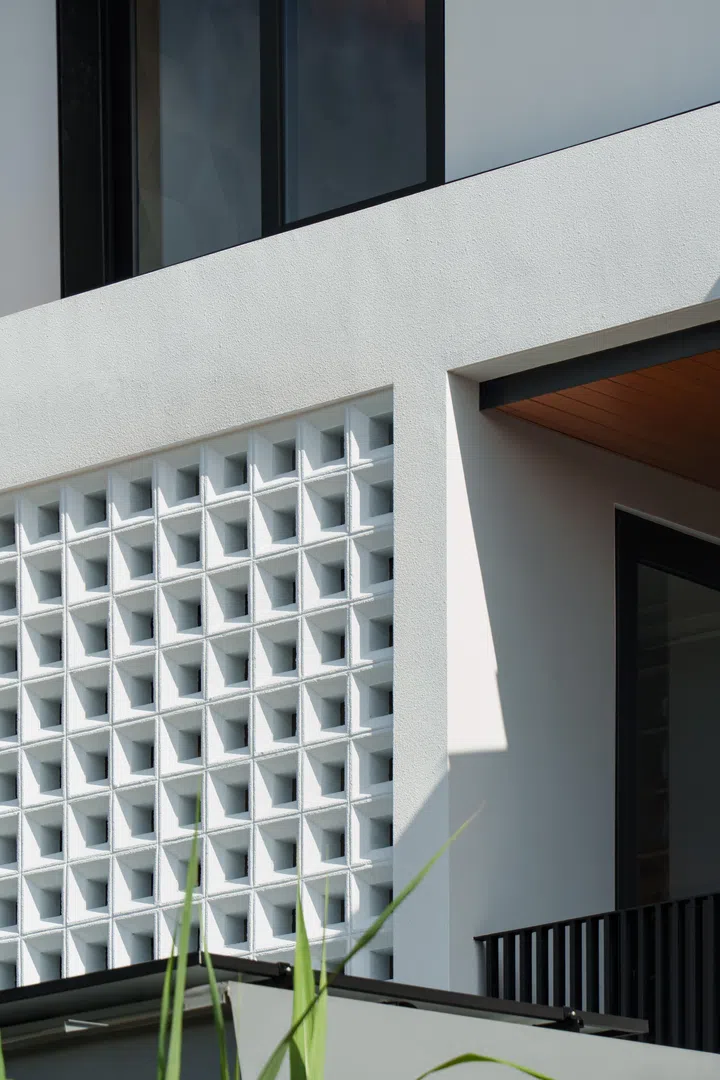
The geometric breeze block façade gives the home its architectural identity while supporting the privacy brief.
A private retreat behind the breeze blocks
Upstairs, the master bedroom carries through the home’s restrained material palette, but with a greater sense of privacy and enclosure. Warm timber tones, soft lighting, and full-height cabinetry keep the room visually calm, while breeze block façade gently shapes the experience of light from within.
“One of the reasons why we used the breeze blocks was because the word privacy was used,” says Yue Wei. “Because I feel that aluminium screenings were too overused in a lot of homes, we circled back to breeze blocks.”
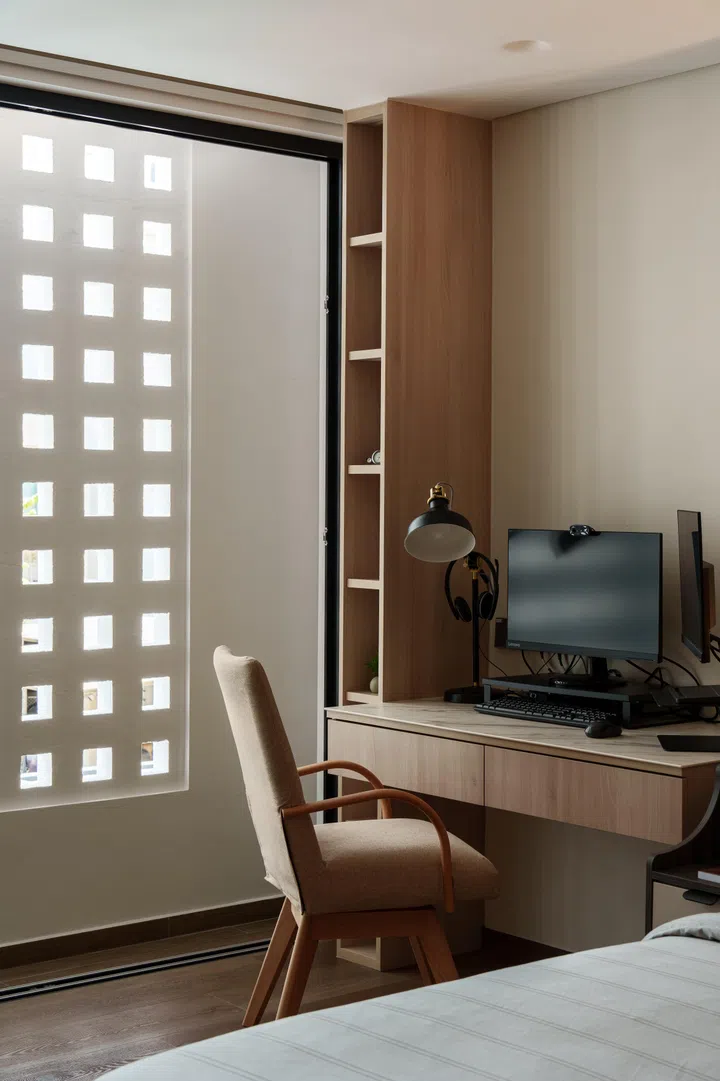
From the master suite, the breeze block screen filters light into the study corner without fully exposing the room.
From the street, the geometric screen gives the Breeze Block House its identity. From within the master suite, it softens daylight and creates a sense of separation from the neighbouring homes, even if the effect is not purely dependent on the blocks themselves.
As the homeowner notes, “It makes the façade more interesting… creates a feeling of privacy without blocking out the natural light should we choose to open the blinds.”
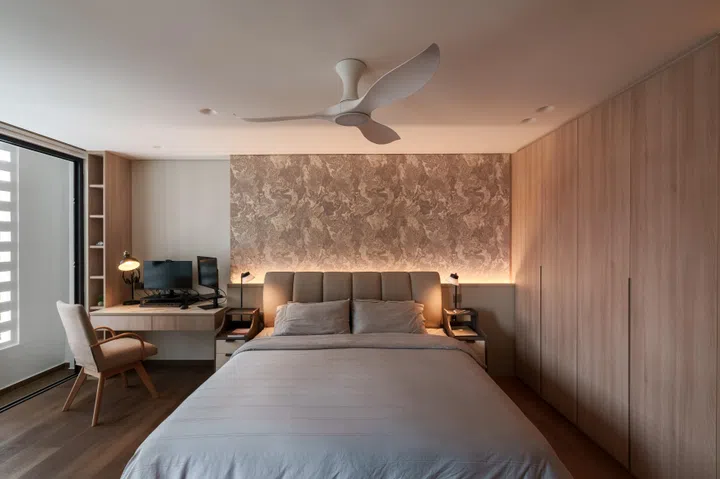
Warm timber tones, concealed storage, and soft lighting give the primary bedroom a calm, retreat-like atmosphere.
The room itself is one of the family’s most loved spaces. “My bedroom,” says the homeowner, when asked about a favourite part of the house. “Because it’s such a relaxing space. Everyone loves to hang out in our bedroom including the children.”
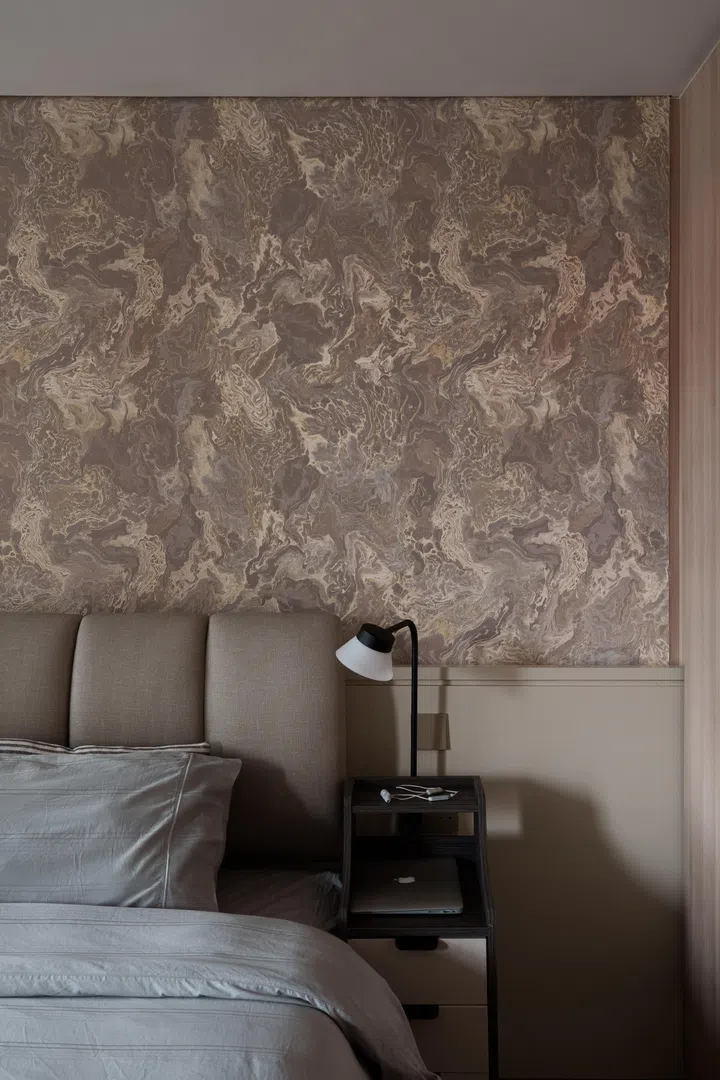
A textured wallcovering adds visual depth behind the bed while keeping within the home’s restrained palette.
That same language of filtered light continues deeper into the suite, where a walk-in wardrobe is illuminated by a wall of glass blocks. Less prominent than the breeze block treatment, it creates a similar softened quality of light while brightening what could otherwise have been an enclosed circulation space.
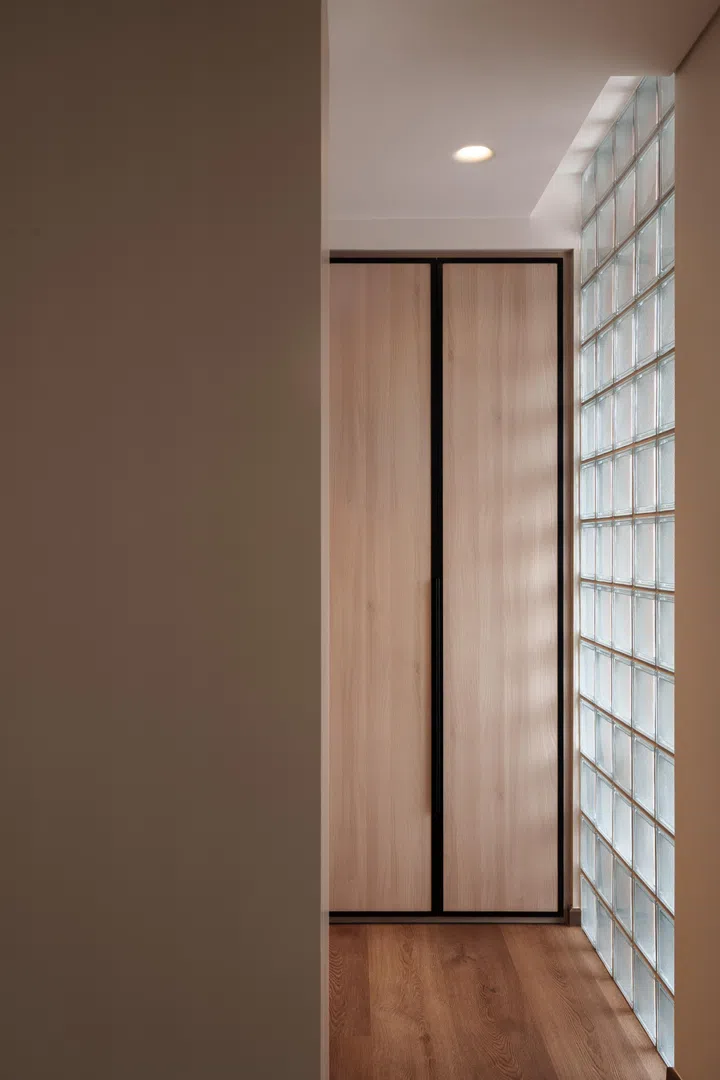
Glass blocks bring natural light into the walk-in wardrobe, continuing the home’s use of filtered light.
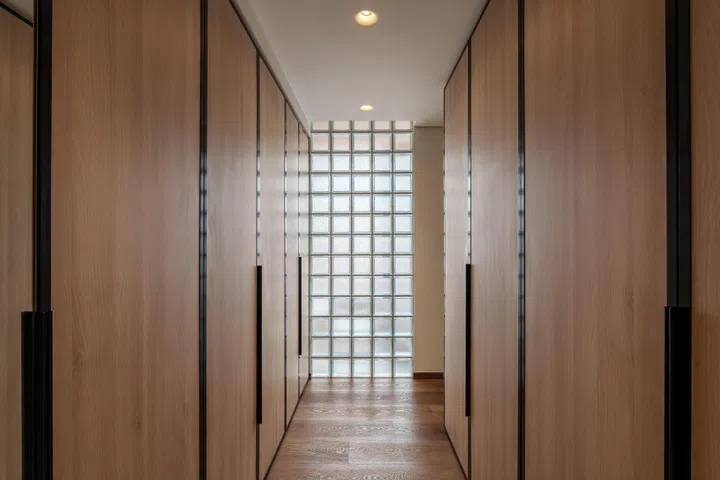
Full-height wardrobes line the walk-in dressing area, where borrowed light softens the functional storage zone.
“I love the glass blocks because it naturally lets in the light to our walk-in wardrobe,” the homeowner says. “It made sense; it lights up the space a little bit. Because it’s a very big room, the walk-in would have been very, very dark if it’s just pure wall.”
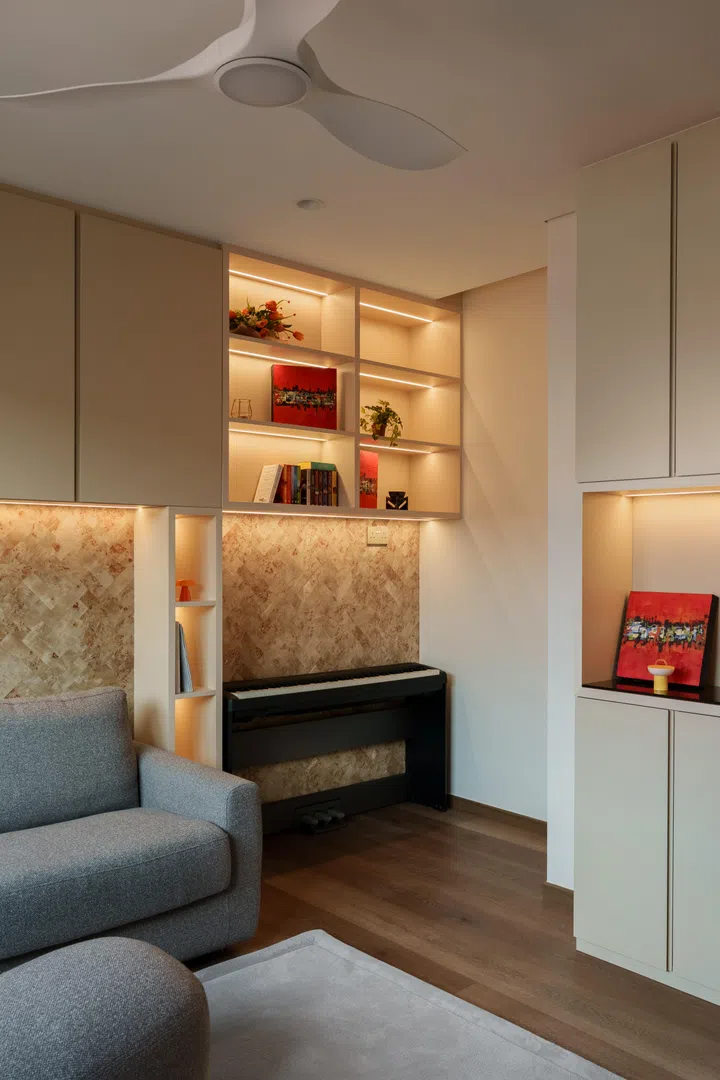
What began as a conventional spare bedroom became a flexible project room for music, reading, crafts, and occasional overnight guests.
A room that does more than one thing
At the top of the house, a flexible project room reflects the same pragmatic thinking that shaped the rest of the renovation. Originally conceived as a spare bedroom, the space evolved into something far more useful.
“The third floor mainly houses the kids and we have one project room,” the homeowners explain. “The project room initially was supposed to be a spare bedroom… [but] why make it a spare bedroom because if there’s a bed in there there’s nothing else we can do with the room?”
Instead, YWA Studio rethought the brief entirely.
“For this particular house, we took into consideration the limited amount of space, but also the functions they needed to squeeze into the house,” says Yue Wei. “They wanted a space where the children can play and do arts and crafts. [The homeowner] likes musical instruments and wanted a space to be able to do that. They also wanted to have a guest room.”
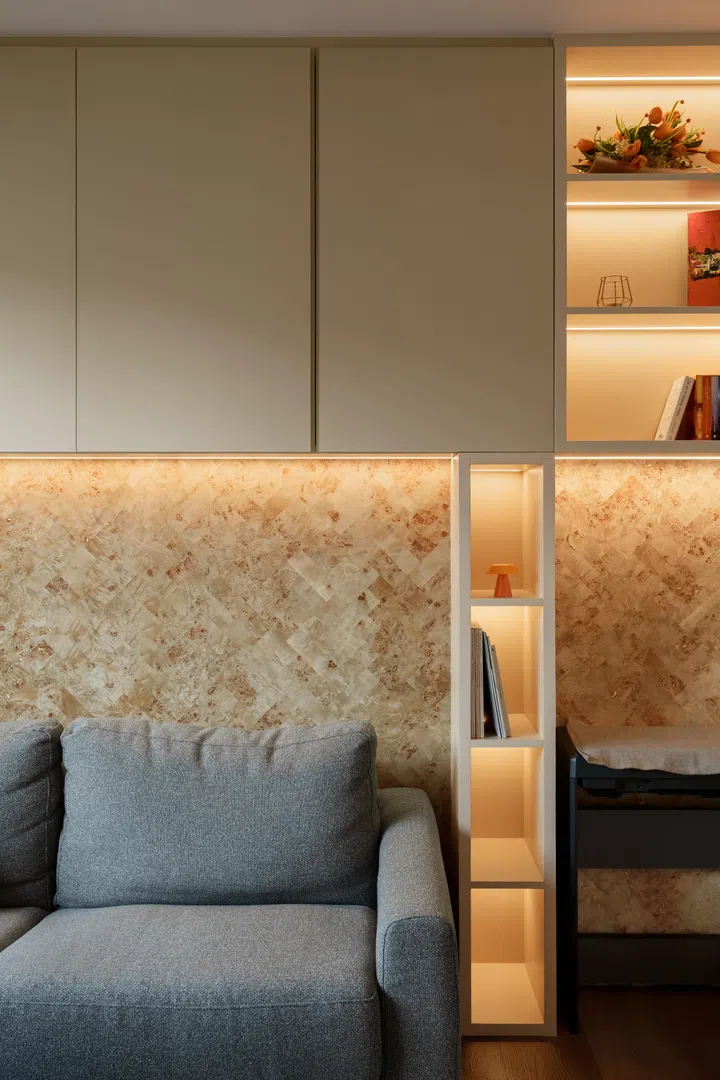
Integrated shelving and warm lighting give the multi-purpose room a relaxed, lived-in character rather than the feel of a room waiting to be used.
The response was what Yue Wei describes as “a Swiss army knife” of a room: a piano corner for music, a height-adjustable coffee table that can double as a workspace for the children, and a conventional sofa bed that allows the room to function as guest accommodation when needed, complete with its own ensuite.
Rather than dedicating precious square footage to a room used only occasionally, the solution keeps the upper level working hard for everyday family life.
“When the kids have their friends over, we can still have our space downstairs,” the homeowners say.
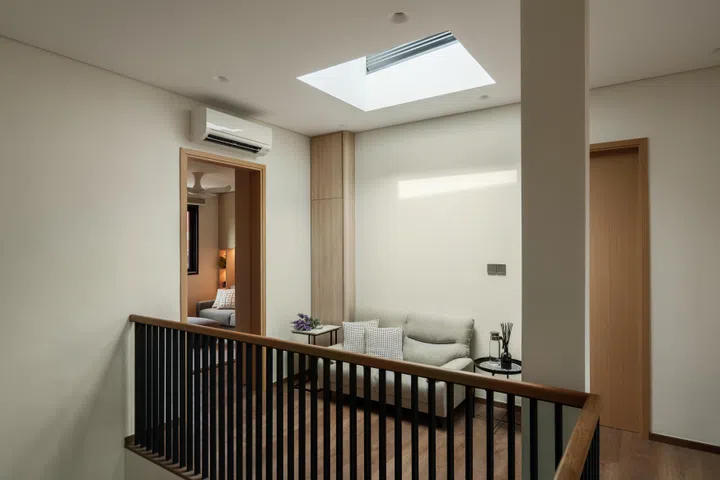
A skylight above the upper landing brings daylight deep into the home while turning a circulation space into a quiet architectural pause.
Light as part of the architecture
Just outside the project room, the upper landing becomes an unexpectedly contemplative moment in the house, animated by a skylight overhead.
“The problem with intermediate terraces is when you build three storeys, the second and third floors become very dark,” the homeowners say. “But Yue Wei built a skylight so the light comes in through the roof to the second floor.”
Yue Wei describes it less as a purely functional intervention than an atmospheric one. “The space outside that room is where we have the skylight on top. It’s quite a lovely space where you can see the clouds move by and even when it’s raining, you can see the glass pitter-patter. It’s a very calming experience.”
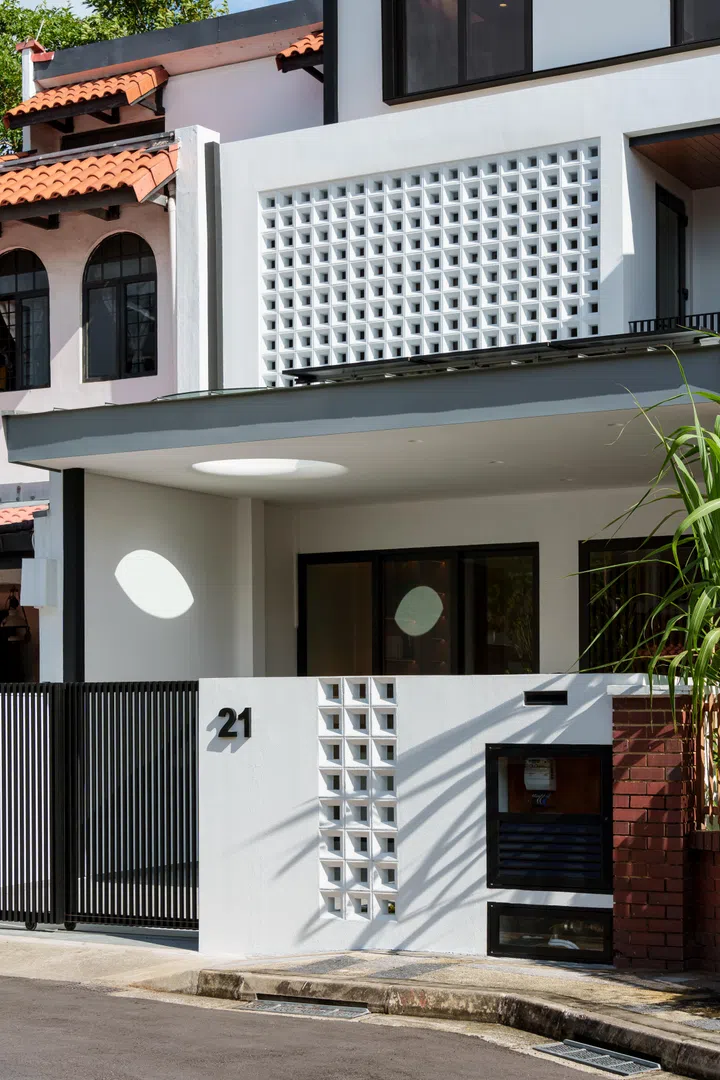
The extended car porch roof solves a practical weather issue, while a circular skylight opening keeps the sheltered entrance bright and visually connected to the sky.
That same thinking appears at the front of the house, where a circular skylight cut into the extended porch ceiling solves a practical problem while creating one of the project’s most distinctive visual moments.
“Previously the car porch roof was too short, so they would get wet when it rained as they got out of the car,” Yue Wei explains. “So we extended the car porch roof by a lot, which introduced another problem of it being too dark, so we introduced a skylight opening to bring in a lot of light.”
By night, the intervention takes on a second role. “We also added a ring of light that turns on in the evening, which helps to throw light upward towards the ventilation blocks that we have as one of the main features of the house façade,” says Yue Wei. “If we don’t have as much light thrown onto the breeze blocks, you won’t be able to appreciate the depth and pattern.”
“The skylight—along the rim of the circle, Yue Wei put lights,” the homeowners explain. “At night it casts up onto the breeze blocks and looks very dramatic. It’s all part of the design.”
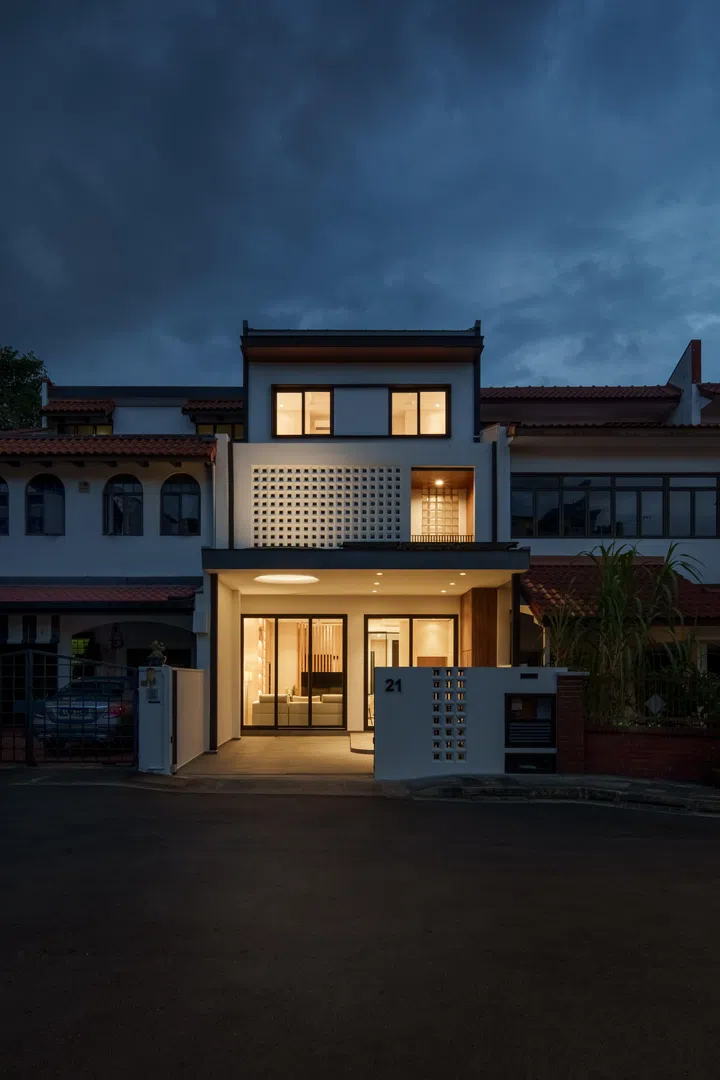
After dark, concealed lighting around the circular skylight throws light upward onto the breeze block façade, revealing the depth and texture of the home’s defining architectural feature.
$130,000 renovation cost
The interior fit-out cost approximately $130,000 and was completed as part of a larger addition-and-alteration project that took about 14 months. YWA Studio was engaged as both architect and interior designer, overseeing the architectural reworking of the terrace house as well as its interiors. According to Yue Wei, “The total construction cost was approximately $900,000 and the interior fit out was $130,000.”
More than a stylistic update, the project was intended as a long-term family home. “A home is not a restaurant space where you go into it and say this is exciting,” says Yue Wei. “Homes are where you go into every day to rest and recharge.”
The homeowners moved in just before Christmas 2024. “We were all very, very excited because the place looked really, really nice,” they say. “Everyone is happy with the result, happy with their own space. The kids love their rooms.”
Rather than feeling finished in a fixed, overly styled way, the home is expected to evolve with the family. “It’s a classic design that will grow with us,” they say. “It will change with the personalities of the family.” And as for whether this is a forever home? “Yup,” they say. “We’re very happy in the space.”