
HDB to Condo Upgrade: Is this ‘Singaporean’ dream still feasible for today’s generation?
By Home & Decor Team -
Share this article
A June 2026 survey by the National University of Singapore’s (NUS) Institute of Real Estate and Urban Studies (Ireus), highlighted by The Business Times (paywall), revealed that 31% of real estate executive respondents expect Singapore’s private housing market to structurally decouple from the HDB market due to diverging buyer profiles, widening price gaps, and persistent supply scarcity.
In simpler words...
31% of real estate professionals (who were surveyed) foresee the HDB buyer pool vs private housing buyer pool to be clearly divided into two separate groups.
The people who will buy HDBs will mostly continue to buy HDBs. The people in the condo and private house departments will, too, stay in their lane.
HDB to Condo upgraders
Historically, public HDB flats and private condominiums moved in tandem. HDB flat owners would hold their flats for five years until they reached their Minimum Occupation Period (MOP), sell them at a healthy profit, and use those cash proceeds to buy a private condo. This constant flow of HDB upgraders formed the backbone of demand for suburban private private properties (Outside Central Region, or OCR).
The survey highlights that this link is weakening - a phenomenon experts call “structural decoupling”. HDB public housing and private condos (and landed houses) are becoming two distinct, separate markets with different sets of buyers, rather than one naturally feeding into the other.
HDB vs Condo buyers’ considerations are different
Why? Because it seems that the HDB buyer vs private house buyers have got different types of consideration. Private property buyers focus heavily on investment, wealth preservation, and global liquidity, whereas HDB buyers are largely constrained by local public housing policies and domestic income ceilings.
And that means - HDB to condo upgraders are expected to be fewer and lesser. This is bolstered by cash problems. The larger initial down payment required for private property has outpaced the general income growth that was feeding the HDB-to-condo upgrading path.

Condo prices grew much faster
Between 2020 and 2026, HDB resale flat prices grew by a significant 48.2% to a median of around $630,000. However, brand-new suburban private condos soared even faster - up 66.1% to a median exceeding $2 million.
Consequently, the median price gap between an HDB resale flat and a new suburban condo surged from $786,980 in 2020 to an eye-watering $1.38 million in H1 2026.
Salaries are not keeping up
While property prices surged, median household incomes grew by a much more modest 17% over a similar timeframe. Because wages did not keep up with new private launch prices, the jump from public to private housing became far steeper.

High earners removed from HDB resale market
The government introduced the Prime, Plus, and Standard HDB framework to keep public housing affordable and fair. Resale Prime and Plus flats now come with strict conditions, including a 10-year MOP, subsidy clawbacks, and income ceilings ($14,000 for families and $7,000 for singles).
By capping who can buy these prime HDB resale flats, high earners are filtered out of the upper tier of public housing, further separating the buyer pools for public and private homes.
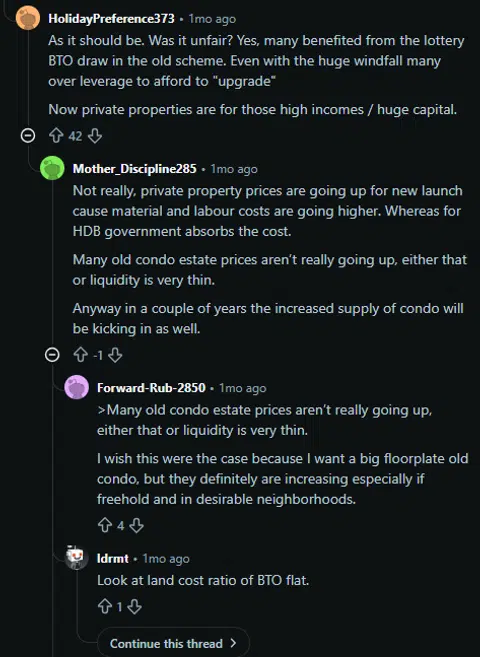
Online, netizens are mixed about the findings of the survey. Many have expressed their acknowledgement and agreement with the widening property, income, and wealth gap. Some praised the recent measures by HDB to curb the HDB-to-Condo upgraders who contributed to the widening price gap.
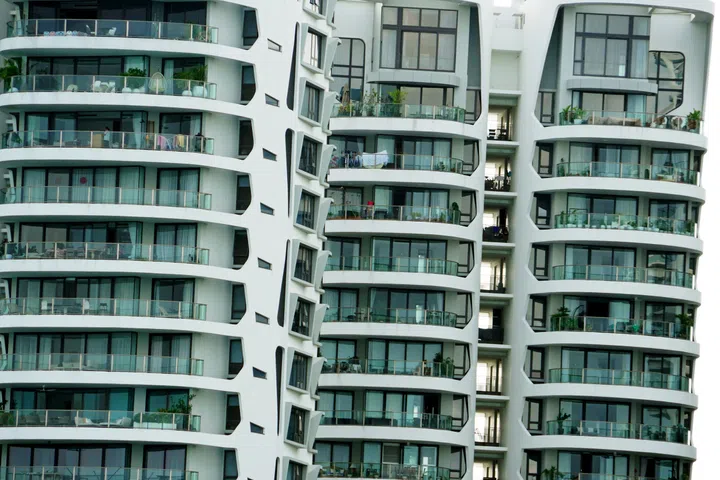
What does this mean for you and I?
Wealthier buyers, so private property prices to remain high
If you are a condo or private property owner, the private condo market is relying less on typical first-time HDB upgraders and more on higher-income buyers, intergenerational wealth transfers, en-bloc sellers, and existing private homeowners buying for investment or downsizing.
Because private property development costs, land prices, and construction overheads remain high, private home prices are expected to stay firm even if HDB resale prices plateau or experience slight contractions.
Finally, you might have lesser potential buyers. While your property value is shielded by limited supply and deep-pocketed buyers, resale liquidity may depend more on other private property owners or high-income buyers rather than mass-market HDB upgraders.
HDB to Condo upgrade will be more difficult
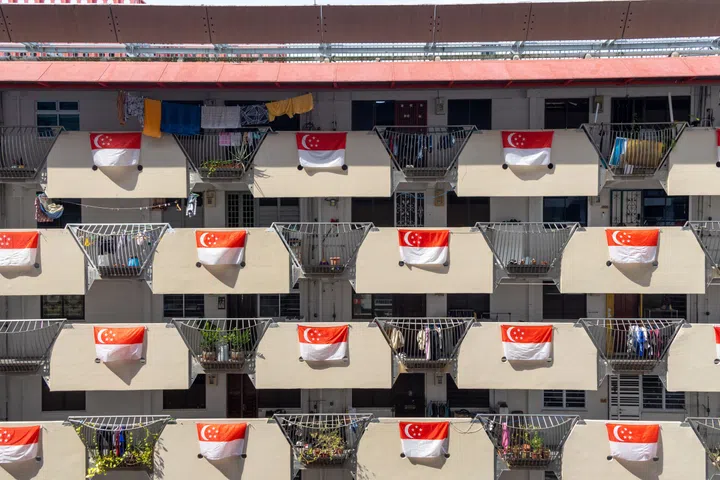
If you are a HDB owner, upgrading to a condo will be a steeper path than it was just a few years ago.
In the past, selling an HDB flat at MOP often yielded enough cash to comfortably cover the 25% downpayment (with at least 5% in cash) for a standard suburban condominium launch, while your household income serviced the rest.
Today, entry-level new condo launches routinely hover above $2 million, and loan stress-test rates remaining prudent under the 55% Total Debt Servicing Ratio (TDSR), the required household income and upfront capital are considerably higher.
However, you can consider a resale condo instead. Because new launch condo prices have pulled ahead much faster, many HDB upgraders are turning to the resale private market instead. The price gap between an HDB flat and a resale condo is substantially narrower than that for a new launch, making it a far more manageable transition for your cash flow.
Finally, HDB Executive Condominiums (ECs) continue to serve as the government-backed bridge for eligible HDB owners. However, bear in mind that EC buyers are subject to a smaller 30% Mortgage Servicing Ratio (MSR) cap, meaning your borrowing capacity is going to be lesser compared to private bank loans.