
Know which countertop material you want? Now let’s talk design
As it turns out, your cooking habits are only half the equation.
Share this article
We’ve all heard about the importance of choosing a kitchen countertop material based on how we cook. But that’s arguably the easy part. Once you’ve settled on quartz, porcelain or natural stone, how do you decide on the design?
Caesarstone’s Regional Marketing & Communications Manager Ryan Ng answers common questions to help you get it right.
1. Does kitchen size matter?
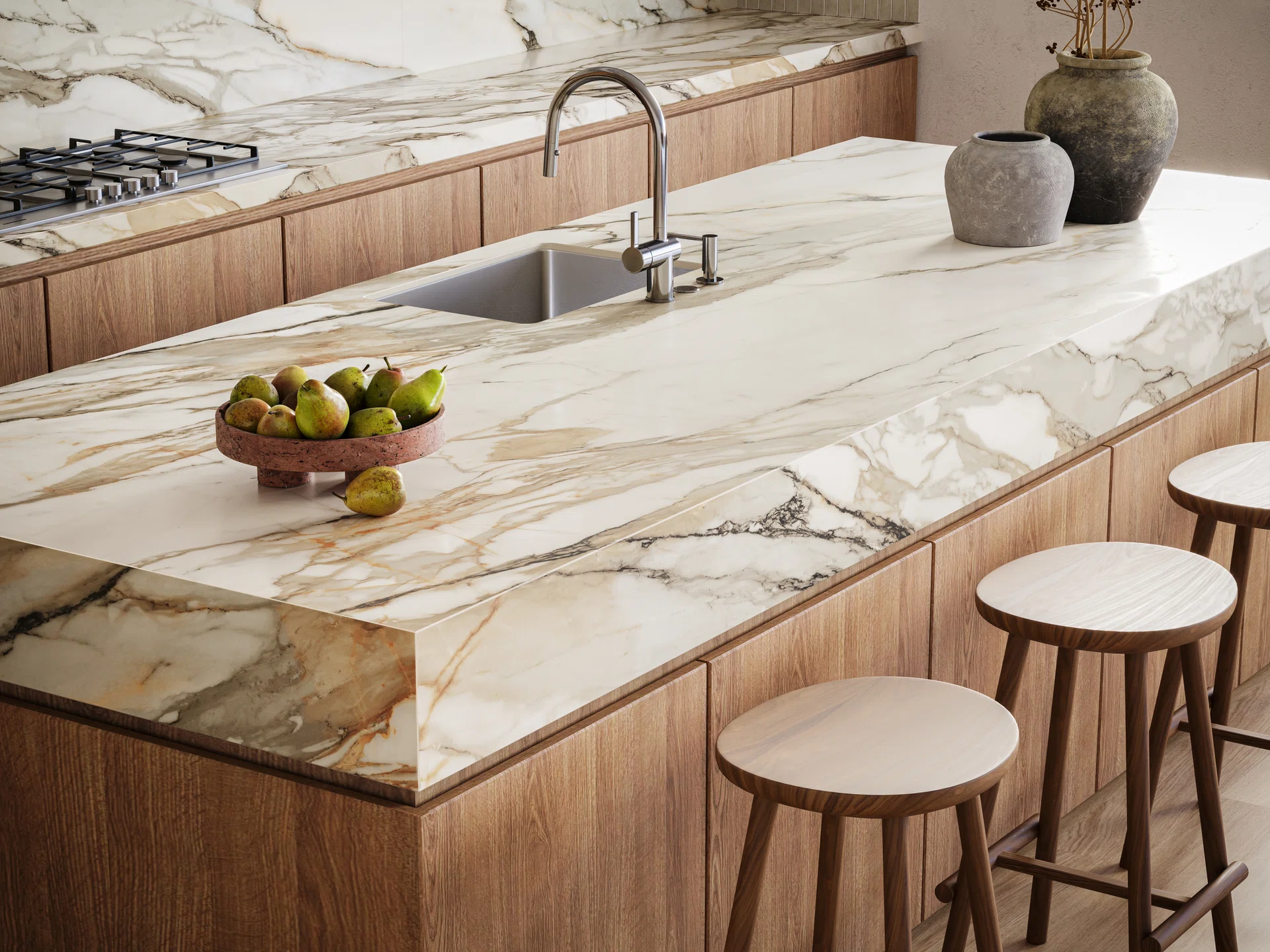
Consider the scale of the pattern in relation to your kitchen. In compact spaces, softer veining or subtler patterns can create a sense of openness, while dramatic patterns may overwhelm the space. Larger kitchens offer more room to experiment with bolder designs, particularly if you want to make the island a focal point.
2. What works with my cabinetry and flooring?
Pay attention to undertones. Whites, greys and beiges can look very different depending on the surrounding materials. For example, a surface with earthy undertones, such as Caesarstone’s 551 Travina, can complement warm-coloured cabinetry or timber flooring.
3. What about the backsplash?
One approach is to let one surface take the lead and the other play a supporting role. A countertop with expressive veining, for instance, can be paired with a more restrained backsplash. Alternatively, using the same material across both surfaces creates a seamless look. Large-format porcelain works especially well here.
Beyond colour and pattern, texture is another way to introduce visual interest. Caesarstone’s 2026 Porcelain Collection features Sensorial Tech, which gives surfaces a tactile quality through finishes such as Luster, Sculpted, Leather, Metal and Wood.
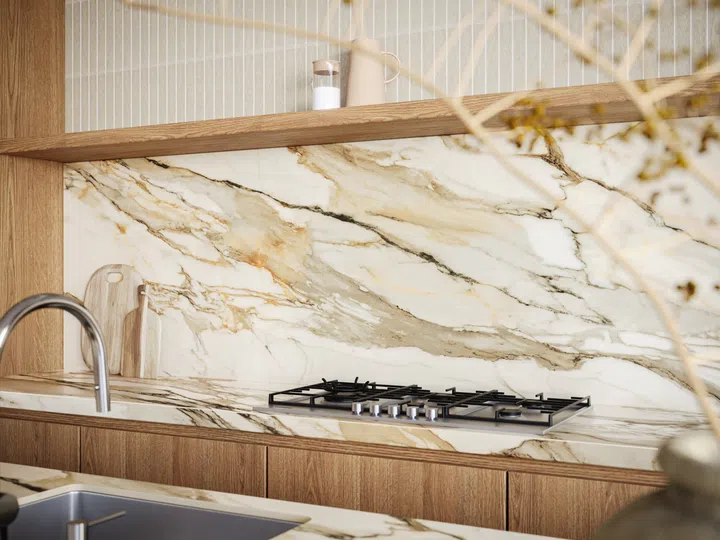
Caesarstone’s 536 Antikella comes in large slabs, so its veining can flow uninterrupted from countertop to backsplash.
4. How do I match my taps and handles?
Rather than matching everything precisely, look for finishes that work well together. Warmer metallics such as brass and bronze complement earthy stone tones, while black hardware or stainless steel can reinforce a cooler, more monochromatic palette.
5. How does lighting affect my countertop?
The same countertop can look different under natural daylight, warm ambient lighting and cooler artificial lighting. Polished and textured finishes also reflect light differently.
Where possible, view samples at different times of the day and alongside your actual cabinetry and flooring to get a better sense of how everything works together.
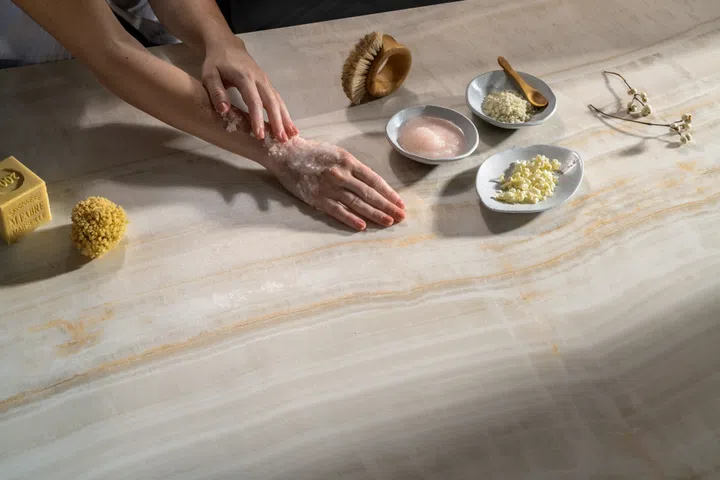
The Luster Effect on Caesarstone’s 509 Onyxa raises the veining slightly, so you can feel the pattern under your fingertips.
6. How can I tie my kitchen and living areas together?
Look for tones, textures or finishes that can be repeated throughout the home. For instance, a warm-toned countertop can complement timber furniture and bronze accents in the living area, while a darker surface can tie in with black lighting fixtures or furniture details.
You can also repeat your countertop material elsewhere, such as on a dining console, dry pantry or bathroom vanity.
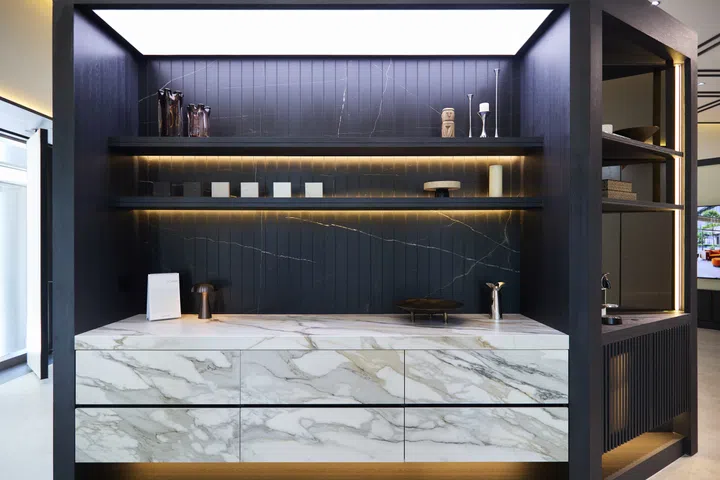
Caesarstone’s Experience Centre at 1 Raffles Link stages surfaces in full-scale kitchen vignettes under layered lighting.
7. What’s a common countertop shopping mistake?
Relying solely on small samples can be risky. While these give you an idea of the colour and finish, larger displays offer a better impression of the overall pattern and veining.
We welcome homeowners to visit the Caesarstone Experience Centre, where they can view larger display panels to better visualise how their chosen surface could look in an actual kitchen setting.
Learn more about Caesarstone’s collections.