
Choosing the right interior designer: $74,000 Renovation for a 30s Singaporean couple’s 4-room BTO in Tampines
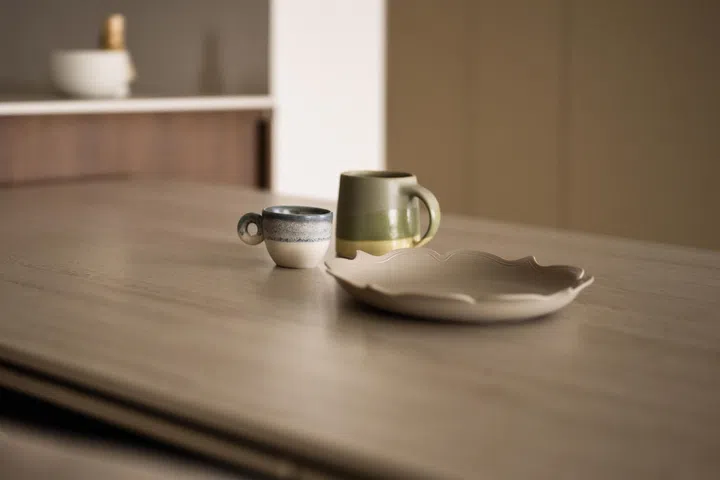
“Finding ceramics is something we do when we go overseas; trying to find something unique. We always take bubble wrap with us…A lot of our ceramics that we have at home, even the utensils and cutlery, are from overseas, like Japan and Korea.”
By Shannon Osztonits -
Share this article
Ceramics and creamy spaces; an overall neutral colour palette; and subtle curves in all the right places…This calming space is a creation of Japandi (and Wabi Sabi) meets minimal clean aesthetics, with touches of European design techniques here and there.
With a penchant for Japan, whether it’s for travel, collecting Japanese ceramics, cooking Japanese food, or even learning the language, homeowners Sam and Jian Hao found themselves landing on Pinterest and Instagram home design pages that were very much inspired by Japanese design–talking both decor and architecture.
“I gravitated towards the Wabi Sabi and Japandi interior designs, and drew a lot of inspiration from those. For example, our laminates are a dark wood colour, mixing dark with the light colours of the home,” says Sam.
As a couple who love to cook, the kitchen was very much a focal point of the home renovation. Whilst you will find Sam studying Japanese, it’s perfecting the art of coffee that Jian Hao enjoys. So much so, the homeowners created a dedicated coffee corner station as part of the dry kitchen.
Who Lives Here: A Singaporean couple in their early 30s, who work in professional services.
Home: 4-room HDB BTO along Tampines Street
Size: 1,000 sq ft
Interior designer: QJ from E+E Design and Build
E+E Design and Build Interior Design
This brand-new HDB BTO features three bedrooms, two bathrooms, an open-plan kitchen and dining space, a living room, a study, and a foyer area. The couple applied for the unit a few years ago, knowing they wanted a home in the Tampines neighbourhood (where Sam grew up).
Their full renovation consisted of hacking works, including knocking down one side of a wall for a study room and adding a glass sliding door. Flooring-wise, they added tiles throughout (except for the kitchen and service yard, which were the only prior areas with existing tiling work). The home also came with no fittings, so the homeowners added all of these works, too.
After exploring five to six different interior designers, Jian Hao and Sam felt most comfortable with E+E Design and Build, who gave them the most assurance in terms of being able to bring their vision to life.
“There were a few interior designers who told us that certain things couldn’t be done,” the homeowners explain. “Ultimately, we went with E+E in terms of cost, and they could also give us most of the things we wanted design-wise. They were very open to listening to what we wanted in our house. One of the biggest reasons we decided to go with them is because the things we wanted to do, they said it was possible. And that’s how our house came to be.”
Open-Plan Kitchen
Both Sam and Jian Hao enjoy spending time in the kitchen cooking. Whereas Jian is the more creative one, always trying out new recipes to see what works, Sam tries to cook healthier alternatives, or whatever is quick and easy.
“But he doesn’t or shouldn’t complain,” jokes Sam, “because there is someone cooking for him all the time.”
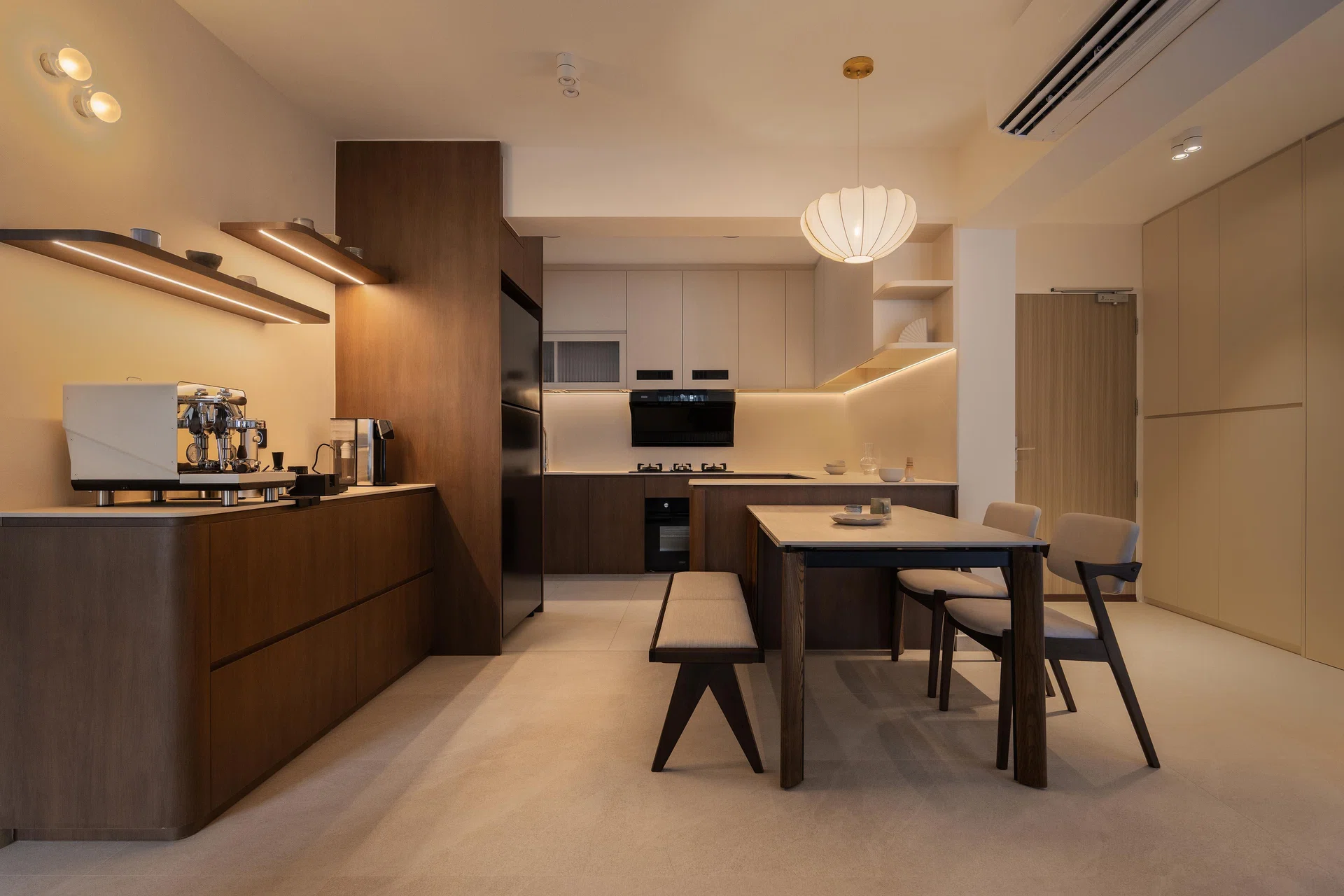
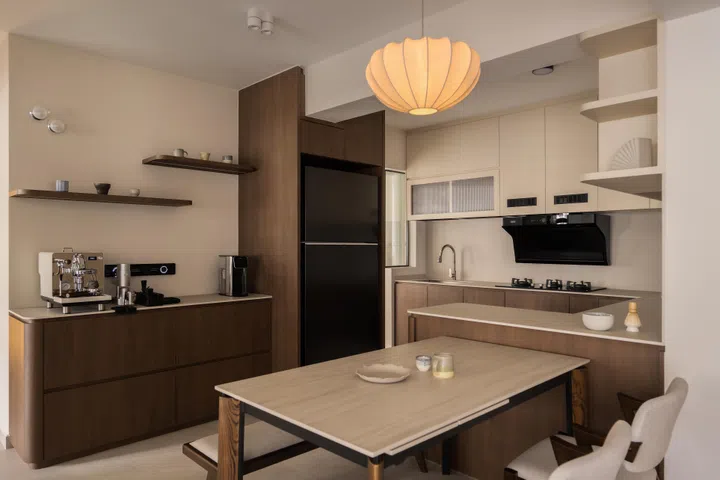
The kitchen is an open-concept design, with custom dark and light cabinetry, creating a lovely contrast as well as balance. Top cabinets are a cream laminate finish, whereas the bottom cabinets (including the bottom half of the island and dry kitchen sections) are a dark wood laminate. All counters and the kitchen backsplash are of the same sintered stone for a seamless look.
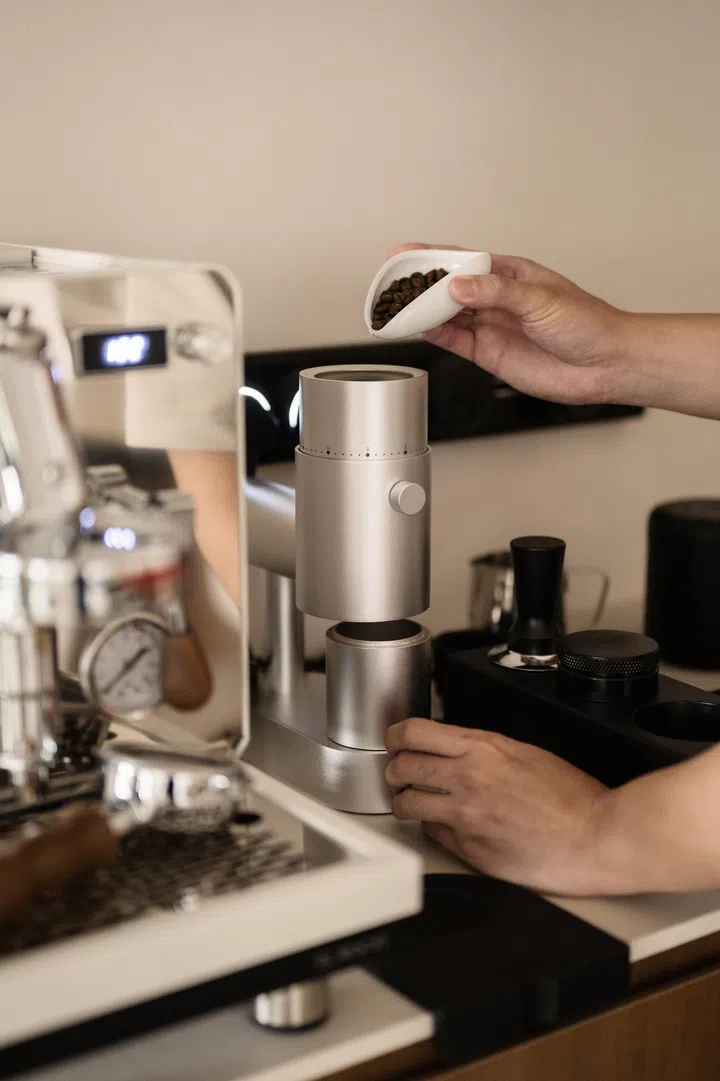
It’s safe to say Jian Hao is a coffee snob, but surprisingly, Sam doesn’t drink coffee!
“Occasionally, I make my own matcha. Since he has coffee, I thought I needed to find something else.”
“I love exploring different beans every time I buy new ones. Now, it’s always about trying new coffee. Whenever we go overseas or even in Singapore, there are a lot of new microroasters that do small batches,” Jian Hao says.
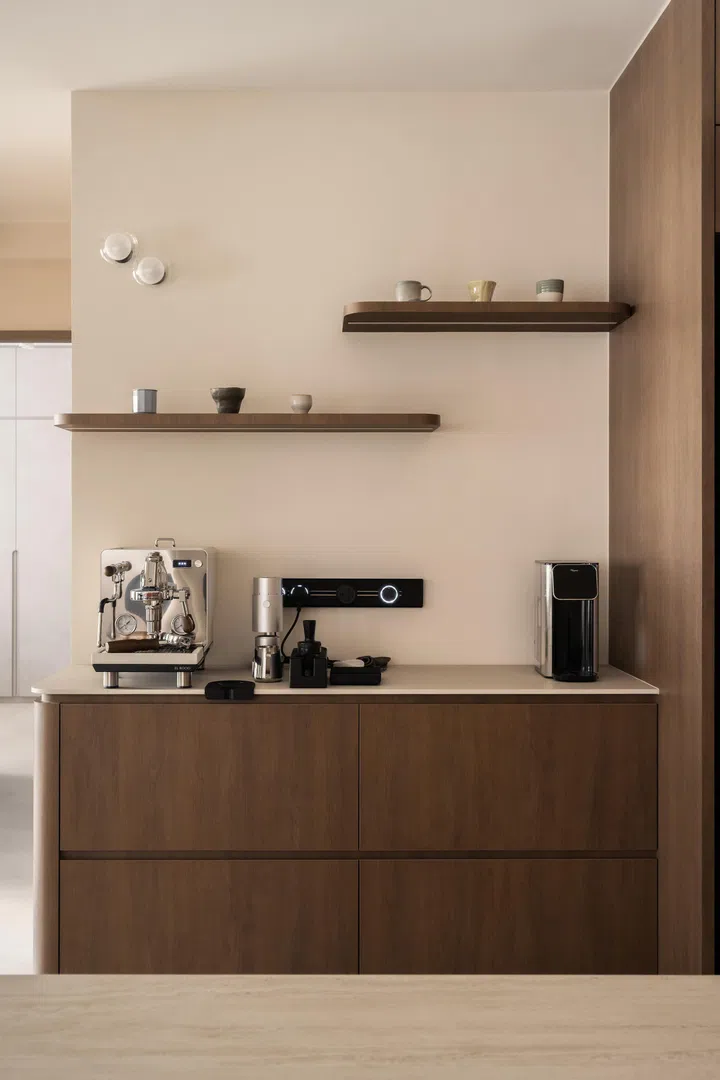
On the left-hand side is the dry kitchen area, where the professional coffee barista machine sits, as well as shelves above lined with beautiful ceramic cups and some other cute items the couple picked up overseas, like a Marshall speaker, a lamp and a clock. LED strip lights highlight the underside of the shelf, and two wall sconces add ambient lighting to this special nook.
Adjacent Dining Area
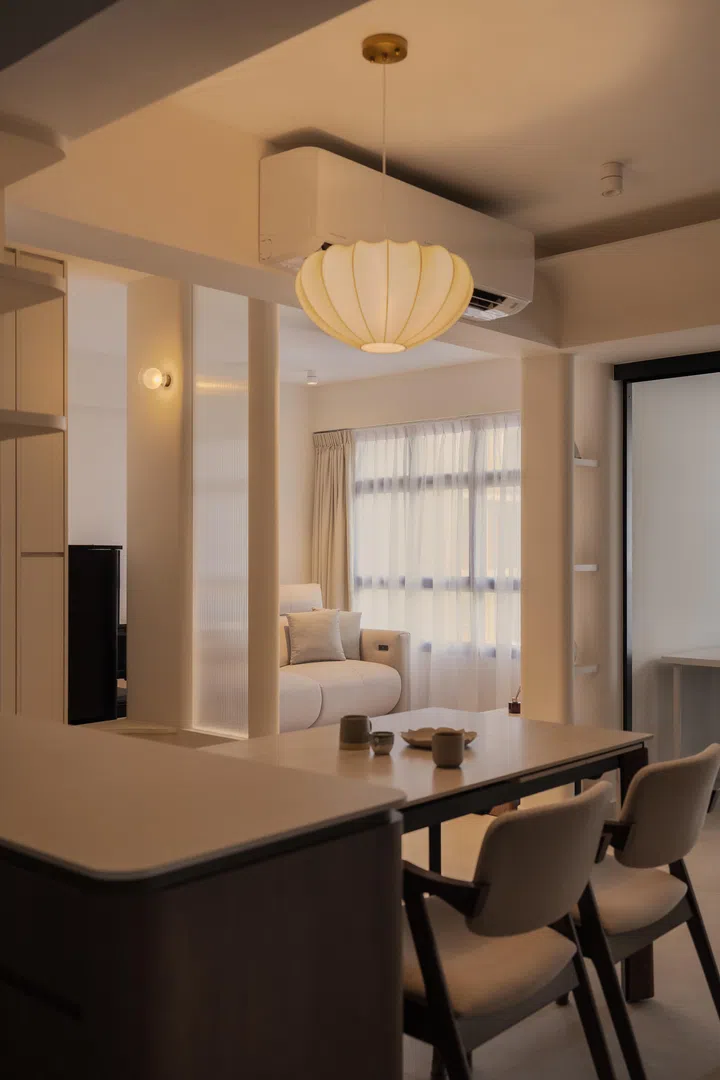
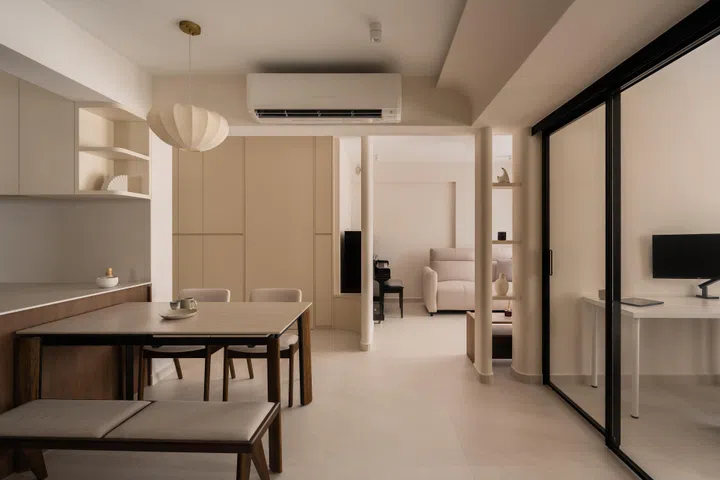
The dining table is adjacent to the kitchen island, and with a similar colour palette, feels very much like an extension of the island (although the table is separate). The homeowners bought the extendable table from Comfort Design, and appreciate its size-changing feature as there isn’t too much free walking space around it. It transforms perfectly, though, for when the couple have people over.
Around the table is a single bench and plush, restaurant-quality dining chairs, purchased from Malaysia during their furniture-sourcing trip to Singapore’s neighbour. A Sol Luminaire pendant light hangs from the ceiling, completing the dining space.
Neutral Living Room
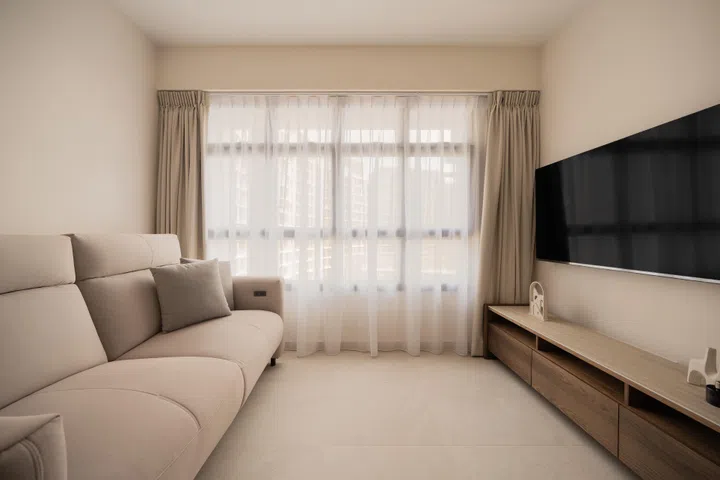
“We searched so many shops for an electric reclining sofa,” the homebody couple tells, who especially love hanging out at home, watching TV and chilling. They eventually found their dream one at V-Haus Living in Malaysia.
Their TV console (constructed with travertine-looking countertop and laminate-finish bottom) is another Malaysian purchase. There is also a piano in the living room–which Sam plays.
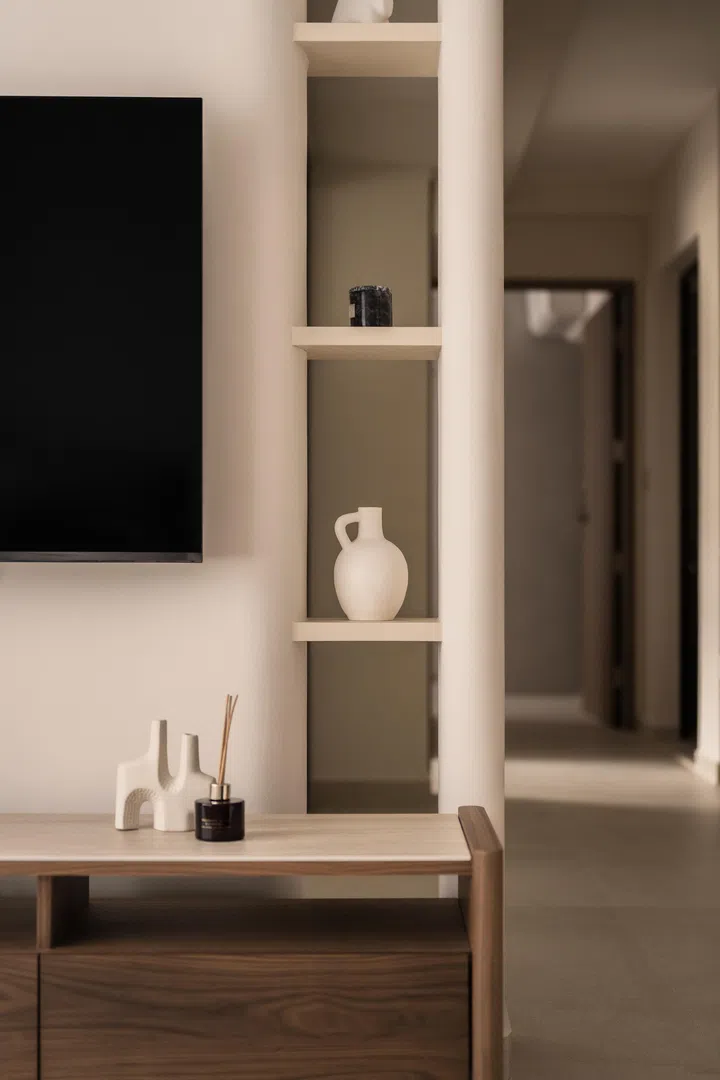
Next to the TV is a customised display shelf that was constructed by the interior design team to eliminate the TV console from protruding out of the wall. Now, here there are more of their ceramics on full display.
“When we hacked the walls, they hacked off a portion of the study room so that the living room is bigger. To offset the living room wall, the design team created a pillar partitioning wall as a wooden self. It was our interior designer’s idea,” tells the couple.
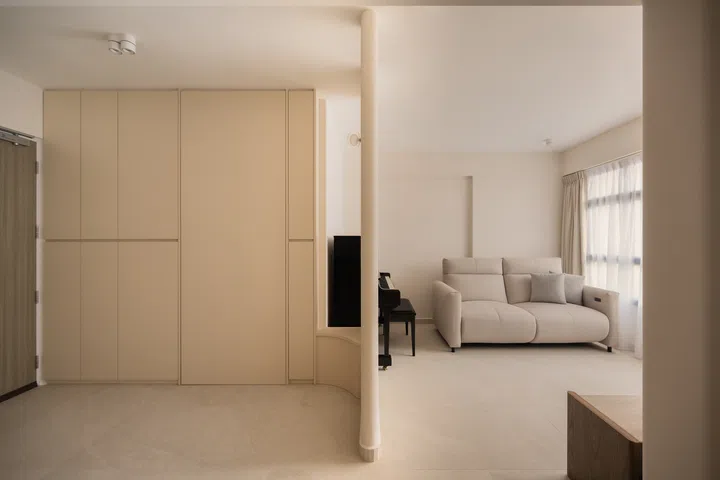
A Japanese-Inspired Foyer
“Japanese homes have a kind of concept where they have a separate foyer from the main house,” explains Sam. “So we have the arched wall between the living room and the entrance to serve this purpose.”
When the homeowners first bought the home, their initial plan was to move the living room to where the study is now (next door) and create an open living room into the dining and kitchen area (swapping the study to where you see the current living room). But once they received the keys and walked through the home, they realised this would simply make the house feel smaller, and decided against this design.
Instead, their interior designer, QJ, suggested adding a curved wall with a fluted glass panel (to allow light to filter through from the living room) as an extra design element. The partition takes up less space and allows the area to feel open, but still holds its own as an entrance.
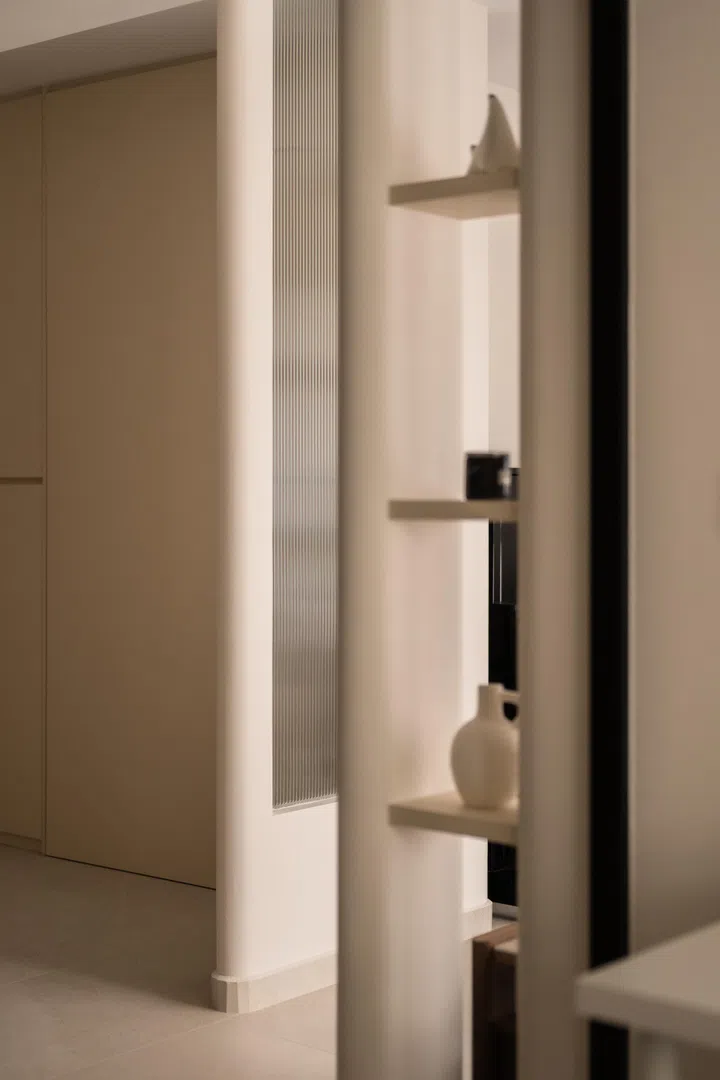
“Some people ask if we did this area for feng shui reasons, but no, we didn’t,” says the couple. “It has no other function other than aesthetics.”
Behind the custom cabinets is the bomb shelter. The cupboard nearest to the door is for shoes, the rest for small household items. The colour scheme and materials of the entrance cupboards are the same as those of the top kitchen cabinets.
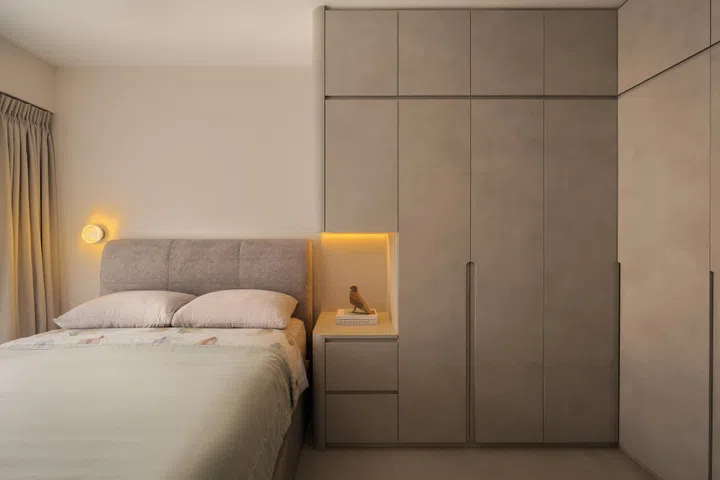
Zen-like Master Bedroom
Choosing a colour palette that is very calming and with soft curved edges, like the arched pattern in the cupboard, the master bedroom feels extremely Zen.
This is enhanced by the limewash laminates used for the custom-designed bedroom cupboards, featuring an in-built standing vanity cabinet, space for clothing, as well as storage doors. A niche extension of the closet acts as a bedside table. Inside the little nook, a warm LED striplight was installed, doubling as a bedside light.
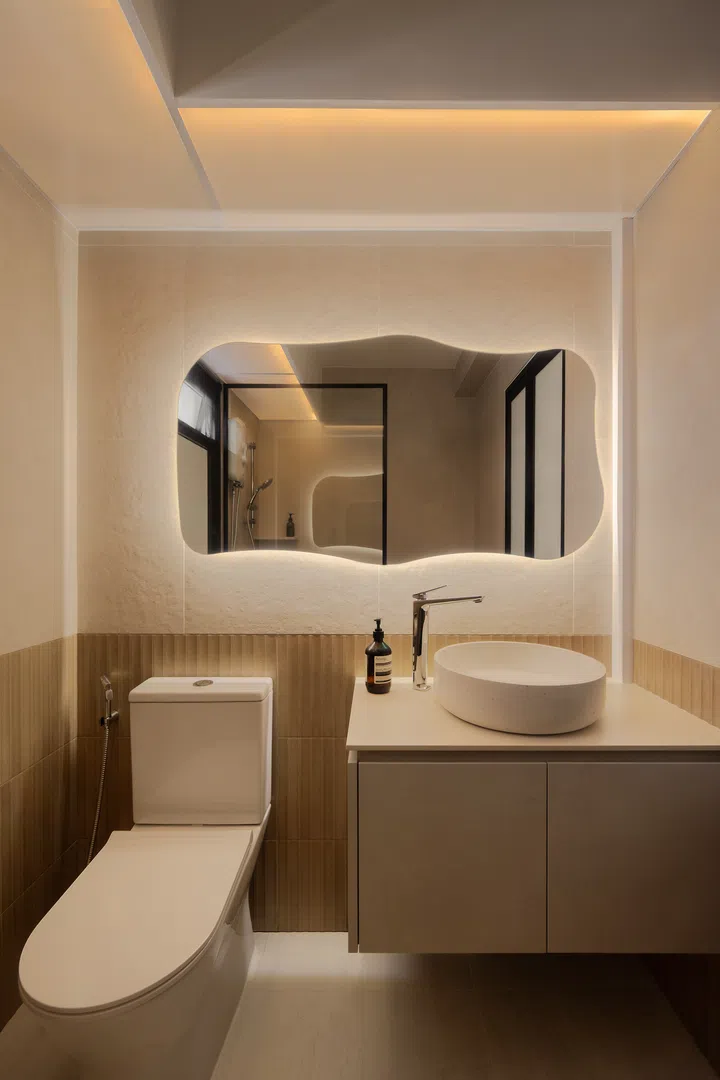
Primary En Suite
An earthy primary en suite highlights the Wabi-Sabi style, favouring a love of natural textures.
At first glance, the top half of the walls appears to have a texture overlay, but this is part of the wall tile’s design. For the bottom half of the wall, there is another illusion, too. It’s not a set of subway tiles; instead, it’s a subway mimicking tile. For the floors, the homeowners opted for an off-white tile thanks to advice from QJ.
“Our interior designer told us to keep the floor tiles clean; something paler in colour so it’s easier to maintain. These have a slight texture, which helps to make watermarks less obvious.”
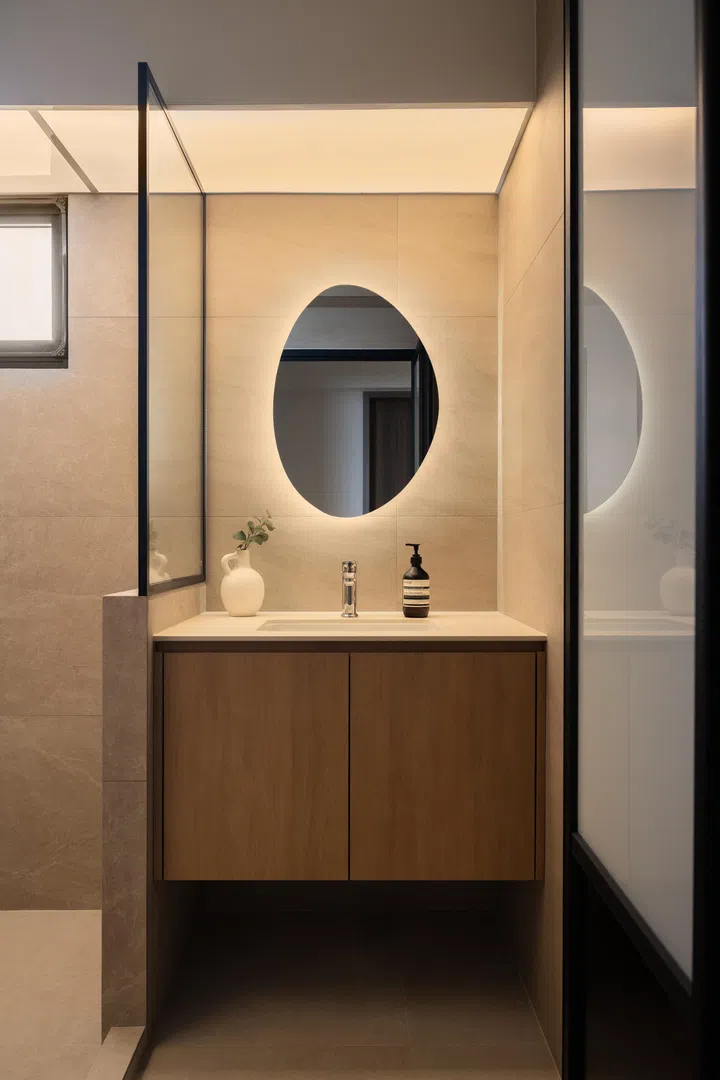
The vanity is custom-built, with a sintered stone counter. Soft geometry is added to the bathroom by a large, curvy-shaped mirror.
Guest Bathroom
The guest bathroom comprises a shower, vanity and toilet.
Whilst the top wall tiles above the vanity and the shower tiles are a similar colour, the tiles are indeed different. The shower tiles display a bit more lines and texture. All of the home’s tiles are from Hafary.
The vanity in the guest bathroom is also custom-built. The countertop is the same as the primary en suite, however, the laminate in this bathroom is more of a lighter wood finish.
For these first-time home renovators, the design process took three months to complete, and construction works were done in another three months.
“A lot of things we didn’t know or expect as first-time renovators, like electrical points and lighting points, we weren’t really familiar with. We were shocked that electrical costs turned out to be a lot more,” says the couple.
For these homeowners, it was very helpful for them to read articles about home renovations, drawing inspiration from these, and learning about what other homeowners went through.
“We drew reference from these and applied it to this process,” says homeowner Sam. “It also helped that our renovation process was seamless, which we have our interior designer to thank for. We didn’t have to explain certain things; he just did it, and he had strong project management skills. He was proactive and on-site every week. QJ provided us with updates all the time, too. So getting an interior designer is a good idea!”