
Share this article
Step into Mr Sim Kwang Wei’s 969 sq ft minimalist home and you might not realise it is almost entirely a do-it-yourself (DIY) job.
Though simple, the 4-room Build-To-Order (BTO) flat in Eunos bears the same light wood flooring and Japandi-influenced Zen that so many Singapore homes favour. And the full job, including appliances, cost just $12,000.
The 35-year-old software programmer was inspired by a Bulgarian he met while working overseas a few years before the Covid-19 pandemic. The man had built his house in his home country from the ground-up out of scrap materials he found in shipyards over a period of eight years.
“I thought, if it can be done for a whole house, why not an HDB flat?” says Mr Sim, who is married.
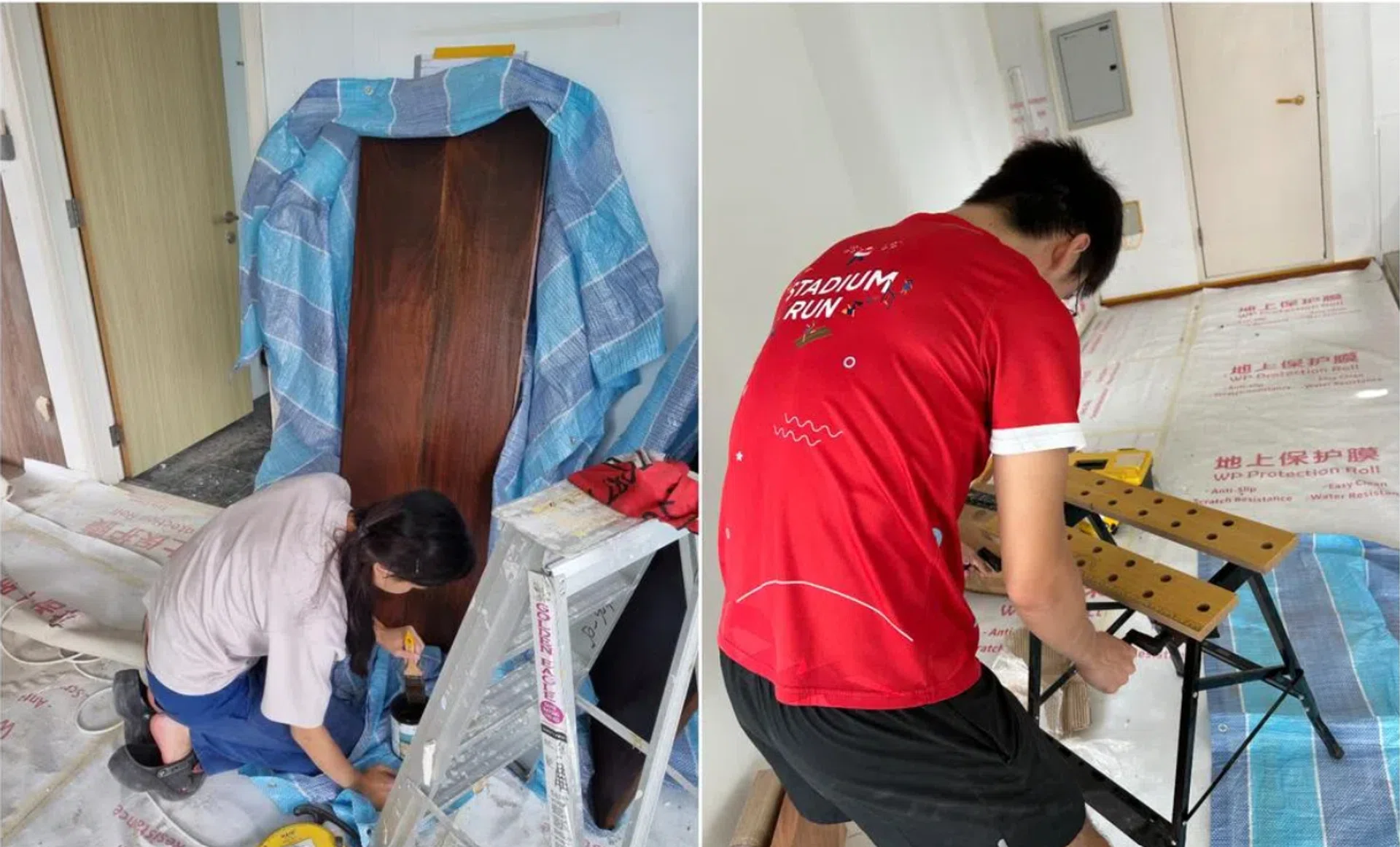
After collecting his house keys in June 2023, he got to work. The only things he left to subcontractors were the kitchen carpentry and floor screeding. Over the next three months, he became a live-in contractor, installing the lights, four doors, vinyl flooring, kitchen sink and bathroom fittings himself.
He and his wife had opted out of the HDB Optional Component Scheme – which may include flooring, sanitary fittings and internal doors, depending on the project – and as such, the flat had no doors.
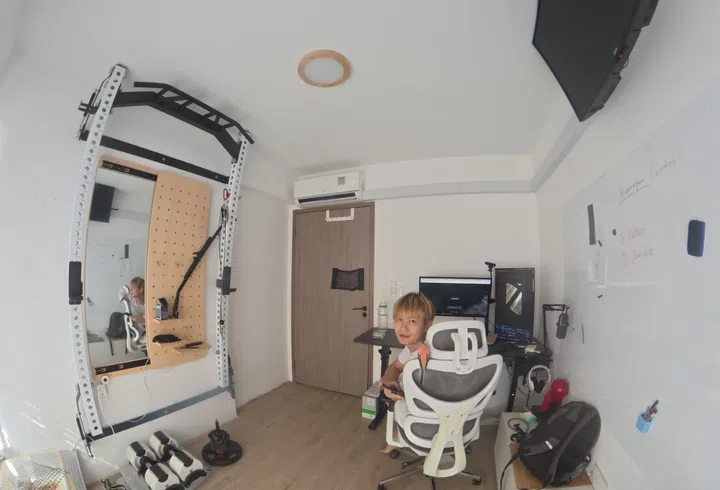
Mr Sim Kwang Wei in the home gym and study room he built himself.
$6,100 DIY Renovation Cost
To get his home up to what he calls a “live-in state”, he spent a total of $6,100. The hardship was well worth it, he says. “It was a bucket-list thing.”
These days, it is not uncommon to see more Singaporeans learning to DIY the interior design aspect of their home renovations, but how many have attempted to DIY the actual renovation work?
In an era where first-time home owners do not bat an eyelid spending $100,000 on renovating their flats, a rare few have decided to take on the grunt work themselves to save costs and get their hands dirty for fun.
According to Housing Board guidelines, hacking and erecting non-structural walls require a permit. Certain electrical installations used for high-capacity equipment such as air-conditioners also require an HDB permit.
Common electrical tasks that do not require a permit include minor additions like new lighting points or standard power sockets, but these should be performed by a licensed electrical worker.
Mr Max Lee, chief executive of interior design firm SG Interior Design, has handled a few six-digit BTO renovation jobs in recent years. The finishes can add up – pegged to decisions like choosing European over Chinese sintered stone or using premium materials like microcement. For example, the labour for laying microcement can be threefold that of tiles.
He estimates that engaging an interior designer (ID) costs about 20 per cent more than working directly with a contractor.
4-Room BTO Renovation Cost
According to him, a four-room BTO flat, if already tiled, can be renovated for $30,000 to $40,000 when engaging an ID; while a four-room resale flat can cost anywhere from $70,000 to $100,000, inclusive of hacking. Hacking typically takes up 10 per cent of the total budget and tiling at 30 per cent, with carpentry the most expensive at 30 to 40 per cent.
Interior Designer vs Contractor
Whether doing it themselves or outsourcing to contractors, those tempted to forgo an ID risk having shoddy workmanship, Mr Lee says.
Leaks can occur in plumbing, wires can be damaged by short circuits, and poorly laid vinyls and tiles can pop over time.
Singaporeans are not known to be handy, and are short on time, space and hard skills. The lack of readily available materials can also be a deterrence, Mr Lee adds.
For example, handyman shops here do not sell ready-made plywood planks like the ones in the United States.
The barriers to entry are high, says Mr Clyde Lim, 31, who built several pieces of wooden furniture with his wife, Ms Chew Yirong, 32, for their home.
“To even start a DIY project, there’s no knowledge. You must go to YouTube to learn. After learning, you need to commit to buying the equipment. I can understand the inertia,” he says.
For their dining tabletop and study desks, the couple, who are in the medical profession, customised and bought raw wood planks from local Singapore upcycled wood company Timber Actually in 2024. It no longer lists such products on its website.
Order wood from Shopee or Taobao
From Mr Lim’s experience, he notes that it is possible to order wood online from e-commerce platforms Shopee or Taobao, but it would not be planed. To plane the wood – which means to remove the surface layer of rough wood for a smooth finish – “you might have to venture into wood shops in the deep west like Sungei Kadut”, he says.
Mr Lee advises curious DIY enthusiasts to proceed with caution.
For instance, third-party electrical services are readily available at a lower price on Carousell, but the workers may not come with the relevant certifications. Poorly laid electrical works can affect built-in carpentry, so he recommends keeping external jobs to the start or end of the main renovation, to avoid a needless blame game.
For beginners, he suggests taking on cosmetic renovations such as painting or laying vinyl flooring. “If you have the time and knowledge, make a fun day of it.”
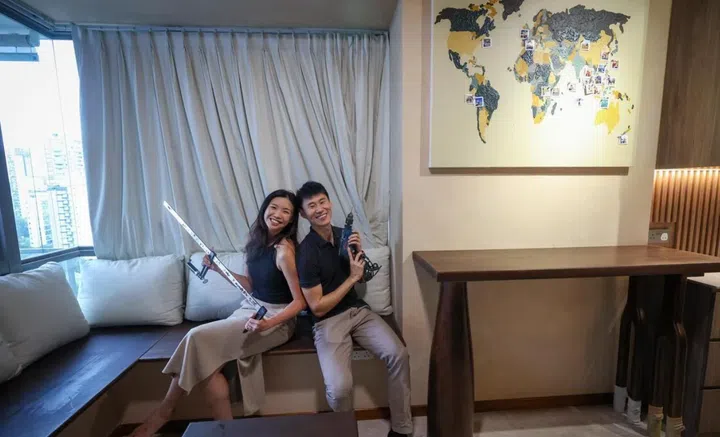
Ms Chew Yirong and Mr Clyde Lim woodworked several pieces of mahogany furniture by hand.
A married couple’s woodworking hobby
How many Singaporeans can say they hand-crafted, sanded and sealed the mahogany tabletop of the dining table they eat off daily?
To add to an already impressive feat, Ms Chew Yirong and Mr Clyde Lim are also the novice carpenters behind the sofa settee, study desks and a coffee table in their 700 sq ft one-bedroom condominium apartment in Newton.
The DIY works were mainly to maximise the many awkward bay windows in their home, though they did engage carpenters to build their wardrobes, kitchen and bedframe.
Ms Chew says: “The dimensions were hard to communicate to the ID. And carpentry provided by them is usually made of cheap pine wood but charged at a premium.”
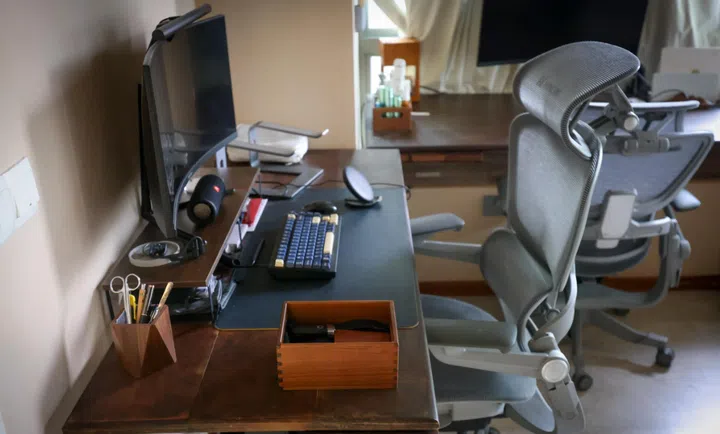
The couple made tabletops for their study desks out of raw wood planks sourced locally.
Started woodworking during Covid-19
The married couple caught the woodworking bug during the Covid-19 pandemic years of 2020 to 2021.
It started with a chopping board-making course and progressed to stools. Mr Lim wanted to continue with the hobby at home and bought materials such as sanders and wood saws.
The first thing they made on their own was a small wooden countertop shelf for his mum’s kitchen. This was followed by a pine dining table measuring 160cm by 80cm that can fit 10 for Ms Chew’s family.
By the time it came to furnishing their own home in 2024, they were well-prepared.
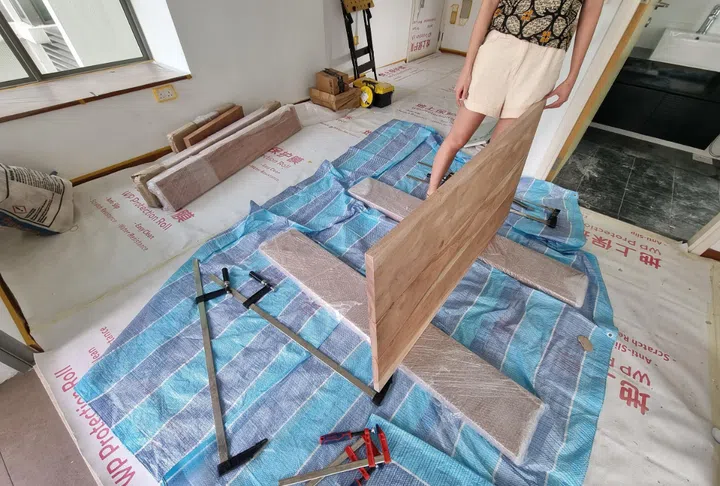
A work-in-progress shot of the woodworking by Ms Chew and Mr Lim in their apartment during the renovation phase.
Bought wood from Timber Actually (Joan Road)
They bought raw wood from Timber Actually, and stained and processed it themselves to make it food-safe.
The tedious job starts with using wood glue to join the planks, which are clamped for up to two weeks.
Then, the planks are sanded down to the same height before they are rounded on the corners, sanded again, and stained. They are finished by sealing with a protective base applied in a few rounds.
It took a month for the couple to complete all the furniture, which they made on the floor of their living room during the renovation phase.
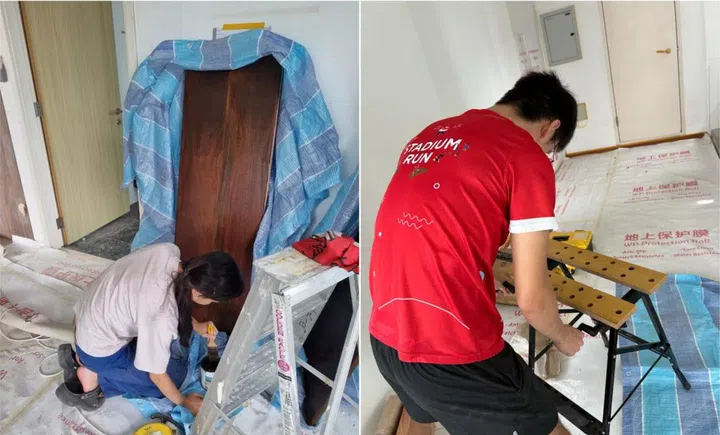
Ms Chew staining a wood plank and Mr Lim working on a piece of wood furniture during the renovation phase.
“The actual woodworking doesn’t require skills,” Ms Chew says, referring to the tabletops. They bought the legs for their dining table, which doubles as a bar countertop, as well as the standing desk mechanisms.
There was a risk that their handmade furniture might be rough, rot or stain other items – or, worst of all, break after a while. But two years in and the pieces are going strong.
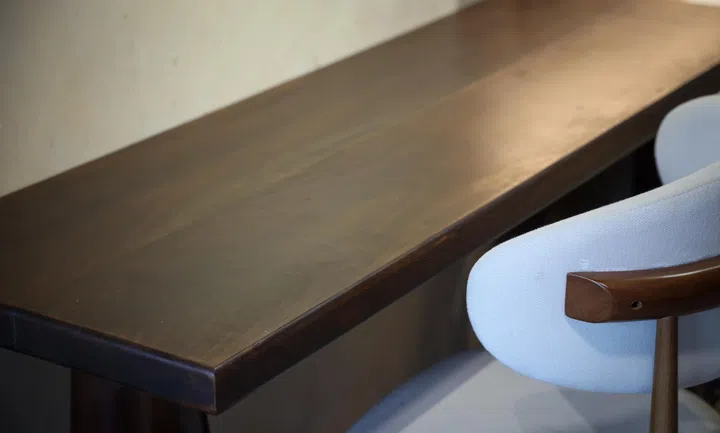
The dining tabletop, which doubles as a bar counter, woodworked by the couple.
Saved on furniture expenses
The monetary savings were a nice bonus. For a sofa and two study tables, they were quoted $2,500 and $1,600 respectively three years ago.
“If I bought the wood myself, the cost difference was quite significant,” says Ms Chew, a serial hobbyist who traces her woodworking interest back to secondary school, where she built props and structures as part of her creative problem-solving CCA, Odyssey of the Mind.
They ended up spending a total of $950 on wood alone, on top of $500 for the equipment – which included clamps, a saw, router, sander and wood finishing – amassed over the years.
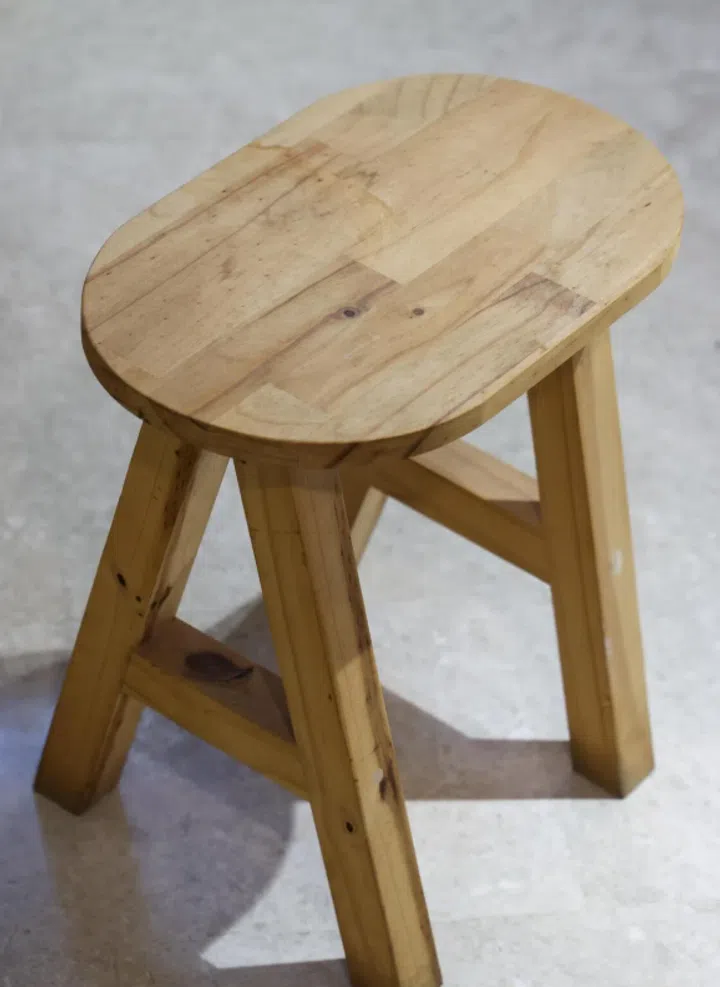
A stool made by the couple.
Singaporeans don’t have the DIY habit
It seemed less daunting seeing how Mr Lim’s American brother-in-law also has handmade furniture in his apartment in New York.
Mentality is the No. 1 hurdle preventing most people from getting their hands dirty, Mr Lim says. “Singaporeans don’t have this practice of doing things themselves. Most would have paid someone to do it.”
Enjoying the process of woodworking is half the battle won. “If you like it, it’s already a win.”
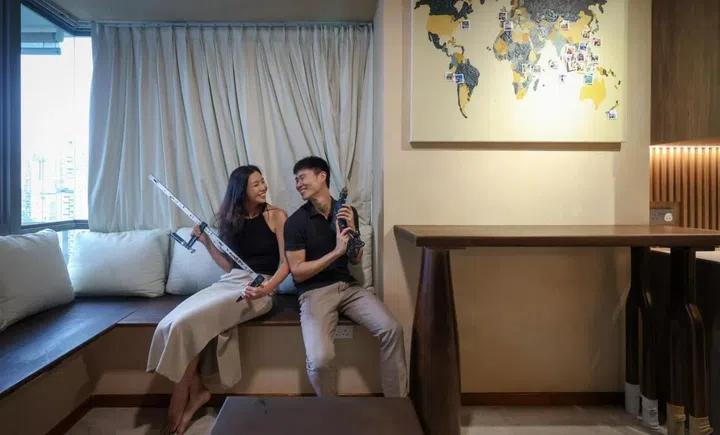
The couple may cut down and repurpose the wood for future use when they eventually move out.
Although they no longer make new pieces on the regular, the couple have takeaways: When shopping for wood, pine costs the least, and the price starts increasing for different tiers of solid wood.
If planing services are available, pay for them. Untreated, unplaned wood is the cheapest – but not worth the extra time spent to try to make flat yourself. Tools can be bought from e-marketplaces like Shopee and Amazon.
Start small and work your way up to bigger projects, adds Mr Lim. “You’ll need a workspace, equipment and a mum who doesn’t get angry at you for dirtying the space.”
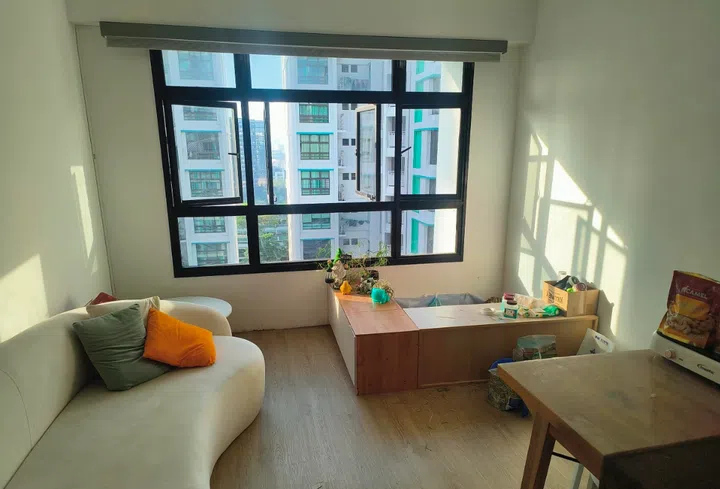
The completed living room of Mr Sim Kwang Wei's four-room flat, whose renovation was partly taken on by the home owner himself.
One-man show brings bare-boned BTO to life
For three months, software programmer Sim Kwang Wei lived in squalor in his incomplete four-room BTO flat.
He had moved in after the floor screeding – the final levelling layer for flooring – was professionally done. While licensed contractors renovated neighbouring flats, he was drilling holes for lighting and plumbing in his new space. Surrounded by dust, he slept on a yoga mat and took cold showers with a hose in the bathroom.
His wife, who works in banking, helped with laying the vinyl flooring. While doing the work, she was mentally prepared to have a proper contractor redo the whole place, but found that the outcome was better than expected, Mr Sim jokes.
“We didn’t want to sink too much into the flat because we planned to sell it,” he says. “And we did not have a fixed idea of the design, so it was easier to convince her to DIY.”
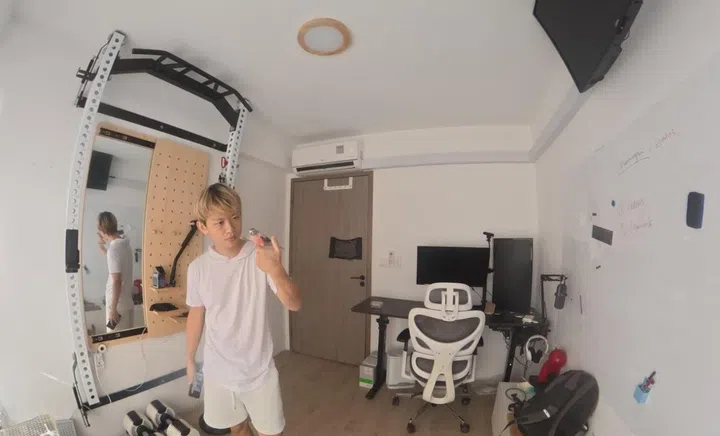
Mr Sim Kwang Wei, pictured with one of his pet birds, in the home gym and study room he built himself.
Watched YouTube tutorials
He has always considered himself a hands-on man – he fixed leaking pipes in his family home from time to time. He taught himself plumbing and hot/cold piping from watching YouTube tutorials and reading HDB wiring manuals.
It was easier to work on the flat while the rest of the BTO project was being built, as he could drill and cause a ruckus freely without worrying about disturbing the neighbours.
Some tasks were harder to complete alone, such as installing the wide kitchen blinds and doors, which were heavy and had to be aligned with hinges and ledges, Mr Sim recalls, wincing at the memory.
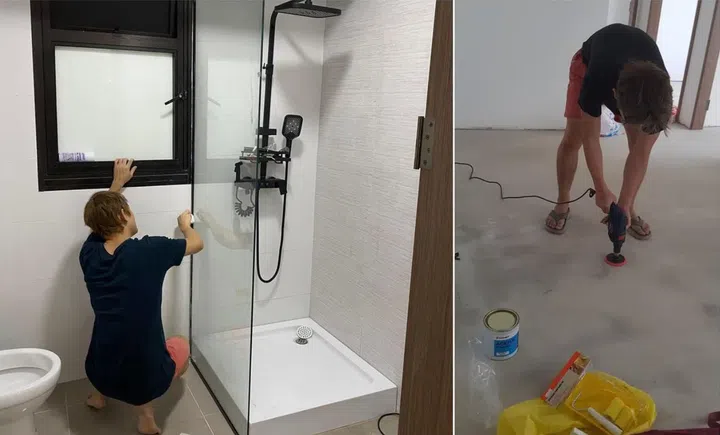
Mr Sim installing and sealing a shower during the renovation phase and finishing his flooring before laying vinyl himself.
Small mistakes – such as drilling in the wrong spot, purchasing errors from Taobao and installing leaky pipes – were also “inevitable”. For example, the drainage pipe from Taobao for the kitchen sink was smaller than what was required to meet the regular size for the pipe’s opening in Singapore, so an adaptor was needed to seal it up.
After experiencing success with one job, however, one gains confidence, he says. “You have to have the ability to stomach failures and fix things along the way.”
Most people are not prepared for that level of commitment and would rather outsource the work to save time, he notes. His other DIY efforts for the flat included building his bed frame and a home gym set-up, as well as small wooden enclosures for the couple’s skinny pigs and birds.
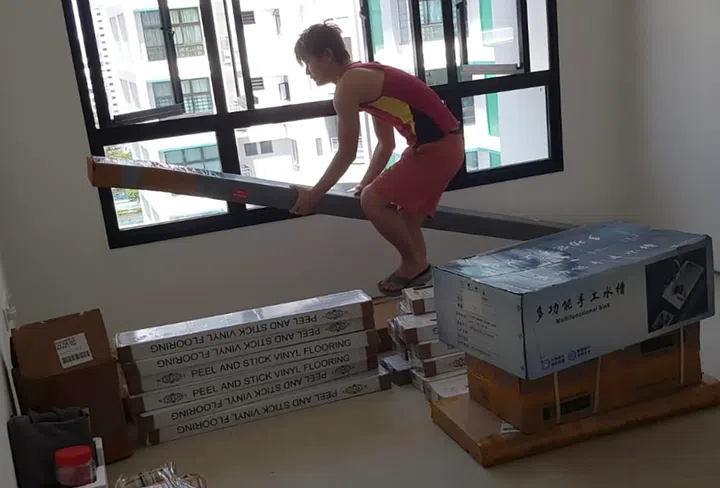
Mr Sim got help from his wife to lay the vinyl flooring, but struggled solo for other tasks such as installing bedroom doors.
$12,000 DIY Renovation Cost
By doing the bulk of the work himself, his savings were significant. For fittings, he spent about $400 on the vinyl flooring, $400 on doors and $120 on the lights. He engaged professional help and spent $2,900 on carpentry and $2,000 on screeding.
The total cost came up to about $12,000 – compared with the $50,000 his friend paid to professionally renovate his four-room flat in Bidadari in the same year.
Labour cost is rightfully expensive, adds Mr Sim, who held an office job at the time and worked on the renovations after work and late into the night.
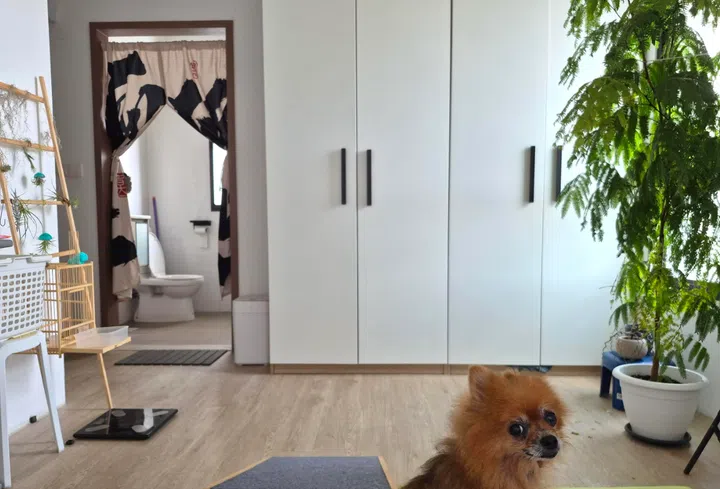
Mr Sim’s completed master bedroom.
But he would not have traded the experience for the world. He fulfilled a lifelong dream of putting together a home with his own hands. And with the flat having held up over the last two years, his wife is now convinced that they can do away with project managers and IDs, he says with a grin.
His advice for aspiring self-made contractors? “Don’t do things that could cause irreparable damage – high-impact works such as levelling the ground. And if you have little tolerance for mistakes, don’t do it.”
This article was first published in The Straits Times on 6 Feb 2026.